
Why did Krishna run to embrace a poor brahmin in rags? Read the Sudama story from the Bhagavatam and learn how a...
Latest posts
-
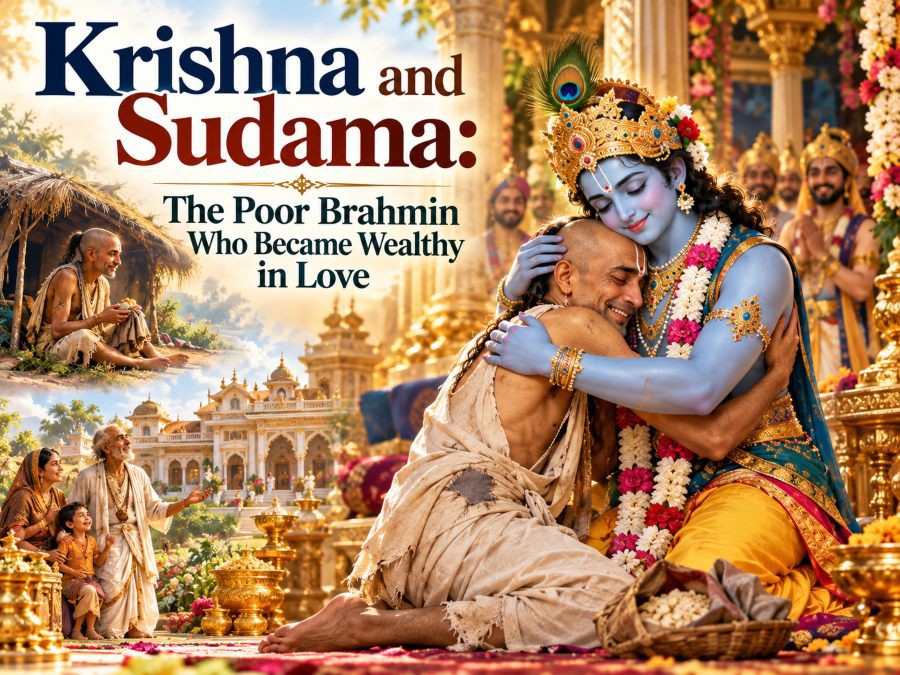 Krishna and Sudama: The Poor Brahmin Who Became Wealthy in LoveRead more
 -
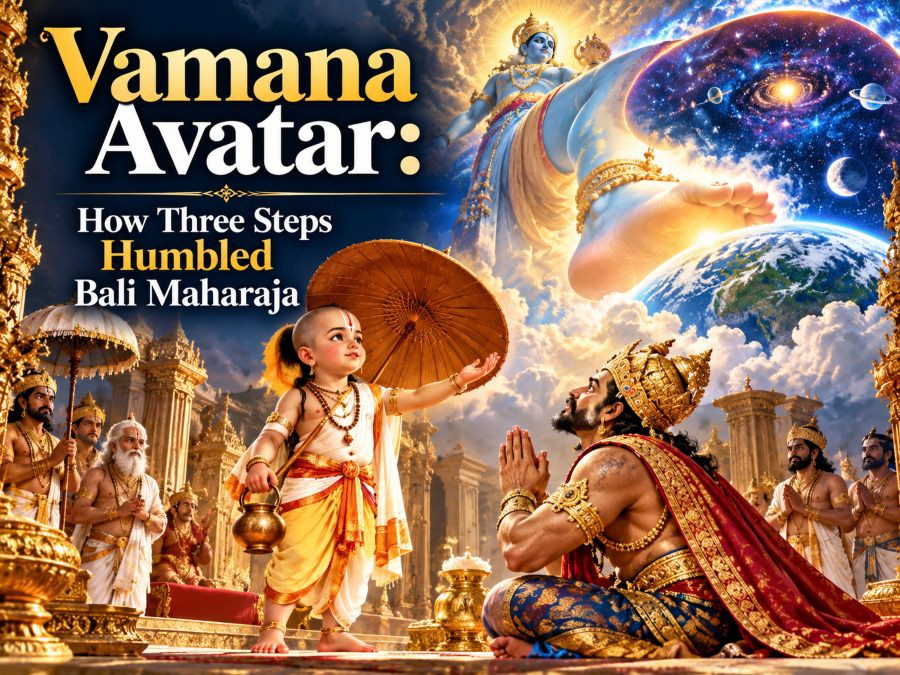 Vamana Avatar: How Three Steps Humbled Bali MaharajaRead more
Why did a powerful king give away three worlds to a boy asking for three steps? Learn the Vamana avatar story from...
-
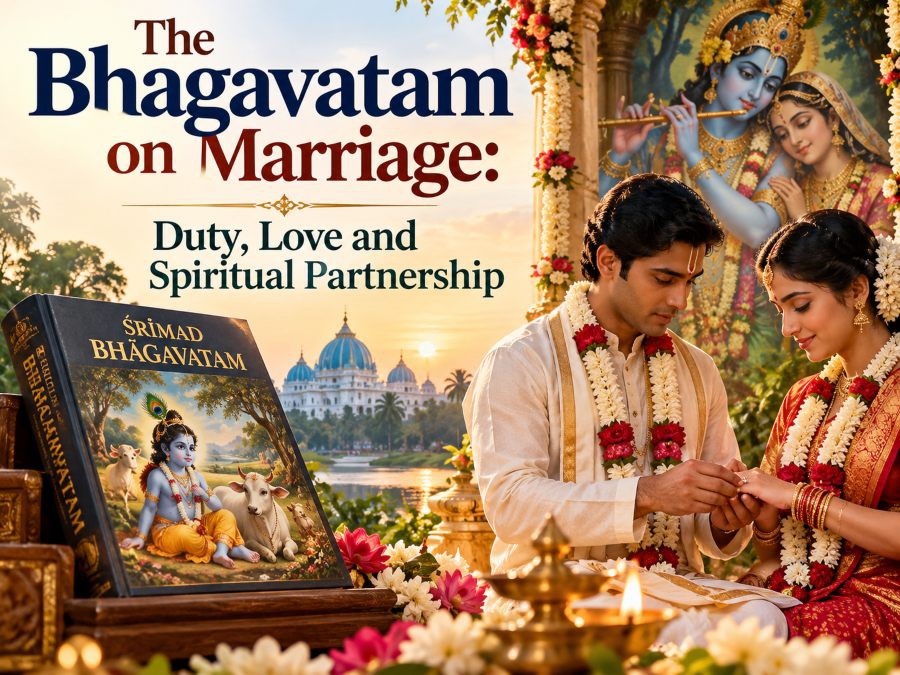 The Bhagavatam on Marriage: Duty, Love and Spiritual PartnershipRead more
What does the Bhagavatam say about marriage? Through the stories of Kardama and Devahuti, Rukmini's secret letter and...
-
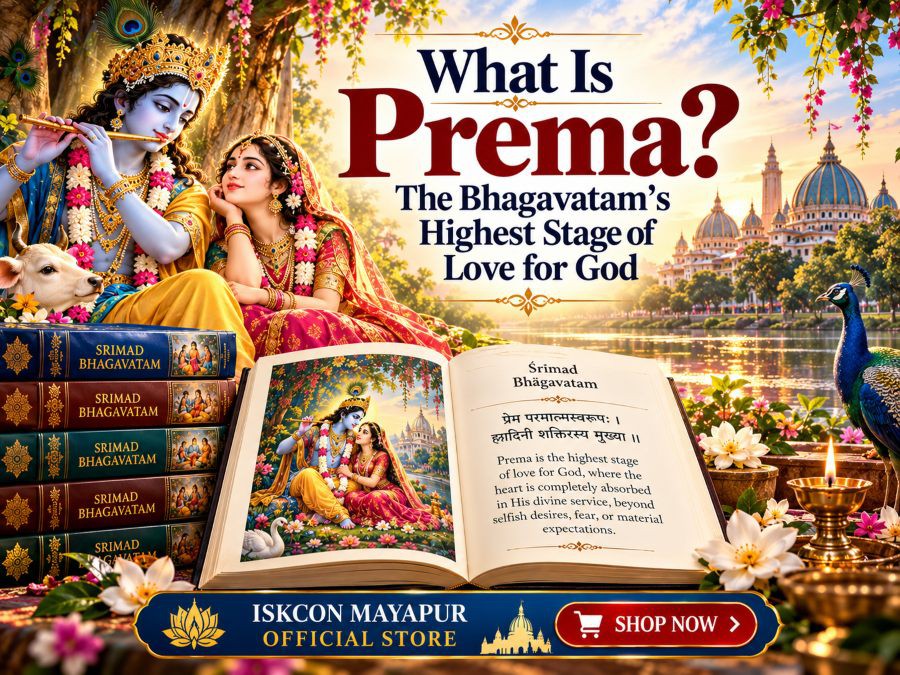 What Is Prema? The Bhagavatam's Highest Stage of Love for GodRead more
Prema is love for God with no "because" attached. Learn how the Bhagavatam describes it, the nine steps from faith to...
-
 Is Shiva Parvati Kalyana Mentioned in Srimad Bhagavatam? What the Scripture Really SaysRead more
Looking for Shiva and Parvati's wedding in the Srimad Bhagavatam? Find out what the scripture actually describes,...
-
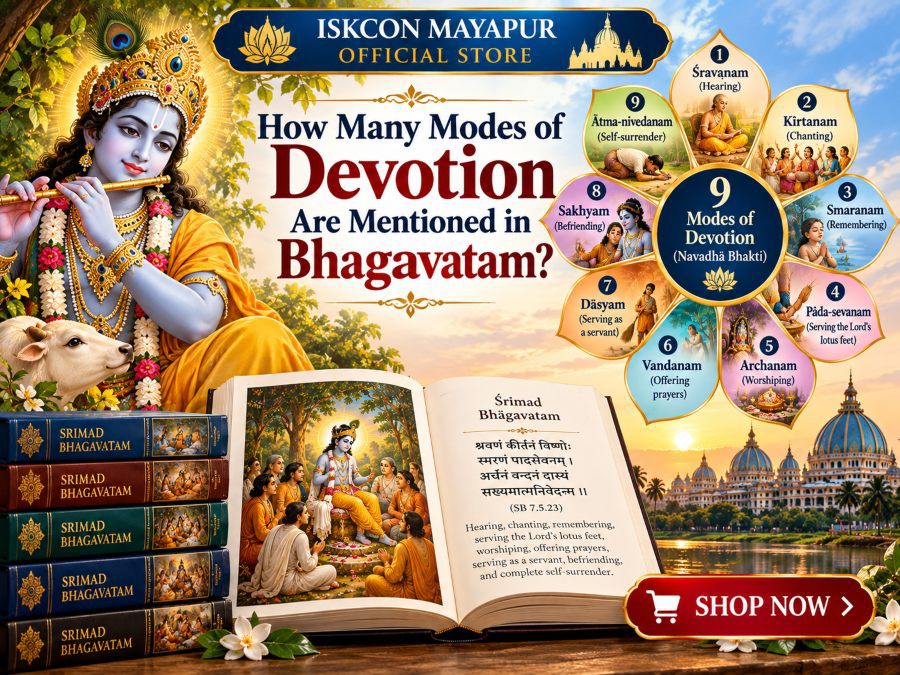 How Many Modes of Devotion Are Mentioned in Bhagavatam?Read more
A young boy named Prahlada listed nine ways to serve God, and the Bhagavatam keeps them as its answer. Learn what the...
-
 What Is Bhagavatam and Why Has It Been Read for 5,000 Years?Read more
A dying king asked one question, and the answer became the Bhagavatam. Learn what this Sanskrit scripture contains,...
-
 Who Is Lord Krishna? His Meaning, Teachings and Pastimes ExplainedRead more
Discover who Krishna is according to Srimad Bhagavatam, including His divine identity, childhood pastimes, teachings,...
-
 Incense in Islam: Bakhoor, Agarbatti and What Tradition SaysRead more
Is burning fragrance part of Muslim tradition? Explore incense in Islam, from the Prophetic practice of fumigating...
-
 History of Agarbatti: From Vedic Dhupa to Modern Incense SticksRead more
Where did agarbatti really come from? Follow the history of agarbatti from Vedic fire rituals and temple dhupa to...
Blog categories
- Default category (0)
- MUSICAL INSTRUMENT (1)
- BOOK (5)
- DEVOTIONAL GIFT (0)
- Blog (30) click
- CHANDAN (12)
- Bhagavatam Wisdom Series (68)
- Krishna Consciousness (14)
- Mridangam Musical Instrument (6)
- Bhagavad Gita for Beginners (13)
- Bhagavad Gita As It Is (37) click
- Bhagavad Gita As It Is Telugu (0)
- Bhagavad Gita As It Is Marathi (0)
- Bhagavad Gita As It Is In Hindi (0)
- Bhagavad Gita As It Is In English (0)
- Bhagavad Gita As It Is In Bengali (8)
- Bhagavad Gita As It Is In Kannada (0)
- Bhagavad Gita As It Is In Gujarati (0)
- Bhagavad Gita As It Is In Panjabi (0)
- Bhagavad Gita As It Is In Tamil (0)
- Bhagavad Gita As It Is Odia (0)
- BHAGAVAD GITA As It Is GERMAN (0)
- Bhagavad Gita As It Is In French (0)
- Bhagavad Gita As It Is In Nepali (0)
- Bhagavad Gita As It Is In Assamese (0)
- Incense or Agarbatti (38)
- Lord Chaitanya Mahaprabhu (3)
- Vedic Temple Mayapur (14)
- kalki (15)
- Mahabharata – Dharma & Destiny (27)
- Vaishnava Scriptures (4)
- healthy product (4)
- chaitanya mahaprabhu (5)
- Tulsi Mala Guide (17)
Search in blog
How many books in srimad bhagavatam
How Many Books Are There in the Srimad Bhagavatam? A Complete Overview
Among the revered scriptures of Sanatan Dharma, the Srimad Bhagavatam, also known as the Bhagavata Purana, holds a supreme position. It is far more than an ancient religious text — it is a monumental source of spiritual knowledge, divine pastimes, philosophy, and culture that has guided seekers for thousands of years. People across the world continue to study this Purana for its lessons on devotion, or bhakti, along with its insights into life and the deeper workings of the universe. Readers who want to begin their own study can find complete, well-printed editions at www.mayapur.store, which makes exploring this text a little easier for anyone starting out.
In this article, we will look closely at exactly how many books, or cantos, the Srimad Bhagavatam is made up of, how those books are structured, and why this scripture continues to matter so deeply to spiritual seekers and everyday readers alike.
How Many Books Are in the Srimad Bhagavatam?
The Srimad Bhagavatam is divided into 12 books, called Cantos in English or Skandhas in Sanskrit. Each Canto covers its own set of stories, philosophical ideas, and divine pastimes, yet all twelve work together to form a single, unified narrative. Altogether, the 12 Cantos span 335 chapters and contain more than 18,000 verses, making it one of the longest and most detailed scriptures within the Puranic tradition.
Key facts at a glance:
- Total number of books (Cantos): 12
- Total chapters: 335
- Total verses: 18,000+
- Original language: Sanskrit
- Traditional author: Sage Vedavyasa (Vyasa Muni)
Structure of the Srimad Bhagavatam — A Canto-by-Canto Summary
Here is a concise overview of what each of the twelve Cantos covers:
Canto | Main Topic |
1 | Introduction; the assembly of sages at Naimisharanya; questions on Dharma; the beginnings of Krishna's pastimes |
2 | Dialogue between Brahma and Narada; creation of the universe; the importance of meditation and bhakti |
3 | Vidura-Maitreya dialogues; cosmology; the secrets of creation; Lord Kapila's teachings on Sankhya yoga |
4 | Stories of Dhruva, Prithu, and other kings; the power of devotion |
5 | Tales of Priyavrata and Rishabhadev; cosmology; descriptions of the hellish planets |
6 | Stories of Ajamila and Daksha Prajapati; the Indra-Vritrasura conflict; the power of forgiveness and devotion |
7 | The story of Prahlada and Hiranyakashipu; the supreme power of devotional service |
8 | Stories of the various Manus; the churning of the ocean; Bali Maharaja and the Vamana avatar |
9 | The dynasties of the Sun and Moon; tales of great kings and their devotional acts |
10 | The childhood and youth pastimes of Lord Krishna in Vrindavan, Mathura, and Dwaraka — the most loved and extensive Canto |
11 | The Uddhava Gita; teachings on yoga and bhakti; instructions on Yuga-Dharma |
12 | Predictions for early Kali Yuga; stories of ages to come; the conclusion of the scripture |
Of all twelve, the Tenth Canto is generally considered the heart of the entire work, since it exclusively describes the divine pastimes, or Leelas, of Lord Krishna. Many readers who are new to the Bhagavatam actually begin here before working through the remaining Cantos, drawn in by the warmth and intimacy of these particular stories.
Why the Twelve-Canto Structure Matters
The division into twelve books is not arbitrary. Each Canto builds a foundation for the next, moving gradually from cosmic philosophy toward the deeply personal relationship between the devotee and Krishna described in the later chapters. The early Cantos lay out how the universe came into being and what dharma really means, while the middle books introduce readers to figures like Prahlada and Dhruva, whose stories show devotion in action rather than as abstract theory. By the time a reader reaches the Tenth Canto, the philosophical groundwork has already been set, which is part of why those stories land with such emotional weight.
Anyone hoping to study the scripture properly will benefit from working through an authentic Srimad Bhagavatam set rather than piecing together isolated chapters or translated excerpts found scattered online. A complete, properly translated set preserves the sequence and commentary tradition that this text was designed to be read within, and it allows the connections between early philosophical chapters and later devotional stories to come through clearly, the way generations of teachers have traditionally presented them.
Importance of the Srimad Bhagavatam
Supreme text of bhakti: The central theme running through all twelve Cantos is pure devotion. The Bhagavatam describes bhakti as the highest goal of human life, placing it above even knowledge and ritual observance.
A treasure trove of spiritual philosophy: From the relationship between the individual soul and the Supersoul, to the origin of the universe, the laws of karma, and the path to ultimate liberation, or moksha, the Bhagavatam addresses nearly every major question in Vedic philosophy.
Relevant to every walk of life: Whether a reader is a householder, a student, a renunciant, or simply someone searching for direction, the teachings inside the Bhagavatam offer a path toward happiness, peace, and clarity of mind.
Thousands of years of influence: Saints, philosophers, and ordinary devotees have drawn on this Purana's wisdom for millennia, and its influence on Indian art, music, and devotional practice remains visible today.
Key Highlights of the Srimad Bhagavatam
- Author: Sage Vedavyasa (Vyasa Muni)
- Category: Mahapurana, one of the eighteen major Puranas of India
- Key focus: The life and pastimes of Lord Krishna, the process of creation, dharma, and spiritual philosophy
- Language: Originally composed in Sanskrit, now translated into nearly every major world language
- Famous verse: "Satyam param dhimahi," meaning "We meditate upon the Supreme Truth"
Benefits of Reading the Srimad Bhagavatam
Reading or hearing the Bhagavatam regularly is said to offer several benefits, both spiritual and personal:
- Guides seekers toward self-realization and ultimate liberation
- Helps ease psychological suffering such as fear, grief, anxiety, and confusion
- Encourages a more righteous, value-based way of living
- Builds inner happiness and strengthens harmony within family and society
- Offers practical wisdom for handling everyday challenges through a spiritual lens
How to Begin Reading
For readers who are just starting out, jumping straight into all twelve Cantos at once can feel overwhelming, given how dense and detailed the text is. A more manageable approach is to begin with a summarized or single-Canto edition, particularly the Tenth Canto, before moving on to the full set. Reading alongside a commentary written within the Vaishnava tradition also helps considerably, since much of the meaning in these verses depends on context that a first-time reader might otherwise miss.
Group study is another valuable option. Temples, local satsang groups, and online communities often hold weekly readings and discussions of the Bhagavatam, and hearing different perspectives on the same verses can deepen understanding in ways that solitary reading sometimes cannot. This mirrors how the text was likely first shared centuries ago, recited aloud and discussed among assemblies of sages and householders alike.
Common Questions Readers Ask
Is the Srimad Bhagavatam the same as the Bhagavad Gita? No, though the names sound similar and they are often confused. The Bhagavad Gita is a shorter text of 700 verses found within the Mahabharata, spoken by Krishna to Arjuna on the battlefield. The Srimad Bhagavatam is a much larger, separate Purana of over 18,000 verses that covers the full scope of creation, dharma, and Krishna's life and pastimes across all twelve Cantos.
Which Canto should a beginner start with? Most readers find the Tenth Canto the easiest entry point, since it focuses on Krishna's childhood and youth in a narrative style that reads almost like a collection of stories. From there, many go back to Cantos One through Nine for the philosophical background, before finishing with the Eleventh and Twelfth.
How long does it take to read the whole Bhagavatam? This depends entirely on the reader and the edition being used, but a steady daily reading pace, even just a chapter or two, can take a dedicated reader through the full twelve Cantos over the course of a year or more. Many devotees treat it as a lifelong study rather than something to be finished quickly.
Why does the Bhagavatam matter today, so many centuries after it was composed? Because the questions it addresses — how to live well, how to handle suffering, what happens after death, and how to find lasting peace — are the same questions people continue to ask today. The specific cultural details may belong to another era, but the underlying human concerns have not changed nearly as much as the world around them has.
Final Thoughts
The Srimad Bhagavatam is not simply a sacred Hindu scripture; it is a complete guide to enlightened living. With its twelve Cantos, 335 chapters, and more than 18,000 verses, it addresses some of the deepest questions about life, reality, and divine love that a person can ask. Whatever a reader's age or background, there is a great deal to be gained from reading, hearing, or studying this timeless Purana, and its lessons remain just as relevant to a seeker today as they were to audiences many centuries ago.
Posted in: Bhagavatam Wisdom Series
Related posts
-
 Why to read srimad bhagavatamReading the Srimad Bhagavatam fosters deep spiritual growth by narrating the life and teachings of Lord Krishna,...Read more
 -
 When was srimad bhagavatam written?The Srimad Bhagavatam is believed to have been written around 9th-10th century CE, though its oral traditions date...Read more
 -
 How many chapters are there in srimad bhagavatam?The Srimad Bhagavatam consists of 12 cantos (books) containing 335 chapters in total. Each canto covers various...Read more
 -
 How many skandhas are there in srimad bhagavatamThe Srimad Bhagavatam is divided into 12 skandhas (cantos or books). Each skandha explores different themes,...Read more
 -
 How many slokas in srimad bhagavatamThe Srimad Bhagavatam contains approximately 18,000 shlokas (verses). These verses are spread across its 12 skandhas...Read more
Leave a comment