₹130.00
Home
A string of tulsi beads looks like a small thing: a few dozen pieces of wood, a cotton thread and a brass screw-clasp. Yet in a Vaishnava home it is often the first item put on in the morning and the last one removed at night. That gap between how humble it looks and how much it means is exactly why this category exists.
Every Tulsi Mala on this page comes from mayapur.store, the official online store of ISKCON Mayapur. You will find neck-worn kanthi strands, hand-held japa strands, and several bead shapes, from chunky barrel-cut beads to fine ones you can barely feel against the skin. Below the product grid, we have written down what we would tell a friend standing at the counter: what a Tulsi Mala actually is, how the styles differ, how to spot real tulsi wood, how to wear one respectfully, and how to keep it in good shape for years.
A Tulsi Mala is a string of beads carved from the stem and thick branches of the tulsi plant, Ocimum tenuiflorum, known in English as Holy Basil and in Sanskrit as Vrinda. The word "stem" matters here, because many first-time buyers assume the beads are seeds, like rudraksha. They are not. Mature tulsi plants grow woody stems, and once that wood is dried, it is cut, shaped, and drilled bead by bead. One plant yields only a small amount of usable wood, which is why a properly made Tulsi Mala takes patience.
The word "mala" covers two different objects. One is worn permanently around the neck and is called a kanthi mala. The other is held in the hand to count mantras and is called a japa mala. Both are made from tulsi, but they are built differently, and a later section explains how.
Ask a devotee this, and you will usually get a one-line answer: because tulsi is dear to Krishna. The longer answer runs through centuries of practice.
In Gaudiya Vaishnavism, the tradition of Sri Chaitanya Mahaprabhu that ISKCON belongs to, tulsi is not treated as a plant that happens to be sacred. She is Tulasi Devi, also called Vrinda Devi, a pure devotee who appears as a plant so that ordinary householders can serve Krishna directly. Her leaves go on the plates offered to the Deity. Her roots are watered morning and evening. In ISKCON temples, Mayapur included, devotees walk around a tulsi plant singing her prayers as part of the daily morning programme.
Beads shaped from her wood carry that connection into ordinary life. The Padma Purana is often quoted on this point: the messengers of Yamaraja, lord of death, are said to keep away from a person who wears tulsi beads on the neck. Whether or not a reader takes that literally, the practical meaning devotees draw from it is simple. The mala is a reminder, worn where you cannot forget it, that a life is meant for remembering Krishna.
Srila Prabhupada founded ISKCON in 1966, and through his followers, tulsi neck beads became a familiar sight far beyond India.
One more point, so nobody is misled: tulsi is also respected in Ayurveda as a medicinal herb, but this page makes no health claims about the beads. Their value here is devotional.
Bead shape changes how a mala looks, how it sits on the neck, and how it behaves in the fingers. These are the four cuts you will meet most often here. Photographs shift with light and screen settings, and tulsi wood is never perfectly uniform, so treat each listing photo as a fair guide, not a colour swatch.
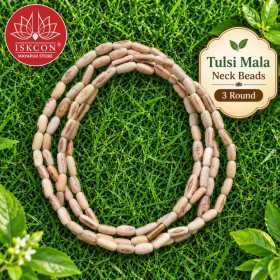
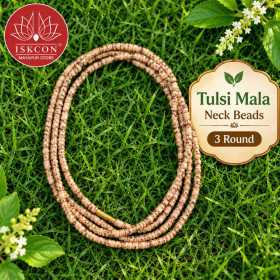
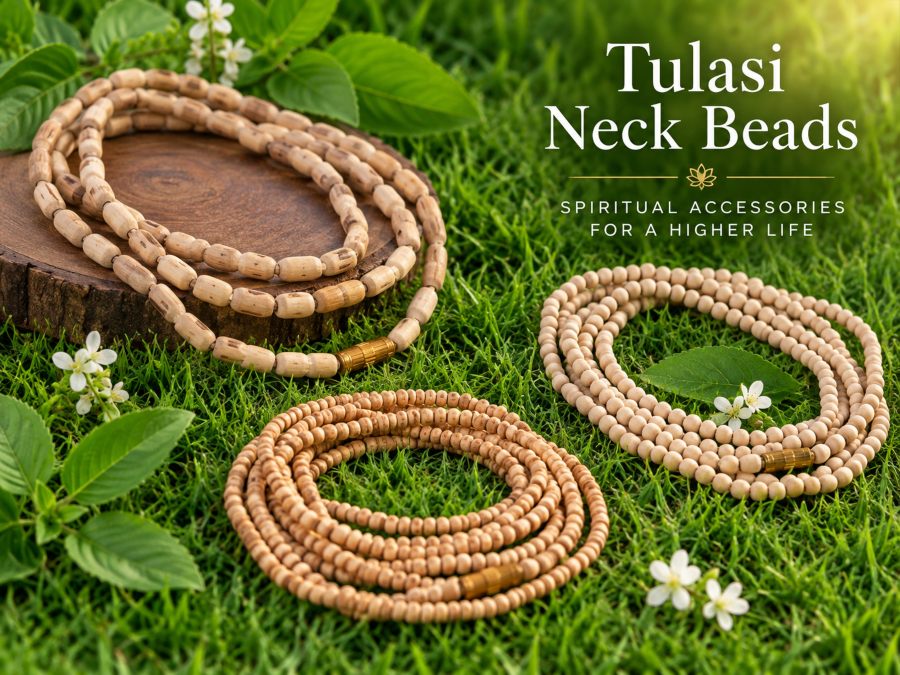
These are the largest of the four: elongated beads, a little like short grains of rice, each showing the pale grain lines and the occasional darker streak of the wood. They are cut by hand, so no two are exactly the same length, and a small chip or rough edge is normal handwork, not a flaw. A brass screw-lock closes the strand. Choose this style if you want the mala to be seen and felt. It has weight, sits visibly at the collar, and looks much like the kanthi malas people wore long before machine-turned beads existed.
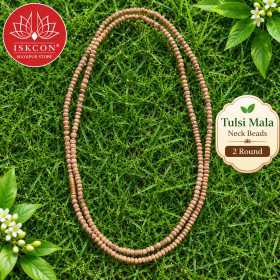
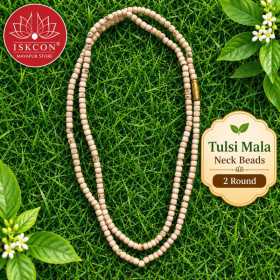
Smooth, rounded beads in a soft cream-to-sand shade, strung in a long double loop. The even surface sits comfortably on skin and slides easily through the fingers if you count on it. This is the style we suggest to buyers who cannot decide: not too bold, not too fine, and easy to wear under a kurta or a plain shirt.
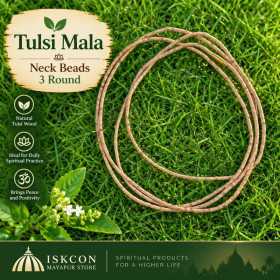
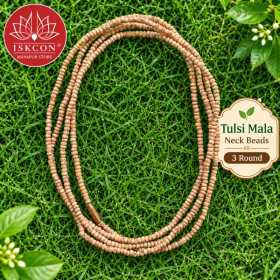
Tiny honey-tan beads wound as several thin loops, close to the classic three-strand kanthi you see on temple residents. Because each bead is so small, the strand feels light and flexible. If you plan to wear your Tulsi Mala all day, work in it and forget it is there, this is the practical pick.
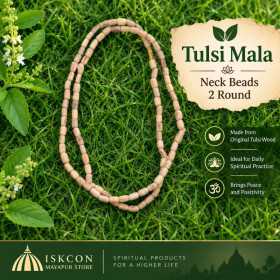
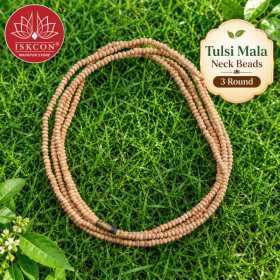
Small beads with a slight ridge around the middle, which catches the light and gives the strand a quiet texture. It comes in a neat double loop. Pick it if the oval style feels too heavy for you, but plain round beads feel too plain.
Each listing carries the bead count, approximate length, and number of strands, so check those details before you order.
New buyers often order the wrong one, so here is the difference in plain terms.
A kanthi mala (kantha means throat) is worn continuously around the neck. It usually has two or three strands and sits snugly at the base of the throat. In ISKCON, initiated devotees receive one at initiation, and many other people wear one as a personal promise to live simply and chant daily. Nothing is counted on it.
A japa mala is a counting tool. It has 108 beads plus one slightly larger head bead that marks where a round begins and ends. You chant the maha-mantra once per bead:
Hare Krishna Hare Krishna Krishna Krishna Hare Hare
Hare Rama Hare Rama Rama Rama Hare Hare
One full circuit is one round of 108 mantras. ISKCON devotees commit to sixteen rounds a day, which is 1,728 mantras and takes many people around two hours. Beginners often start with one or two rounds and build up at their own pace.
A japa Tulsi Mala normally lives in a small cloth bag, off the floor and away from dirt, while a kanthi mala stays on the body. Some devotees own both. If your aim is daily chanting, choose japa. If you want a lifelong neck mala, choose kanthi.
Decide the purpose first, then run through these checks. If you would like to compare strands side by side, the genuine tulsi wood malas in this collection are photographed on the same surface, so bead size and color are easy to compare.
Bead size. For japa, beads of roughly 6 to 8 mm are comfortable for most hands. Much smaller beads are hard to feel one at a time, and much larger ones tire the thumb over sixteen rounds. For a kanthi mala, size is a matter of taste: bold beads for presence, fine beads for comfort.
Length and fit. A kanthi mala must pass over your head, because it has no way to open. Cut a piece of string, loop it over your head, and mark the length at which it rests snugly at the base of the throat without pressing. Compare that measurement with the length in the listing.
Number of strands. Two and three strands are both in use. Lineages differ on this, so if you are initiated, follow your guru's instruction.
How you live. Very thin strands suit a quiet desk life. If you work with your hands, travel a lot or have children who tug at everything, pick a sturdier bead cut and check the thread.
The market is full of lookalikes: beads turned from other pale woods, then stained. You do not need a laboratory to catch most of them.
No home test is perfect, so the most reliable check is buying from a source that can tell you where its beads came from.
Chanting the Holy Name is open to everyone. Wearing tulsi neck beads is traditionally a step taken by people who are ready to live by simple standards. In ISKCON those standards are the four regulative principles: no meat, fish, or eggs; no intoxication; no gambling; and no illicit sex. If these feel far away, talk to a devotee before you begin wearing a kanthi mala. A japa Tulsi Mala carries no such condition; you can start chanting on one today.
A few habits are followed by most Vaishnavas:
Tulsi wood is soft and drinks up moisture, so treat it kindly.
Cleaning. Rinse in plain water when needed, pat dry, and let it air out. Soap, perfume, and cleaning sprays dull the wood and weaken the thread.
Thread. Cotton thread wears out with use. Restring roughly once a year, or the day you see fraying. Keep a spare thread in your bead bag.
Storage. A japa mala rests in its cloth bag. A kanthi mala you take off for travel or medical reasons goes in a clean, dry cloth, never a plastic box that traps damp.
When a mala breaks beyond repair. Please do not throw it in the bin. Many devotees place worn beads at the base of a tulsi plant or offer them to a flowing river.
If you are new to japa, this is the method most devotees follow:
1. Sit upright somewhere quiet and hold the mala in your right hand.
2. Let it rest over your middle finger, and keep your index finger pointing away from the beads.
3. Start beside the head bead. Chant one full maha-mantra, then roll the next bead forward with your thumb and middle finger.
4. When you arrive back at the head bead, do not cross over it. Turn the mala around and begin the second round in the opposite direction.
5. Chant loud enough to hear your own voice. Count your rounds on a small tally counter so the mind is free to listen.
Keep the mala in a bead bag with a small opening for the fingers. It keeps the beads clean and stops them touching your clothes or the ground.
A Tulsi Mala is one of the few gifts that can actually change a person's daily routine. It suits someone who has just started chanting, a friend leaving on a pilgrimage, or a family member celebrating an initiation. Check first what the person already wears, because devotees can be particular about bead size and strand count. Pair the mala with a cloth japa bag, or with a copy of the Bhagavad Gita, and it becomes a complete starting kit.
Mayapur is the appearance place of Sri Chaitanya Mahaprabhu, and this store is run in connection with the ISKCON Mayapur community that serves the temple and its pilgrims in West Bengal. That matters when you are buying something you will hold every morning. You are buying devotional items from people who use them, not from a general jewelry counter. Price, bead count, length, and availability are shown on each product listing, so nothing is hidden behind a phone call. Browse the collection above, pick the style that fits your hand and your neck, and begin.
Whichever style suits you, every mala here is genuine tulsi wood, cut and strung by hand. A quick way to jump straight to a specific piece:
Can anyone wear a Tulsi Mala?
Yes, men and women both wear them. Neck beads carry traditional expectations about lifestyle, described in the section on wearing respectfully. Japa beads carry none.
How many beads are in a japa Tulsi Mala?
A japa mala has 108 beads plus one larger head bead. Kanthi malas have no fixed count and are sized to fit the neck.
Should I take it off to bathe?
Many devotees leave a kanthi mala on while bathing, because plain water does no harm. Avoid soap directly on the beads and let the strand dry naturally.
Why has my Tulsi Mala turned darker?
That is natural. Tulsi wood absorbs handling and skin oils over time, so the color deepens gradually. It is a sign of a real, well-used mala.
Can I wear tulsi together with other beads?
In Gaudiya Vaishnava practice, tulsi is worn on its own. Beads from other traditions, such as rudraksha, are normally not mixed with it.
Which is better, a two-strand or a three-strand kanthi mala?
Neither is better. Practice varies by lineage, so follow your guru's instruction if you have one, and choose by comfort if you do not.
There are 8 products.