
Why did Krishna run to embrace a poor brahmin in rags? Read the Sudama story from the Bhagavatam and learn how a...
Latest posts
-
 Krishna and Sudama: The Poor Brahmin Who Became Wealthy in LoveRead more
 -
 Vamana Avatar: How Three Steps Humbled Bali MaharajaRead more
Why did a powerful king give away three worlds to a boy asking for three steps? Learn the Vamana avatar story from...
-
 The Bhagavatam on Marriage: Duty, Love and Spiritual PartnershipRead more
What does the Bhagavatam say about marriage? Through the stories of Kardama and Devahuti, Rukmini's secret letter and...
-
 What Is Prema? The Bhagavatam's Highest Stage of Love for GodRead more
Prema is love for God with no "because" attached. Learn how the Bhagavatam describes it, the nine steps from faith to...
-
 Is Shiva Parvati Kalyana Mentioned in Srimad Bhagavatam? What the Scripture Really SaysRead more
Looking for Shiva and Parvati's wedding in the Srimad Bhagavatam? Find out what the scripture actually describes,...
-
 How Many Modes of Devotion Are Mentioned in Bhagavatam?Read more
A young boy named Prahlada listed nine ways to serve God, and the Bhagavatam keeps them as its answer. Learn what the...
-
 What Is Bhagavatam and Why Has It Been Read for 5,000 Years?Read more
A dying king asked one question, and the answer became the Bhagavatam. Learn what this Sanskrit scripture contains,...
-
 Who Is Lord Krishna? His Meaning, Teachings and Pastimes ExplainedRead more
Discover who Krishna is according to Srimad Bhagavatam, including His divine identity, childhood pastimes, teachings,...
-
 Incense in Islam: Bakhoor, Agarbatti and What Tradition SaysRead more
Is burning fragrance part of Muslim tradition? Explore incense in Islam, from the Prophetic practice of fumigating...
-
 History of Agarbatti: From Vedic Dhupa to Modern Incense SticksRead more
Where did agarbatti really come from? Follow the history of agarbatti from Vedic fire rituals and temple dhupa to...
Blog categories
- Default category (0)
- MUSICAL INSTRUMENT (1)
- BOOK (5)
- DEVOTIONAL GIFT (0)
- Blog (30) click
- CHANDAN (12)
- Bhagavatam Wisdom Series (68)
- Krishna Consciousness (14)
- Mridangam Musical Instrument (6)
- Bhagavad Gita for Beginners (13)
- Bhagavad Gita As It Is (37) click
- Bhagavad Gita As It Is Telugu (0)
- Bhagavad Gita As It Is Marathi (0)
- Bhagavad Gita As It Is In Hindi (0)
- Bhagavad Gita As It Is In English (0)
- Bhagavad Gita As It Is In Bengali (8)
- Bhagavad Gita As It Is In Kannada (0)
- Bhagavad Gita As It Is In Gujarati (0)
- Bhagavad Gita As It Is In Panjabi (0)
- Bhagavad Gita As It Is In Tamil (0)
- Bhagavad Gita As It Is Odia (0)
- BHAGAVAD GITA As It Is GERMAN (0)
- Bhagavad Gita As It Is In French (0)
- Bhagavad Gita As It Is In Nepali (0)
- Bhagavad Gita As It Is In Assamese (0)
- Incense or Agarbatti (38)
- Lord Chaitanya Mahaprabhu (3)
- Vedic Temple Mayapur (14)
- kalki (15)
- Mahabharata – Dharma & Destiny (27)
- Vaishnava Scriptures (4)
- healthy product (4)
- chaitanya mahaprabhu (5)
- Tulsi Mala Guide (17)
Search in blog
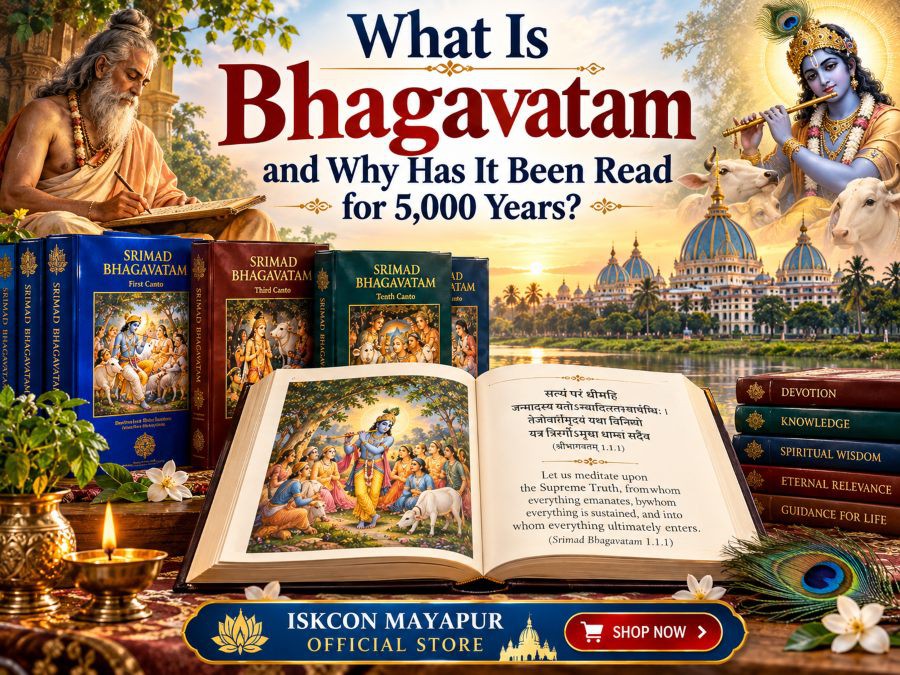
What Is Bhagavatam and Why Has It Been Read for 5,000 Years?
What Is Bhagavatam and Why Has It Been Read for 5,000 Years?
Imagine a king is told that a snake will kill him in seven days. No appeal, no escape, no second opinion. What does he do with the week? Parikshit, the grandson of Arjuna, did not panic or throw a party. He walked to the bank of the Ganges, sat down, and asked one question: what should a dying man listen to? The answer he received became the Bhagavatam, a Sanskrit scripture of about 18,000 verses that people have chanted, sung, argued over and wept over for centuries.
If you have ever typed "what is Bhagavatam" into a search bar, this guide gives you the plain version: what the book contains, where it came from, whether the 5,000-year claim holds up, and how to start reading it yourself.
So, What Exactly Is the Bhagavatam?
The Bhagavatam, also called Srimad Bhagavatam or Bhagavata Purana, is one of the eighteen major Puranas of the Vedic tradition. A Purana is not a history textbook, and it is not quite poetry either. Think of it as a large, story-driven scripture that carries philosophy inside narrative. The Bhagavatam does this better than most. It runs to roughly 18,000 verses across 12 books, called cantos, and 335 chapters.
The name is simple once you break it open. Bhagavan means the Supreme Person, the one who possesses all opulences. Bhagavata means "belonging to Bhagavan." So this is the book about God and about God's devotees. Everything else in it, the cosmology, the royal family trees, the cowherd boys, the sages, the demons, circles back to that centre.
Tradition credits Vyasadeva with writing it. He is the same sage who arranged the Vedas and compiled the Mahabharata. Here is the interesting part. Vyasa composed the Bhagavatam after finishing all that work, and he still felt restless. His teacher Narada told him why: he had described duty, ritual and war at enormous length, but he had never fully sung the glory of Bhagavan himself. The Bhagavatam was Vyasa's answer to that gap. Many Vaishnava schools treat it as his own commentary on the Vedanta Sutra, the short philosophical text he also authored.
The Seven-Day Story That Started It All
Back to the king.
Parikshit had been cursed after an unthinking act of disrespect toward a meditating sage. The punishment was death by snakebite within seven days. He did not argue. He handed the kingdom to his son, left the palace, and sat down on the Ganges bank to fast and wait. Great sages gathered around him. Then a young man arrived, wandering and barely dressed, with a face that seemed to hold no worry at all. It was Sukadeva Goswami, Vyasa's son.
Parikshit asked him the question that frames the whole book: What should a person who is about to die hear? What should anyone hear, since death comes for everybody?
Sukadeva spoke for seven days. That speech is the Bhagavatam.
There is a second layer, and it is easy to miss. The version we read today is not Sukadeva speaking directly to us. It is Suta Goswami retelling it years later to a gathering of sages in the forest of Naimisharanya. So you get a story inside a story, a bit like a family elder repeating what he heard from his own teacher. That structure is also why the book opens in a forest conversation rather than at the palace.
The format tells you something. The Bhagavatam was built for people short on time. Which is everyone. Even now, the tradition of Bhagavata Saptaha, a full seven-day recitation, is held in temples and homes across India, and people sit through it in a way they rarely sit through anything else.
Twelve Cantos, One Big Idea
The Bhagavatam is long, but its shape is easy to follow once you see the outline:
- Cantos 1–2: Parikshit's question, the setting, and a compact preview of the whole book.
- Cantos 3–4: Creation, plus Kapila's teachings to his mother Devahuti, and the story of the boy Dhruva who went into the forest to find God.
- Canto 5: The structure of the universe as the tradition describes it, and the lives of Rishabhadeva and King Bharata.
- Canto 6: The story of Ajamila, a man who lived carelessly and was rescued at the moment of death, and the prayers of Vritra.
- Canto 7: Prahlada, the child devotee who stood up to his father, the tyrant Hiranyakashipu.
- Canto 8: Gajendra, an elephant caught by a crocodile, the churning of the ocean, and Vamana's meeting with King Bali.
- Canto 9: Dynasties of the sun and moon, the story of Rama, and the devotee-king Ambarisha.
- Canto 10: Krishna.
- Canto 11: Krishna's final teachings to his friend Uddhava.
- Canto 12: The ages of time, the end of Parikshit's story, and a closing summary.
Read that list again and notice who the heroes are. A child in danger. An elephant in a crocodile's jaws. A sinner on his deathbed. A king with seven days left. The Bhagavatam keeps returning to people at the edge of their own strength. That is not an accident. Its central claim is that the soul is eternal, that God is a person who responds, and that loving connection with him is the real goal of life. Most other things in the book, the philosophy, the genealogies, the cosmic geography, are scaffolding around that single idea.
Why Krishna Gets a Whole Canto
Canto 10 is the longest of the twelve, with 90 chapters, which is more than a quarter of the entire book. It covers Krishna's birth in a prison, his childhood among the cowherds of Vrindavan, the stories of the butter thief and the boy who lifted a hill, the rasa dance, the confrontation with his tyrant uncle Kamsa, and his later life in Dvaraka.
Plenty of scriptures tell you about God. This canto shows him as a child who is scolded by his mother, a friend who shares lunch with cowherd boys, a beloved who is missed. For the traditions that follow the Bhagavatam, this is the heart of the book. The philosophy in the earlier cantos prepares the reader. Canto 10 is where it comes alive.
Is It Really 5,000 Years Old?
The title of this article uses the number 5,000, so it deserves a straight answer.
The traditional view: Vyasa lived at the meeting point of the Dvapara and Kali ages. By the traditional calendar, Kali began around 3102 BCE, which puts the Bhagavatam at roughly 5,000 years old. Devotees count the age from the moment Vyasa composed it and Sukadeva spoke it.
The academic view: Historians usually date the Bhagavatam in its present written form to somewhere around the 9th or 10th century CE, often associating it with South India, while accepting that parts of the material are much older and were passed along orally before anyone wrote them down.
These two positions do not need to cancel each other out. Oral traditions in India were often preserved with remarkable care, and a text that was recited for generations before being written can carry two ages at once: the age of the teaching and the age of the manuscript. Nobody can prove the earlier date with a laboratory test. What you can say with confidence is that people have read the Bhagavatam without interruption for at least a thousand years, and that its own tradition claims much more. Whichever clock you trust, it is a very long run.
Why People Kept Reading It
It answers the one question nobody escapes
Most books give advice about careers, habits or relationships. The Bhagavatam begins with death. It does not treat the subject as morbid. It treats it as the deadline that gives every other question its weight. A book that opens with that is hard to dismiss as a casual read.
Stories carry the philosophy
Abstract teachings fade quickly. A child who refuses to give up his faith while his father rages at him does not. The book hides its hardest ideas inside narratives people remember at six years old and still understand at sixty.
A chain of great commentators
The Bhagavatam survived because thinkers kept writing about it. Sridhara Swami wrote a widely used commentary in the 14th century. Jiva Goswami organised its philosophy in his Sandarbhas, and Vishvanatha Chakravarti added his own explanations later on. Sri Chaitanya Mahaprabhu, who appeared in Mayapur in 1486, treated the Bhagavatam as the highest scriptural authority, and the Gaudiya Vaishnava tradition follows him in this. In the 20th century, A.C. Bhaktivedanta Swami Prabhupada produced an English translation with extensive commentary, which carried the book to readers far outside India.
It spoke in every region's voice
The Bhagavatam did not stay in Sanskrit. In Assam, Srimanta Sankardev composed his own Bhagavata in Assamese. In Kerala, Melpathur Narayana Bhattathiri condensed it into the Narayaneeyam, a poem of about a thousand verses. Marathi, Bengali, Odia and many other languages have their own retellings. A text that keeps getting rewritten by local poets is a text people refuse to let go of.
How a Beginner Can Start Reading
You do not need to begin on page one and march through all 18,000 verses. A few practical suggestions:
- Start with one story. Prahlada in Canto 7 is a good opener. It is short, gripping, and gives you the flavour of the whole book.
- Then go back to Cantos 1 and 2. They set up the framework, and everything makes more sense afterwards.
- Pick an edition with word-for-word meanings and commentary. Sanskrit terms carry a lot, and a plain translation can flatten them.
- Read a few verses aloud. This text was meant to be heard, not only seen.
- Fix a small daily slot. Fifteen minutes a day will take you further than one long session a month.
- Find a reading group or weekly class if you can. A scripture of this size is easier with company.
The Book That Keeps Asking the Same Question
Parikshit's question to Sukadeva was never really about one king. It was about everyone who will, someday, run out of time. That may be the simplest reason the Bhagavatam has lasted. Empires, languages and fashions have all changed around it, and the question underneath has stayed exactly where it was.
So if you are still asking what the Bhagavatam is, here is the shortest answer: it is a seven-day conversation with a dying king, and it has been going on for a very long time. You are welcome to join it.
Posted in: Bhagavatam Wisdom Series
Related posts
-
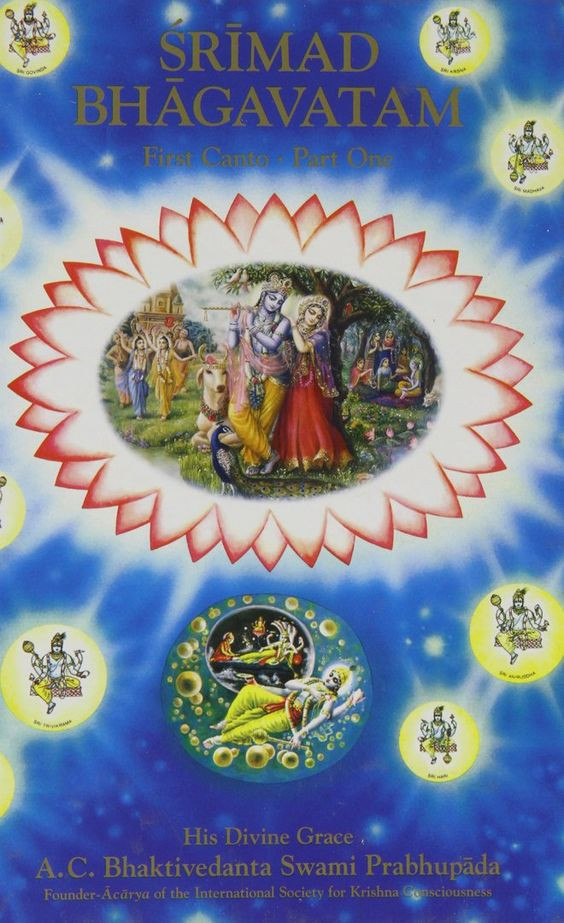 Why to read srimad bhagavatamReading the Srimad Bhagavatam fosters deep spiritual growth by narrating the life and teachings of Lord Krishna,...Read more
 -
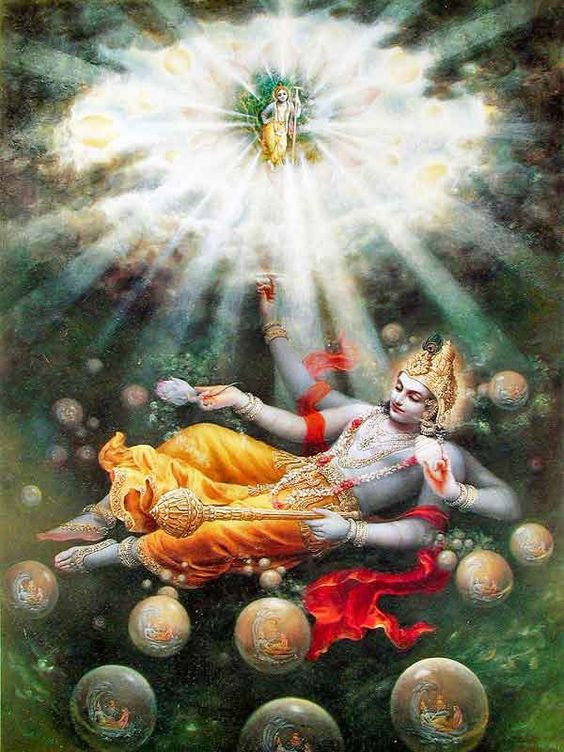 When was srimad bhagavatam written?The Srimad Bhagavatam is believed to have been written around 9th-10th century CE, though its oral traditions date...Read more
 -
 How many chapters are there in srimad bhagavatam?The Srimad Bhagavatam consists of 12 cantos (books) containing 335 chapters in total. Each canto covers various...Read more
 -
 How many skandhas are there in srimad bhagavatamThe Srimad Bhagavatam is divided into 12 skandhas (cantos or books). Each skandha explores different themes,...Read more
 -
 How many slokas in srimad bhagavatamThe Srimad Bhagavatam contains approximately 18,000 shlokas (verses). These verses are spread across its 12 skandhas...Read more
Leave a comment