
Why did Krishna run to embrace a poor brahmin in rags? Read the Sudama story from the Bhagavatam and learn how a...
Latest posts
-
 Krishna and Sudama: The Poor Brahmin Who Became Wealthy in LoveRead more
 -
 Vamana Avatar: How Three Steps Humbled Bali MaharajaRead more
Why did a powerful king give away three worlds to a boy asking for three steps? Learn the Vamana avatar story from...
-
 The Bhagavatam on Marriage: Duty, Love and Spiritual PartnershipRead more
What does the Bhagavatam say about marriage? Through the stories of Kardama and Devahuti, Rukmini's secret letter and...
-
 What Is Prema? The Bhagavatam's Highest Stage of Love for GodRead more
Prema is love for God with no "because" attached. Learn how the Bhagavatam describes it, the nine steps from faith to...
-
 Is Shiva Parvati Kalyana Mentioned in Srimad Bhagavatam? What the Scripture Really SaysRead more
Looking for Shiva and Parvati's wedding in the Srimad Bhagavatam? Find out what the scripture actually describes,...
-
 How Many Modes of Devotion Are Mentioned in Bhagavatam?Read more
A young boy named Prahlada listed nine ways to serve God, and the Bhagavatam keeps them as its answer. Learn what the...
-
 What Is Bhagavatam and Why Has It Been Read for 5,000 Years?Read more
A dying king asked one question, and the answer became the Bhagavatam. Learn what this Sanskrit scripture contains,...
-
 Who Is Lord Krishna? His Meaning, Teachings and Pastimes ExplainedRead more
Discover who Krishna is according to Srimad Bhagavatam, including His divine identity, childhood pastimes, teachings,...
-
 Incense in Islam: Bakhoor, Agarbatti and What Tradition SaysRead more
Is burning fragrance part of Muslim tradition? Explore incense in Islam, from the Prophetic practice of fumigating...
-
 History of Agarbatti: From Vedic Dhupa to Modern Incense SticksRead more
Where did agarbatti really come from? Follow the history of agarbatti from Vedic fire rituals and temple dhupa to...
Blog categories
- Default category (0)
- MUSICAL INSTRUMENT (1)
- BOOK (5)
- DEVOTIONAL GIFT (0)
- Blog (30) click
- CHANDAN (12)
- Bhagavatam Wisdom Series (68)
- Krishna Consciousness (14)
- Mridangam Musical Instrument (6)
- Bhagavad Gita for Beginners (13)
- Bhagavad Gita As It Is (37) click
- Bhagavad Gita As It Is Telugu (0)
- Bhagavad Gita As It Is Marathi (0)
- Bhagavad Gita As It Is In Hindi (0)
- Bhagavad Gita As It Is In English (0)
- Bhagavad Gita As It Is In Bengali (8)
- Bhagavad Gita As It Is In Kannada (0)
- Bhagavad Gita As It Is In Gujarati (0)
- Bhagavad Gita As It Is In Panjabi (0)
- Bhagavad Gita As It Is In Tamil (0)
- Bhagavad Gita As It Is Odia (0)
- BHAGAVAD GITA As It Is GERMAN (0)
- Bhagavad Gita As It Is In French (0)
- Bhagavad Gita As It Is In Nepali (0)
- Bhagavad Gita As It Is In Assamese (0)
- Incense or Agarbatti (38)
- Lord Chaitanya Mahaprabhu (3)
- Vedic Temple Mayapur (14)
- kalki (15)
- Mahabharata – Dharma & Destiny (27)
- Vaishnava Scriptures (4)
- healthy product (4)
- chaitanya mahaprabhu (5)
- Tulsi Mala Guide (17)
Search in blog
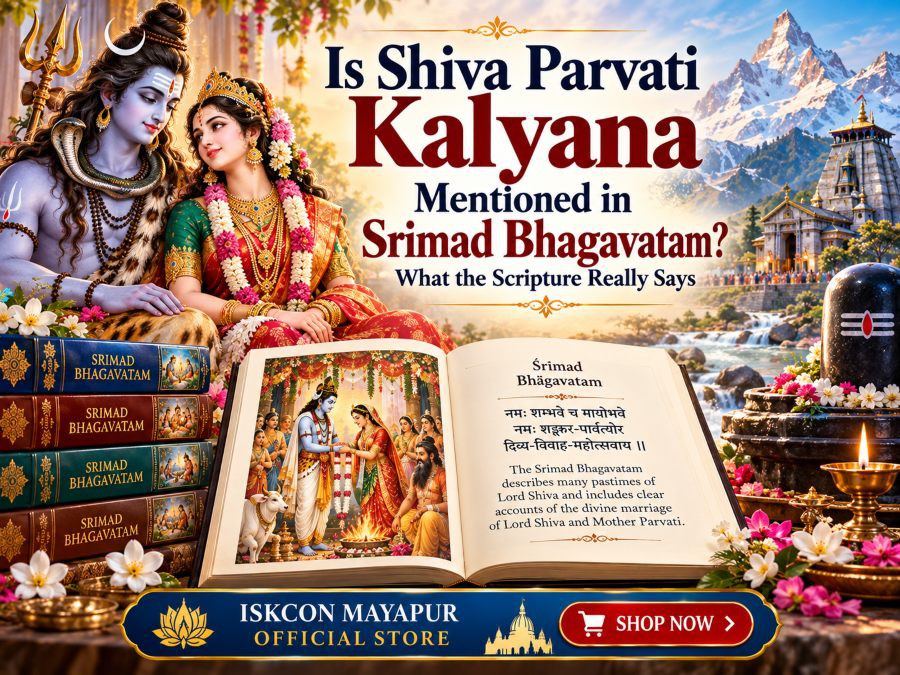
Is Shiva Parvati Kalyana Mentioned in Srimad Bhagavatam? What the Scripture Really Says
Is Shiva Parvati Kalyana Mentioned in Srimad Bhagavatam? What the Scripture Really Says
Open a copy of the Srimad Bhagavatam and hunt for the wedding of Shiva and Parvati. Look for the Himalayan procession, the baraat of ghosts and goblins, Parvati's mother fainting at the sight of the groom. You will not find any of it. If you are holding the original Bhagavatam text and coming up empty, you are not reading badly. The book tells a different Shiva-and-Devi story, and the reason it does so says a lot about how the Puranas divide their work.
The Straight Answer
No, the Srimad Bhagavatam does not narrate the Shiva-Parvati kalyana. There is no courtship, no Kamadeva being burned, no Saptarishis visiting Himalaya, no wedding feast.
What it does contain is:
- The marriage of Shiva and Sati, Daksha's daughter, mentioned briefly
- A long, dramatic account of Sati's death at her father's sacrifice
- Several scenes where Parvati (Uma, Bhavani) appears as Shiva's wife, in other cantos
So the honest summary is this: the Bhagavatam knows Parvati, respects her, and shows her several times, but it never stops to describe the wedding.
Sati, the Wife the Bhagavatam Actually Writes About
Most of the Shiva-and-wife material sits in Canto 4, chapters 1 to 7. The wife in question is Sati, not Parvati.
A marriage handled in one breath
Sati was the youngest daughter of Daksha and Prasuti. The Bhagavatam records that she was given to Shiva and then moves on. No ceremony, no guests, no dialogue. For a text that spends whole chapters on a cow-herding boy's lunch break, the speed is striking. The author is clearly not interested in the wedding. He is interested in what happens next.
The insult that broke a family
Daksha, newly made leader of the Prajapatis, entered a grand assembly. Everyone stood up except Shiva, who stayed seated. Daksha took it as an insult from a son-in-law and answered with a stream of abuse, calling Shiva uncivilised and unfit for sacrificial shares. The tension is built carefully: a proud father, a silent husband, a daughter caught between them.
Sati's choice
Daksha planned a huge sacrifice and invited nearly everyone except Shiva. Sati wanted to attend anyway. She argued that a daughter needs no invitation to visit her father's house. Shiva warned her gently that family can wound deeper than strangers. She went.
At the sacrifice, her mother and sisters welcomed her. Daksha did not. He insulted Shiva again in front of the whole gathering. Sati, unable to bear it, sat down, sipped water, and gave up her body through yogic fire. The Bhagavatam treats this as a statement, not a tragedy for its own sake: she refused to carry a body that came from a man who dishonoured her husband.
Shiva's response
Shiva heard of it from Narada and plucked a lock of his matted hair and dashed it to the ground. From it rose Virabhadra, who destroyed the sacrifice. Then the gods, led by Brahma, came to Shiva with folded hands and asked forgiveness for Daksha. Shiva agreed, Daksha was revived with a goat's head, and he offered prayers. The chapter ends in reconciliation, not in revenge.
Where Parvati Shows Up Anyway
The Bhagavatam may skip her wedding, but she walks through the book in short, vivid scenes. Here are the ones worth knowing.
The curse on Chitraketu (Canto 6, chapter 17)
King Chitraketu was flying in a celestial vehicle when he saw Shiva sitting among sages with Parvati on his lap. He laughed and teased Shiva about embracing his wife in public. Parvati was furious and cursed him to be born as an asura. Chitraketu accepted the curse calmly and bowed. He was reborn as Vritrasura. The story is more about humility than anger, and it shows Parvati as someone who defends her husband's dignity.
The poison of the ocean (Canto 8, chapter 7)
When the halahala poison rose from the churning of the milk ocean and frightened the gods, they ran to Shiva. He turned to Bhavani, who gave her approval, and he drank the poison, holding it in his throat. The Bhagavatam includes her consent as a detail worth recording. Even in a cosmic emergency, he checks with his wife.
The visit to see Mohini (Canto 8, chapter 12)
After the nectar episode, Shiva went to see Vishnu's female form, Mohini, with Parvati beside him. He lost his composure chasing her, then recovered. Vishnu praised Shiva for returning to his senses, saying very few could have done so. Parvati stands there as a witness to the whole thing, which makes the scene more human than any lecture could.
A forest where men become women (Canto 9, chapter 1)
King Sudyumna wandered into a forest where Shiva and Parvati were enjoying private time. Out of respect for her, Shiva had arranged that any male entering the place would turn female. Sudyumna became Ila. His story continues for several pages, and Parvati is its quiet cause.
Ilavrita-varsha (Canto 5, chapter 17)
In the geography section, the Bhagavatam describes a region where Shiva lives with Bhavani and countless attendants, worshipping Sankarshana. Only Shiva is allowed to be male there. It shows the Bhagavatam's view of the couple: not just lovers, but joint devotees of Vishnu.
A blessing for Markandeya (Canto 12, chapter 10)
The sage Markandeya, floating through the cosmic flood, was spotted by Shiva and Parvati as they passed through the sky on their bull. Parvati asked Shiva to bless the old sage. He did. The kindness comes from her request.
So Where Is the Wedding Told?
The full kalyana comes from other texts:
- Shiva Purana (the Rudra Samhita, in the section on Parvati's life)
- Skanda Purana
- Kumarasambhava, Kalidasa's Sanskrit epic poem
- Regional retellings in Tamil, Telugu, Kannada and Bengali traditions
They tell it roughly the same way. Parvati is born to Himavan and Mena. She grows up wanting Shiva. The gods need a son of Shiva to defeat the demon Tarakasura, so they send Kamadeva to disturb his meditation, and Shiva burns him with his third eye. Parvati goes into austerities. The Saptarishis test her resolve. Shiva himself appears disguised as a brahmin and criticises Shiva to her face, and she defends him fiercely. Then comes the wedding procession, with Mena's famous alarm at the groom.
If someone is reading the kalyana at a temple festival, it came from one of these, not from the Bhagavatam.
Why Would a Vaishnava Book Leave It Out?
This question deserves more than a shrug. A few reasons, in rough order of weight:
1. The Puranas share the work. Each major Purana has a spotlight. The Shiva Purana centres on Shiva's life. The Bhagavatam centres on Vishnu and his avatars, especially Krishna. A wedding story that belongs to Shiva's own Purana does not need to be repeated here.
2. The Bhagavatam wants lessons, not biographies. The Sati episode teaches one thing very well: do not insult a devotee, even if you are his father-in-law. The book spends its pages on that lesson.
3. Shiva is respected, not sidelined. A famous verse near the end of the book (Canto 12, chapter 13) calls Shambhu the best of Vaishnavas. The Bhagavatam includes him in a way that is respectful and consistent, just not exhaustive.
My own reading is that the book treats Shiva as an example, someone who drinks poison for others, bows to Vishnu, and tolerates insult. A wedding story would turn him into a groom. The Bhagavatam keeps him as a devotee.
Common Mix-Ups to Avoid
- Sati and Parvati are not two different goddesses to most readers. Tradition and commentators treat Parvati as Sati reborn. So the "wedding in the Bhagavatam" people recall is usually Sati's, in a single line.
- Devi Bhagavata Purana is a different book. It is a Shakta text focused on the Goddess, and it shares part of its name with the Srimad Bhagavatam. Many search results blur the two.
- Kalyanam festival texts come from Shiva Purana or local sources, not from the Bhagavatam. If a pandit says "as in the Bhagavatam," ask which chapter. That question usually clears things up quickly.
- Do not trust unsourced quotes. Posts online sometimes attach famous wedding verses to "Srimad Bhagavatam" without a canto reference. A real citation always has canto, chapter and verse.
How to Check It Yourself
You do not need to take anyone's word, including mine. A short reading list:
- Canto 4, chapters 1 to 7: Sati, Daksha, Virabhadra, and the reconciliation
- Canto 6, chapter 17: Parvati and Chitraketu
- Canto 8, chapters 7 and 12: the poison and the Mohini scene
- Canto 9, chapter 1: Sudyumna and the forest
- Canto 12, chapter 10: Markandeya's blessing
Pick an edition with Sanskrit text, word-for-word meaning and translation, so you can check names like Uma, Bhavani, Ambika and Gauri, all of which refer to Shiva's consort.
What You Take Away
The Bhagavatam does not hand you the wedding. It hands you something smaller and more pointed: a marriage that ends in a devastating insult, a wife who walks away from her own body to defend her husband, a husband whose grief shakes the universe, and later glimpses of the couple as gentle, powerful, quarrelsome and kind.
If you want the procession and the feast, the Shiva Purana and Kalidasa have it. If you want to see what Shiva and his wife are like when things go wrong, and what they do about it, the Bhagavatam is where to look.
Posted in: Bhagavatam Wisdom Series
Related posts
-
 Why to read srimad bhagavatamReading the Srimad Bhagavatam fosters deep spiritual growth by narrating the life and teachings of Lord Krishna,...Read more
 -
 When was srimad bhagavatam written?The Srimad Bhagavatam is believed to have been written around 9th-10th century CE, though its oral traditions date...Read more
 -
 How many chapters are there in srimad bhagavatam?The Srimad Bhagavatam consists of 12 cantos (books) containing 335 chapters in total. Each canto covers various...Read more
 -
 How many skandhas are there in srimad bhagavatamThe Srimad Bhagavatam is divided into 12 skandhas (cantos or books). Each skandha explores different themes,...Read more
 -
 How many slokas in srimad bhagavatamThe Srimad Bhagavatam contains approximately 18,000 shlokas (verses). These verses are spread across its 12 skandhas...Read more
Leave a comment