
Why did Krishna run to embrace a poor brahmin in rags? Read the Sudama story from the Bhagavatam and learn how a...
Latest posts
-
 Krishna and Sudama: The Poor Brahmin Who Became Wealthy in LoveRead more
 -
 Vamana Avatar: How Three Steps Humbled Bali MaharajaRead more
Why did a powerful king give away three worlds to a boy asking for three steps? Learn the Vamana avatar story from...
-
 The Bhagavatam on Marriage: Duty, Love and Spiritual PartnershipRead more
What does the Bhagavatam say about marriage? Through the stories of Kardama and Devahuti, Rukmini's secret letter and...
-
 What Is Prema? The Bhagavatam's Highest Stage of Love for GodRead more
Prema is love for God with no "because" attached. Learn how the Bhagavatam describes it, the nine steps from faith to...
-
 Is Shiva Parvati Kalyana Mentioned in Srimad Bhagavatam? What the Scripture Really SaysRead more
Looking for Shiva and Parvati's wedding in the Srimad Bhagavatam? Find out what the scripture actually describes,...
-
 How Many Modes of Devotion Are Mentioned in Bhagavatam?Read more
A young boy named Prahlada listed nine ways to serve God, and the Bhagavatam keeps them as its answer. Learn what the...
-
 What Is Bhagavatam and Why Has It Been Read for 5,000 Years?Read more
A dying king asked one question, and the answer became the Bhagavatam. Learn what this Sanskrit scripture contains,...
-
 Who Is Lord Krishna? His Meaning, Teachings and Pastimes ExplainedRead more
Discover who Krishna is according to Srimad Bhagavatam, including His divine identity, childhood pastimes, teachings,...
-
 Incense in Islam: Bakhoor, Agarbatti and What Tradition SaysRead more
Is burning fragrance part of Muslim tradition? Explore incense in Islam, from the Prophetic practice of fumigating...
-
 History of Agarbatti: From Vedic Dhupa to Modern Incense SticksRead more
Where did agarbatti really come from? Follow the history of agarbatti from Vedic fire rituals and temple dhupa to...
Blog categories
- Default category (0)
- MUSICAL INSTRUMENT (1)
- BOOK (5)
- DEVOTIONAL GIFT (0)
- Blog (30) click
- CHANDAN (12)
- Bhagavatam Wisdom Series (68)
- Krishna Consciousness (14)
- Mridangam Musical Instrument (6)
- Bhagavad Gita for Beginners (13)
- Bhagavad Gita As It Is (37) click
- Bhagavad Gita As It Is Telugu (0)
- Bhagavad Gita As It Is Marathi (0)
- Bhagavad Gita As It Is In Hindi (0)
- Bhagavad Gita As It Is In English (0)
- Bhagavad Gita As It Is In Bengali (8)
- Bhagavad Gita As It Is In Kannada (0)
- Bhagavad Gita As It Is In Gujarati (0)
- Bhagavad Gita As It Is In Panjabi (0)
- Bhagavad Gita As It Is In Tamil (0)
- Bhagavad Gita As It Is Odia (0)
- BHAGAVAD GITA As It Is GERMAN (0)
- Bhagavad Gita As It Is In French (0)
- Bhagavad Gita As It Is In Nepali (0)
- Bhagavad Gita As It Is In Assamese (0)
- Incense or Agarbatti (38)
- Lord Chaitanya Mahaprabhu (3)
- Vedic Temple Mayapur (14)
- kalki (15)
- Mahabharata – Dharma & Destiny (27)
- Vaishnava Scriptures (4)
- healthy product (4)
- chaitanya mahaprabhu (5)
- Tulsi Mala Guide (17)
Search in blog
How Many Modes of Devotion Are Mentioned in Bhagavatam?
How Many Modes of Devotion Are Mentioned in Bhagavatam?
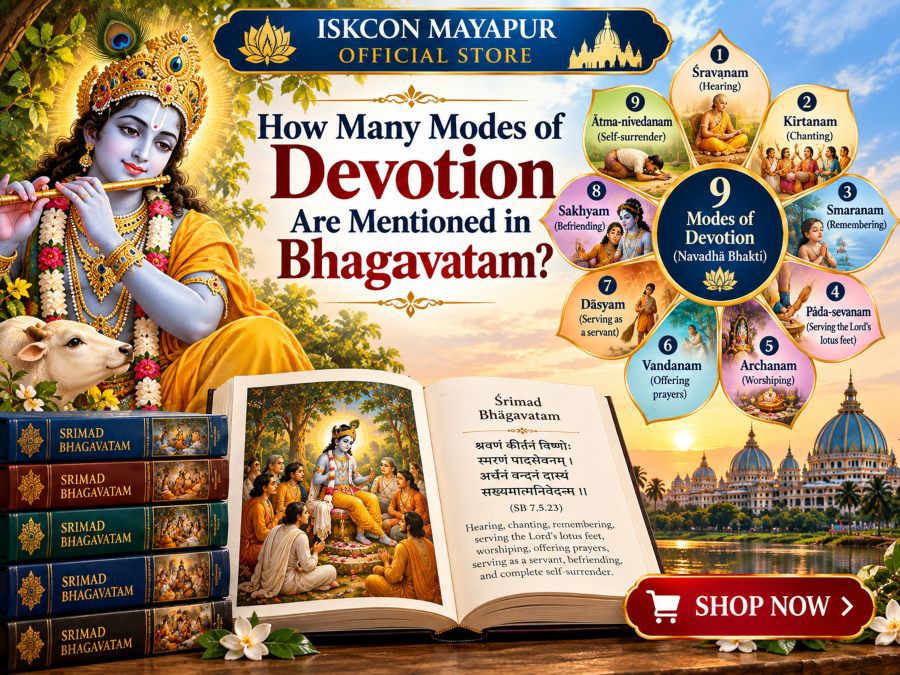
A tyrant king sets his small son on his lap and asks a simple question: what is the best thing you have learned at school? The boy, Prahlada, skips arithmetic and politics and gives a list of nine things instead. That list sits in the seventh canto of the Bhagavatam, and it is the book's own answer to this article's title. If you own any of the ISKCON Bhagavatam Books, open Canto 7, chapter 5, and you can read it for yourself.
The Short Answer: Nine, and a Child Named Them
The Bhagavatam names nine processes of devotional service, known in Sanskrit as navadha bhakti. They appear in verses 23 and 24 of the fifth chapter of Canto 7, spoken by Prahlada to his father and classmates. In plain English, they are:
- Shravanam: hearing about Krishna (Vishnu), his name, form, qualities and pastimes
- Kirtanam: chanting and singing those same glories
- Smaranam: remembering him
- Pada-sevanam: serving his feet
- Archanam: worshipping him with offerings
- Vandanam: offering prayers
- Dasyam: serving as his servant
- Sakhyam: befriending him
- Atma-nivedanam: surrendering oneself completely
Prahlada adds a line that is easy to skim past. If a person has offered himself to Vishnu through these nine, he says, that is the education worth calling complete. His father, Hiranyakashipu, had hoped to hear about statecraft and was not impressed. The rest of the canto shows how that disagreement ended.
"Modes" Can Mean Two Different Things
People searching for "modes of devotion" often mean one of two things, so it helps to separate them.
If you meant the three modes of material nature (goodness, passion and ignorance), the Bhagavatam does look at devotion through that lens. In Canto 3, chapter 29, Lord Kapila tells his mother Devahuti that the same act of worship carries a different quality depending on the worshipper's motive. Worship done to harm a rival is tamasic. Worship done for fame or wealth is rajasic. Worship done out of duty is sattvic. Worship with no motive at all, he says, sits beyond the three.
If you meant processes, the answer is the nine above. Rupa Goswami later expanded the picture in his Bhakti-rasamrita-sindhu into sixty-four limbs, but those are extensions and subdivisions. The nine remain the Bhagavatam's headline answer.
A Menu, Not a Staircase
Most people read the list top to bottom and assume it is a staircase: hear first, then chant, then remember, and climb until you reach surrender. That reading is tidy and mostly wrong. Nothing in the verses tells you to finish one before beginning the next. The order has a logic, since you cannot remember what you have never heard, but the nine work more like a menu where every dish already feeds you.
The tradition makes the point through nine devotees, each credited with one process. None of them is described as climbing the other eight first. Each reached the goal through the single path that suited him.
Nine Devotees, Nine Ways In
1. Parikshit: Hearing
A king with seven days to live does not need a library. He needs one qualified speaker. Parikshit sat on the Ganges bank, fasted, and listened to Sukadeva Goswami recite the Bhagavatam without a break. By the end of the week, the snake no longer frightened him. Hearing here is not casual listening. It means giving full attention to someone who has realised what he speaks about, which is why the Bhagavatam keeps stressing who is speaking and not only what is said.
2. Sukadeva Goswami: Chanting
Sukadeva is the other half of the same scene. He was born detached from the world and uninterested in it, yet the Bhagavatam says even sages like him are drawn to the pastimes of Krishna. Kirtana is not a performance. It gets its force from sincerity, and Sukadeva shows that a liberated sage still cannot stay quiet about Krishna.
3. Prahlada: Remembering
The speaker of the list is also its model for remembering. According to the Bhagavatam, he was thrown from a cliff, trampled by elephants, and given poison, and through all of it his mind stayed fixed on Vishnu. Smarana is the process that works when everything else is taken away: no temple, no book, no teacher, only the mind and what it holds.
4. Lakshmi: Serving the Feet
In the tradition's picture of Vaikuntha, the goddess of fortune sits massaging Vishnu's feet. The one who owns all wealth chooses humble, hands-on service that needs no audience. Pada-sevana covers that kind of devotion: quiet, practical, unannounced.
5. Prithu Maharaja: Worship
King Prithu ran an entire kingdom, and worship stayed at the centre of how he ran it. Archana, the worship of the deity with flowers, water, incense and lamps, suits people who like structure and live busy lives. Prithu's story in Canto 4 shows that public duty and daily worship can share the same day.
6. Akrura: Prayer
Akrura was sent by Kamsa to bring Krishna to Mathura, and his mind was full of worry and hope. When he bathed in the Yamuna on the way, he saw a vision of the Lord and offered a long prayer, recorded in Canto 10, chapter 40. Vandana in the Bhagavatam is rarely a polite recital. It is confession, praise and wonder in the same breath, spoken to someone you know is listening.
7. Hanuman: Service
The Bhagavatam mentions Hanuman only briefly, in its description of Jambudvipa, where he is shown worshipping Rama, but the tradition treats him as the model servant. Dasya means taking your place in someone else's mission and counting that place as an honour. The servant here is not smaller than the master in dignity, only in position.
8. Arjuna: Friendship
Arjuna rode into war with Krishna as his charioteer and treated him as an equal for years. Sakhya is devotion with the formalities removed. Friends ask uncomfortable questions, and the Gita opens with exactly that. The Bhagavatam shows the same mood in the cowherd boys of Vrindavan, who shared their lunch with Krishna and argued with him over games.
9. Bali Maharaja: Total Surrender
Bali was a demon king who ruled the three worlds. When Vamana, a dwarf brahmin, asked for three steps of land, Bali agreed. When the third step had nowhere left to fall, Bali offered his own head. His teacher, Shukracharya, tried to stop him. Atma-nivedana means no reservations. It does not say "I will give some of my time." It says "I am yours."
Which One Should You Start With?
The Bhagavatam answers this too. In Canto 12, verse 3.51, it says that the age of Kali is full of faults but has one great quality: simply by chanting the name of Krishna, a person can be freed from attachment and reach the goal. Sri Chaitanya Mahaprabhu built an entire movement on that verse.
Hearing and chanting are also the lightest processes to begin. You need no priest, no temple, and no money. A practical start looks like this:
- Read or listen to a few verses each day, ideally aloud
- Chant the Hare Krishna mantra for a fixed number of minutes
- Pick one story, such as Prahlada or Dhruva, and return to it often enough to remember it
- Add a second process only after the first feels natural
You are not skipping the other seven. Hearing and chanting tend to pull them in.
The Pattern Hidden Inside the Nine
Here is one way to read the list. It is an interpretation, not a quote from the text, but it explains why the nine feel complete.
- Three go through the senses and mind: hearing, chanting, remembering. These are what you take in.
- Three give shape to action: serving the feet, worshipping, praying. These are what you do.
- Three describe a relationship: servant, friend, self-giver. These are who you become.
Taken together, they cover what comes in, what goes out, and what changes in you. Nothing is left over, which may be why Prahlada felt safe calling the list a full education.
Mistakes People Make With the Nine
- Treating it as a checklist. Ticking all nine boxes in a week misses the point. The Bhagavatam wants one process done with feeling, not nine done mechanically.
- Skipping hearing. Many people jump to ritual or chanting and leave out the study. The book itself puts hearing first for a reason.
- Confusing devotion with ritual. Worship with flowers is one of nine. It is not the whole path.
- Waiting to feel ready. Parikshit had seven days. Nobody in the book waits.
Where to Go From Here
If you want to see the nine at work, read Canto 7 for Prahlada, Canto 8 for Bali and Gajendra, and Canto 10 for the pastimes of Krishna. A good edition with word-for-word meanings will save you a lot of confusion over Sanskrit terms. Read slowly and let the stories do the explaining.
Prahlada's answer to his father still holds. Nine ways, and a lifetime to practise any of them.
Posted in: Bhagavatam Wisdom Series
Related posts
-
 Why to read srimad bhagavatamReading the Srimad Bhagavatam fosters deep spiritual growth by narrating the life and teachings of Lord Krishna,...Read more
 -
 When was srimad bhagavatam written?The Srimad Bhagavatam is believed to have been written around 9th-10th century CE, though its oral traditions date...Read more
 -
 How many chapters are there in srimad bhagavatam?The Srimad Bhagavatam consists of 12 cantos (books) containing 335 chapters in total. Each canto covers various...Read more
 -
 How many skandhas are there in srimad bhagavatamThe Srimad Bhagavatam is divided into 12 skandhas (cantos or books). Each skandha explores different themes,...Read more
 -
 How many slokas in srimad bhagavatamThe Srimad Bhagavatam contains approximately 18,000 shlokas (verses). These verses are spread across its 12 skandhas...Read more
Leave a comment