
Why did Krishna run to embrace a poor brahmin in rags? Read the Sudama story from the Bhagavatam and learn how a...
Latest posts
-
 Krishna and Sudama: The Poor Brahmin Who Became Wealthy in LoveRead more
 -
 Vamana Avatar: How Three Steps Humbled Bali MaharajaRead more
Why did a powerful king give away three worlds to a boy asking for three steps? Learn the Vamana avatar story from...
-
 The Bhagavatam on Marriage: Duty, Love and Spiritual PartnershipRead more
What does the Bhagavatam say about marriage? Through the stories of Kardama and Devahuti, Rukmini's secret letter and...
-
 What Is Prema? The Bhagavatam's Highest Stage of Love for GodRead more
Prema is love for God with no "because" attached. Learn how the Bhagavatam describes it, the nine steps from faith to...
-
 Is Shiva Parvati Kalyana Mentioned in Srimad Bhagavatam? What the Scripture Really SaysRead more
Looking for Shiva and Parvati's wedding in the Srimad Bhagavatam? Find out what the scripture actually describes,...
-
 How Many Modes of Devotion Are Mentioned in Bhagavatam?Read more
A young boy named Prahlada listed nine ways to serve God, and the Bhagavatam keeps them as its answer. Learn what the...
-
 What Is Bhagavatam and Why Has It Been Read for 5,000 Years?Read more
A dying king asked one question, and the answer became the Bhagavatam. Learn what this Sanskrit scripture contains,...
-
 Who Is Lord Krishna? His Meaning, Teachings and Pastimes ExplainedRead more
Discover who Krishna is according to Srimad Bhagavatam, including His divine identity, childhood pastimes, teachings,...
-
 Incense in Islam: Bakhoor, Agarbatti and What Tradition SaysRead more
Is burning fragrance part of Muslim tradition? Explore incense in Islam, from the Prophetic practice of fumigating...
-
 History of Agarbatti: From Vedic Dhupa to Modern Incense SticksRead more
Where did agarbatti really come from? Follow the history of agarbatti from Vedic fire rituals and temple dhupa to...
Blog categories
- Default category (0)
- MUSICAL INSTRUMENT (1)
- BOOK (5)
- DEVOTIONAL GIFT (0)
- Blog (30) click
- CHANDAN (12)
- Bhagavatam Wisdom Series (68)
- Krishna Consciousness (14)
- Mridangam Musical Instrument (6)
- Bhagavad Gita for Beginners (13)
- Bhagavad Gita As It Is (37) click
- Bhagavad Gita As It Is Telugu (0)
- Bhagavad Gita As It Is Marathi (0)
- Bhagavad Gita As It Is In Hindi (0)
- Bhagavad Gita As It Is In English (0)
- Bhagavad Gita As It Is In Bengali (8)
- Bhagavad Gita As It Is In Kannada (0)
- Bhagavad Gita As It Is In Gujarati (0)
- Bhagavad Gita As It Is In Panjabi (0)
- Bhagavad Gita As It Is In Tamil (0)
- Bhagavad Gita As It Is Odia (0)
- BHAGAVAD GITA As It Is GERMAN (0)
- Bhagavad Gita As It Is In French (0)
- Bhagavad Gita As It Is In Nepali (0)
- Bhagavad Gita As It Is In Assamese (0)
- Incense or Agarbatti (38)
- Lord Chaitanya Mahaprabhu (3)
- Vedic Temple Mayapur (14)
- kalki (15)
- Mahabharata – Dharma & Destiny (27)
- Vaishnava Scriptures (4)
- healthy product (4)
- chaitanya mahaprabhu (5)
- Tulsi Mala Guide (17)
Search in blog
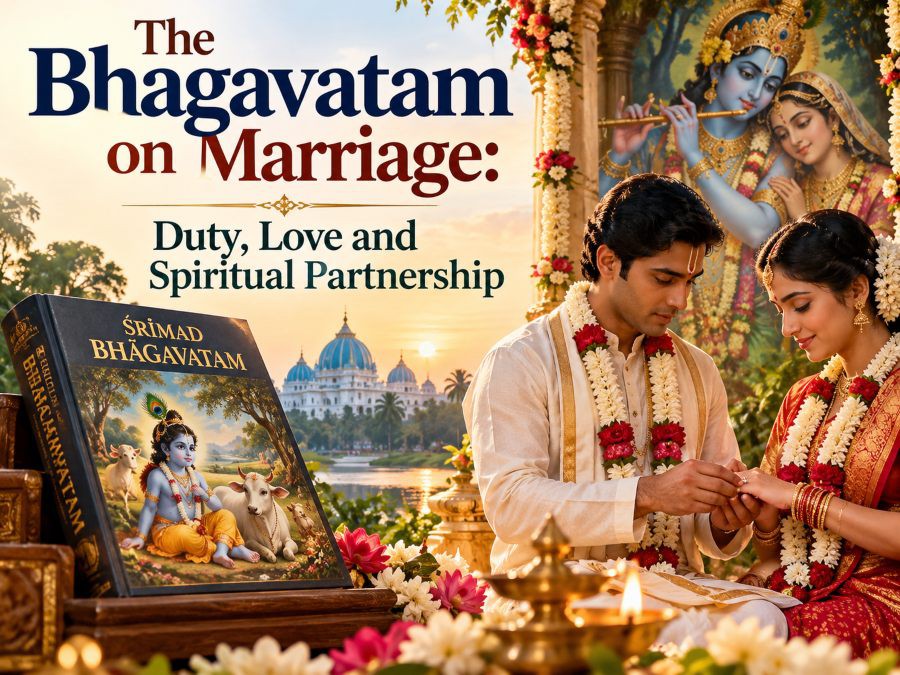
The Bhagavatam on Marriage: Duty, Love and Spiritual Partnership
The Bhagavatam on Marriage: Duty, Love and Spiritual Partnership
A princess of Vidarbha is shut inside her father's palace. She has never met the man she loves. Her family has promised her to someone else, and the wedding is days away. So she writes a letter and hands it to a trusted brahmana. That scene from the tenth canto of the Bhagavatam is one of the boldest love letters in any scripture. If you want to read the full text, translations with commentary are available at the ISKCON Mayapur Store. Yet the same Bhagavatam also describes a hermit who spends years in quiet service beside a wife who asks for almost nothing. Which of the two is the model for marriage? Both are, and the tension between them is where the real teaching sits.
Why a Book About God Has So Much to Say About Husbands and Wives
Most people expect the Bhagavatam to be all renunciation: forests, fasting, silence. Open it and you meet kings with quarrelsome queens, sages who get married, and fathers who lose their patience. The text keeps returning to the household, and that is deliberate.
Home is where spiritual ideas get tested. It is easy to feel peaceful on a mountain with no one to disagree with. It is harder when the person across the breakfast table has a different opinion about money, in-laws and everything else. The Bhagavatam treats marriage as a training ground. It does not treat it as a distraction from the spiritual path, and it does not pretend the training is easy.
Three themes run through its marriage stories:
- Duty is what you owe the other person even on days you don't feel like it.
- Love is what makes the duty bearable.
- Spiritual partnership is the reason the first two exist at all.
Remove any one of them and the structure wobbles. Keep all three and the stories start to look surprisingly modern.
Kardama and Devahuti: A Marriage That Began With a Terms-and-Conditions Page
Start with the third canto. Manu, the first king, goes looking for a husband for his daughter Devahuti. She has grown up hearing about the sage Kardama Muni and wants no one else. Kardama is an ascetic living by the banks of a lake, and he does not leap at the offer. He agrees to marry her on a condition: once a child is born, he will leave for a life of renunciation.
Devahuti accepts. Few marriage proposals open that way.
What follows is a quiet study of what service looks like when it is freely given. Devahuti, a princess raised in comfort, lives in a hermitage and attends to her husband with devotion. Over the years her body grows thin from the austerity of it. Kardama notices. He is moved, and he uses his yogic power to give her a luxurious flying palace, gardens included, so that she can enjoy the household life she had set aside.
Look closely and the arrangement is not one-sided. Kardama is serious about his spiritual commitments, but he does not treat his wife as furniture. He sees her sacrifice and answers it. Devahuti gives her service, and Kardama gives attention, which in any marriage is the rarer gift.
They have nine daughters and then a son, Kapila, who is described as an incarnation of the Lord. Kardama keeps his word and departs. Here the story takes its most interesting turn. Devahuti, now alone, goes to her own son and asks him for knowledge. Kapila teaches her at length about the soul, about matter, and about devotion. The wife who was once a student of her husband's quiet life becomes a student of the highest philosophy, and she attains the goal she sought.
The lesson is easy to miss. In the Bhagavatam, a marriage that serves its purpose does not have to last until the final page. It has to leave both people closer to the truth than they were when they began.
Rukmini's Letter: When Love Chooses for Itself
Now return to the princess in the opening scene. She is Rukmini, and her letter to Krishna is full of nerve. She says she has heard of him, that her heart has settled on him, and that she is not interested in the match her brother Rukmi has arranged with Shishupala. She even gives him a plan. On the eve of the wedding, she will visit a temple, and he can meet her there.
Think about what the Bhagavatam is doing here. It is not a modern novel, yet it gives a young woman her own voice, her own judgment and her own strategy. Rukmini is not passive. She does not wait to be rescued; she organizes it. Krishna arrives, takes her away, and a fight with her angry relatives follows.
Later, in a famous scene, Krishna teases her about why she chose a man with no throne, no obvious wealth and a fondness for wandering. Rukmini answers him with a mix of hurt and conviction. The exchange is playful and sharp, and it is one of the most human conversations in the book. Husband and wife talk like people who know each other well enough to joke and to wound, and who care enough to repair it.
For readers who assume ancient scripture has no room for romance, this episode is a good corrective. The Bhagavatam does not treat love as a distraction from spiritual life. It treats love as one of the places spiritual life shows up.
Duty Is Not the Opposite of Love
Many people picture a choice between a marriage built on duty and a marriage built on love. The Bhagavatam doesn't accept that framing.
In the seventh canto, the sage Narada gives Yudhishthira a long talk on household life. The advice is practical, almost like a manual. Earn honestly. Take what you need and no more. Treat the people who depend on you as part of your own family. Welcome guests. Share what you have. A person who lives this way, Narada says, can make a home as spiritually productive as a monastery.
Two ideas sit underneath all that guidance.
First, the household is held in trust. Narada's householder owns very little in his own mind. The house, the income and even the children are entrusted to him. That outlook changes ordinary friction. If you see your spouse as someone entrusted to your care, a quarrel about who forgot the bills becomes less about winning.
Second, duty is how love survives bad weather. Feelings rise and fall. A person who only acts when the feeling is strong will be unreliable. A person who acts from duty during the dry months keeps the relationship alive until the feeling returns, and it usually does.
So when someone says "I did my duty, but my heart wasn't in it," the Bhagavatam would probably say: fine, that is a start. Keep doing it. The heart often catches up.
Yayati: The Man Who Tried Every Shortcut
Not every marriage story in the Bhagavatam is warm. Some are warnings, and the ninth canto's account of King Yayati may be the clearest.
Yayati marries Devayani, daughter of the great teacher Shukracharya. He also takes up with Sharmishtha, who had been Devayani's attendant. When Devayani learns of it, she goes to her father, and Shukracharya curses the king with premature old age. Yayati, who is not ready to give up pleasure, asks his sons to trade their youth for his age. Only the youngest, Puru, agrees.
Yayati then spends a thousand years pursuing every enjoyment he can think of. At the end of it, he comes to a conclusion any honest person recognizes: desire does not die from being fed. It behaves like a fire that you keep pouring ghee on. He hands the youth back to Puru and walks away from the household.
What does this say about marriage? The failure here is not that Yayati had a wife. It is that he treated marriage, and everyone in it, as a supply line for his own appetite. Devayani is wounded, Sharmishtha is caught in the middle, and his own son pays for his restlessness. The story shows what happens when the partnership is replaced by consumption.
Marriage as a Shared Spiritual Project
If duty is the floor and love is the warmth, spiritual partnership is the roof. It gives the home a direction.
The Bhagavatam keeps returning to one question: what is all this for? A home in which both people are comfortable, but neither is growing, is missing something. Look at the couples the text admires. Kardama and Devahuti end up in a different place than they started. Krishna and Rukmini's household is full of worship, hospitality and conversation about higher things, even as the royal business carries on.
In practical terms, a spiritual partnership might look like this:
- Shared practice. Chanting, reading or visiting a temple together, even for ten minutes a day.
- Honest conversations about priorities. What are we building, and does the way we spend our time match it?
- Room for each person's growth. Devahuti's growth did not stop because her husband left.
- Forgiveness as a habit. Both people will fall short. What matters is how quickly they return.
None of this requires a particular tradition to be useful. But for devotees, the Bhagavatam gives it a center: each partner helps the other remember their relationship with Krishna.
Where the Text Asks Hard Questions
An honest reading has to admit that the Bhagavatam was composed in a different era. Some of its social assumptions, about who leads the household and who serves it, will sit uneasily with many modern readers. It would be a disservice to skip over that.
But notice how often the text complicates its own examples. Rukmini speaks and acts decisively. Devahuti becomes a teacher's student and attains liberation. Kardama is both a stern ascetic and a considerate husband. Even the story of Sati and Shiva, in which a wife's loyalty collides with her father's pride, ends by showing that clinging to status and ego, not marriage, is what ruins families.
A thoughtful reader does not have to accept every cultural detail to take the deeper point. The Bhagavatam keeps asking whether your relationships are pushing you toward humility or toward pride. That question works in any century.
What You Can Take Home
Here is the short version, for the reader who wants something to use this week.
- Treat your partner as someone entrusted to you. That shift in perspective cools more arguments than clever words do.
- Do the small duties without applause. They are the load-bearing walls of a long marriage.
- Let love be expressed, not assumed. Rukmini wrote a letter. Krishna answered with teasing and tenderness. Say the thing out loud.
- Watch for the Yayati trap. If a relationship exists mainly to supply you with something, ask what you are giving back.
- Keep a shared direction. Even a small common practice gives the two of you something to walk toward.
A Last Thought
The Bhagavatam does not sell a fantasy of marriage. Its couples face separation, pride, temptation and loss. What it offers is a way of reading all of that as meaningful. Duty keeps the home standing, love keeps it warm, and a shared spiritual aim keeps it from turning into mere routine.
Read the stories slowly, ideally with a good translation and commentary, and you may find that the sage in the hermitage and the princess with her letter are teaching the same lesson. A marriage grows when each person stops asking "What do I get?" and starts asking "What can I offer, and where are we going together?"
Posted in: Bhagavatam Wisdom Series
Related posts
-
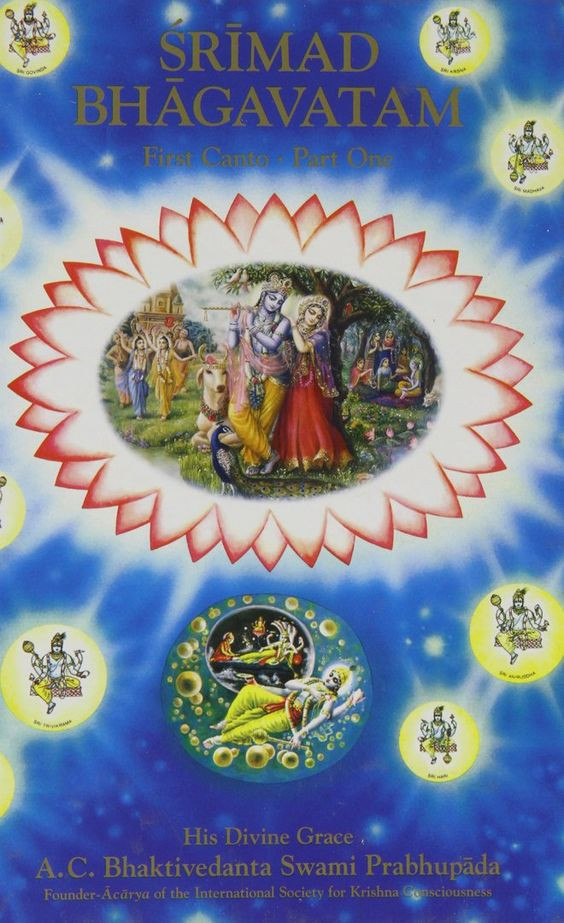 Why to read srimad bhagavatamReading the Srimad Bhagavatam fosters deep spiritual growth by narrating the life and teachings of Lord Krishna,...Read more
 -
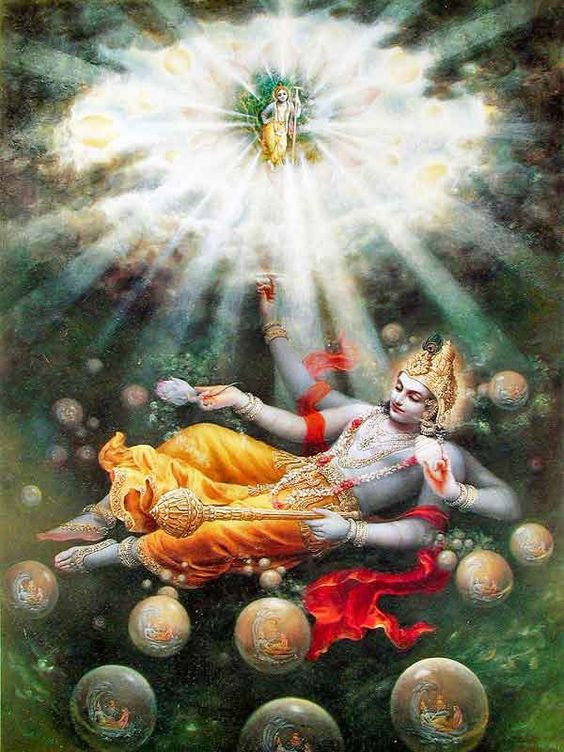 When was srimad bhagavatam written?The Srimad Bhagavatam is believed to have been written around 9th-10th century CE, though its oral traditions date...Read more
 -
 How many chapters are there in srimad bhagavatam?The Srimad Bhagavatam consists of 12 cantos (books) containing 335 chapters in total. Each canto covers various...Read more
 -
 How many skandhas are there in srimad bhagavatamThe Srimad Bhagavatam is divided into 12 skandhas (cantos or books). Each skandha explores different themes,...Read more
 -
 How many slokas in srimad bhagavatamThe Srimad Bhagavatam contains approximately 18,000 shlokas (verses). These verses are spread across its 12 skandhas...Read more
Leave a comment