
Why did Krishna run to embrace a poor brahmin in rags? Read the Sudama story from the Bhagavatam and learn how a...
Latest posts
-
 Krishna and Sudama: The Poor Brahmin Who Became Wealthy in LoveRead more
 -
 Vamana Avatar: How Three Steps Humbled Bali MaharajaRead more
Why did a powerful king give away three worlds to a boy asking for three steps? Learn the Vamana avatar story from...
-
 The Bhagavatam on Marriage: Duty, Love and Spiritual PartnershipRead more
What does the Bhagavatam say about marriage? Through the stories of Kardama and Devahuti, Rukmini's secret letter and...
-
 What Is Prema? The Bhagavatam's Highest Stage of Love for GodRead more
Prema is love for God with no "because" attached. Learn how the Bhagavatam describes it, the nine steps from faith to...
-
 Is Shiva Parvati Kalyana Mentioned in Srimad Bhagavatam? What the Scripture Really SaysRead more
Looking for Shiva and Parvati's wedding in the Srimad Bhagavatam? Find out what the scripture actually describes,...
-
 How Many Modes of Devotion Are Mentioned in Bhagavatam?Read more
A young boy named Prahlada listed nine ways to serve God, and the Bhagavatam keeps them as its answer. Learn what the...
-
 What Is Bhagavatam and Why Has It Been Read for 5,000 Years?Read more
A dying king asked one question, and the answer became the Bhagavatam. Learn what this Sanskrit scripture contains,...
-
 Who Is Lord Krishna? His Meaning, Teachings and Pastimes ExplainedRead more
Discover who Krishna is according to Srimad Bhagavatam, including His divine identity, childhood pastimes, teachings,...
-
 Incense in Islam: Bakhoor, Agarbatti and What Tradition SaysRead more
Is burning fragrance part of Muslim tradition? Explore incense in Islam, from the Prophetic practice of fumigating...
-
 History of Agarbatti: From Vedic Dhupa to Modern Incense SticksRead more
Where did agarbatti really come from? Follow the history of agarbatti from Vedic fire rituals and temple dhupa to...
Blog categories
- Default category (0)
- MUSICAL INSTRUMENT (1)
- BOOK (5)
- DEVOTIONAL GIFT (0)
- Blog (30) click
- CHANDAN (12)
- Bhagavatam Wisdom Series (68)
- Krishna Consciousness (14)
- Mridangam Musical Instrument (6)
- Bhagavad Gita for Beginners (13)
- Bhagavad Gita As It Is (37) click
- Bhagavad Gita As It Is Telugu (0)
- Bhagavad Gita As It Is Marathi (0)
- Bhagavad Gita As It Is In Hindi (0)
- Bhagavad Gita As It Is In English (0)
- Bhagavad Gita As It Is In Bengali (8)
- Bhagavad Gita As It Is In Kannada (0)
- Bhagavad Gita As It Is In Gujarati (0)
- Bhagavad Gita As It Is In Panjabi (0)
- Bhagavad Gita As It Is In Tamil (0)
- Bhagavad Gita As It Is Odia (0)
- BHAGAVAD GITA As It Is GERMAN (0)
- Bhagavad Gita As It Is In French (0)
- Bhagavad Gita As It Is In Nepali (0)
- Bhagavad Gita As It Is In Assamese (0)
- Incense or Agarbatti (38)
- Lord Chaitanya Mahaprabhu (3)
- Vedic Temple Mayapur (14)
- kalki (15)
- Mahabharata – Dharma & Destiny (27)
- Vaishnava Scriptures (4)
- healthy product (4)
- chaitanya mahaprabhu (5)
- Tulsi Mala Guide (17)
Search in blog
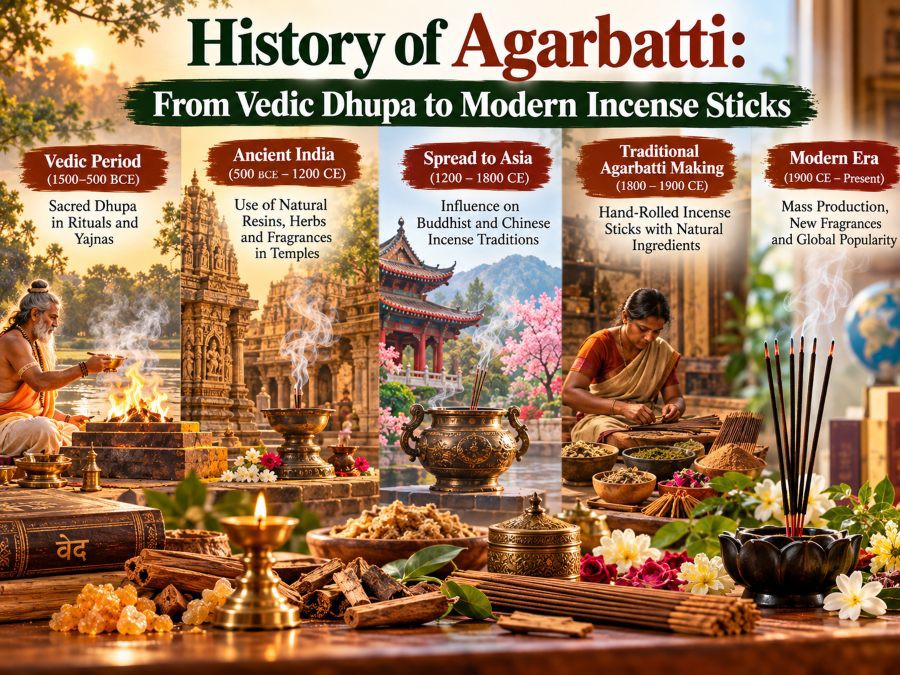
History of Agarbatti: From Vedic Dhupa to Modern Incense Sticks
History of Agarbatti: From Vedic Dhupa to Modern Incense Sticks
Picture a fire pit on a riverbank, thousands of years ago. A priest tips a spoonful of ghee onto the flames, adds a pinch of fragrant bark, and the smoke rises with a smell nobody in the gathering will forget. Now picture a woman in a small workshop in Karnataka, rolling perfumed paste onto a bamboo stick with quick, practised fingers. Between those two scenes lies one long, winding story.
This is the history of agarbatti, and it is far older and stranger than the neat bundle on your shelf suggests. If you are curious about the history of incense in India, follow the smoke back to where it started.
Where did the smoke begin?
Nobody can point to a single day and say, "Here, agarbatti was invented." The truth is messier, and more interesting.
Long before anyone rolled a stick, people burned fragrant materials for three simple reasons. Smoke keeps insects away. Pleasant smells cover bad ones. And rising smoke looks like a message travelling upward. Almost every early culture stumbled onto some version of this idea.
In the Indian subcontinent, the idea took root in ritual. The Vedic fire ceremony, the yajna or homa, placed offerings of ghee, grains and fragrant woods into a sacred fire. Aromatic plants were not an afterthought. Early Sanskrit literature, including the Vedic hymns, refers to fragrant substances and their use in worship and healing. Some archaeologists also suggest that aromatic burning may have been part of daily life in ancient Indus Valley towns, though the evidence is limited and scholars are careful about how much to claim.
So agarbatti's ancestor was not a stick at all. It was a fire, a fragrance and a purpose.
Dhupa: incense becomes a duty
As Vedic ritual gave way to temple worship and household puja, the burning of fragrance took a new shape. It became dhupa, one of the standard offerings made to a deity.
In the traditional order of worship, known as the upacharas, the worshipper welcomes the Lord like an honoured guest. Water is offered for washing the feet. Flowers are offered. A lamp is waved. And dhupa, fragrant smoke, is presented as a gesture of hospitality. In Vaishnava temples, including ISKCON Mayapur, incense remains part of the arati sequence to this day, alongside the lamp, water, cloth, flower and fan.
Notice what this did to the product. Because dhupa was a religious necessity, not a luxury, demand became steady and widespread. Temples needed it daily. Households needed it every morning. Any craft with that kind of dependable demand tends to grow fast, and that is exactly what happened here.
What went into the early recipes
Before the modern stick, dhupa was made from raw or lightly processed materials:
- Guggul, a resin from the Commiphora tree
- Sandalwood shavings and paste
- Agarwood (aguru), prized and costly
- Benzoin, loban and other tree resins
- Camphor, spices and flowers
These were burned on hot coals, in small clay or metal vessels, or shaped into cones and lumps.
Medicine, hygiene and the nose
Here is a part of the story that surprises many people. Early Indian incense was as much about health as about worship.
Classical Ayurvedic works describe dhupana, the practice of fumigating rooms, clothes, wounds and even newborn spaces with medicinal smoke. The thinking was practical, if not always scientific by modern standards: strong-smelling herbs and resins were believed to cleanse the air and ward off illness. Whether or not every claim holds up, the habit shows how deeply fragrance was stitched into everyday care.
This dual role, sacred and practical, is a big reason incense never stayed confined to temples. It moved into homes, sickrooms, royal courts and marketplaces.
Spices, sailors and the great scent trade
Fragrant materials are light, valuable and easy to carry, which makes them ideal trade goods. India sat right in the middle of the ancient trading world.
Indian sandalwood, aromatic resins and spices travelled by land and sea to Arabia, Persia, Rome and Southeast Asia. Arabian frankincense and myrrh came the other way. Records from classical trade show that aromatics were among the most sought-after goods of their age.
Religion carried scent too. As Buddhism spread from India into Central Asia, China, Korea and Japan, incense practices travelled with monks, texts and images. Chinese and Japanese cultures took the idea and developed it in their own directions, with their own woods, tools and refined traditions. So the great incense cultures of East Asia owe part of their origin to Indian ritual and trade, even though they grew into something distinct.
When did the stick appear?
This is the question everyone wants answered, and honesty requires a hedge. The exact birth of the bamboo-core stick is not well documented. Coreless incense, shaped by hand and burned as it was, is the older form across Asia. The bamboo-core stick, the kind we now call agarbatti, seems to have become common in India much more recently, and it spread widely as a convenient, cheap, easy-to-light format.
The name itself offers a clue. "Agar" likely points to agarwood, the legendary aromatic, while "batti" in Hindi means a wick or a stick. Put together, the word describes a fragrant stick, a small, portable version of a great temple offering.
The bamboo core solved real problems:
- It gave the incense a stiff, straight body so it could stand in a holder
- It let makers use less costly aromatic paste, since the core does part of the work
- It made mass production simple, because sticks could be rolled, dried and packed in bulk
- It allowed uniform burning time, which suited daily rituals
That last point matters more than it seems. A predictable half-hour burn turned incense into a small unit of time, a habit people could plan around.
The workshop era: hand-rolled and home-based
By the nineteenth and twentieth centuries, agarbatti had grown into a serious cottage industry, and parts of southern India became famous for it. Mysore and Bengaluru in Karnataka emerged as major centres, and other regions, including parts of Gujarat and Tamil Nadu, built strong industries of their own.
The work was, and often still is, done by hand. Families rolled masala paste onto bamboo sticks, laid them out to dry in the sun, and packed them for local shops. A huge share of this labour has been done by women working from home, fitting production around household duties. That gave the industry a social side that statistics rarely capture: it was, and remains, a livelihood for many small households.
Some names from this era became household words. Mysore-based agarbatti makers built brands that reached across the country, and their sticks became fixtures in shrines and shops from Kerala to Kashmir.
Champa, sandal and the smell of a generation
Fragrance families also settled in. Sandalwood stayed the classic. Rose, jasmine and kewra took the floral role. And then there was Nag Champa, a blend built around the sweet, creamy scent of the champa flower along with resin notes, often associated with the resin halmaddi.
Nag Champa went far beyond India. In the 1960s and 70s, travellers on the well-worn trail to India came home with bundles of it, and the scent became tied to yoga studios, meditation rooms and record shops in the West. A blend that began as a temple and household staple became, almost accidentally, a global fragrance identity.
That is a nice reminder of how odd the history of agarbatti can be. A smell made for morning puja in Bengaluru ended up in a student flat in London.
Machines, chemicals and a big shift
The late twentieth century brought a real turning point. Machines arrived that could roll and coat sticks at speeds no household could match. Production numbers climbed. Prices fell. Agarbatti reached every corner shop, every festival stall and every export container.
But scale had a cost. To keep prices low, many makers moved toward:
- Cheaper charcoal or sawdust bases
- Synthetic perfume oils in place of natural resins and essential oils
- Imported bamboo sticks and standardised formulas
Cheap synthetic fragrance can smell sharp and flat, and heavy use in small rooms can feel harsh. This shift split the market in two. On one side stand mass-market sticks, affordable and instantly recognisable. On the other, a growing number of makers and buyers now prefer natural, resin-based, hand-crafted incense, closer in spirit to the older dhupa tradition.
Old practice, new questions
Today, the story is still moving. Buyers are asking better questions than they used to:
- What is actually in this stick?
- Is the fragrance natural or synthetic?
- How is the smoke affecting the air in my home?
- Who made it, and were they paid fairly?
Makers have started to answer with cleaner recipes, charcoal-free formulas, flower-based sticks made from recycled temple offerings, and clearer labelling. Some of these ideas feel new, yet they lean on the oldest logic in the history of agarbatti: use good materials, respect the purpose, and keep the offering clean.
What the history teaches us
Look back over the whole arc and a pattern shows up.
Agarbatti began as sacred fire, became temple offering, then household habit, then trade good, then factory product, and now, in some circles, a craft revival. At each step the shape changed, but the reason for burning it stayed close to the same: to mark a moment as special, to invite calm, and to say, without words, that this space and this time matter.
That is why a stick that costs a few rupees can hold a few thousand years of meaning. When you light one tomorrow morning, you are joining a chain that runs from Vedic riverbanks through temple courtyards, spice ships, southern workshops and hippie-trail backpacks, all the way to your own doorway. Not bad for something you can hold between two fingers.
Posted in: Incense or Agarbatti
Related posts
-
 How to Light Incense SticksDiscover the right way to light incense sticks (agarbatti) for worship, meditation, and peace. Learn step-by-step...Read more
 -
 Where to Buy Incense SticksDiscover where to buy the best natural incense sticks for your daily puja, meditation, and relaxation. Explore pure,...Read more
 -
 Is Incense Sticks Bad for Pregnancy? Wondering if incense sticks are safe during pregnancy? Discover the truth about incense smoke, its effects on...Read more
 -
 Do Incense Sticks Trigger Fire Alarms? Wondering if incense sticks can trigger fire alarms? Learn how smoke affects detectors, safe burning tips, and...Read more
 -
 How Many Incense Sticks to Burn for Good LuckDiscover how many incense sticks to burn for good luck and prosperity. Learn the ideal numbers, rituals, and natural...Read more
Leave a comment