
Why did Krishna run to embrace a poor brahmin in rags? Read the Sudama story from the Bhagavatam and learn how a...
Latest posts
-
 Krishna and Sudama: The Poor Brahmin Who Became Wealthy in LoveRead more
 -
 Vamana Avatar: How Three Steps Humbled Bali MaharajaRead more
Why did a powerful king give away three worlds to a boy asking for three steps? Learn the Vamana avatar story from...
-
 The Bhagavatam on Marriage: Duty, Love and Spiritual PartnershipRead more
What does the Bhagavatam say about marriage? Through the stories of Kardama and Devahuti, Rukmini's secret letter and...
-
 What Is Prema? The Bhagavatam's Highest Stage of Love for GodRead more
Prema is love for God with no "because" attached. Learn how the Bhagavatam describes it, the nine steps from faith to...
-
 Is Shiva Parvati Kalyana Mentioned in Srimad Bhagavatam? What the Scripture Really SaysRead more
Looking for Shiva and Parvati's wedding in the Srimad Bhagavatam? Find out what the scripture actually describes,...
-
 How Many Modes of Devotion Are Mentioned in Bhagavatam?Read more
A young boy named Prahlada listed nine ways to serve God, and the Bhagavatam keeps them as its answer. Learn what the...
-
 What Is Bhagavatam and Why Has It Been Read for 5,000 Years?Read more
A dying king asked one question, and the answer became the Bhagavatam. Learn what this Sanskrit scripture contains,...
-
 Who Is Lord Krishna? His Meaning, Teachings and Pastimes ExplainedRead more
Discover who Krishna is according to Srimad Bhagavatam, including His divine identity, childhood pastimes, teachings,...
-
 Incense in Islam: Bakhoor, Agarbatti and What Tradition SaysRead more
Is burning fragrance part of Muslim tradition? Explore incense in Islam, from the Prophetic practice of fumigating...
-
 History of Agarbatti: From Vedic Dhupa to Modern Incense SticksRead more
Where did agarbatti really come from? Follow the history of agarbatti from Vedic fire rituals and temple dhupa to...
Blog categories
- Default category (0)
- MUSICAL INSTRUMENT (1)
- BOOK (5)
- DEVOTIONAL GIFT (0)
- Blog (30) click
- CHANDAN (12)
- Bhagavatam Wisdom Series (68)
- Krishna Consciousness (14)
- Mridangam Musical Instrument (6)
- Bhagavad Gita for Beginners (13)
- Bhagavad Gita As It Is (37) click
- Bhagavad Gita As It Is Telugu (0)
- Bhagavad Gita As It Is Marathi (0)
- Bhagavad Gita As It Is In Hindi (0)
- Bhagavad Gita As It Is In English (0)
- Bhagavad Gita As It Is In Bengali (8)
- Bhagavad Gita As It Is In Kannada (0)
- Bhagavad Gita As It Is In Gujarati (0)
- Bhagavad Gita As It Is In Panjabi (0)
- Bhagavad Gita As It Is In Tamil (0)
- Bhagavad Gita As It Is Odia (0)
- BHAGAVAD GITA As It Is GERMAN (0)
- Bhagavad Gita As It Is In French (0)
- Bhagavad Gita As It Is In Nepali (0)
- Bhagavad Gita As It Is In Assamese (0)
- Incense or Agarbatti (38)
- Lord Chaitanya Mahaprabhu (3)
- Vedic Temple Mayapur (14)
- kalki (15)
- Mahabharata – Dharma & Destiny (27)
- Vaishnava Scriptures (4)
- healthy product (4)
- chaitanya mahaprabhu (5)
- Tulsi Mala Guide (17)
Search in blog
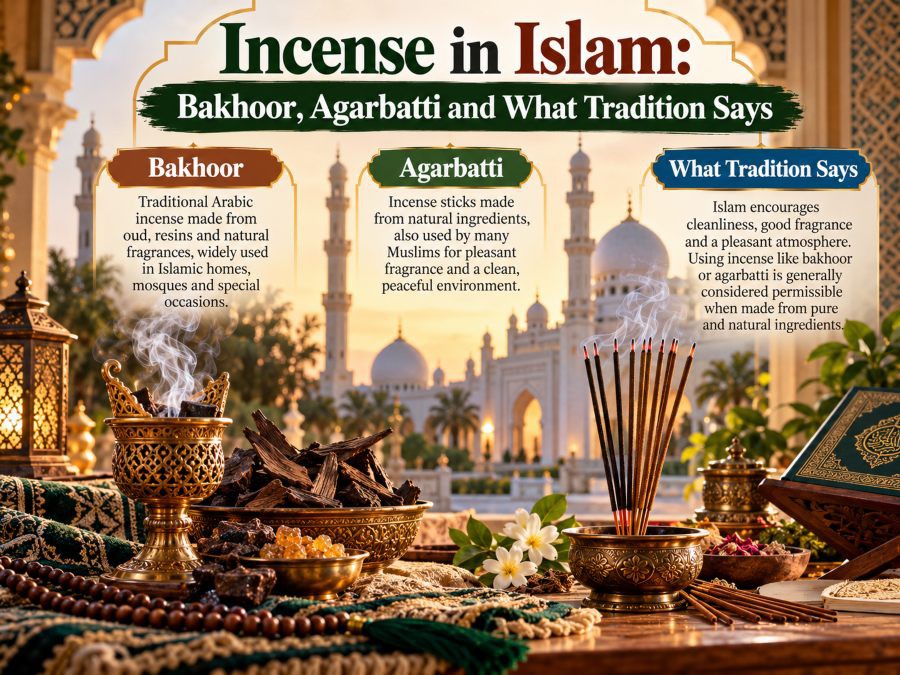
Incense in Islam: Bakhoor, Agarbatti and What Tradition Says
Incense in Islam: Bakhoor, Agarbatti and What Tradition Says
A guest walks into a Gulf home and, before the tea arrives, a small burner glides past. Fragrant smoke curls up, the guest waves a little of it toward the face and clothes, and something unspoken has just happened: you are welcome here. Nobody explained it. Nobody had to.
Now move a few thousand kilometres east, to a lane in Hyderabad or Lucknow, where a bundle of agarbatti smokes beside a shrine or a shop counter. Both scenes involve fragrant smoke, both involve Muslims, and both raise the same question. What does incense in Islam actually look like, and where does the religion draw its lines? For readers who love traditional fragrance, whether from Arabian bakhoor or from a source like Mayapur Store, the answer is more welcoming, and more nuanced, than most people expect.
Does Islam even talk about fragrance?
It does, and warmly.
Fragrance sits close to the centre of Prophetic character. A well-known narration reports the Prophet Muhammad ﷺ saying that perfume was made beloved to him from this world, and that his comfort lay in prayer. Notice the pairing. Scent and worship are placed side by side, not set against each other.
The tradition also records practical habits:
- The Prophet ﷺ rarely refused a gift of perfume. A narration in Sahih Muslim quotes him saying that anyone offered a fragrant plant (rayhan) should not turn it down, because it is light to carry and pleasant to smell.
- Friday was a day for cleanliness. Reports in Sahih al-Bukhari encourage a full bath, clean clothes and applying fragrance before the congregational prayer.
- Fragrance was tied to dignity in gatherings. Sitting beside someone in prayer is intimate, so smelling pleasant was treated as basic courtesy.
Put together, these narrations paint a picture where good smell is part of good manners. That is the foundation on which the Muslim world built its remarkable incense culture.
The one hadith everyone brings up
If you ask a knowledgeable person for a direct Prophetic precedent for burning incense, they will usually point to a report in Sahih Muslim about Abdullah ibn Umar, the Prophet's companion.
Ibn Umar is reported to have fumigated with aloeswood (ud), sometimes plain and sometimes mixed with a little camphor. He then said that this was how the Messenger of Allah used to fumigate.
That single narration carries a lot of weight. It shows that burning fragrant wood was known and practised at the time of the Prophet , and it names the material. It also explains why agarwood became the most treasured ingredient in Muslim fragrance culture. When people call oud "liquid gold", they are respecting an old association as much as a high price.
Some historical reports also mention that early caliphs had mosques perfumed with incense on special days, though scholars discuss the strength of these reports and it is fair to describe them as traditions rather than settled rulings. What the sources do agree on is the general attitude: pleasant fragrance in places of worship is seen as fitting.
Bakhoor: the Arabian answer to agarbatti
Bakhoor is the Arabic word for fragrant material burned for its smoke. If agarbatti is a slim bamboo stick, bakhoor is more like a small handful of scented treasure.
What is it made of?
A typical bakhoor blend includes:
- Agarwood (oud) chips, often soaked in perfume oil
- Sandalwood, amber, musk and rose
- Frankincense (luban), especially from Oman and Yemen
- Resins, sugar or honey, and aromatic oils that hold the pieces together
Some bakhoor is sold as loose chips, and some is pressed into soft pellets or paste, often called maamoul. It is placed on a glowing charcoal disc inside a burner called a mabkhara or mijmar, and it releases smoke slowly as it warms.
How it differs from agarbatti
The difference is not only shape. It is a difference in how you use it.
- Agarbatti is self-burning. Light the tip, it smoulders on its own.
- Bakhoor is heat-driven. It needs charcoal underneath and a burner to sit in.
- Agarbatti usually gives a steady, continuous scent.
- Bakhoor tends to give a rich, heavy, resinous cloud that builds quickly.
Bakhoor is also often used on clothes. In many Arab households, people hold a garment above the burner so the smoke settles into the fabric. That practice has no exact match in the agarbatti world.
More than a home fragrance
Incense in Muslim life stretches beyond the living room.
Hospitality. In Gulf homes and majlis gatherings, passing the mabkhara among guests signals respect and often marks the end of a visit. The message is warm and precise.
Weddings and Eid. Brides, guests and homes are perfumed with oud and bakhoor. In Sudan, the dukhan, a traditional smoke bath made with acacia wood and aromatics, is part of preparing a bride.
Ramadan and the Hajj season. Many households light bakhoor after breaking the fast or before Taraweeh, and in Makkah and Madinah the air around the sacred mosques is often lightly scented.
Burial customs. Fragrance appears in preparing the deceased. Camphor is used in the final wash, and reports from early sources mention perfuming the shroud. It reflects a Muslim principle that the body is treated with tenderness and respect until the end.
What about agarbatti in Muslim homes?
Here is where things get more interesting, and where honesty matters.
In South Asia, agarbatti is woven into many Muslim households. Some light a stick after cleaning the house, on Thursday evenings, before guests arrive, or on festival days. Vendors of attar and incense are a familiar sight near major mosques and dargahs, and many Muslim families in India, Pakistan and Bangladesh use agarbatti simply as a home fragrance, no different in spirit from a good perfume.
Islamic scholars generally focus on three questions when they assess this.
1. Is the substance itself permissible?
Fragrant woods, flowers, resins and spices are natural and clean. Burning them for scent is, in principle, permissible, and the ud narration supports the wider idea.
2. What is the intention?
This is the important one. Using agarbatti to freshen a room, welcome a guest or enjoy a pleasant smell falls under ordinary fragrance. But burning incense as a ritual act of worship or offering to anything other than Allah is a different matter, because worship in Islam belongs to God alone. Scholars agree on this principle even when they differ on how it applies in specific cases.
3. What about local customs, such as at shrines?
Views vary. Some scholars regard lighting incense at graves or shrines as a cultural habit that is best avoided, because it can blur the line between respect and ritual. Others treat it more leniently as a custom of honour and fragrance, so long as no one believes the smoke itself has power. Communities and schools of thought within Islam do not all answer the same way.
That variety is real, and it is worth respecting. If you are wondering about a specific practice, the best step is to ask a trusted local scholar who knows your school of thought. Nothing here is a religious ruling.
A question people quietly ask: does the brand matter?
Some Muslim buyers wonder whether an agarbatti made by a non-Muslim company, or one associated with a temple, is a problem. Most scholars focus on what the product is and how you use it, not on who made it. A stick made of natural woods and flowers is still a stick of woods and flowers. Others prefer caution and choose products with no explicit religious branding or dedication.
Personal comfort plays a role here, and it is fine to have one. If a product's packaging mentions deities or ritual purposes and that bothers you, choose one that does not. Plenty of plain, ingredient-focused options exist.
Other things worth checking before you buy
Regardless of tradition, a few practical points help.
- Look for natural ingredients. Real oud, sandalwood, rose and resins smell layered and change as they burn. Flat, sugary scents often signal synthetic oil.
- Check for alcohol-based liquids. Most incense is dry, but attars and sprays sometimes contain alcohol. If this matters to you, choose oil-based (alcohol-free) attar.
- Be careful with the price of oud. Genuine agarwood is expensive. A very cheap "pure oud" bundle deserves suspicion.
- Keep sensitive people in mind. Children, elderly relatives and anyone with asthma or allergies may not tolerate heavy smoke.
Burning it safely
Islam places strong weight on avoiding harm, and that includes the small harms of a smoky room. Simple habits fit well with that spirit:
- Ventilate. Open a window slightly while burning.
- Use a stable holder or mabkhara on a heat-safe surface.
- Keep charcoal and burning sticks away from curtains, rugs and children.
- Use small amounts. A few chips of bakhoor or a single stick is usually plenty.
- Put it out before sleeping or leaving.
- Avoid burning it directly around infants and pets.
Fragrance is meant to bring ease. If it gives someone a headache or a cough, it has stopped doing its job.
So what is the takeaway?
Look at the whole picture and a few threads stand out.
Islam values fragrance. The Prophet ﷺ loved it, used it, and encouraged cleanliness and good scent, especially for gatherings and prayer.
Burning aloeswood has direct precedent. The narration about Ibn Umar and the Prophet's habit of fumigating gives incense a firm place in Muslim tradition, and bakhoor is its living heir.
Agarbatti is largely a question of intention and comfort. Used as a plain fragrance, most scholars see no difficulty. Used as an act of ritual offering to anything besides God, it crosses a line, and views on grey areas differ.
Quality and moderation matter. Natural materials, fresh air and small amounts make the experience better and safer.
Incense in Islam, in the end, is less about a stick versus a chip and more about a habit of grace: making the house, the guest and the moment of prayer a little more pleasant than you found them. That is an old idea, and it still works.
Posted in: Incense or Agarbatti
Related posts
-
 How to Light Incense SticksDiscover the right way to light incense sticks (agarbatti) for worship, meditation, and peace. Learn step-by-step...Read more
 -
 Where to Buy Incense SticksDiscover where to buy the best natural incense sticks for your daily puja, meditation, and relaxation. Explore pure,...Read more
 -
 Is Incense Sticks Bad for Pregnancy? Wondering if incense sticks are safe during pregnancy? Discover the truth about incense smoke, its effects on...Read more
 -
 Do Incense Sticks Trigger Fire Alarms? Wondering if incense sticks can trigger fire alarms? Learn how smoke affects detectors, safe burning tips, and...Read more
 -
 How Many Incense Sticks to Burn for Good LuckDiscover how many incense sticks to burn for good luck and prosperity. Learn the ideal numbers, rituals, and natural...Read more
Leave a comment