
Why did Krishna run to embrace a poor brahmin in rags? Read the Sudama story from the Bhagavatam and learn how a...
Latest posts
-
 Krishna and Sudama: The Poor Brahmin Who Became Wealthy in LoveRead more
 -
 Vamana Avatar: How Three Steps Humbled Bali MaharajaRead more
Why did a powerful king give away three worlds to a boy asking for three steps? Learn the Vamana avatar story from...
-
 The Bhagavatam on Marriage: Duty, Love and Spiritual PartnershipRead more
What does the Bhagavatam say about marriage? Through the stories of Kardama and Devahuti, Rukmini's secret letter and...
-
 What Is Prema? The Bhagavatam's Highest Stage of Love for GodRead more
Prema is love for God with no "because" attached. Learn how the Bhagavatam describes it, the nine steps from faith to...
-
 Is Shiva Parvati Kalyana Mentioned in Srimad Bhagavatam? What the Scripture Really SaysRead more
Looking for Shiva and Parvati's wedding in the Srimad Bhagavatam? Find out what the scripture actually describes,...
-
 How Many Modes of Devotion Are Mentioned in Bhagavatam?Read more
A young boy named Prahlada listed nine ways to serve God, and the Bhagavatam keeps them as its answer. Learn what the...
-
 What Is Bhagavatam and Why Has It Been Read for 5,000 Years?Read more
A dying king asked one question, and the answer became the Bhagavatam. Learn what this Sanskrit scripture contains,...
-
 Who Is Lord Krishna? His Meaning, Teachings and Pastimes ExplainedRead more
Discover who Krishna is according to Srimad Bhagavatam, including His divine identity, childhood pastimes, teachings,...
-
 Incense in Islam: Bakhoor, Agarbatti and What Tradition SaysRead more
Is burning fragrance part of Muslim tradition? Explore incense in Islam, from the Prophetic practice of fumigating...
-
 History of Agarbatti: From Vedic Dhupa to Modern Incense SticksRead more
Where did agarbatti really come from? Follow the history of agarbatti from Vedic fire rituals and temple dhupa to...
Blog categories
- Default category (0)
- MUSICAL INSTRUMENT (1)
- BOOK (5)
- DEVOTIONAL GIFT (0)
- Blog (30) click
- CHANDAN (12)
- Bhagavatam Wisdom Series (68)
- Krishna Consciousness (14)
- Mridangam Musical Instrument (6)
- Bhagavad Gita for Beginners (13)
- Bhagavad Gita As It Is (37) click
- Bhagavad Gita As It Is Telugu (0)
- Bhagavad Gita As It Is Marathi (0)
- Bhagavad Gita As It Is In Hindi (0)
- Bhagavad Gita As It Is In English (0)
- Bhagavad Gita As It Is In Bengali (8)
- Bhagavad Gita As It Is In Kannada (0)
- Bhagavad Gita As It Is In Gujarati (0)
- Bhagavad Gita As It Is In Panjabi (0)
- Bhagavad Gita As It Is In Tamil (0)
- Bhagavad Gita As It Is Odia (0)
- BHAGAVAD GITA As It Is GERMAN (0)
- Bhagavad Gita As It Is In French (0)
- Bhagavad Gita As It Is In Nepali (0)
- Bhagavad Gita As It Is In Assamese (0)
- Incense or Agarbatti (38)
- Lord Chaitanya Mahaprabhu (3)
- Vedic Temple Mayapur (14)
- kalki (15)
- Mahabharata – Dharma & Destiny (27)
- Vaishnava Scriptures (4)
- healthy product (4)
- chaitanya mahaprabhu (5)
- Tulsi Mala Guide (17)
Search in blog
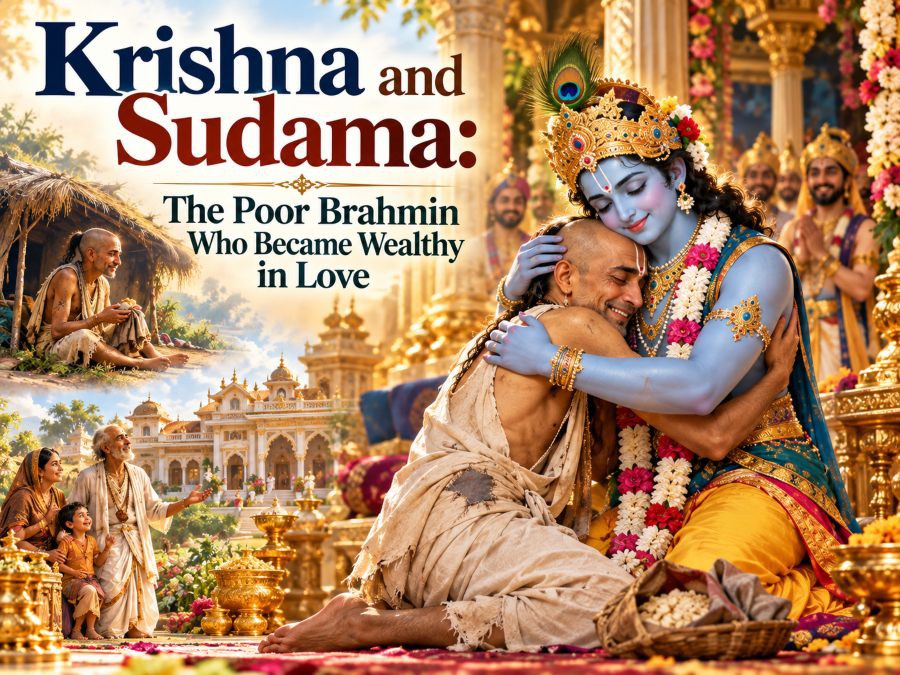
Krishna and Sudama: The Poor Brahmin Who Became Wealthy in Love
Krishna and Sudama: The Poor Brahmin Who Became Wealthy in Love
A man walks through the golden streets of Dvaraka with a small bundle tucked under his arm. His clothes are patched, his ribs show, and the guards look at him twice. The bundle holds four fistfuls of flattened rice, borrowed from neighbors because he had nothing else to offer. He is on his way to see the king of the city, a man he once shared a classroom with. This is how the Bhagavatam introduces one of its best-loved friendships, and you can read the full episode in the tenth canto of the ISKCON Complete Bhagavatam collection. It is a short story, just two chapters. Yet people have been retelling it for centuries, and it still has the power to catch you off guard.
Two Boys, One Forest, One Storm
Start at the beginning. Krishna and his brother Balarama were sent to study under the sage Sandipani Muni in Avanti. In that gurukula, a boy named Sudama became Krishna's close friend. The text calls him a learned brahmana, a person who had mastered his senses and who was content with very little.

The Bhagavatam later gives us a memory from those student days. One evening the guru's wife sent Krishna and Sudama into the forest to collect firewood. Then the weather turned. Dark clouds came in, rain lashed down, the wind howled, and night fell. The two boys lost their way and spent the dark hours soaked and shivering, holding on to each other. At dawn their teacher found them, deeply moved that they had suffered on his behalf, and blessed them.
Notice what this memory is for. It is not a miracle story. It is a story about two kids who were cold and scared, and who got through the night side by side. That is what a real friendship rests on. Years later, when one of them is a king and the other a beggar, the memory is still there, waiting.
The Wife Who Pushed Him Out the Door
Years pass. Krishna rules Dvaraka. Sudama remains in his village, poorer than ever. The Bhagavatam does not soften the details. His wife is thin from hunger, and so are the children. The house is falling apart. There are days when nothing is cooked.
One day she speaks up. She tells her husband that his old classmate is now the husband of Lakshmi, the lord of the Yadavas, a person who loves the devoted and helps those who are in need. Why not go and see him? Sudama is reluctant. He has never begged from anyone, and he does not want to turn up as a petitioner. But she is persistent, and, truth be told, there is another motive inside him that he is happy to admit: he would simply like to see Krishna.
So he agrees, with one condition on himself. He will go, but he will not ask for money. She borrows four handfuls of chipped rice from the neighbors, knots them in a worn piece of cloth, and sends him off.
That small bundle is the most touching detail in the story. It is not a grand gift, and it is not expensive. It is the only thing a poor household could scrape together, offered with its whole heart.
Past Three Gates, Into the Palace
Sudama reaches Dvaraka and walks through three guarded gateways. The Bhagavatam says the guards did not stop him, which already hints that something unusual is going on. He enters the quarters of Krishna's sixteen thousand queens, a city within a city.
At the time, Krishna is sitting on the couch of his chief queen, Rukmini. He sees Sudama from a distance and springs up. He does not wait to be announced. He rushes across the room and hugs his old friend, and tears fill his eyes.
Think about what this scene is doing. A king who rules an empire gets up in the middle of his afternoon and runs to a man in rags. The Bhagavatam wants us to see the scale of this gesture. Krishna does not treat Sudama as a poor relation. He treats him as a long-lost companion.
What follows is almost domestic.
- Krishna seats him on his own couch.
- He washes Sudama's feet himself, and then sprinkles the water on his own head.
- Rukmini fans him with a chamara, the royal whisk, while the queens look on in astonishment.
- Krishna applies sandalwood paste, offers incense and lamps, and welcomes him as if a great sage had arrived.
Sudama, meanwhile, is stunned. The whole palace is watching this thin, weathered brahmana being served by the master of the universe, and he feels he has done nothing to deserve it.
A Small Packet and a Big Appetite
Once Sudama is settled, the two friends start talking about the old days. They laugh about the forest and the storm. Krishna recalls how the guru's wife had asked them to fetch wood, and how his friend had held up through the night. They speak of their teacher, their lessons, their childhood.
Then Krishna smiles and asks a question with a hint of mischief. What did you bring me? A friend should never come empty-handed, he says. He notes that even a tiny offering, given with love, pleases him enormously, while a mountain of gifts from someone without devotion means little.
Sudama is embarrassed. He lowers his head. How can he present this wretched bundle of rice to the lord of Lakshmi? But Krishna can see the cloth tucked away, and with a laugh he pulls it out of Sudama's hand. "What is this?" he says, and he eats a handful at once.
He reaches in for a second. Rukmini, the goddess of fortune herself, catches his hand. She says, in effect, that one handful is enough. That single bite had already bestowed on Sudama every kind of prosperity, in this life and the next.
This is a lovely moment, and a little funny. The Lord of everything is behaving like a hungry schoolboy, and his wife has to step in.
The Man Who Forgot to Ask
Now comes the part that gives the story its unusual shape.
Sudama stays the night in Krishna's palace. He eats well, sleeps on a soft bed, and feels, as the Bhagavatam puts it, as though he had gone to the spiritual world. In the morning, he sets off for home. And through the whole visit, he never mentions his poverty.
Read that again. He walked all the way to Dvaraka to fix his family's hunger, and he left without saying a word about it.
Why? The text gives us his thoughts as he walks away. He is not disappointed. He thinks about how kindly Krishna treated him. He says to himself that he is a poor, sinful man, and yet the Lord, the abode of Lakshmi, embraced him. Besides, he reasons, Krishna must have known why he came. If he gave me nothing, it must be because wealth often makes people arrogant, and the Lord wanted to protect me from that.
There is real psychological depth here. Sudama is not pretending to be noble. He is genuinely so absorbed in the memory of the meeting that his needs have shrunk. Something larger took their place.
The Hut That Wasn't There
As he walks into his village, Sudama is confused. His house is gone. In its place stands a magnificent palace, with gardens, birds and shining towers. He wonders if he has taken the wrong road.
Then a crowd of men and women, beautifully dressed and singing, comes out to meet him. His wife steps forward, no longer in rags, but wearing jewels and fine silk, glowing with joy. She leads him inside.
Sudama understands at once. This is Krishna's doing. He had known about the poverty the whole time, and had answered it without being asked.
Here is the point many readers miss. The riches are not the reward for good behavior. They are a gift from a friend. And what does Sudama do with them? The Bhagavatam says that he enjoyed his new life without attachment, remained absorbed in remembering Krishna, and in time attained the Lord's own abode. The house changed. The man stayed the same.
What the Story Actually Teaches
On the surface, this looks like a tale about getting rich through devotion. That reading misses the center of it. Look at what Sudama actually does: nothing. He does not argue, plead, perform a ritual or name a price. He arrives with a handful of rice and an open heart.
A few ideas stand out.
- Love is measured by sincerity, not size. The rice was cheap. The offering was priceless.
- The Lord responds to the heart. Krishna was not moved by Sudama's learning or by his social standing. He was moved by affection.
- Not asking can be its own form of trust. Sudama believed his friend already knew what he needed.
- Prosperity is safest when it is held lightly. Sudama's later life shows that wealth need not carry pride along with it.
- Friendship is a spiritual relationship. The Bhagavatam places the bond between friends alongside the bond between servant and master, parent and child, lover and beloved.
It is also worth noticing who Krishna is in this episode. He is the king of Dvaraka, the husband of thousands of queens, and the figure the entire cosmos depends on. And he spends his afternoon washing the feet of a poor schoolmate. The story quietly reverses every assumption about power. In Dvaraka, the greatest person in the room is the one who serves.
Why Sudama Still Matters
Many people have read this story as children and carried it for the rest of their lives. There is a reason. It answers a fear that almost everyone has felt at some point: that we are too small, too poor, too unremarkable to matter to anything greater than ourselves.
Sudama has no credentials. He carries a bundle that embarrasses him. Yet the person he came to see jumps from his seat and runs to meet him.
That is the promise at the heart of the tale. It does not say that effort is pointless or that you should sit back and wait. It says that sincerity is seen, and that the one who sees it responds with more generosity than we can imagine.
If you have never read the full episode, set aside twenty minutes with a good translation and its commentary. The Bhagavatam has grander scenes, with battles, cosmic forms and long philosophical discourses. Few are as warm as this one: a hungry man, a handful of rice, and a friend who never forgot the night in the rain.
Posted in: Krishna Consciousness
Related posts
-
 Krishna Consciousness: The Endless Path of Bhakti and DevotionExplore Krishna Consciousness—the eternal path of bhakti and devotion rooted in ancient wisdom. Discover the...Read more
 -
 Why Krishna Consciousness is the Key to Inner Peace & HappinessDiscover how Krishna Consciousness offers the key to lasting inner peace and true happiness through devotion,...Read more
 -
 Unlocking the Power of Bhakti Yoga through Krishna ConsciousnessUnlock the power of Bhakti Yoga through Krishna Consciousness—discover how devotion, chanting, and ISKCON Mayapur...Read more
 -
 Discovering Krishna Consciousness: The Science of Self-RealizationDiscover Krishna Consciousness as the science of self-realization—unlock your true spiritual identity and attain...Read more
 -
 Chant, Dance, and Rejoice: Experiencing Krishna ConsciousnessExperience the joy of Krishna Consciousness through chanting, dancing, and rejoicing. Discover how these devotional...Read more
Leave a comment