
Why did Krishna run to embrace a poor brahmin in rags? Read the Sudama story from the Bhagavatam and learn how a...
Latest posts
-
 Krishna and Sudama: The Poor Brahmin Who Became Wealthy in LoveRead more
 -
 Vamana Avatar: How Three Steps Humbled Bali MaharajaRead more
Why did a powerful king give away three worlds to a boy asking for three steps? Learn the Vamana avatar story from...
-
 The Bhagavatam on Marriage: Duty, Love and Spiritual PartnershipRead more
What does the Bhagavatam say about marriage? Through the stories of Kardama and Devahuti, Rukmini's secret letter and...
-
 What Is Prema? The Bhagavatam's Highest Stage of Love for GodRead more
Prema is love for God with no "because" attached. Learn how the Bhagavatam describes it, the nine steps from faith to...
-
 Is Shiva Parvati Kalyana Mentioned in Srimad Bhagavatam? What the Scripture Really SaysRead more
Looking for Shiva and Parvati's wedding in the Srimad Bhagavatam? Find out what the scripture actually describes,...
-
 How Many Modes of Devotion Are Mentioned in Bhagavatam?Read more
A young boy named Prahlada listed nine ways to serve God, and the Bhagavatam keeps them as its answer. Learn what the...
-
 What Is Bhagavatam and Why Has It Been Read for 5,000 Years?Read more
A dying king asked one question, and the answer became the Bhagavatam. Learn what this Sanskrit scripture contains,...
-
 Who Is Lord Krishna? His Meaning, Teachings and Pastimes ExplainedRead more
Discover who Krishna is according to Srimad Bhagavatam, including His divine identity, childhood pastimes, teachings,...
-
 Incense in Islam: Bakhoor, Agarbatti and What Tradition SaysRead more
Is burning fragrance part of Muslim tradition? Explore incense in Islam, from the Prophetic practice of fumigating...
-
 History of Agarbatti: From Vedic Dhupa to Modern Incense SticksRead more
Where did agarbatti really come from? Follow the history of agarbatti from Vedic fire rituals and temple dhupa to...
Blog categories
- Default category (0)
- MUSICAL INSTRUMENT (1)
- BOOK (5)
- DEVOTIONAL GIFT (0)
- Blog (30) click
- CHANDAN (12)
- Bhagavatam Wisdom Series (68)
- Krishna Consciousness (14)
- Mridangam Musical Instrument (6)
- Bhagavad Gita for Beginners (13)
- Bhagavad Gita As It Is (37) click
- Bhagavad Gita As It Is Telugu (0)
- Bhagavad Gita As It Is Marathi (0)
- Bhagavad Gita As It Is In Hindi (0)
- Bhagavad Gita As It Is In English (0)
- Bhagavad Gita As It Is In Bengali (8)
- Bhagavad Gita As It Is In Kannada (0)
- Bhagavad Gita As It Is In Gujarati (0)
- Bhagavad Gita As It Is In Panjabi (0)
- Bhagavad Gita As It Is In Tamil (0)
- Bhagavad Gita As It Is Odia (0)
- BHAGAVAD GITA As It Is GERMAN (0)
- Bhagavad Gita As It Is In French (0)
- Bhagavad Gita As It Is In Nepali (0)
- Bhagavad Gita As It Is In Assamese (0)
- Incense or Agarbatti (38)
- Lord Chaitanya Mahaprabhu (3)
- Vedic Temple Mayapur (14)
- kalki (15)
- Mahabharata – Dharma & Destiny (27)
- Vaishnava Scriptures (4)
- healthy product (4)
- chaitanya mahaprabhu (5)
- Tulsi Mala Guide (17)
Search in blog
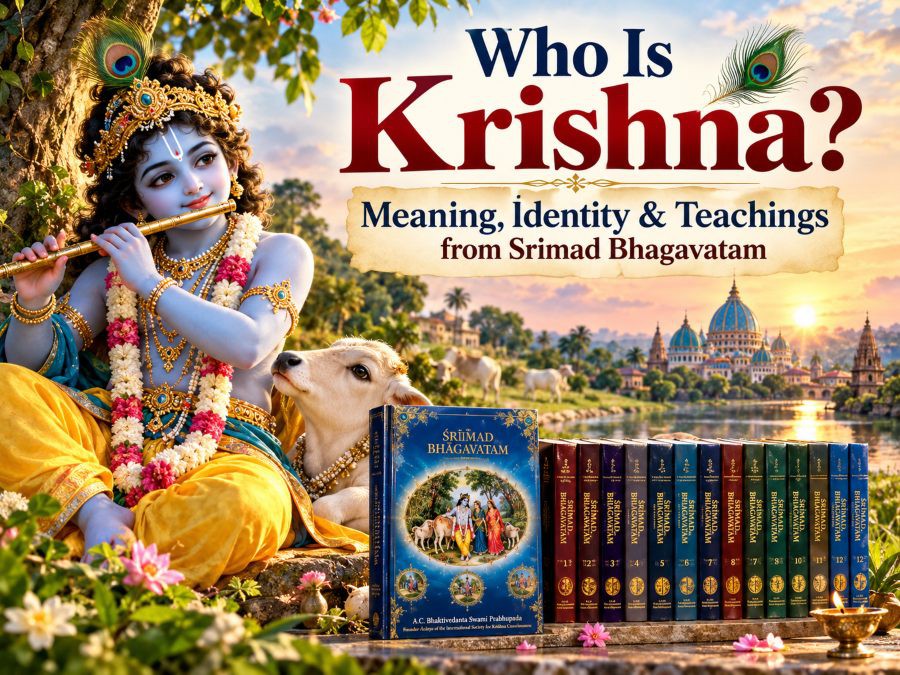
Who Is Lord Krishna? His Meaning, Teachings and Pastimes Explained
Who Is Krishna? Meaning, Identity & Teachings from Srimad Bhagavatam
Who is Krishna? Is He a historical personality, a divine teacher, the Supreme Being, or the beloved cowherd of Vrindavan?
For a reader approaching Krishna through Srimad Bhagavatam, the answer is not limited to one description. Krishna is presented as a complete spiritual personality whose identity can be understood through His teachings, relationships, qualities, and activities. He is at once the Supreme Lord described by philosophy and the affectionate child who allows Mother Yashoda to tie Him with a rope.
That apparent contradiction is actually one of the most interesting features of Krishna's identity.
Srimad Bhagavatam does not ask us to understand Krishna as an abstract concept. It presents Him as a person who can be remembered, served, loved, questioned, and approached through devotion. His life in Vrindavan, His friendship with the Pandavas, His guidance to Arjuna, and His dealings with devotees all contribute to a larger spiritual message.

To understand who Krishna is, therefore, we have to look beyond isolated stories. We need to understand what Srimad Bhagavatam says about His identity, why He appears in the world, what His teachings reveal about the soul, and why millions of people continue to build their spiritual lives around His name.
What Does the Name Krishna Mean?
The name Krishna comes from Sanskrit and is traditionally associated with the idea of attracting or drawing others toward oneself.
This meaning becomes particularly interesting when applied to Krishna's personality.
People are naturally attracted to different qualities. Someone may admire beauty. Another person values intelligence. Someone else seeks strength, wealth, fame, kindness, or wisdom. In the Bhagavata tradition, Krishna is understood as the complete source of these divine qualities.
His personality therefore cannot be reduced to a single role.
Krishna appears as:
- A playful child in Vrindavan
- The beloved of His devotees
- A friend of the cowherd boys
- The son of Nanda and Yashoda in His earthly pastimes
- The protector of the residents of Vrindavan
- The companion and guide of Arjuna
- The spiritual teacher of the Bhagavad Gita
- The Supreme Personality of Godhead according to Srimad Bhagavatam
Each description reveals something different.
A person who sees Krishna only as a philosophical figure misses the warmth of His personal relationships. Someone who sees Him only as a charming child may miss the profound theological claims made about Him.
Srimad Bhagavatam brings these dimensions together.
Krishna in Srimad Bhagavatam: Who Does the Bhagavatam Say He Is?
Srimad Bhagavatam places Krishna at the center of its theological vision, especially in the Tenth Canto, which describes His birth, childhood, relationships, adventures, and teachings through a series of deeply personal narratives.
One famous statement appears in the First Canto:
“Kṛṣṇas tu bhagavān svayam.”
This is traditionally translated as “Krishna is Bhagavan Himself.”
The word Bhagavan refers to the Supreme Being possessing fullness of divine qualities. Within the Bhagavata understanding, Krishna is therefore not merely a saint, prophet, demigod, or exceptionally powerful historical figure.
He is presented as the Supreme Lord Himself.
Yet the Bhagavatam does something unusual with this theological idea.
It does not keep Krishna at a distant cosmic level.
Instead, it brings the Supreme Being into intimate human relationships.
Krishna allows Mother Yashoda to scold Him. He plays with His friends. He runs through the forests of Vrindavan. He interacts with cows and cowherds. He accepts the affection of devotees who sometimes become so absorbed in love for Him that they do not think about His position as the Supreme Lord.
This personal quality is at the heart of Krishna's identity.
Why Does Krishna Appear in the World?
One of the oldest questions in spiritual literature is why God would enter the material world at all.
The Bhagavad Gita gives a direct explanation. Krishna says that He appears when dharma declines and disorder rises. His appearance is connected with protecting devotees, restoring righteousness, and confronting destructive forces.
Srimad Bhagavatam presents these ideas through stories.
Krishna's appearance is connected with the oppressive rule of Kamsa. His childhood activities demonstrate His protective nature. His later activities involve kings, warriors, sages, and devotees.
But there is another dimension that deserves attention.
Krishna does not appear merely to defeat evil.
If that were His only purpose, the stories of Vrindavan would be unnecessary.
The Bhagavatam gives enormous attention to His relationships with devotees because Krishna's appearance also reveals the possibility of a personal relationship between the individual soul and the Supreme.
This is one reason His childhood pastimes are so important.
The Child Krishna: Why Would God Play Like an Ordinary Boy?
Picture a small child running through a village while His mother follows Him with a stick because He has been stealing butter.
It sounds like an ordinary family scene.
Yet according to Srimad Bhagavatam, that child is Krishna—the Supreme Lord.
Why would the Supreme Being behave this way?
The answer lies in the Bhagavatam's understanding of divine love.
Mother Yashoda does not spend her day thinking, “My child is the Supreme Absolute Truth.”
She thinks, “My son needs to eat. My son is making trouble. My son must be protected.”
Her relationship with Krishna is based on affection rather than philosophical calculation.
This creates a remarkable spiritual picture. Krishna's divine greatness does not prevent intimacy. Instead, His devotees can become so absorbed in love that their relationship becomes completely natural.
The famous story of Yashoda attempting to bind Krishna with rope captures this beautifully. The Supreme Lord appears unable to escape the affection of His mother.
The lesson is not that Krishna has somehow lost His power.
It is that love can become more intimate than awe.
Krishna and Govardhana Hill: The Protector of Vrindavan
One of Krishna's best-known pastimes is the lifting of Govardhana Hill.
The residents of Vrindavan traditionally worshipped Indra, associated with rain and the forces of nature. Krishna encouraged them to worship Govardhana Hill, the cows, the land, and the community that directly sustained their lives.
Indra became angry and sent devastating rain.
Krishna responded by lifting Govardhana Hill and providing shelter for the residents of Vrindavan.
The story carries several meanings.
At one level, it reveals Krishna's extraordinary power.
At another, it challenges a mechanical approach to religious practice. Krishna redirects attention toward gratitude, responsibility, community, and devotion rather than fear-driven ritual.
Most importantly, the episode reinforces His role as the shelter of His devotees.
The residents of Vrindavan did not defeat the storm themselves. They took shelter of Krishna.
That theme appears repeatedly throughout Bhagavata literature: spiritual life involves learning where genuine shelter can be found.

Krishna and the Bhagavad Gita: From Friend to Spiritual Teacher
To understand Krishna fully, Srimad Bhagavatam should be read alongside the Bhagavad Gita, where Krishna speaks directly to Arjuna.
The setting is dramatic. Arjuna stands between two armies, overwhelmed by grief and confusion. He does not know whether fighting is morally justified.
Krishna does not simply tell him what to do.
He teaches him how to understand life.
The conversation addresses some of the deepest questions human beings face:
Who am I?
What happens when the body dies?
What is my responsibility?
How should I act when every available choice carries consequences?
Can work become a spiritual practice?
What is the relationship between the individual soul and God?
Krishna's answers form the philosophical foundation for many traditions of Hindu thought.
Krishna's Teaching About the Soul
One of Krishna's central teachings is that the individual self is not identical with the temporary physical body.
The body changes from childhood to youth and from youth to old age. Yet throughout these changes, a person experiences a sense of continuous identity.
Krishna uses this observation to explain the distinction between the body and the conscious self.
This idea has practical value.
If identity is reduced entirely to the body, then aging can feel like the loss of the self. Success becomes essential to personal worth. Physical appearance can become a source of anxiety. Death appears to be absolute annihilation.
Krishna offers a different framework.
The body is temporary, but the conscious self is spiritual.
This does not mean the body should be neglected. Rather, it means that physical existence should be understood within a larger spiritual identity.
Krishna's Message About Work and Detachment
Another important teaching concerns action.
Krishna does not advise Arjuna to escape from responsibility simply because responsibility is difficult.
Instead, He teaches him to act according to dharma while reducing attachment to personal results.
This principle is often misunderstood.
Detachment does not mean becoming careless.
It does not mean saying, “I don't care what happens.”
A more accurate understanding is:
Give your best effort, but do not allow the result to control your entire consciousness.
That distinction can change how someone approaches work.
A business owner can work sincerely without allowing profit to become the sole measure of life.
A student can study seriously without believing that one examination determines their worth.
A parent can care deeply for a child without trying to control every outcome.
A spiritual practitioner can serve sincerely without constantly asking, “What recognition will I receive?”
Krishna's teaching turns action into an opportunity for spiritual growth.
Why Is Bhakti So Important to Krishna?
If there is one word that captures the heart of Srimad Bhagavatam, it is bhakti.
Bhakti is commonly translated as devotion, but it involves much more than attending a religious ceremony.
It means developing a loving relationship with Krishna through practices such as:
- Hearing about Krishna
- Chanting His names
- Remembering His activities
- Worshipping Him
- Serving devotees
- Offering food to Him
- Reading sacred texts
- Cultivating humility and compassion
The deeper purpose is transformation of consciousness.
A person can possess enormous amounts of religious information without becoming more peaceful, compassionate, or self-controlled.
Srimad Bhagavatam repeatedly brings the reader back to the heart.
What kind of person are you becoming?
That question matters.
Spiritual knowledge should gradually influence how we speak, work, treat others, respond to difficulty, and understand our own desires.
Krishna Is Known Through Relationships
One of the most beautiful aspects of Krishna's personality is the variety of relationships described around Him.
Some devotees approach Him with reverence.
Some see Him as their master.
Some relate to Him as a friend.
Mother Yashoda relates to Him as her child.
The cowherd boys enjoy His company as an intimate friend.
The residents of Vrindavan love Him with extraordinary emotional closeness.
This variety tells us something important about the Bhagavata understanding of God.
The Divine is not presented merely as an impersonal force.
Krishna is a person.
And because He is personal, relationship becomes possible.
That is why two people can read the same Krishna story and experience it differently. One may be moved by His philosophy. Another may be attracted to His childhood. Someone else may be inspired by His friendship with Arjuna.
The stories provide different doors into the same spiritual reality.
What Does Krishna Teach About Real Happiness?
Modern life often defines happiness through accumulation.
More money.
More possessions.
More recognition.
More entertainment.
More followers.
More achievements.
Krishna's teachings challenge that formula.
Material things can provide comfort, but they cannot permanently satisfy the spiritual self because everything material is subject to change.
The body changes.
Relationships change.
Wealth changes.
Social position changes.
Circumstances change.
If happiness depends entirely upon these things, happiness becomes unstable.
Krishna instead points toward a deeper source of fulfillment: understanding the self, performing one's responsibilities properly, developing spiritual knowledge, and cultivating devotion to the Supreme.
This does not require abandoning ordinary life.
A person can work, raise a family, operate a business, study, travel, and participate in society while developing Krishna consciousness.
The question is not simply what are you doing?
It is also for whom, and with what consciousness, are you doing it?
Why Krishna Remains Relevant Today
Thousands of years may separate modern readers from the world described in Srimad Bhagavatam, but the questions Krishna addresses have not disappeared.
People still struggle with fear.
People still worry about death.
People still chase recognition.
People still experience disappointment.
Families still face conflict.
Ambition still creates anxiety.
Human beings still search for meaning.
Krishna's teachings speak to these problems because they begin with a deeper understanding of identity.
If I believe I am nothing more than my temporary circumstances, every change can threaten my sense of self.
If I understand myself as a spiritual being, circumstances can still hurt, but they no longer define the whole of my existence.
That shift in perspective is one of the lasting strengths of Krishna's teachings.
Krishna Is More Than Someone to Read About
There is a difference between learning facts about Krishna and developing a relationship with Krishna.
You can learn where Krishna appeared, who His parents were, the names of His friends, the places connected with His pastimes, and the philosophical teachings of the Bhagavad Gita.
All of that has value.
But Srimad Bhagavatam ultimately invites the reader to go further.
Hear about Krishna. Remember Krishna. Speak about Krishna. Serve Krishna. Develop devotion toward Krishna.
This is why hearing occupies such an important place in Bhagavata practice.
A person's consciousness is shaped by what they repeatedly hear and remember.
When the mind constantly consumes anger, fear, envy, and material competition, those impressions influence character.
When the mind repeatedly hears about compassion, devotion, service, wisdom, and Krishna, a different kind of consciousness can develop.
The process is gradual.
It is also deeply personal.
So, Who Is Krishna?
According to Srimad Bhagavatam, Krishna is the Supreme Personality of Godhead and the ultimate object of loving devotion.
But that statement becomes meaningful only when we look at the personality behind the title.
Krishna is the child who plays in Vrindavan.
He is the friend who shares food with the cowherd boys.
He is the protector who shelters the residents of Vrindavan beneath Govardhana Hill.
He is the beloved of His devotees.
He is the guide who speaks to Arjuna when Arjuna cannot see a way forward.
He is the teacher who explains the difference between the temporary body and the eternal self.
He is the Supreme Lord described through the philosophical vision of Srimad Bhagavatam.
And perhaps most importantly, Krishna is presented as a Divine personality who can be approached through love, service, remembrance, and sincere devotion.
That is what makes the question “Who is Krishna?” much bigger than a simple request for a biography.
It becomes a question about our own identity.
If Krishna is the Supreme source of existence, then understanding Krishna also changes how we understand ourselves, our relationships, our responsibilities, and the purpose of human life.
For someone beginning the study of Srimad Bhagavatam, there is no need to understand everything at once.
Start with the stories.
Read the teachings.
Listen carefully.
Ask questions.
Reflect on the character of Krishna and the people who love Him.
Over time, the stories begin to connect. The philosophy begins to make more sense. And the central message becomes easier to see:
Krishna is not presented merely as someone to believe in. He is presented as someone to know, remember, serve, and love.
That is the invitation at the heart of Srimad Bhagavatam.
Posted in: Krishna Consciousness
Related posts
-
 Krishna Consciousness: The Endless Path of Bhakti and DevotionExplore Krishna Consciousness—the eternal path of bhakti and devotion rooted in ancient wisdom. Discover the...Read more
 -
 Why Krishna Consciousness is the Key to Inner Peace & HappinessDiscover how Krishna Consciousness offers the key to lasting inner peace and true happiness through devotion,...Read more
 -
 Unlocking the Power of Bhakti Yoga through Krishna ConsciousnessUnlock the power of Bhakti Yoga through Krishna Consciousness—discover how devotion, chanting, and ISKCON Mayapur...Read more
 -
 Discovering Krishna Consciousness: The Science of Self-RealizationDiscover Krishna Consciousness as the science of self-realization—unlock your true spiritual identity and attain...Read more
 -
 Chant, Dance, and Rejoice: Experiencing Krishna ConsciousnessExperience the joy of Krishna Consciousness through chanting, dancing, and rejoicing. Discover how these devotional...Read more
Leave a comment