
Why did Krishna run to embrace a poor brahmin in rags? Read the Sudama story from the Bhagavatam and learn how a...
Latest posts
-
 Krishna and Sudama: The Poor Brahmin Who Became Wealthy in LoveRead more
 -
 Vamana Avatar: How Three Steps Humbled Bali MaharajaRead more
Why did a powerful king give away three worlds to a boy asking for three steps? Learn the Vamana avatar story from...
-
 The Bhagavatam on Marriage: Duty, Love and Spiritual PartnershipRead more
What does the Bhagavatam say about marriage? Through the stories of Kardama and Devahuti, Rukmini's secret letter and...
-
 What Is Prema? The Bhagavatam's Highest Stage of Love for GodRead more
Prema is love for God with no "because" attached. Learn how the Bhagavatam describes it, the nine steps from faith to...
-
 Is Shiva Parvati Kalyana Mentioned in Srimad Bhagavatam? What the Scripture Really SaysRead more
Looking for Shiva and Parvati's wedding in the Srimad Bhagavatam? Find out what the scripture actually describes,...
-
 How Many Modes of Devotion Are Mentioned in Bhagavatam?Read more
A young boy named Prahlada listed nine ways to serve God, and the Bhagavatam keeps them as its answer. Learn what the...
-
 What Is Bhagavatam and Why Has It Been Read for 5,000 Years?Read more
A dying king asked one question, and the answer became the Bhagavatam. Learn what this Sanskrit scripture contains,...
-
 Who Is Lord Krishna? His Meaning, Teachings and Pastimes ExplainedRead more
Discover who Krishna is according to Srimad Bhagavatam, including His divine identity, childhood pastimes, teachings,...
-
 Incense in Islam: Bakhoor, Agarbatti and What Tradition SaysRead more
Is burning fragrance part of Muslim tradition? Explore incense in Islam, from the Prophetic practice of fumigating...
-
 History of Agarbatti: From Vedic Dhupa to Modern Incense SticksRead more
Where did agarbatti really come from? Follow the history of agarbatti from Vedic fire rituals and temple dhupa to...
Blog categories
- Default category (0)
- MUSICAL INSTRUMENT (1)
- BOOK (5)
- DEVOTIONAL GIFT (0)
- Blog (30) click
- CHANDAN (12)
- Bhagavatam Wisdom Series (68)
- Krishna Consciousness (14)
- Mridangam Musical Instrument (6)
- Bhagavad Gita for Beginners (13)
- Bhagavad Gita As It Is (37) click
- Bhagavad Gita As It Is Telugu (0)
- Bhagavad Gita As It Is Marathi (0)
- Bhagavad Gita As It Is In Hindi (0)
- Bhagavad Gita As It Is In English (0)
- Bhagavad Gita As It Is In Bengali (8)
- Bhagavad Gita As It Is In Kannada (0)
- Bhagavad Gita As It Is In Gujarati (0)
- Bhagavad Gita As It Is In Panjabi (0)
- Bhagavad Gita As It Is In Tamil (0)
- Bhagavad Gita As It Is Odia (0)
- BHAGAVAD GITA As It Is GERMAN (0)
- Bhagavad Gita As It Is In French (0)
- Bhagavad Gita As It Is In Nepali (0)
- Bhagavad Gita As It Is In Assamese (0)
- Incense or Agarbatti (38)
- Lord Chaitanya Mahaprabhu (3)
- Vedic Temple Mayapur (14)
- kalki (15)
- Mahabharata – Dharma & Destiny (27)
- Vaishnava Scriptures (4)
- healthy product (4)
- chaitanya mahaprabhu (5)
- Tulsi Mala Guide (17)
Search in blog
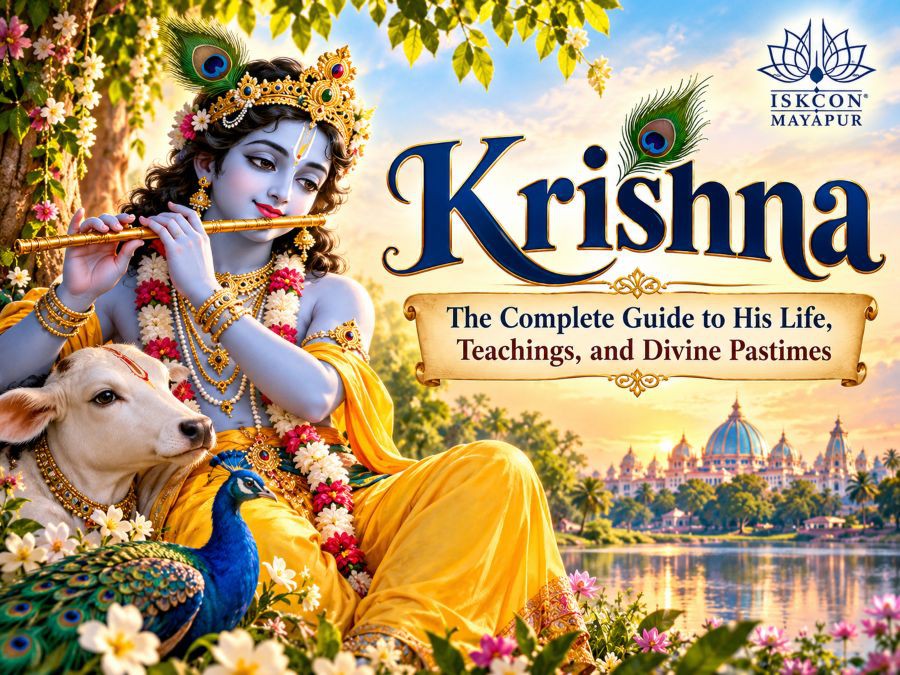
Krishna | The Complete Guide to His Life, Teachings, and Divine Pastimes
Krishna | The Complete Guide to His Life, Teachings, and Divine Pastimes
Ask a hundred people who Krishna is, and you'll get a hundred different answers. Some will point to a blue-skinned figure holding a flute. Some will mention a warrior who spoke on a battlefield. Others will talk about a mischievous child who stole butter from his neighbors' kitchens. Almost none of them will give you the same picture twice.
That's strange for someone who is supposed to be, according to the Brahma Samhita, the source of all other forms of God rather than a form derived from something greater. Krishna isn't a side character in a larger mythology. In the Gaudiya Vaishnava tradition, he's the starting point — the origin from which everything else, including Vishnu, Rama, and every other divine form, is said to expand.
This guide isn't going to give you the sanitized, comic-book version. It's going to walk through Krishna's life, his philosophy, and the pastimes that devotees have found meaning in for over five thousand years — and it's going to do that using the actual source texts: the Srimad Bhagavatam, the Bhagavad Gita, the Vishnu Purana, the Garga Samhita, and the Brahma Samhita itself.
Who Is Krishna, Really? Beyond the Blue-Skinned Deity in Temple Art
Start with the name itself. "Krishna" comes from a Sanskrit root that carries two related meanings: "the all-attractive one" and, more literally, "dark" or "black," referring to his complexion. Both meanings matter. The Bhagavata Purana doesn't present him as a symbolic figure or an abstract principle — it treats him as a person, with a personality, preferences, relationships, and a very specific chronology of events in his life.
Here's where it gets interesting philosophically. The Brahma Samhita, an ancient text that Krishna Chaitanya himself is said to have recovered from a South Indian temple library, opens with a verse that Gaudiya Vaishnavas consider foundational:
"Krishna is the original Personality of Godhead, an ocean of tranquility, wisdom, and unlimited bliss."
That's not a small claim. It positions Krishna not as one god among many, not as an avatar of something more primary, but as the source itself. Vishnu, in this framework, is described as a plenary expansion — a complete manifestation, but still an expansion — of Krishna, not the other way around. If you've grown up thinking of Krishna as "one of the ten avatars of Vishnu," this reframing might genuinely surprise you.
A few things worth holding onto before we go further:
- Krishna is described as sat-chit-ananda — eternal, full of knowledge, and full of bliss. This isn't poetic flourish; it's the technical definition Vedantic texts use to distinguish the Absolute from ordinary matter.
- He has a specific, describable form — dark-complexioned, dressed in yellow, holding a flute — rather than being purely formless in this tradition's reading.
- His pastimes are considered eternally ongoing, not historical events that happened once and ended.
The Birth That Broke Every Prison Wall: Krishna's Appearance in Mathura
The story the Bhagavatam tells is dramatic enough for any screenplay. King Kamsa of Mathura hears a prophecy: the eighth child of his sister Devaki will kill him. His response is to imprison Devaki and her husband Vasudeva, killing each child as it's born.
By the time the eighth pregnancy arrives, Kamsa is watching closely. And yet — at the exact moment of Krishna's birth, the prison guards fall asleep, the chains loosen on their own, and the doors swing open. Vasudeva carries the newborn out through a storm, crosses the flooding Yamuna river (which, according to the text, parts to let him pass), and reaches the home of Nanda and Yashoda in Vrindavana, where he swaps the baby for their newborn daughter.
Whether you read this literally, symbolically, or somewhere in between, the narrative structure is doing something specific: it's establishing from page one that ordinary rules don't fully apply here. A king with an army can't stop this birth. A river in flood can't stop it. Locked doors can't stop it.
A quick timeline of the early years:
- Krishna and his brother Balarama grow up in Vrindavana as cowherd children
- Kamsa repeatedly sends demons — Putana, Trinavarta, Aghasura — to kill him, and each attempt fails
- Krishna eventually returns to Mathura as a young man and kills Kamsa directly, fulfilling the original prophecy
- He restores his grandfather Ugrasena to the throne rather than taking it himself
That last point tends to get overlooked, but it's important. The Bhagavatam doesn't portray Krishna as someone seeking power. He resolves the crisis and hands authority back to the rightful elder — a pattern that repeats throughout his life.
Vrindavana Days: Butter Thieves, Cowherd Boys, and the Making of a Legend
If Mathura is where Krishna's story begins in terms of plot, Vrindavana is where it lives emotionally. This is the setting most devotional literature keeps returning to — not the palace, not the battlefield, but a small pastoral village with cowherd families, a river, and forests.
The stories from this period are deliberately intimate rather than grand. Krishna steals butter from neighbors' homes and gets caught by his mother Yashoda, who ties him to a mortar as punishment — only for him to drag it between two trees and free two cursed celestial beings trapped inside them. He lifts the entire Govardhana Hill on his little finger to shelter the villagers from a storm sent by an angry Indra, teaching a pointed lesson about misplaced pride even among the gods.
What's easy to miss, reading these stories quickly, is the emotional logic underneath them. The residents of Vrindavana don't worship Krishna from a distance the way you might worship a remote, untouchable deity. They scold him, indulge him, worry about him, and love him the way you'd love a child or a close friend. Gaudiya Vaishnava theology actually treats this as the point rather than a flaw in the storytelling — it argues that intimate, personal love (what's called bhakti) is a higher form of connection with the divine than formal reverence from a distance.
Radha and Krishna: Why This Is the Most Misunderstood Love Story in Spiritual History
No conversation about Krishna is complete without Radha, and yet Radha's role gets flattened more often than almost any other figure in this tradition.
In the Garga Samhita and later Gaudiya literature, Radha Krishna isn't presented as a simple romance. Radha is described as Krishna's original consort, the personification of his internal, feminine energy — not separate from him in essence, but distinct enough to allow for the drama, longing, and reciprocation that devotional love requires. Later Vaishnava theologians describe their relationship as the template for the soul's longing for the divine — not eroticism for its own sake, but a metaphor precise enough that generations of poets, from Jayadeva to Chandidas, built entire literary traditions around it.
Here's the detail that surprises a lot of newcomers: Radha and Krishna are not depicted as married in the earliest core texts. Their relationship is one of intense devotion and separation as much as union — and that longing, that ache of separation (viraha), is treated in Gaudiya theology as one of the most exalted emotional states a devotee can cultivate. The pain of missing the divine is not treated as a problem to be solved; it's treated as evidence of real love.
If you want to understand Radha as more than "Krishna's girlfriend," this is the frame to use: she's the emotional and devotional ideal that the entire Vrindavana theology is built around.
The Rasa Lila and the Truth About Krishna's Divine Pastimes
The Rasa Lila — the circular dance Krishna performs with the gopis (cowherd women) of Vrindavana under a full autumn moon — is probably the most misread episode in the entire Krishna canon, especially by readers encountering it outside its theological context.
Read superficially, it looks like a story about a young man dancing with multiple women simultaneously. Read through the commentary tradition, particularly Rupa Goswami's writings on rasa (devotional mellow or flavor), it's describing something else entirely: a multiplication of Krishna's own form so that each gopi experiences his exclusive, undivided attention at once. The text is explicit that Krishna expands himself, standing beside every single gopi simultaneously, so that no one feels secondary.
Why this matters theologically, not just narratively:
- It illustrates the idea that divine love isn't a scarce resource divided among devotees — it's fully present with each one individually.
- The gopis' love is held up in Bhagavata commentary as ahaituki — without ulterior motive, without calculation, offered without expecting anything material back.
- Krishna's temporary withdrawal from the dance (he disappears partway through, prompting the gopis to search for him in anguish) is read as a lesson about how pride, even devotional pride, creates distance from the divine.
This is what devotees mean when they refer to Krishna's "eternal pastimes" — not one-time historical events, but activities considered to be perpetually occurring in a spiritual dimension beyond material time, of which the earthly Vrindavana pastimes are a reflection.
From Cowherd to Charioteer: Krishna's Role in the Mahabharata
The Krishna of the Mahabharata reads almost like a different person from the Krishna of Vrindavana — and that contrast is intentional. Gone is the flute-playing cowherd; in his place is a shrewd political strategist, diplomat, and eventually a charioteer who refuses to fight directly.
By the time of the Kurukshetra war, Krishna has relocated to Dwaraka, married Rudmini and several other queens, and become a central political figure among the Yadava clan. When war becomes unavoidable between the Pandavas and Kauravas, Krishna offers both sides a choice: his enormous army, or himself alone, unarmed, as an advisor. Duryodhana, seeing the army as the obviously stronger option, takes the troops. Arjuna, the Pandava prince, chooses Krishna himself — a decision the text treats as the wiser one, even though it looks foolish on paper.
That choice sets up the single most influential philosophical dialogue in the entire tradition.
The Bhagavad Gita: Krishna's Teachings When the World Was Falling Apart
Picture the scene for a second: two armies are lined up, weapons ready, and the fighting hasn't started yet. Arjuna looks across the battlefield, sees his own relatives, teachers, and friends on the opposing side, and simply sits down. He drops his bow. He tells Krishna he'd rather not fight at all than kill people he loves.
This is the moment the Bhagavad Gita begins — not as an abstract philosophical treatise, but as a response to a very specific, very human crisis of conscience. And that context matters, because it explains why the Gita's teachings feel less like theology and more like counseling under pressure.
Some of the core teachings Krishna delivers in this dialogue:
- The soul (atma) is eternal and distinct from the body. Krishna tells Arjuna that weapons cannot cut the soul, fire cannot burn it, and water cannot wet it — the body changes and dies, but the self within it does not.
- Action without attachment to results (nishkama karma). Krishna's advice isn't to withdraw from responsibility, but to perform one's duty without obsessing over the outcome — a teaching that later influenced figures as varied as Mahatma Gandhi and countless modern readers looking for a framework to act under uncertainty.
- Devotion (bhakti) as the most accessible path. While the Gita discusses the paths of knowledge and disciplined action at length, Krishna repeatedly circles back to loving devotion as the path available to everyone, regardless of social position or intellectual capacity.
- The famous cosmic revelation. When Arjuna asks to see Krishna's universal form, Krishna grants him a vision of his all-encompassing, terrifying, magnificent cosmic body — after which Arjuna asks him to please go back to his familiar, two-armed human form. Even divine grandeur, it turns out, is less comforting than a friend you recognize.
The Gita's real achievement is refusing to give Arjuna — or the reader — an easy way out. Krishna doesn't say war is good. He says that duty, performed with the right internal disposition, is more important than avoiding an uncomfortable outcome. That's a harder, more useful teaching than most summaries give it credit for.
Hare Krishna: What This Mantra Actually Means
If you've heard chanting in a public square or seen the phrase on a bumper sticker, you've encountered the Hare Krishna mantra without necessarily knowing what it's doing. The full mantra reads:
Hare Krishna, Hare Krishna, Krishna Krishna, Hare Hare, Hare Rama, Hare Rama, Rama Rama, Hare Hare
"Hare" is a vocative form addressing Radha (referred to here as Hara), the energy of the divine. "Krishna" and "Rama" are names of God himself. So the mantra, in essence, is a direct address — calling out to both the divine energy and the divine person simultaneously, asking to be engaged in loving service.
Chaitanya Mahaprabhu, the 15th-century saint whose movement gave rise to the Gaudiya Vaishnava tradition and eventually to ISKCON, popularized this specific chant as the recommended spiritual practice for the current age. His reasoning, as recorded in Chaitanya Charitamrita, was practical: elaborate rituals require resources, time, and access that most people don't have, but sound — chanting — is available to absolutely everyone, regardless of birth, wealth, or education.
That's worth sitting with. The mantra isn't a magic formula in the sense of controlling outcomes. It's described as a method of purifying consciousness through repeated, sincere remembrance — closer to how repeating a person's name keeps them present in your mind than to a spell in the way pop culture sometimes frames it.
Krishna According to the Brahma Samhita: The Original Form of Godhead
We touched on this earlier, but it deserves its own section, because the Brahma Samhita makes a claim that a lot of comparative religion writing glosses over: it's arguing for a specific theological hierarchy, not just describing Krishna as "a god."
The text describes Krishna's abode, Goloka Vrindavana, as a spiritual realm distinct from the material universe — untouched by the cycles of creation and destruction that govern ordinary cosmology. Within that realm, Krishna is surrounded by cows, cowherd friends, and Radha, engaged in what the text calls his eternal, blissful pastimes.
This matters for how the tradition understands time itself. Material events happen once and end. The Brahma Samhita's position is that Krishna's Vrindavana pastimes are not that kind of event — they're ongoing, eternal, and what happened in Mathura and Vrindavana on Earth was a manifestation of something already, always occurring.
Garga Samhita and Vishnu Purana: Two Overlooked Windows into Krishna's Story
Most readers encounter Krishna through the Bhagavad Gita and the Srimad Bhagavatam, and understandably so — they're the two most widely translated and distributed texts. But two other sources fill in details worth knowing.
The Vishnu Purana provides one of the earliest systematic accounts of Krishna's life, predating some of the more elaborate devotional detail found in the Bhagavatam. It's more restrained in tone, focused on establishing Krishna's identity as a direct manifestation of Vishnu and situating his life within the larger Puranic cosmology — the ages of the universe, the roles of various avatars, and the mechanics of divine intervention in worldly affairs.
The Garga Samhita, attributed to the sage Garga (who is also depicted in the Bhagavatam as the priest who names Krishna and Balarama in their childhood), goes in the opposite direction — it expands significantly on episodes that other texts mention only briefly. It offers much more detail on Krishna's relationship with Radha, on events in Dwaraka, and on aspects of his character that get compressed elsewhere. For anyone who has read the Bhagavatam and wants more texture on the Radha-Krishna relationship specifically, this is the text scholars and devotees both point to.
Together, these two texts function almost like a wide-angle and a close-up lens on the same subject — one establishing Krishna's cosmic role, the other lingering on the emotional and relational details that make the devotional tradition what it is.
What Krishna's Story Actually Asks of You
Here's the thing about spending real time with these texts rather than a summarized version: Krishna's story keeps refusing to resolve into one simple message. He's a child who steals butter and a king's advisor who counsels restraint. He's a lover whose relationship with Radha is treated as the highest devotional ideal, and a diplomat who tries — repeatedly — to prevent a war before ultimately steering it. He gives Arjuna the most philosophically dense teaching in the Sanskrit canon and then, apparently, spends eternity in a pasture playing a flute.
The Gaudiya Vaishnava tradition doesn't see these as contradictions to smooth over. It sees them as different facets of a single, complete personality — a way of saying that the divine isn't confined to one mode of being: not only majestic, not only intimate, not only a teacher, not only a friend, but somehow genuinely all of it at once.
Whether you approach Krishna as a historical figure, a philosophical teacher, or the object of devotional worship, the invitation embedded in these texts is consistent: not to observe from a distance, but to enter the relationship the way the residents of Vrindavana did — with argument, affection, longing, and an ongoing conversation that the tradition insists is still open today.
Bottom Line
Krishna's story isn't asking to be believed from a distance — it's asking to be entered into, argued with, loved, and questioned, the same way Vrindavana did it first.
Posted in: Krishna Consciousness
Related posts
-
 Krishna Consciousness: The Endless Path of Bhakti and DevotionExplore Krishna Consciousness—the eternal path of bhakti and devotion rooted in ancient wisdom. Discover the...Read more
 -
 Why Krishna Consciousness is the Key to Inner Peace & HappinessDiscover how Krishna Consciousness offers the key to lasting inner peace and true happiness through devotion,...Read more
 -
 Unlocking the Power of Bhakti Yoga through Krishna ConsciousnessUnlock the power of Bhakti Yoga through Krishna Consciousness—discover how devotion, chanting, and ISKCON Mayapur...Read more
 -
 Discovering Krishna Consciousness: The Science of Self-RealizationDiscover Krishna Consciousness as the science of self-realization—unlock your true spiritual identity and attain...Read more
 -
 Chant, Dance, and Rejoice: Experiencing Krishna ConsciousnessExperience the joy of Krishna Consciousness through chanting, dancing, and rejoicing. Discover how these devotional...Read more
Leave a comment