
Why did Krishna run to embrace a poor brahmin in rags? Read the Sudama story from the Bhagavatam and learn how a...
Latest posts
-
 Krishna and Sudama: The Poor Brahmin Who Became Wealthy in LoveRead more
 -
 Vamana Avatar: How Three Steps Humbled Bali MaharajaRead more
Why did a powerful king give away three worlds to a boy asking for three steps? Learn the Vamana avatar story from...
-
 The Bhagavatam on Marriage: Duty, Love and Spiritual PartnershipRead more
What does the Bhagavatam say about marriage? Through the stories of Kardama and Devahuti, Rukmini's secret letter and...
-
 What Is Prema? The Bhagavatam's Highest Stage of Love for GodRead more
Prema is love for God with no "because" attached. Learn how the Bhagavatam describes it, the nine steps from faith to...
-
 Is Shiva Parvati Kalyana Mentioned in Srimad Bhagavatam? What the Scripture Really SaysRead more
Looking for Shiva and Parvati's wedding in the Srimad Bhagavatam? Find out what the scripture actually describes,...
-
 How Many Modes of Devotion Are Mentioned in Bhagavatam?Read more
A young boy named Prahlada listed nine ways to serve God, and the Bhagavatam keeps them as its answer. Learn what the...
-
 What Is Bhagavatam and Why Has It Been Read for 5,000 Years?Read more
A dying king asked one question, and the answer became the Bhagavatam. Learn what this Sanskrit scripture contains,...
-
 Who Is Lord Krishna? His Meaning, Teachings and Pastimes ExplainedRead more
Discover who Krishna is according to Srimad Bhagavatam, including His divine identity, childhood pastimes, teachings,...
-
 Incense in Islam: Bakhoor, Agarbatti and What Tradition SaysRead more
Is burning fragrance part of Muslim tradition? Explore incense in Islam, from the Prophetic practice of fumigating...
-
 History of Agarbatti: From Vedic Dhupa to Modern Incense SticksRead more
Where did agarbatti really come from? Follow the history of agarbatti from Vedic fire rituals and temple dhupa to...
Blog categories
- Default category (0)
- MUSICAL INSTRUMENT (1)
- BOOK (5)
- DEVOTIONAL GIFT (0)
- Blog (30) click
- CHANDAN (12)
- Bhagavatam Wisdom Series (68)
- Krishna Consciousness (14)
- Mridangam Musical Instrument (6)
- Bhagavad Gita for Beginners (13)
- Bhagavad Gita As It Is (37) click
- Bhagavad Gita As It Is Telugu (0)
- Bhagavad Gita As It Is Marathi (0)
- Bhagavad Gita As It Is In Hindi (0)
- Bhagavad Gita As It Is In English (0)
- Bhagavad Gita As It Is In Bengali (8)
- Bhagavad Gita As It Is In Kannada (0)
- Bhagavad Gita As It Is In Gujarati (0)
- Bhagavad Gita As It Is In Panjabi (0)
- Bhagavad Gita As It Is In Tamil (0)
- Bhagavad Gita As It Is Odia (0)
- BHAGAVAD GITA As It Is GERMAN (0)
- Bhagavad Gita As It Is In French (0)
- Bhagavad Gita As It Is In Nepali (0)
- Bhagavad Gita As It Is In Assamese (0)
- Incense or Agarbatti (38)
- Lord Chaitanya Mahaprabhu (3)
- Vedic Temple Mayapur (14)
- kalki (15)
- Mahabharata – Dharma & Destiny (27)
- Vaishnava Scriptures (4)
- healthy product (4)
- chaitanya mahaprabhu (5)
- Tulsi Mala Guide (17)
Search in blog
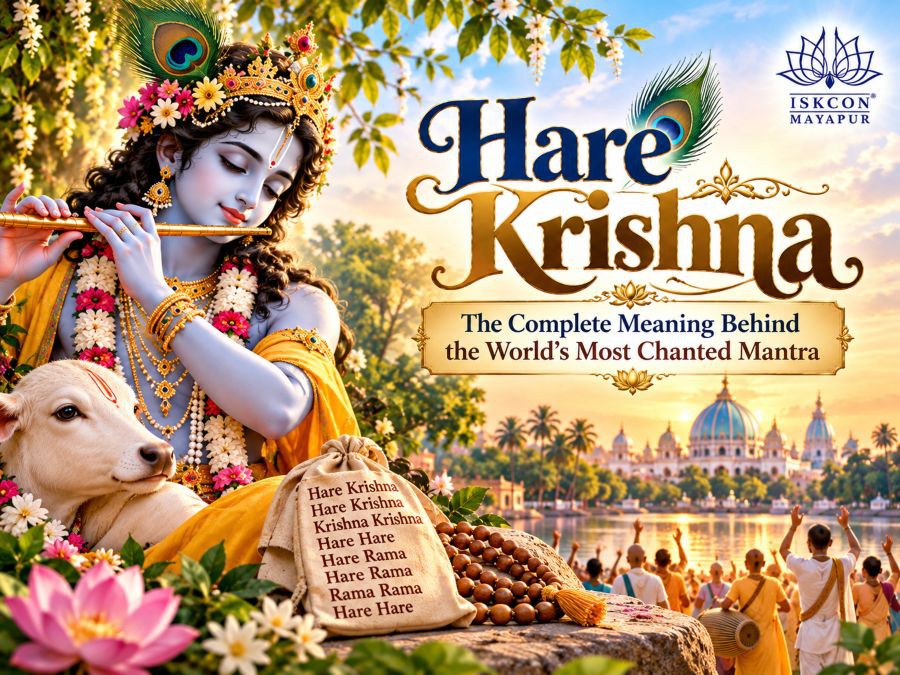
Hare Krishna | The Complete Meaning Behind the World's Most Chanted Mantra
Hare Krishna | The Complete Meaning Behind the World's Most Chanted Mantra
Sixteen words. That's the entire mantra. No elaborate ritual instructions, no secret initiation required to begin, no special equipment. And yet this sixteen-word combination has been chanted, by some estimates, more continuously across more countries than almost any other spiritual phrase in modern history — on street corners in New York, in temple courtyards in Mayapur, in prison cells, in hospital rooms, by people who couldn't tell you what a single word of it technically means.
That last part is the strange thing worth sitting with. Millions of people chant this mantra without knowing what they're actually saying. This guide exists to fix that — to walk through what the Hare Krishna maha-mantra actually means, where it came from, why Chaitanya Mahaprabhu built an entire movement around these specific sixteen words instead of any other prayer available to him, and what's actually claimed to happen when someone chants it with attention rather than habit. Along the way, it'll also become clear why this mantra is inseparable from the theology of Radha Krishna — the divine pair it's actually addressing.
The Sixteen Words, Written Out in Full
Before going further, here's the mantra in its complete form, since a surprising number of people have heard fragments of it without ever seeing the whole thing written out:
Hare Krishna, Hare Krishna, Krishna Krishna, Hare Hare, Hare Rama, Hare Rama, Rama Rama, Hare Hare
Sixteen words, three names repeated in a specific rotating pattern — Hare, Krishna, and Rama — sixteen times total when you count every repetition. It's not sixteen different words. It's three words, arranged with careful attention to rhythm and sequence.
A quick structural breakdown:
- The mantra appears in two symmetrical halves, each addressing Krishna and Rama in turn, framed by "Hare" on either side.
- Nothing in the sequence is arbitrary — the traditional explanation treats the rotation itself as significant, not just the individual words.
- It's classified specifically as a maha-mantra — a "great mantra" — a designation not handed out casually in Vedic literature, reserved for a small number of chants considered uniquely powerful.
What "Hare" Actually Means (Hint: It's Not Filler)
Here's where most casual explanations get it wrong. A lot of people assume "Hare" is a rhythmic sound with no independent meaning, something like "amen" tacked on for musicality. It isn't.
"Hare" is a vocative form — a way of directly addressing someone — derived from "Hara," a name for Radha herself, understood as the divine energy or potency of Krishna. So every time the mantra is chanted, the practitioner isn't just calling out to Krishna and Rama. They're first calling out to Radha, asking to be engaged in loving service through her mercy and her energy.
This matters more than it might initially seem, because it reframes the entire mantra. It's not simply "praise Krishna, praise Krishna, praise Rama." It's closer to: "O energy of the divine, O Krishna, O Rama — please engage me in devotional service." The mantra is structured as a request, not just a declaration.
Krishna and Rama: Why These Two Names Specifically
The mantra rotates between two names — Krishna and Rama — and it's worth asking why these two, out of the countless names available in Vaishnava tradition, ended up in the maha-mantra rather than others.
Both names carry specific meanings tied to core theological ideas:
- Krishna translates roughly as "the all-attractive one," pointing to the idea, developed at length in the Brahma Samhita, that Krishna represents the original Personality of Godhead, the source from which all other divine forms expand rather than an expansion of something more primary.
- Rama means "the source of all pleasure" or "one who gives joy" — not to be confused, in this context, with a request for material happiness, but referring to the spiritual satisfaction the soul is described as actually seeking beneath every other desire.
Traditional commentary treats these two names as functionally addressing the same Supreme Being from two angles rather than as competing or separate deities within the mantra. Chaitanya Mahaprabhu's own commentary, as recorded by his followers, doesn't treat the choice between Krishna and Rama as a matter of picking a favorite — the mantra deliberately includes both.
Where This Mantra Actually Comes From
The maha-mantra isn't something Chaitanya Mahaprabhu invented from scratch in the fifteenth century, even though he's the figure most responsible for its widespread popularity. Its earliest textual reference appears in the Kali-Santarana Upanishad, a relatively short Upanishad that addresses a specific, practical question: given that the current age (Kali-yuga) makes the elaborate rituals and disciplines of earlier ages difficult or impossible to perform properly, what practice remains genuinely accessible?
The Upanishad's answer is direct — chanting these sixteen names. Sage Narada, according to the text, receives this instruction from Brahma after asking exactly this question, and the mantra is presented as the specific remedy suited to an age when resources, teachers, and the discipline required for older practices are all in short supply.
Why this origin story matters practically:
- It positions the mantra as something explicitly designed for accessibility, not restricted by caste, wealth, education, or formal initiation.
- It predates Chaitanya Mahaprabhu by centuries, meaning he wasn't creating a new practice so much as reviving and dramatically popularizing an existing one.
- It explains why the tradition treats sincerity of chanting as more important than technical precision — the entire premise is that this method works even for people without access to elaborate training.
Chaitanya Mahaprabhu: The Man Who Made This Mantra Impossible to Ignore
If the Kali-Santarana Upanishad supplied the mantra, Chaitanya Mahaprabhu supplied the movement. Born in Navadvipa, West Bengal in the late fifteenth century, he's understood within Gaudiya Vaishnavism as an especially significant figure — not simply a reformer or a popular preacher, but as Krishna himself appearing in the mood and complexion of Radha, uniting the object of divine love and the ideal of loving devotion within a single form.
What he actually did, practically speaking, was organize public chanting — sankirtan — on a scale that hadn't been attempted before in that region. Rather than restricting this practice to temples, private worship, or an educated elite capable of reading Sanskrit scripture, he took it into the streets, encouraging large groups to chant together publicly, regardless of social background. Historical accounts describe him leading massive congregational chanting processions through Navadvipa, deliberately including people who had been excluded from more traditional religious participation. In this sense, every kirtan he led was really a public celebration of Radha Krishna together — never one name without the other, since the mantra itself refuses to separate them.
A few specifics that show why his approach was genuinely disruptive for its era:
- He insisted the mantra didn't require Sanskrit literacy, caste privilege, or formal initiation to be effective — a position that directly challenged prevailing religious hierarchies of his time.
- He treated group chanting (kirtan) as at least as valuable as private, individual chanting (japa), building an entirely public, communal dimension into what had often been a more private practice.
- His teachings, later systematized by his close followers — the Six Goswamis of Vrindavana, including Rupa Goswami and Jiva Goswami — became the theological foundation of the entire Gaudiya Vaishnava tradition that still uses this mantra today.
Japa vs. Kirtan: Two Different Ways of Engaging the Same Sixteen Words
The mantra shows up in practice in two distinct forms, and understanding the difference clears up a lot of confusion for newcomers.
Japa refers to quiet, individual, meditative chanting — typically performed using a strand of 108 beads (a japa mala), with the practitioner completing a set number of rounds daily, moving one bead per full mantra. This is a private, contemplative practice, closer in structure to counted prayer traditions found elsewhere in world religion, though the specific mantra and the specific number of beads carry their own tradition-specific significance.
Kirtan, by contrast, is public, musical, and communal — call-and-response chanting, often accompanied by mridanga drums and karatalas (hand cymbals), building in tempo and intensity as a group. This is the version most people have actually encountered, whether at a public event, a temple festival, or a street procession, and it's the form Chaitanya Mahaprabhu himself emphasized most heavily as a public practice.
Gaudiya teachers generally don't rank one as superior to the other; they're understood as complementary — japa cultivating personal, quiet absorption, and kirtan cultivating a shared, communal experience of the same practice.
What's Actually Claimed to Happen When You Chant This
Here's where it's worth being precise rather than vague, because the tradition's claims are specific, not just generically "spiritual."
The core claim is that chanting the names of God — specifically these names, in this arrangement — works as a process of purification for consciousness itself. The philosophical reasoning runs like this: in Gaudiya Vaishnava theology, sound isn't considered separate from its object. Krishna's name isn't treated as a mere symbolic label pointing at something else, the way a word like "table" points at an object distinct from the sound itself. The name is considered non-different from Krishna — meaning that sincere chanting is described as bringing one into actual contact with the divine, not simply reminding the practitioner of a concept.
That's a significant theological claim, and it explains a few things that otherwise seem strange:
- Why the tradition doesn't require the chanter to fully understand Sanskrit or theology before beginning — contact through sound is treated as available regardless of intellectual comprehension.
- Why quantity and consistency (a set number of daily rounds) matter as much as, or more than, occasional intense sessions — the process is described as gradual and cumulative.
- Why offenses in chanting (chanting mechanically, with pride, or while committing sinful acts) are taken seriously in the tradition's literature — if the name carries this much weight, careless chanting is treated as a real lapse, not a minor stylistic issue.
The Global Spread: How a Bengali Street Chant Reached Times Square
The maha-mantra's journey from fifteenth-century Navadvipa to twentieth-century Western cities has a fairly specific historical throughline, and it's worth knowing because it explains why this particular chant, out of many Sanskrit mantras, became globally recognizable.
A.C. Bhaktivedanta Swami Prabhupada, a disciple in the Gaudiya Vaishnava lineage tracing back to Chaitanya Mahaprabhu, traveled to the United States in 1965 at the age of 69, arriving with limited resources and no established following. Within a few years, he had founded the International Society for Krishna Consciousness (ISKCON) and was leading public chanting sessions in New York's Tompkins Square Park — a deliberate continuation of the same public sankirtan approach Chaitanya Mahaprabhu had used centuries earlier, adapted for an entirely different cultural context.
That single decision — take the chant into a public park in a Western city rather than restrict it to temple settings — is largely why so many people outside India encountered this mantra at all. The countercultural movements of the late 1960s provided fertile ground, and the mantra's rhythmic, repetitive structure made it accessible to people with no background in Sanskrit or Vaishnava philosophy whatsoever.
Common Misunderstandings Worth Clearing Up
A few misconceptions come up often enough that they're worth addressing directly.
It's not a spell or a wish-granting formula. The mantra isn't described in the tradition as a mechanism for controlling outcomes — getting a job, winning an argument, manifesting wealth. Its stated purpose is purification of consciousness and cultivation of devotion, not material results, even though practitioners sometimes report incidental benefits alongside it.
It's not exclusive to any single organization. While ISKCON is the most visible institution associated with this mantra globally, the chant itself predates the organization by centuries and is used across multiple Gaudiya Vaishnava lineages and beyond.
Chanting quietly doesn't make it less effective than chanting loudly. Japa and kirtan serve different purposes, but the tradition doesn't treat volume as a measure of sincerity — a softly murmured, attentive round of japa is not considered inferior to an energetic public kirtan.
Why This Mantra, Specifically, Still Matters
Step back from the history and the theology for a second, and here's the practical case this tradition makes: most spiritual practices require resources most people don't reliably have — time for elaborate ritual, access to trained teachers, literacy in a classical language, financial capacity for pilgrimage or ceremony. The maha-mantra was specifically designed, according to its own origin story in the Kali-Santarana Upanishad, to work without any of that.
Sixteen words. No equipment required beyond a strand of beads, and not even that if you're chanting in a group. Available to someone with no formal education and no financial means exactly as much as to a scholar or a wealthy patron. That accessibility is the actual argument the tradition makes for why this specific combination of Hare, Krishna, and Rama — addressed first to Radha energy, then to Krishna, then to Rama — has outlasted so many more elaborate practices and traveled so much further than anyone chanting it in fifteenth-century Navadvipa could have predicted.
Posted in: Krishna Consciousness
Related posts
-
 Krishna Consciousness: The Endless Path of Bhakti and DevotionExplore Krishna Consciousness—the eternal path of bhakti and devotion rooted in ancient wisdom. Discover the...Read more
 -
 Why Krishna Consciousness is the Key to Inner Peace & HappinessDiscover how Krishna Consciousness offers the key to lasting inner peace and true happiness through devotion,...Read more
 -
 Unlocking the Power of Bhakti Yoga through Krishna ConsciousnessUnlock the power of Bhakti Yoga through Krishna Consciousness—discover how devotion, chanting, and ISKCON Mayapur...Read more
 -
 Discovering Krishna Consciousness: The Science of Self-RealizationDiscover Krishna Consciousness as the science of self-realization—unlock your true spiritual identity and attain...Read more
 -
 Chant, Dance, and Rejoice: Experiencing Krishna ConsciousnessExperience the joy of Krishna Consciousness through chanting, dancing, and rejoicing. Discover how these devotional...Read more
Leave a comment