
Why did Krishna run to embrace a poor brahmin in rags? Read the Sudama story from the Bhagavatam and learn how a...
Latest posts
-
 Krishna and Sudama: The Poor Brahmin Who Became Wealthy in LoveRead more
 -
 Vamana Avatar: How Three Steps Humbled Bali MaharajaRead more
Why did a powerful king give away three worlds to a boy asking for three steps? Learn the Vamana avatar story from...
-
 The Bhagavatam on Marriage: Duty, Love and Spiritual PartnershipRead more
What does the Bhagavatam say about marriage? Through the stories of Kardama and Devahuti, Rukmini's secret letter and...
-
 What Is Prema? The Bhagavatam's Highest Stage of Love for GodRead more
Prema is love for God with no "because" attached. Learn how the Bhagavatam describes it, the nine steps from faith to...
-
 Is Shiva Parvati Kalyana Mentioned in Srimad Bhagavatam? What the Scripture Really SaysRead more
Looking for Shiva and Parvati's wedding in the Srimad Bhagavatam? Find out what the scripture actually describes,...
-
 How Many Modes of Devotion Are Mentioned in Bhagavatam?Read more
A young boy named Prahlada listed nine ways to serve God, and the Bhagavatam keeps them as its answer. Learn what the...
-
 What Is Bhagavatam and Why Has It Been Read for 5,000 Years?Read more
A dying king asked one question, and the answer became the Bhagavatam. Learn what this Sanskrit scripture contains,...
-
 Who Is Lord Krishna? His Meaning, Teachings and Pastimes ExplainedRead more
Discover who Krishna is according to Srimad Bhagavatam, including His divine identity, childhood pastimes, teachings,...
-
 Incense in Islam: Bakhoor, Agarbatti and What Tradition SaysRead more
Is burning fragrance part of Muslim tradition? Explore incense in Islam, from the Prophetic practice of fumigating...
-
 History of Agarbatti: From Vedic Dhupa to Modern Incense SticksRead more
Where did agarbatti really come from? Follow the history of agarbatti from Vedic fire rituals and temple dhupa to...
Blog categories
- Default category (0)
- MUSICAL INSTRUMENT (1)
- BOOK (5)
- DEVOTIONAL GIFT (0)
- Blog (30) click
- CHANDAN (12)
- Bhagavatam Wisdom Series (68)
- Krishna Consciousness (14)
- Mridangam Musical Instrument (6)
- Bhagavad Gita for Beginners (13)
- Bhagavad Gita As It Is (37) click
- Bhagavad Gita As It Is Telugu (0)
- Bhagavad Gita As It Is Marathi (0)
- Bhagavad Gita As It Is In Hindi (0)
- Bhagavad Gita As It Is In English (0)
- Bhagavad Gita As It Is In Bengali (8)
- Bhagavad Gita As It Is In Kannada (0)
- Bhagavad Gita As It Is In Gujarati (0)
- Bhagavad Gita As It Is In Panjabi (0)
- Bhagavad Gita As It Is In Tamil (0)
- Bhagavad Gita As It Is Odia (0)
- BHAGAVAD GITA As It Is GERMAN (0)
- Bhagavad Gita As It Is In French (0)
- Bhagavad Gita As It Is In Nepali (0)
- Bhagavad Gita As It Is In Assamese (0)
- Incense or Agarbatti (38)
- Lord Chaitanya Mahaprabhu (3)
- Vedic Temple Mayapur (14)
- kalki (15)
- Mahabharata – Dharma & Destiny (27)
- Vaishnava Scriptures (4)
- healthy product (4)
- chaitanya mahaprabhu (5)
- Tulsi Mala Guide (17)
Search in blog
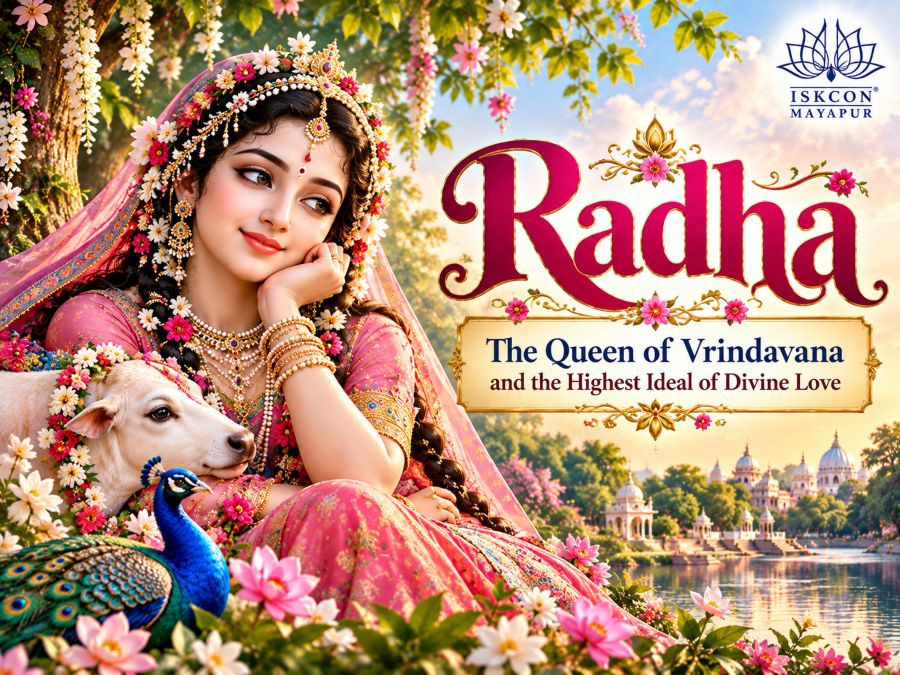
Radha | The Queen of Vrindavana and the Highest Ideal of Divine Love
Radha | The Queen of Vrindavana and the Highest Ideal of Divine Love
Here's a question worth sitting with before reading another line: why would an entire spiritual tradition build its highest philosophy around a woman who, on the surface, is described mainly through her feelings — her longing, her jealousy, her joy — rather than through miracles, conquests, or cosmic power?
That's exactly what Gaudiya Vaishnavism does with Radha. She doesn't lift mountains or kill demons. She doesn't deliver philosophical discourses on a battlefield. And yet the tradition treats her not as a secondary figure standing beside its central deity, but as the very definition of what devotion is supposed to look like. Understanding why requires setting aside the assumption that she's simply "Krishna girlfriend" and looking at what the actual texts — the Brahma Samhita, the Padma Purana, the Garga Samhita, and centuries of Gaudiya commentary — actually claim about her.
Where Radha Actually Comes From
Different texts tell her origin story slightly differently, which is worth acknowledging honestly rather than smoothing over. The Padma Purana and later Brahma Vaivarta Purana describe her appearing from Krishna's own left side, born simultaneously with him in a sense, as his direct feminine counterpart rather than as an ordinary soul who later attained a special position through devotion. The Garga Samhita, meanwhile, gives her a more grounded birth story: she appears as the daughter of King Vrishabhanu and Queen Kirtida in Barsana, a town not far from Vrindavana, under unusual circumstances — some versions describe her being found rather than born in the ordinary way, already radiant, already extraordinary.
Both accounts agree on the underlying point even where the details diverge: Radha isn't presented as a woman who earned her position through extreme austerity or accumulated merit the way some other devotional figures are. She's described as eternally connected to Krishna, present with him before the material universe existed, her identity woven into his from the start rather than added to it later.
A few specifics worth knowing:
- Barsana, her associated birthplace, remains an active pilgrimage site today, distinct from Vrindavana itself, with its own temple dedicated to her as Ladli Lal — the beloved daughter.
- She's described in the Brahma Samhita tradition as Krishna's hladini-shakti, his internal pleasure-giving potency, rather than an external partner in the way human couples relate.
- Multiple later saints, including Rupa Goswami, describe her not as one gopi among many in Vrindavana but as the source from which the other gopis' capacity for devotion itself expands.
Not Just Beautiful — Why Her Beauty Gets Described the Way It Does
Devotional poetry spends an enormous amount of energy on Radha's physical description, and it's tempting to read that as simple romantic exaggeration. But there's a theological point buried in it that's easy to miss.
Her complexion is repeatedly compared to molten gold or lightning against a monsoon cloud — a deliberate visual contrast with Krishna's own dark, storm-cloud coloring. Poets from Jayadeva onward treat this pairing of colors as symbolically significant: light against dark, radiance meeting depth, two qualities that complete each other rather than compete. This isn't shallow physical fixation. It's an attempt to use aesthetic language to point at something that's actually about complementary wholeness — the idea that divine love requires two distinct principles, coming together without either one dissolving into the other.
Her described qualities go well beyond appearance:
- Sharp wit and independence — in the Gita Govinda and countless later Vraja poems, she's shown arguing with Krishna, refusing him, testing his sincerity, and holding positions of her own rather than simply receiving his attention.
- Total absorption in Krishna's wellbeing — commentators use the term para-dukha-dukhi to describe her, meaning she suffers more from Krishna's pain than her own, a quality Gaudiya theology treats as the clearest marker of authentic love as opposed to self-interested attachment.
- Unshakeable constancy — even during Krishna's long absences after he leaves for Mathura and later Dwaraka, her devotion doesn't taper off or become conditional on his presence.
Her Sakhis: The Friends Who Make Her Story Make Sense
You can't really understand Radha's role without understanding the women around her — her sakhis, or intimate friends, and beneath them, the manjaris, younger attendants whose entire devotional life is oriented around assisting her relationship with Krishna rather than pursuing him directly.
This detail matters more than it might first appear. In raganuga bhakti — the advanced devotional practice cultivated in Gaudiya lineages — the aspiration isn't typically to relate to Krishna independently. It's to serve Radha, to assist in facilitating her happiness and her meetings with him, adopting the identity of a manjari within meditation. That's a strikingly indirect goal if you're used to religious traditions built around a direct relationship with a central deity. Here, the highest devotional aspiration runs through Radha first.
Why this structure exists, according to Gaudiya commentary:
- Radha's love is considered so complete and so refined that participating in it, even in a supporting role, gives a devotee access to a quality of devotion they couldn't generate on their own.
- Her sakhis aren't rivals for Krishna's attention; they're extensions of her own desire for his happiness, arranging meetings and moments not for their own benefit but for hers.
- This entire social structure around her is treated as evidence that she isn't simply the object of Krishna's love — she has her own court, her own devoted community, her own emotional world that exists independent of him.
Mana: What Radha's Jealousy Is Actually Teaching
One of the more surprising elements in Vraja devotional literature is how much attention gets paid to Radha's mana — a kind of sulking jealousy or wounded pride she displays when she suspects Krishna's attention has wandered toward another gopi. On the surface, this looks like an ordinary human relationship complication. Read through the commentary tradition, it's doing something more specific.
Mana is treated as evidence of the depth of her investment, not a character flaw to apologize for. A love with no capacity for jealousy, the argument goes, would be a shallow love — indifferent to whether it's reciprocated exclusively or not. Her mana episodes, where she withdraws, refuses Krishna's approaches, and has to be coaxed back by her sakhis, become extended meditations in Vraja poetry on the emotional complexity of real devotion: how longing, hurt, pride, and love can coexist without canceling each other out.
Rupa Goswami's Bhakti-rasamrita-sindhu catalogs these emotional states with almost clinical precision, treating them as distinct devotional flavors (rasa) worth cultivating and understanding rather than emotions to be smoothed over in favor of constant serenity.
Radha and the Meaning Behind Hare Krishna
The Hare Krishna mantra gets chanted by millions of people who've never been told what the opening word actually refers to. "Hare" is a direct address to Radha, called Hara in this vocative form — the energy and potency of the divine, addressed before Krishna's own name appears in the mantra:
Hare Krishna, Hare Krishna, Krishna Krishna, Hare Hare, Hare Rama, Hare Rama, Rama Rama, Hare Hare
That sequencing isn't accidental. Chaitanya Mahaprabhu, credited with popularizing this specific chant, is understood within Gaudiya theology as a combined form of Radha Krishna — Krishna internally experiencing Radha's own mood and complexion externally, uniting the object of devotion and the ideal of devotion into a single teaching figure. When someone chants this mantra, they're not bypassing Radha to reach Krishna faster. They're invoking her first, on the understanding that access to Krishna's association runs through her mercy and her recommendation.
Why Some Traditions Worship Radha Above Krishna Himself
This is the detail that surprises newcomers most: several major Gaudiya acharyas — Jiva Goswami among them — describe Radha as more worshippable than Krishna, not equally worshippable, not slightly less. The reasoning follows a specific logic worth working through carefully.
Krishna, however supreme, is described as the object of love in this framework — the one being loved. Radha represents the perfection of the loving itself. And devotion, according to this theology, is ultimately measured by the quality of the love offered rather than the status of the one receiving it. If her love is considered the most complete, unmotivated, and constant love that exists in any realm, material or spiritual, then she becomes the actual standard a devotee is trying to approach — not Krishna's position of being loved, but her position of loving without limit or condition.
This is also why her name is spoken first in the compound "Radha Krishna" rather than reversed, and why Gaudiya temples almost never install a deity of Krishna without her presence beside him. It's not a small courtesy. It reflects an actual theological ranking that a lot of casual observers miss entirely.
Radhashtami: A Festival That Belongs to Her Alone
If Radha were genuinely secondary, there'd be little reason for an entire festival built around her birth specifically. Radhashtami, observed roughly a month after Krishna's own Janmashtami celebration, does precisely that — devotees in Barsana and Vrindavana fast, sing, and worship her image on this day, separate from any combined celebration of the pair together.
The tradition also preserves an extensive list of a thousand names glorifying her — the Radha Sahasranama — structured the same way similar name-lists glorify other major deities elsewhere in Hindu literature. Each name in that list points toward a different facet of who she is: queen of Vraja, the one whose mercy opens the door to Krishna's company, the embodiment of love untouched by material limitation. Studying these names is treated as a way of appreciating her as a complete figure in her own right, not a role defined entirely by proximity to someone else.
What Radha's Example Is Actually Asking of a Devotee Today
Strip away the poetry and the centuries of commentary, and here's what's left: Radha's entire devotional identity is built around loving without a guarantee. She doesn't get consistent presence. She doesn't get certainty. What she gets is separation, distance, and long stretches where Krishna is politically occupied in Dwaraka while she remains in Vrindavana — and her devotion doesn't shrink to match the available return on it.
Most people, if they're honest, structure their relationships and their spiritual practice around some expectation of reciprocity. Radha's story is used in this tradition specifically to push against that instinct. Gaudiya teachers regularly point to her as evidence that the highest form of love isn't the kind that gets confirmed constantly — it's the kind that holds steady regardless of whether it's confirmed at all.
That's a demanding standard, and the tradition doesn't pretend otherwise. But it's also why, centuries after these texts were composed, Radha remains the figure devotees turn to first — not as an object of casual admiration, but as proof that this particular kind of love is actually possible, and worth attempting, even when nothing about it is easy.
Posted in: Krishna Consciousness
Related posts
-
 Krishna Consciousness: The Endless Path of Bhakti and DevotionExplore Krishna Consciousness—the eternal path of bhakti and devotion rooted in ancient wisdom. Discover the...Read more
 -
 Why Krishna Consciousness is the Key to Inner Peace & HappinessDiscover how Krishna Consciousness offers the key to lasting inner peace and true happiness through devotion,...Read more
 -
 Unlocking the Power of Bhakti Yoga through Krishna ConsciousnessUnlock the power of Bhakti Yoga through Krishna Consciousness—discover how devotion, chanting, and ISKCON Mayapur...Read more
 -
 Discovering Krishna Consciousness: The Science of Self-RealizationDiscover Krishna Consciousness as the science of self-realization—unlock your true spiritual identity and attain...Read more
 -
 Chant, Dance, and Rejoice: Experiencing Krishna ConsciousnessExperience the joy of Krishna Consciousness through chanting, dancing, and rejoicing. Discover how these devotional...Read more
Leave a comment