
Why did Krishna run to embrace a poor brahmin in rags? Read the Sudama story from the Bhagavatam and learn how a...
Latest posts
-
 Krishna and Sudama: The Poor Brahmin Who Became Wealthy in LoveRead more
 -
 Vamana Avatar: How Three Steps Humbled Bali MaharajaRead more
Why did a powerful king give away three worlds to a boy asking for three steps? Learn the Vamana avatar story from...
-
 The Bhagavatam on Marriage: Duty, Love and Spiritual PartnershipRead more
What does the Bhagavatam say about marriage? Through the stories of Kardama and Devahuti, Rukmini's secret letter and...
-
 What Is Prema? The Bhagavatam's Highest Stage of Love for GodRead more
Prema is love for God with no "because" attached. Learn how the Bhagavatam describes it, the nine steps from faith to...
-
 Is Shiva Parvati Kalyana Mentioned in Srimad Bhagavatam? What the Scripture Really SaysRead more
Looking for Shiva and Parvati's wedding in the Srimad Bhagavatam? Find out what the scripture actually describes,...
-
 How Many Modes of Devotion Are Mentioned in Bhagavatam?Read more
A young boy named Prahlada listed nine ways to serve God, and the Bhagavatam keeps them as its answer. Learn what the...
-
 What Is Bhagavatam and Why Has It Been Read for 5,000 Years?Read more
A dying king asked one question, and the answer became the Bhagavatam. Learn what this Sanskrit scripture contains,...
-
 Who Is Lord Krishna? His Meaning, Teachings and Pastimes ExplainedRead more
Discover who Krishna is according to Srimad Bhagavatam, including His divine identity, childhood pastimes, teachings,...
-
 Incense in Islam: Bakhoor, Agarbatti and What Tradition SaysRead more
Is burning fragrance part of Muslim tradition? Explore incense in Islam, from the Prophetic practice of fumigating...
-
 History of Agarbatti: From Vedic Dhupa to Modern Incense SticksRead more
Where did agarbatti really come from? Follow the history of agarbatti from Vedic fire rituals and temple dhupa to...
Blog categories
- Default category (0)
- MUSICAL INSTRUMENT (1)
- BOOK (5)
- DEVOTIONAL GIFT (0)
- Blog (30) click
- CHANDAN (12)
- Bhagavatam Wisdom Series (68)
- Krishna Consciousness (14)
- Mridangam Musical Instrument (6)
- Bhagavad Gita for Beginners (13)
- Bhagavad Gita As It Is (37) click
- Bhagavad Gita As It Is Telugu (0)
- Bhagavad Gita As It Is Marathi (0)
- Bhagavad Gita As It Is In Hindi (0)
- Bhagavad Gita As It Is In English (0)
- Bhagavad Gita As It Is In Bengali (8)
- Bhagavad Gita As It Is In Kannada (0)
- Bhagavad Gita As It Is In Gujarati (0)
- Bhagavad Gita As It Is In Panjabi (0)
- Bhagavad Gita As It Is In Tamil (0)
- Bhagavad Gita As It Is Odia (0)
- BHAGAVAD GITA As It Is GERMAN (0)
- Bhagavad Gita As It Is In French (0)
- Bhagavad Gita As It Is In Nepali (0)
- Bhagavad Gita As It Is In Assamese (0)
- Incense or Agarbatti (38)
- Lord Chaitanya Mahaprabhu (3)
- Vedic Temple Mayapur (14)
- kalki (15)
- Mahabharata – Dharma & Destiny (27)
- Vaishnava Scriptures (4)
- healthy product (4)
- chaitanya mahaprabhu (5)
- Tulsi Mala Guide (17)
Search in blog
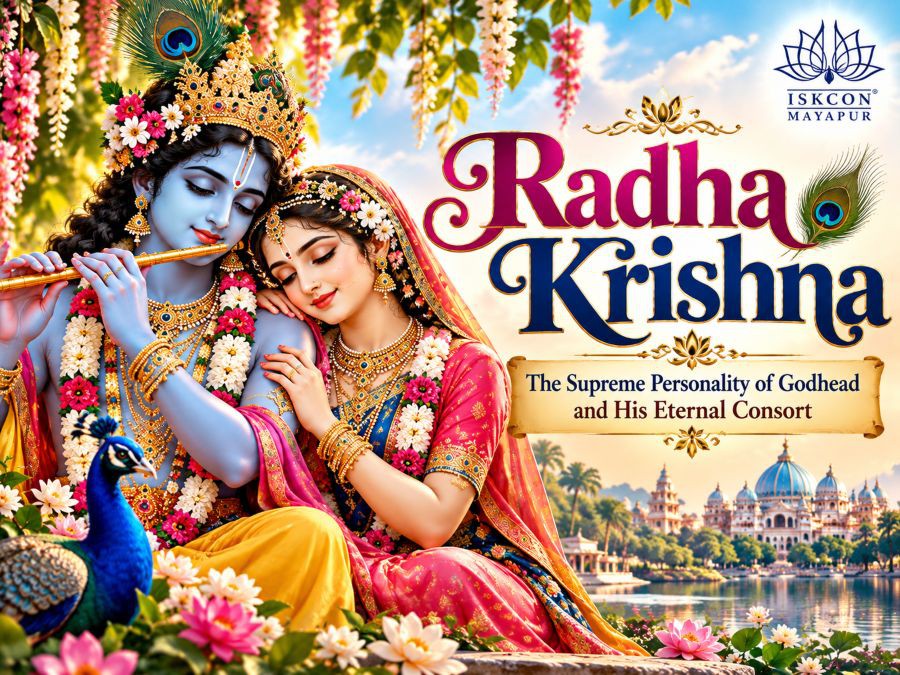
Radha Krishna | The Supreme Personality of Godhead and His Eternal Consort
Radha Krishna | The Supreme Personality of Godhead and His Eternal Consort
What if the most important relationship in Vaishnava theology isn't a story about romance at all — but a story about how the divine actually loves?
That's the question most people skip when they hear the name Radha Krishna. They picture a couple. A god and his beloved. Maybe something like a Hindu equivalent of a Greek myth, minus the tragedy. But that framing misses almost everything that Gaudiya Vaishnava philosophy is actually trying to say through this pairing, and it flattens a theological structure that took centuries of commentary, poetry, and lived devotion to build.
According to the Brahma Samhita, Krishna is described as the Supreme Personality of Godhead — not a form of God, not an avatar of something else, but the source from which every other divine form, including Vishnu, expands. And standing beside him, inseparable in essence yet distinct in form, is Radha — not a mythological add-on, but according to Gaudiya theology, his own internal pleasure potency, the energy through which his love finds expression. Understanding Radha Krishna properly means understanding both halves of that sentence, not just the love story on the surface.
Radha Rani: Why She's Called the Queen of Vrindavana, Not Just Krishna's Beloved
Before anything else, let's correct something that gets lost when Radha is treated only as a supporting character in Krishna's story. In Vraja, she isn't addressed as a companion or a consort in the ordinary sense. She's addressed as Radha Rani — literally, Queen Radha — and that title isn't decorative. It reflects an actual position within Gaudiya Vaishnava theology: she is described as the presiding deity of Vrindavana itself, its ruling princess, the one whose mood and pleasure determine the emotional atmosphere of the entire realm.
Here's a detail that surprises people who assume Krishna simply outranks everyone, including Radha: several major Gaudiya acharyas, including Jiva Goswami and later Vishvanatha Chakravarti, describe Radha as more worshippable than Krishna himself, not less. The logic runs like this — Krishna is the object of love, the one being loved, while Radha represents the perfection of loving itself. Devotion, in this framework, isn't ultimately measured by how exalted the beloved is; it's measured by the quality of the love offered. Since Radha's love is considered the most complete, unmotivated, and intense love that exists anywhere, in any realm, material or spiritual, she becomes the standard every devotee is actually trying to reach — not Krishna's position, but Radha's heart.
A few concrete ways this shows up in the tradition:
- In many Gaudiya lineages, devotees pray for the mercy of Radha specifically, believing that her recommendation is what actually grants access to Krishna's association — she functions less like a bystander and more like the gatekeeper of devotional life in Vraja.
- Temples in the Gaudiya tradition almost never install a deity of Krishna without Radha beside him, and her name is typically spoken first — "Radha Krishna," not "Krishna Radha" — a small linguistic detail that reflects a real theological priority.
- Radha's birthplace, Barsana, has its own independent pilgrimage significance, separate from Vrindavana proper, with temples and festivals dedicated entirely to her.
Her Qualities: What Actually Makes Radha the Ideal of Devotion
It's worth naming specifically what devotional literature attributes to her, rather than leaving her described only in relation to Krishna.
- Unmatched beauty (rupa) — texts describe her complexion, often compared to molten gold, as so radiant that it's said to outshine Krishna's own dark luster when they stand together, creating a contrast poets have spent centuries trying to capture.
- Supreme intelligence and wit — the Gita Govinda and later Vraja literature repeatedly show her outmaneuvering Krishna in conversation, teasing him, testing his sincerity, and holding her own emotional ground rather than being a passive recipient of his affection.
- Unbroken constancy — regardless of separation, distance, or Krishna's long absences in Mathura and Dwaraka, her devotion never wavers or becomes conditional.
- Total selflessness (para-dukha-dukhi) — she's described as feeling pain not from her own suffering but from Krishna's, more disturbed by his difficulties than her own, which Gaudiya commentators treat as the clearest marker of real love as opposed to attachment.
- The eight expressions of ecstatic love (ashta-sattvika-bhava) — trembling, tears, horripilation, and other involuntary responses attributed to her in moments of intense devotional feeling, treated in Bhakti-rasamrita-sindhu as the physical evidence of the highest spiritual emotion a being can experience.
Ashtakaliya Lila: Radha's Eternal Daily Life in Vraja
One of the more remarkable ideas in this tradition is the Ashtakaliya Lila — the belief that Radha and Krishna's daily activities in the spiritual realm of Goloka Vrindavana are eternally ongoing, divided into eight specific periods across a single day, each with its own mood, activity, and devotional meditation associated with it. Devotees who practice raganuga bhakti meditate on these eight time periods daily — dawn, morning, late morning, afternoon, evening, night, and beyond — imagining themselves serving Radha directly within each one, often as one of her handmaidens (a manjari) rather than approaching Krishna independently.
This detail matters because it shows how central Radha actually is to the tradition's most advanced devotional practice. The goal isn't described as reaching Krishna directly. It's described as gaining entrance into Radha personal service, on the logic that her proximity to Krishna, and the quality of her love for him, is what devotees are ultimately trying to share in — not replace or compete with, but participate in as an assistant to her own devotion.
Why "Supreme Personality of Godhead" Isn't Just a Fancy Title
Let's deal with the theology first, because everything else about Radha Krishna depends on getting this part right.
The Bhagavad Gita has Krishna say something remarkable in its ninth and tenth chapters: he describes himself as the source of all material and spiritual worlds, the origin from which everything emanates and to which everything eventually returns. That's not a minor claim. Most religious traditions place their central deity within a hierarchy — a supreme, formless Brahman above, with personal deities as manifestations beneath it. Gaudiya Vaishnavism, drawing heavily on the Brahma Samhita and the Bhagavatam, flips that hierarchy. Krishna, in his original two-armed form as the cowherd of Vrindavana, is treated as the source, and the formless Brahman is described as merely the effulgence radiating from his transcendental body.
That's why the title "Supreme Personality of Godhead" gets used so precisely and so often in this tradition's literature, rather than more generic words like "Lord" or "deity." It's making a specific philosophical argument: God is not ultimately impersonal. God has a name, a form, qualities, relationships, and — crucially for this article — a consort.
A few things this framework establishes clearly:
- Krishna possesses six opulences in complete and unlimited measure: wealth, strength, fame, beauty, knowledge, and renunciation.
- He is described as sat-chit-ananda — eternally existing, fully conscious, and inherently blissful.
- His abode, Goloka Vrindavana, exists beyond the material universe's cycles of creation and destruction, untouched by time in the way we usually understand it.
None of that answers why Radha matters yet. That's the next piece.
Radha: Not a Character in Krishna's Story, But an Extension of Him
Here's where a lot of casual readers get tripped up. If Krishna is described as complete and self-sufficient — full in every quality, lacking nothing — why does the tradition insist on Radha's presence at all?
The answer Gaudiya theologians give is genuinely elegant. Bliss, by its nature, needs an object. Even complete bliss needs somewhere to express itself, someone to be shared with, in order for that bliss to be experienced rather than merely possessed in the abstract. Radha is described as Krishna's hladini-shakti — his internal potency of pleasure — the personification of the love that Krishna feels for himself, given a separate form so that a relationship, rather than a static state, becomes possible.
This is subtle, so it's worth restating differently: Radha isn't external to Krishna the way a romantic partner is external to another person in ordinary human relationships. She's described as inseparable from him in essence, one identity expressed as two, so that love — which requires a lover and a beloved — can actually occur. Later Gaudiya saints, particularly Chaitanya Mahaprabhu, are considered by the tradition to represent the union of these two — Krishna experiencing his own sweetness through Radha's perspective.
Why this distinction actually matters for how you read every Radha Krishna story afterward:
- It reframes their "romance" as a theological demonstration rather than mythology for its own sake.
- It explains why devotional texts treat Radha's moods — joy, jealousy, longing — as spiritually significant rather than as flaws in an otherwise perfect love story.
- It clarifies why worship in Gaudiya temples almost always presents the two deities together, never Krishna alone, in the central altar.
The Love Story the Garga Samhita Actually Tells
If you want texture rather than theology, the Garga Samhita is where you go. Attributed to the sage Garga — the same priest the Bhagavatam credits with naming Krishna and Balarama in their childhood — this text spends far more time on the relational details between Radha and Krishna than the more widely translated Bhagavatam does.
It describes their meeting in Vrindavana, the intensity of their attraction, and — this is the part modern readers often find unexpected — a relationship built as much around separation as union. Radha and Krishna are depicted spending significant portions of their story apart, longing for each other, rather than contentedly together. The Garga Samhita, along with later poetic works like Jayadeva's Gita Govinda, treats this separation (called viraha) not as an unfortunate plot complication but as one of the most exalted emotional states a devotee can aspire to feel toward the divine.
Think about what that's actually claiming. Most people assume spiritual fulfillment looks like closeness, presence, arrival. This tradition argues that the ache of separation, when directed toward God with sincerity, is itself a form of devotion so intense that some Gaudiya theologians rank it above the satisfaction of union. Radha's longing for Krishna during his time away in Mathura and Dwaraka becomes, in devotional poetry, the template for how a soul should feel about its distance from the divine — not despair, but a particular kind of sacred restlessness.
Why Krishna Left Vrindavana — And What Radha's Response Teaches
There's a detail in the Bhagavatam that devotional commentators return to constantly: Krishna eventually leaves Vrindavana for Mathura and never permanently returns to live there again. He goes on to kill Kamsa, relocate to Dwaraka, marry several queens, and take up an entirely different life as a political and military figure.
Radha, in this reading, stays behind — the eternal resident of Vrindavana, never leaving, her devotion never contingent on Krishna's physical presence. This isn't framed as abandonment. It's framed as a demonstration that real devotion doesn't require proximity to sustain itself. The gopis of Vrindavana, with Radha as their emotional center, become the tradition's model for what unconditional, unmotivated love toward God actually looks like — love that continues regardless of whether it's reciprocated in any immediately visible way.
This section of the story sets up a few recurring devotional themes:
- Love that demands nothing back is held up as spiritually superior to love that requires constant confirmation.
- Physical distance doesn't diminish genuine devotion — arguably, it reveals whether the devotion was real to begin with.
- Radha's steadiness becomes the standard against which a devotee's own consistency gets measured.
Hare Krishna: The Mantra That Carries Radha's Name Inside It
Most people who've encountered the Hare Krishna mantra assume "Hare" is just a rhythmic filler word. It isn't. "Hare" is a vocative address to Radha herself, referred to in this context as Hara — the energy of the divine. The full mantra —
Hare Krishna, Hare Krishna, Krishna Krishna, Hare Hare, Hare Rama, Hare Rama, Rama Rama, Hare Hare
— is structured as a direct appeal to both Radha and Krishna together, asking to be engaged in loving service to both. That's a significant detail, because it means every time this mantra is chanted, Radha isn't a footnote. She's being addressed first, in a sense, as the gateway through which approach to Krishna becomes possible.
Chaitanya Mahaprabhu, the saint credited with popularizing this specific chant in the sixteenth century, is himself understood in Gaudiya theology as an especially significant figure precisely because of the Radha-Krishna connection: he's described as Krishna internally experiencing the mood and complexion of Radha externally, uniting both principles in a single form in order to teach and demonstrate this very devotion. That's not incidental theology tacked onto a chanting practice — it's the entire reason the practice was introduced the way it was.
What the Vishnu Purana Adds — And What It Deliberately Leaves Out
The Vishnu Purana takes a noticeably different approach than the Garga Samhita or the later Gaudiya poetic tradition. It's an earlier, more restrained text, focused on establishing Krishna's cosmological identity as a manifestation of Vishnu and situating his life within the larger structure of the universe's ages and cycles.
It's worth noting what this text doesn't emphasize as heavily: the intimate, relational detail of Radha and Krishna's bond gets far less attention here than it does in later devotional literature. This isn't a contradiction between sources — it reflects a difference in purpose. The Vishnu Purana is doing cosmological and historical work, establishing Krishna's place in the universal order. The Garga Samhita and the Bhagavatam's later cantos are doing devotional and emotional work, exploring what it means to love this figure personally. Reading both side by side gives you the full picture: the cosmic scale and the intimate scale aren't competing versions of the story — they're two different lenses pointed at the same subject.
Radhashtami: The Day Vraja Celebrates Her, Not Him
If Radha were truly secondary to Krishna, there'd be no reason for an entire festival built around her birth alone. But Radhashtami, observed roughly a month after Krishna's own birth celebration of Janmashtami, does exactly that — it's dedicated entirely to Radha, celebrated with particular intensity in Barsana and Vrindavana, where devotees fast, sing, and worship her image specifically rather than the combined deity pair.
The tradition also preserves the Radha Sahasranama — a thousand names glorifying her, structured the same way the more famous Vishnu Sahasranama glorifies Vishnu. Each name in this list points to a different facet of who she is: queen of Vraja, embodiment of divine love, the one whose mercy grants entrance to Krishna's company, the eternal beloved untouched by material limitation. Reciting or studying these names is treated in Gaudiya practice as a way of understanding her multidimensional identity, rather than reducing her to a single role in someone else's narrative.
Why Radha Krishna's Story Isn't Really About Romance At All
Here's the reframe worth sitting with by the end of all this: calling Radha Krishna a "love story" isn't wrong, but it's incomplete in a way that misses the point of why the tradition tells it at all.
Human romantic love, at its most ordinary, tends to be transactional in subtle ways — built on reciprocity, on being seen, on getting something back. What Gaudiya Vaishnava theology is using Radha and Krishna's relationship to illustrate is a version of love stripped of that transactional core: devotion offered without guarantee, longing sustained without resolution, and joy in the beloved's happiness even when it doesn't directly benefit the lover. Radha's love for Krishna is repeatedly described in devotional commentary as ahaituki — without ulterior motive — and apratihata — unstoppable, unbroken by circumstance.
That's an unusually high bar, and it's precisely why the tradition treats this pairing as the highest devotional ideal rather than as a footnote to Krishna's broader story. Radha isn't secondary to Krishna. She's the demonstration of what loving him actually, fully looks like — and every devotee who chants, worships, or studies this relationship is being invited to measure their own devotion against hers.
Radha Krishna, read properly, isn't asking you to admire a couple from a distance. It's asking you to notice what unconditional love actually costs, and whether you're willing to offer that kind of love yourself — without asking, first, what you'll get back.
Posted in: Krishna Consciousness
Related posts
-
 Krishna Consciousness: The Endless Path of Bhakti and DevotionExplore Krishna Consciousness—the eternal path of bhakti and devotion rooted in ancient wisdom. Discover the...Read more
 -
 Why Krishna Consciousness is the Key to Inner Peace & HappinessDiscover how Krishna Consciousness offers the key to lasting inner peace and true happiness through devotion,...Read more
 -
 Unlocking the Power of Bhakti Yoga through Krishna ConsciousnessUnlock the power of Bhakti Yoga through Krishna Consciousness—discover how devotion, chanting, and ISKCON Mayapur...Read more
 -
 Discovering Krishna Consciousness: The Science of Self-RealizationDiscover Krishna Consciousness as the science of self-realization—unlock your true spiritual identity and attain...Read more
 -
 Chant, Dance, and Rejoice: Experiencing Krishna ConsciousnessExperience the joy of Krishna Consciousness through chanting, dancing, and rejoicing. Discover how these devotional...Read more
Leave a comment