
Why did Krishna run to embrace a poor brahmin in rags? Read the Sudama story from the Bhagavatam and learn how a...
Latest posts
-
 Krishna and Sudama: The Poor Brahmin Who Became Wealthy in LoveRead more
 -
 Vamana Avatar: How Three Steps Humbled Bali MaharajaRead more
Why did a powerful king give away three worlds to a boy asking for three steps? Learn the Vamana avatar story from...
-
 The Bhagavatam on Marriage: Duty, Love and Spiritual PartnershipRead more
What does the Bhagavatam say about marriage? Through the stories of Kardama and Devahuti, Rukmini's secret letter and...
-
 What Is Prema? The Bhagavatam's Highest Stage of Love for GodRead more
Prema is love for God with no "because" attached. Learn how the Bhagavatam describes it, the nine steps from faith to...
-
 Is Shiva Parvati Kalyana Mentioned in Srimad Bhagavatam? What the Scripture Really SaysRead more
Looking for Shiva and Parvati's wedding in the Srimad Bhagavatam? Find out what the scripture actually describes,...
-
 How Many Modes of Devotion Are Mentioned in Bhagavatam?Read more
A young boy named Prahlada listed nine ways to serve God, and the Bhagavatam keeps them as its answer. Learn what the...
-
 What Is Bhagavatam and Why Has It Been Read for 5,000 Years?Read more
A dying king asked one question, and the answer became the Bhagavatam. Learn what this Sanskrit scripture contains,...
-
 Who Is Lord Krishna? His Meaning, Teachings and Pastimes ExplainedRead more
Discover who Krishna is according to Srimad Bhagavatam, including His divine identity, childhood pastimes, teachings,...
-
 Incense in Islam: Bakhoor, Agarbatti and What Tradition SaysRead more
Is burning fragrance part of Muslim tradition? Explore incense in Islam, from the Prophetic practice of fumigating...
-
 History of Agarbatti: From Vedic Dhupa to Modern Incense SticksRead more
Where did agarbatti really come from? Follow the history of agarbatti from Vedic fire rituals and temple dhupa to...
Blog categories
- Default category (0)
- MUSICAL INSTRUMENT (1)
- BOOK (5)
- DEVOTIONAL GIFT (0)
- Blog (30) click
- CHANDAN (12)
- Bhagavatam Wisdom Series (68)
- Krishna Consciousness (14)
- Mridangam Musical Instrument (6)
- Bhagavad Gita for Beginners (13)
- Bhagavad Gita As It Is (37) click
- Bhagavad Gita As It Is Telugu (0)
- Bhagavad Gita As It Is Marathi (0)
- Bhagavad Gita As It Is In Hindi (0)
- Bhagavad Gita As It Is In English (0)
- Bhagavad Gita As It Is In Bengali (8)
- Bhagavad Gita As It Is In Kannada (0)
- Bhagavad Gita As It Is In Gujarati (0)
- Bhagavad Gita As It Is In Panjabi (0)
- Bhagavad Gita As It Is In Tamil (0)
- Bhagavad Gita As It Is Odia (0)
- BHAGAVAD GITA As It Is GERMAN (0)
- Bhagavad Gita As It Is In French (0)
- Bhagavad Gita As It Is In Nepali (0)
- Bhagavad Gita As It Is In Assamese (0)
- Incense or Agarbatti (38)
- Lord Chaitanya Mahaprabhu (3)
- Vedic Temple Mayapur (14)
- kalki (15)
- Mahabharata – Dharma & Destiny (27)
- Vaishnava Scriptures (4)
- healthy product (4)
- chaitanya mahaprabhu (5)
- Tulsi Mala Guide (17)
Search in blog
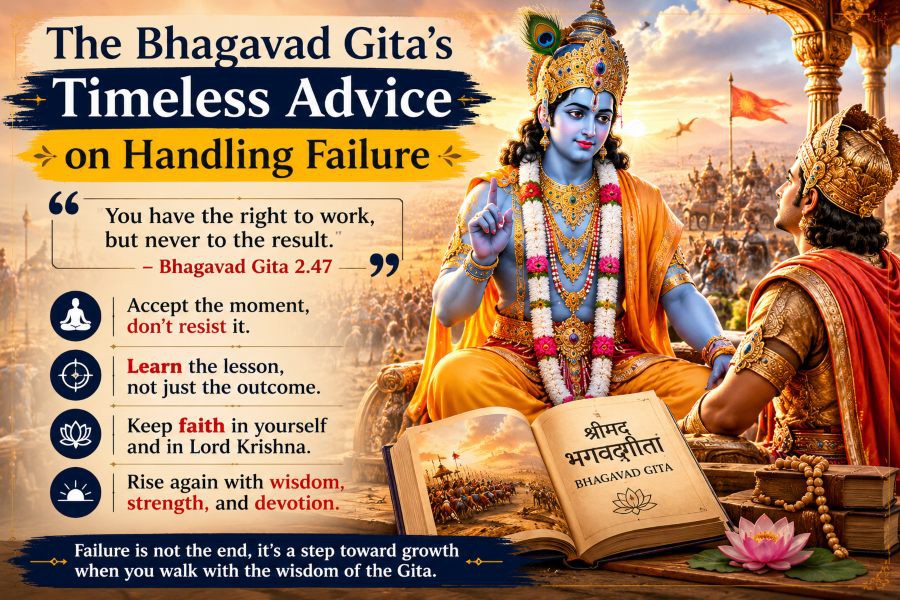
The Bhagavad Gita's Timeless Advice on Handling Failure
The Bhagavad Gita's Timeless Advice on Handling Failure
You just lost the job you'd been chasing for two years. Or the exam result came back, and it wasn't what you expected. Or the relationship you poured yourself into simply ended. Somewhere in that gut-punch moment, a question rises up that almost everyone asks at some point: did I fail because I wasn't good enough, or is failure just... part of the deal?
Five thousand years ago, a warrior named Arjuna stood on a battlefield asking a version of that same question, except his stakes were life and death. His hands shook. His bow slipped from his grip. He wasn't scared of losing — he was scared of losing meaning itself. And it was in that exact moment of collapse that Krishna began speaking the words we now know as the Bhagavad Gita. If you've ever wanted a serious, no-nonsense guide to failure that isn't wrapped in empty positivity, the Mayapur Store Bhagavad Gita Book is a good place to actually sit with these teachings instead of just skimming quotes online.
This isn't a self-help pep talk. It's older, sharper, and honestly more useful than most of what passes for advice today.
Why Arjuna's Breakdown Still Feels So Familiar
Arjuna wasn't a coward. He was one of the finest archers alive, trained since childhood, tested in war after war. Yet when he saw his teachers, cousins, and friends standing on the opposite side of the battlefield, something in him cracked. He didn't just doubt the war — he doubted the point of fighting at all.
That's worth sitting with for a second. Failure doesn't only happen when you lose. Sometimes it happens the moment you stop believing your effort matters. Arjuna hadn't even fought yet, and he was already defeated in his mind. Sound familiar? Most people don't quit after failing once. They quit after imagining failure so vividly that trying no longer feels worth it.
Krishna didn't respond with sympathy. He didn't say, "It's okay, take your time." He essentially told Arjuna his logic was flawed — and then spent seventeen more chapters explaining why.
The Line That Changes Everything: You Never Controlled the Outcome Anyway
If there's one verse from the Gita that gets quoted more than any other, it's this one, and for good reason:
"You have a right to perform your prescribed duties, but you are not entitled to the fruits of your actions."
People usually read this as a nice sentiment about staying humble. It's actually a precise, almost mathematical argument about why failure hurts as much as it does.
Here's the logic: when you tie your sense of worth to a result — the promotion, the score, the relationship staying intact — you're placing your identity in something you were never fully in charge of to begin with. A hundred variables outside your control shape any outcome: timing, other people's choices, sheer luck, circumstances you'll never even know about. So when the result doesn't go your way, it feels like you failed as a person, when really, one variable among hundreds didn't line up.
Krishna isn't telling Arjuna to stop caring about the war. He's telling him to stop confusing his effort with the scoreboard. Your job was always the doing, never the guaranteeing.
This reframe alone can quietly dismantle years of self-blame. It doesn't mean you stop trying hard — it means you stop treating every unfavorable result as a verdict on your character.
Failure Feels Personal Because You've Confused Yourself With Your Circumstances
Chapter 2 of the Gita makes a claim that sounds almost too abstract to be practical: the soul is eternal, unchanging, untouched by the rise and fall of worldly events. Krishna tells Arjuna that the body changes, situations change, even entire lifetimes come and go — but the self underneath all of it remains constant.
Strip away the metaphysics for a second, and there's a genuinely useful psychological tool here. You are not the sum of your setbacks. A failed business isn't proof that you're a failure; it's proof that one specific attempt, under one specific set of conditions, didn't work out. The Gita is essentially arguing that people who tie their entire identity to outcomes will suffer endlessly, because outcomes never stop shifting. Something will always be going wrong somewhere.
This is why some people bounce back from a layoff within weeks while others carry the sting for years. The difference usually isn't talent or luck — it's how tightly they'd wrapped their self-image around that one job.
The Two Kinds of People Krishna Describes (and You've Met Both)
Later in the text, Krishna draws a distinction between two mental states — one anchored in equanimity, and one constantly thrown around by pleasure and pain, gain and loss, praise and blame. He calls the first a person of "steady wisdom."
Think about the people you know who seem unshakeable, not because nothing bad ever happens to them, but because their sense of self doesn't collapse every time it does. And then think about people — maybe yourself on a rough day — who feel like an entirely different person after one piece of bad news.
Krishna's point isn't that you should feel nothing when you fail. Grief, disappointment, frustration — these are honest human responses, and the Gita never asks you to fake indifference. What it does ask is that you stop letting a single event dictate your entire emotional architecture. Feel the failure. Just don't let it become the story of who you are.
"But What If I Actually Made a Mistake?"
Fair question. Not every failure is a neutral roll of the dice — sometimes you genuinely got something wrong. The Gita doesn't pretend otherwise. In fact, Krishna spends a good portion of Chapter 18 talking about the nature of right action, the quality of your intentions, and the importance of doing your duty with full sincerity rather than half-effort.
Here's where it gets interesting, though. Even when Krishna talks about mistakes and imperfect action, he never tells Arjuna to spiral into shame. He tells him to look honestly at what happened, learn from it, and act again — this time with clearer intention. There's a well-known verse where Krishna says it's better to perform your own duty imperfectly than to perform someone else's duty perfectly. Translation: don't abandon your path just because you stumbled on it once. Stumbling is data, not a disqualification.
This matters because so many people treat one failed attempt as permanent proof they're on the wrong track. The Gita suggests something different — that failure is often just feedback wearing an uncomfortable disguise.
What the Battlefield Actually Represents
It's easy to read the Gita as ancient war poetry and miss what Kurukshetra is really standing in for. The battlefield is every difficult decision you've ever had to make while everything inside you screamed to retreat. It's the interview you almost didn't show up to. The relationship conversation you kept postponing. The business idea you sat on for three years because you were terrified of what would happen if it flopped.
Arjuna's real enemy was never the army in front of him — it was the paralysis inside him. And that's arguably the most relevant thing about this text for anyone dealing with failure today: most people don't fail because they tried and lost. They fail because fear of losing kept them from ever fully trying.
If you've been sitting with a decision, half-convinced you already know how badly it'll go, that hesitation itself is the loss the Gita is warning you about.
Practical Takeaways You Can Actually Use
Strip away the Sanskrit and the battlefield imagery, and the Gita's approach to failure boils down to a handful of workable principles:
- Separate effort from outcome. Judge yourself on whether you showed up fully, not on whether the result cooperated.
- Don't let one event rewrite your identity. A failed attempt is information about a situation, not a verdict on your worth.
- Feel it, don't feed it. Disappointment is honest. Obsessive rumination is optional.
- Treat mistakes as feedback, not disqualification. Adjust the approach; don't abandon the path.
- Notice when fear — not the actual risk — is what's stopping you. That fear is often the real failure in disguise.
None of this makes failure painless. It just stops failure from being the final word.
Why People Keep Returning to This 5,000-Year-Old Text
There's something almost funny about how relevant a battlefield conversation from millennia ago still feels in an era of quarterly performance reviews and social media comparison. But maybe that's exactly why it holds up — human beings haven't actually changed all that much. We still tie our worth to results we can't control. We still freeze before decisions that matter. We still need someone to tell us, plainly, that effort was never supposed to guarantee anything.
If this way of thinking resonates, it's worth spending real time with the source text rather than secondhand quotes floating around the internet. A well-translated copy — the kind of edition available through the bhagavad gita price listings at Mayapur Store — gives you Krishna's full argument, not just the highlight reel. Reading Chapter 2 and Chapter 18 back to back, specifically, is probably the fastest way to understand why this text has outlasted empires.
A Different Way to Measure Yourself
Maybe the real shift the Gita offers isn't a technique for avoiding failure — it's a completely different scoreboard. Not "did it work," but "did I show up fully, with honesty and effort, regardless of what I couldn't control." That's a much harder standard in some ways, because it demands consistency rather than luck. But it's also far kinder, because it stops punishing you for things that were never yours to guarantee in the first place.
Arjuna eventually picked up his bow again. Not because Krishna promised him victory — he never did — but because Arjuna finally understood that showing up fully was the only part of the equation that was ever really his.
Posted in: Bhagavad Gita As It Is
Related posts
-
 Why the Bhagavad Gita Feels Like a Personal Conversation with KrishnaThe Bhagavad Gita feels like a personal conversation with Krishna because its timeless wisdom directly addresses our...Read more
 -
 Shrimad Bhagwat Geeta: The Forgotten Life Manual for Modern StressShrimad Bhagwat Geeta is more than a sacred scripture—it’s a forgotten life manual that offers timeless solutions for...Read more
 -
 Who Wrote the Bhagavad Gita? Discover the true authorship of the Bhagavad Gita—exploring Ved Vyasa’s role as the compiler, Lord Krishna’s divine...Read more
 -
 How Many Shlokas in Bhagavad Gita? Complete Chapter-Wise Breakdown & MeaningDiscover how many shlokas are in the Bhagavad Gita, with a complete chapter-wise breakdown, variations in verse...Read more
 -
 How to Read Bhagavad Gita: A Complete Step-by-Step Guide for BeginnersDiscover how to read the Bhagavad Gita step by step—learn the right mindset, chapter order, and tips to understand...Read more
Leave a comment