
Why did Krishna run to embrace a poor brahmin in rags? Read the Sudama story from the Bhagavatam and learn how a...
Latest posts
-
 Krishna and Sudama: The Poor Brahmin Who Became Wealthy in LoveRead more
 -
 Vamana Avatar: How Three Steps Humbled Bali MaharajaRead more
Why did a powerful king give away three worlds to a boy asking for three steps? Learn the Vamana avatar story from...
-
 The Bhagavatam on Marriage: Duty, Love and Spiritual PartnershipRead more
What does the Bhagavatam say about marriage? Through the stories of Kardama and Devahuti, Rukmini's secret letter and...
-
 What Is Prema? The Bhagavatam's Highest Stage of Love for GodRead more
Prema is love for God with no "because" attached. Learn how the Bhagavatam describes it, the nine steps from faith to...
-
 Is Shiva Parvati Kalyana Mentioned in Srimad Bhagavatam? What the Scripture Really SaysRead more
Looking for Shiva and Parvati's wedding in the Srimad Bhagavatam? Find out what the scripture actually describes,...
-
 How Many Modes of Devotion Are Mentioned in Bhagavatam?Read more
A young boy named Prahlada listed nine ways to serve God, and the Bhagavatam keeps them as its answer. Learn what the...
-
 What Is Bhagavatam and Why Has It Been Read for 5,000 Years?Read more
A dying king asked one question, and the answer became the Bhagavatam. Learn what this Sanskrit scripture contains,...
-
 Who Is Lord Krishna? His Meaning, Teachings and Pastimes ExplainedRead more
Discover who Krishna is according to Srimad Bhagavatam, including His divine identity, childhood pastimes, teachings,...
-
 Incense in Islam: Bakhoor, Agarbatti and What Tradition SaysRead more
Is burning fragrance part of Muslim tradition? Explore incense in Islam, from the Prophetic practice of fumigating...
-
 History of Agarbatti: From Vedic Dhupa to Modern Incense SticksRead more
Where did agarbatti really come from? Follow the history of agarbatti from Vedic fire rituals and temple dhupa to...
Blog categories
- Default category (0)
- MUSICAL INSTRUMENT (1)
- BOOK (5)
- DEVOTIONAL GIFT (0)
- Blog (30) click
- CHANDAN (12)
- Bhagavatam Wisdom Series (68)
- Krishna Consciousness (14)
- Mridangam Musical Instrument (6)
- Bhagavad Gita for Beginners (13)
- Bhagavad Gita As It Is (37) click
- Bhagavad Gita As It Is Telugu (0)
- Bhagavad Gita As It Is Marathi (0)
- Bhagavad Gita As It Is In Hindi (0)
- Bhagavad Gita As It Is In English (0)
- Bhagavad Gita As It Is In Bengali (8)
- Bhagavad Gita As It Is In Kannada (0)
- Bhagavad Gita As It Is In Gujarati (0)
- Bhagavad Gita As It Is In Panjabi (0)
- Bhagavad Gita As It Is In Tamil (0)
- Bhagavad Gita As It Is Odia (0)
- BHAGAVAD GITA As It Is GERMAN (0)
- Bhagavad Gita As It Is In French (0)
- Bhagavad Gita As It Is In Nepali (0)
- Bhagavad Gita As It Is In Assamese (0)
- Incense or Agarbatti (38)
- Lord Chaitanya Mahaprabhu (3)
- Vedic Temple Mayapur (14)
- kalki (15)
- Mahabharata – Dharma & Destiny (27)
- Vaishnava Scriptures (4)
- healthy product (4)
- chaitanya mahaprabhu (5)
- Tulsi Mala Guide (17)
Search in blog
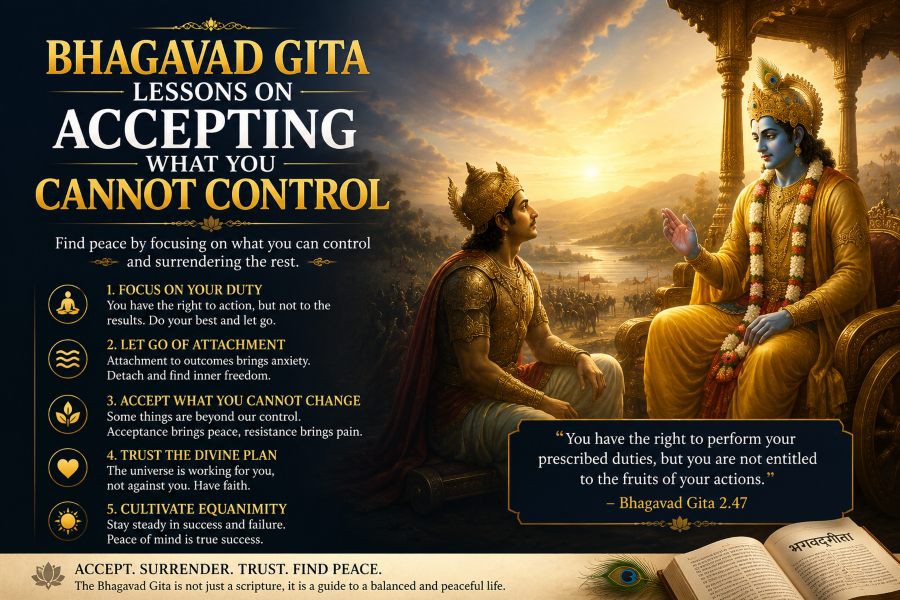
Bhagavad Gita Lessons on Accepting What You Cannot Control
Bhagavad Gita Lessons on Accepting What You Cannot Control
Picture this: you've done everything right. You prepared for months, showed up on time, gave it everything you had — and it still fell apart because of something you never saw coming. A sudden policy change. A recession nobody predicted. A person who simply changed their mind. Where does that leave you? Furious? Defeated? Or strangely, unexpectedly, at peace? The Bhagavad Gita was written for exactly this moment, and its answer to that question is sharper than almost anything modern self-help has managed to produce since. Long before therapists started talking about "radical acceptance," Krishna was already walking Arjuna through the exact same idea on a battlefield, and if you want to sit with the full argument rather than a summary of it, the ISKCON Mayapur Store carries a translation worth actually reading cover to cover.
This isn't a lesson about giving up. It's a lesson about where your energy actually belongs.
The Trap of Believing You're in Charge of Everything
Most people walk around with a quiet, unexamined assumption: if I work hard enough, plan carefully enough, and want something badly enough, it will happen. It's a comforting belief. It's also mostly false, and the Gita says so directly.
Arjuna stood on the battlefield at Kurukshetra convinced that the coming war's outcome — who lived, who died, who would inherit the kingdom — was something he needed to personally guarantee. That belief is what paralyzed him. Krishna's response wasn't sympathy. It was a correction: you were never in control of the outcome to begin with, so stop acting like your peace of mind depends on it.
Here's the uncomfortable truth buried in that idea. The moment you believe you control an outcome, you've handed that outcome permission to control you. Every fear, every sleepless night, every spike of anxiety over something "going wrong" traces back to this one misunderstanding — that the result was ever fully yours to command.
What You Actually Control (It's Shorter Than You Think)
Krishna draws a clean line in Chapter 2, one that's easy to read past too quickly: "You have a right to perform your prescribed duty, but you are not entitled to the fruits of your actions."
Strip away the poetry, and this is basically a diagram of what belongs to you and what doesn't:
- Your effort — belongs to you, fully.
- Your intention — belongs to you, fully.
- Your honesty in the process — belongs to you, fully.
- The result — never belonged to you, not even for a second.
That last item is the one people fight hardest to accept, because it feels like giving something up. It isn't. It's just recognizing something that was already true. Weather, other people's decisions, timing, market conditions, someone else's mood on a given day — none of these were ever under your authority, no matter how much effort you poured into the situation. You were never the author of outcomes. You were only ever the author of your own actions.
Why This Isn't the Same as "Not Caring"
There's a common misreading of this teaching worth clearing up immediately, because it trips people up constantly. Accepting what you can't control doesn't mean becoming indifferent. It doesn't mean showing up half-heartedly because "it's out of my hands anyway."
Krishna never tells Arjuna to fight carelessly. He tells him to fight with full commitment and skill, while releasing his grip on the result. That's a genuinely difficult balance — full effort, zero attachment to how it turns out — and it's precisely why so few people actually manage it. Most people swing to one of two extremes: either they obsess over outcomes to the point of anxiety, or they use "it's not in my control" as an excuse to stop trying altogether.
The Gita is asking for something harder than either extreme. Care enough to give everything you have. Care little enough that the result doesn't own you afterward.
The Physics of Suffering, According to Krishna
There's a strange kind of logic running underneath this entire teaching, and once you see it, it's hard to unsee. Suffering, in the Gita's framework, isn't caused by events themselves. It's caused by the gap between what you expected to happen and what actually happened.
Think about it honestly. A rainstorm doesn't make you suffer if you weren't counting on sunshine. A promotion going to someone else doesn't devastate you the same way if you never assumed it was guaranteed. The pain isn't in the event. It's in the collision between the event and your certainty about how things were supposed to go.
This is why two people can experience the identical setback — a failed business, a canceled plan, a rejection — and walk away with completely different emotional outcomes. One had quietly built an entire identity around a specific result happening. The other showed up fully, stayed honest about the uncertainty the whole time, and simply adjusted when reality diverged from the plan. Same event. Wildly different aftermath.
Krishna's Argument About the Nature of Change Itself
Chapter 2 makes an argument that sounds almost mathematical: everything material is constantly in motion, constantly shifting, and pretending otherwise is where most human suffering begins. Bodies age. Relationships evolve. Businesses rise and fall. Seasons change whether you're ready or not.
Krishna tells Arjuna that a wise person doesn't grieve over what naturally changes, because grieving over change is like grieving over the fact that rivers flow. It's not tragic. It's just what rivers do. The tragedy only appears when you convince yourself the river should have stayed still.
This reframing matters more than it sounds like it should. So much modern anxiety comes from treating change as an injustice rather than as the baseline condition of existence. Your job wasn't supposed to be permanent. Neither was that friendship, that health, that version of your life exactly as it currently is. None of that is bad news — it's just how things have always worked, and resisting it is optional suffering layered on top of unavoidable change.
How to Actually Practice This (Because Knowing Isn't the Same as Doing)
Understanding this philosophically is one thing. Living it during an actual crisis is another. A few practical anchors, drawn straight from Krishna's approach with Arjuna, tend to help:
Ask the right question before acting. Instead of "will this work out," ask "am I doing this with full honesty and effort." The first question is unanswerable and anxiety-inducing. The second is entirely within your power to answer with a clear yes.
Separate preparation from prediction. Preparing thoroughly for an outcome is wise. Assuming you can predict or guarantee that outcome is where the suffering begins. Do the first. Drop the second.
Notice when you're arguing with reality. A huge amount of daily frustration is just quiet resistance to something that's already happened. The traffic is already there. The decision has already been made. Arguing with what's already true wastes energy that could go toward what happens next.
Return to duty, not despair. After Krishna's teaching, Arjuna doesn't sit around philosophizing forever — he picks up his bow and acts. The Gita isn't advocating passivity. It's advocating engaged action without the crushing weight of guaranteed results.
The Part Nobody Likes to Admit: Control Was Always an Illusion Anyway
Here's something worth sitting with honestly. Even in situations where you feel most in control — your own health, your own finances, your own relationships — you're really only ever influencing probabilities, not guaranteeing outcomes. A careful driver can still get into an accident caused by someone else. A dedicated employee can still get laid off during a company restructuring that has nothing to do with their performance.
This isn't meant to feel bleak. It's meant to feel like relief. If control was always partial at best, then the exhausting effort of trying to force certainty out of an uncertain world was never a fight you could actually win. You weren't failing at control. Control, as most people imagine it, was never fully available to begin with.
Once that sinks in, something shifts. The energy that used to go into white-knuckling outcomes can go somewhere far more useful — into the quality of your effort, the honesty of your intentions, and the steadiness of how you show up regardless of what happens next.
What Arjuna's Story Actually Teaches About Letting Go
It's worth remembering how this entire conversation started. Arjuna wasn't paralyzed by weakness. He was paralyzed by trying to hold the entire outcome of the war in his own two hands — every death, every consequence, every ripple effect stretching years into the future. No human being can carry that weight, and the Gita's teaching essentially tells him to put it down.
That release doesn't come from apathy. It comes from a clear-eyed understanding of where his actual responsibility began and ended. His job was to fight with skill, honesty, and full commitment to duty. Everything past that point belonged to forces far larger than himself — fate, other people's choices, the unfolding of dharma itself.
If you're looking to understand this teaching in full rather than through summaries, it's worth spending real time with a proper translation of the text itself. You can buy ISKCON Bhagavad Gita editions that walk through this argument methodically, chapter by chapter, rather than piecing it together from scattered quotes online.
Letting Go Isn't Losing — It's Finally Putting the Weight Down
Maybe the simplest way to hold onto this teaching is this: control was never really taken away from you. It was never yours in the first place, not in the way you assumed. What was always yours — fully, completely, without exception — was the quality of your effort and the honesty of your intention behind it.
Arjuna eventually picked up his bow, not because Krishna guaranteed him victory, but because he finally understood that victory was never the part that belonged to him. The fighting did. The rest, as Krishna makes clear, was always going to unfold exactly as it was meant to — with or without Arjuna's permission.
Posted in: Bhagavad Gita As It Is
Related posts
-
 Why the Bhagavad Gita Feels Like a Personal Conversation with KrishnaThe Bhagavad Gita feels like a personal conversation with Krishna because its timeless wisdom directly addresses our...Read more
 -
 Shrimad Bhagwat Geeta: The Forgotten Life Manual for Modern StressShrimad Bhagwat Geeta is more than a sacred scripture—it’s a forgotten life manual that offers timeless solutions for...Read more
 -
 Who Wrote the Bhagavad Gita? Discover the true authorship of the Bhagavad Gita—exploring Ved Vyasa’s role as the compiler, Lord Krishna’s divine...Read more
 -
 How Many Shlokas in Bhagavad Gita? Complete Chapter-Wise Breakdown & MeaningDiscover how many shlokas are in the Bhagavad Gita, with a complete chapter-wise breakdown, variations in verse...Read more
 -
 How to Read Bhagavad Gita: A Complete Step-by-Step Guide for BeginnersDiscover how to read the Bhagavad Gita step by step—learn the right mindset, chapter order, and tips to understand...Read more
Leave a comment