
Why did Krishna run to embrace a poor brahmin in rags? Read the Sudama story from the Bhagavatam and learn how a...
Latest posts
-
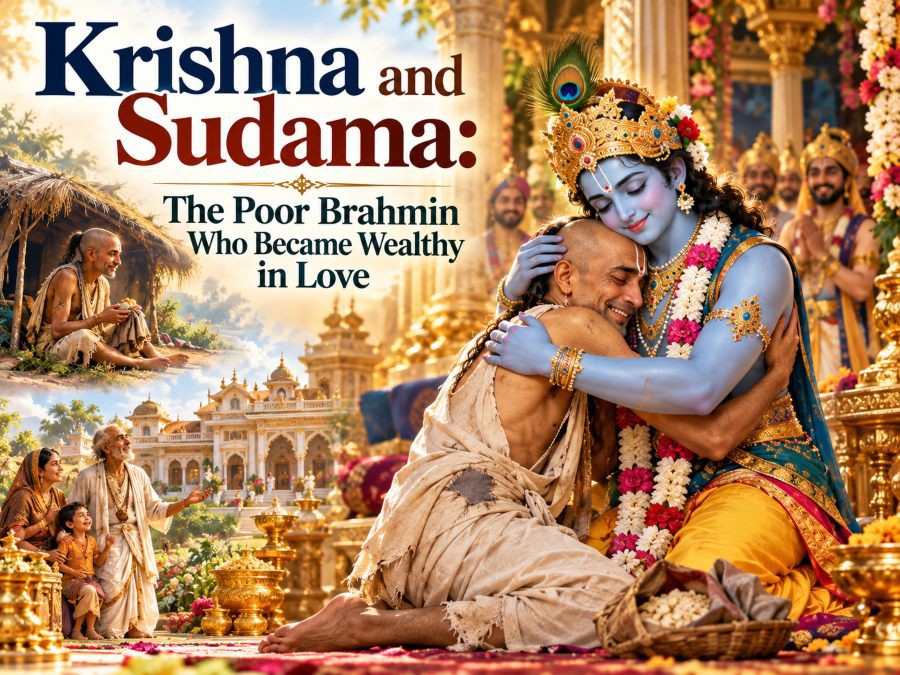 Krishna and Sudama: The Poor Brahmin Who Became Wealthy in LoveRead more
 -
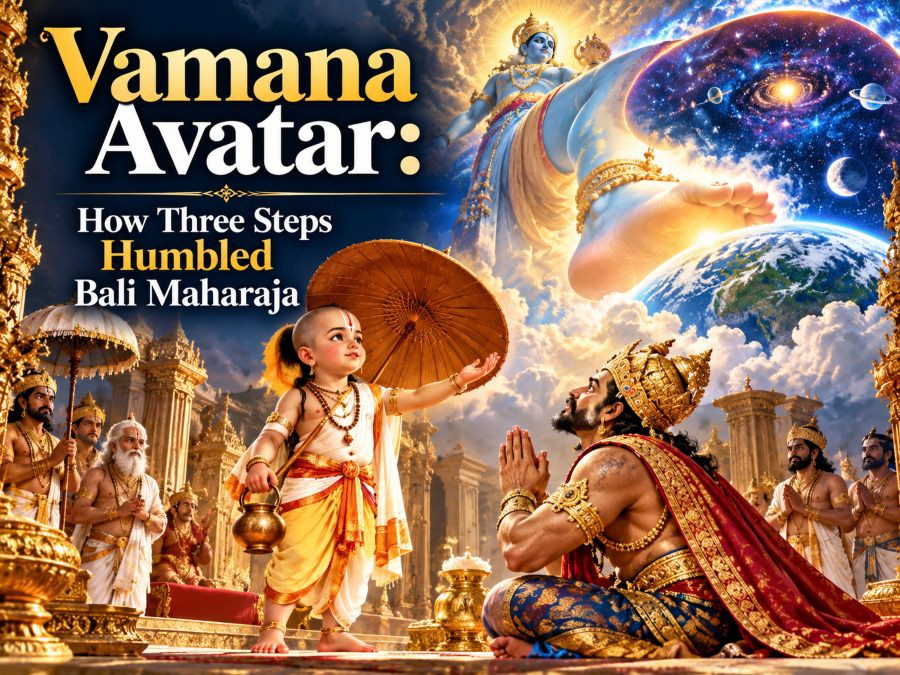 Vamana Avatar: How Three Steps Humbled Bali MaharajaRead more
Why did a powerful king give away three worlds to a boy asking for three steps? Learn the Vamana avatar story from...
-
 The Bhagavatam on Marriage: Duty, Love and Spiritual PartnershipRead more
What does the Bhagavatam say about marriage? Through the stories of Kardama and Devahuti, Rukmini's secret letter and...
-
 What Is Prema? The Bhagavatam's Highest Stage of Love for GodRead more
Prema is love for God with no "because" attached. Learn how the Bhagavatam describes it, the nine steps from faith to...
-
 Is Shiva Parvati Kalyana Mentioned in Srimad Bhagavatam? What the Scripture Really SaysRead more
Looking for Shiva and Parvati's wedding in the Srimad Bhagavatam? Find out what the scripture actually describes,...
-
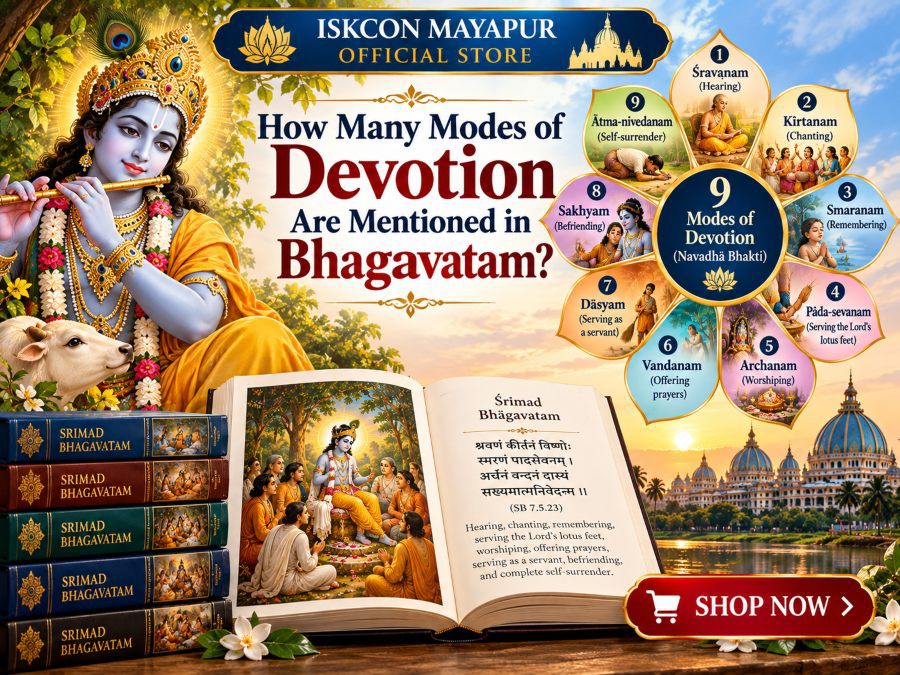 How Many Modes of Devotion Are Mentioned in Bhagavatam?Read more
A young boy named Prahlada listed nine ways to serve God, and the Bhagavatam keeps them as its answer. Learn what the...
-
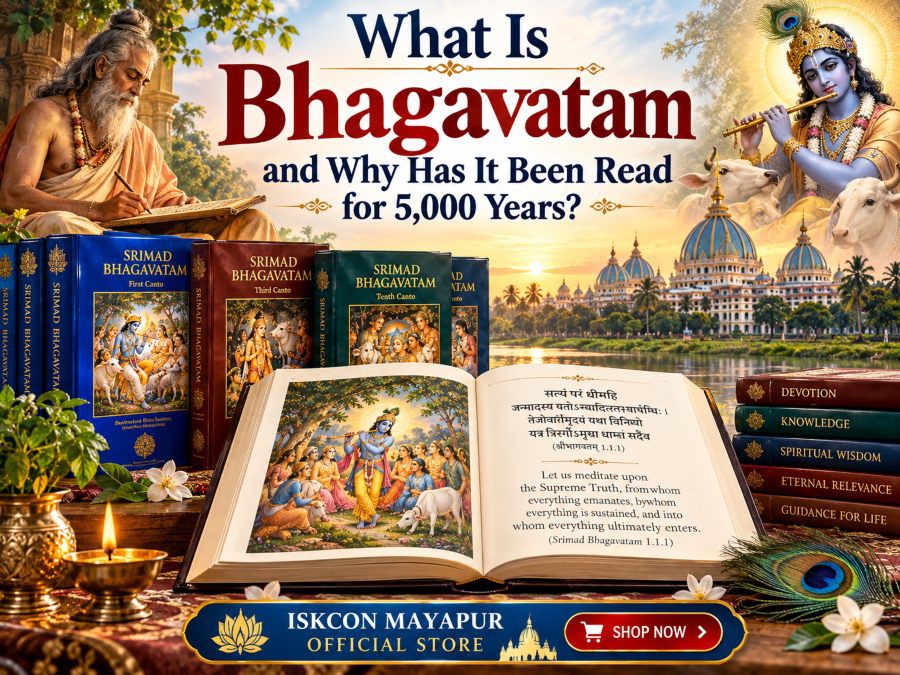 What Is Bhagavatam and Why Has It Been Read for 5,000 Years?Read more
A dying king asked one question, and the answer became the Bhagavatam. Learn what this Sanskrit scripture contains,...
-
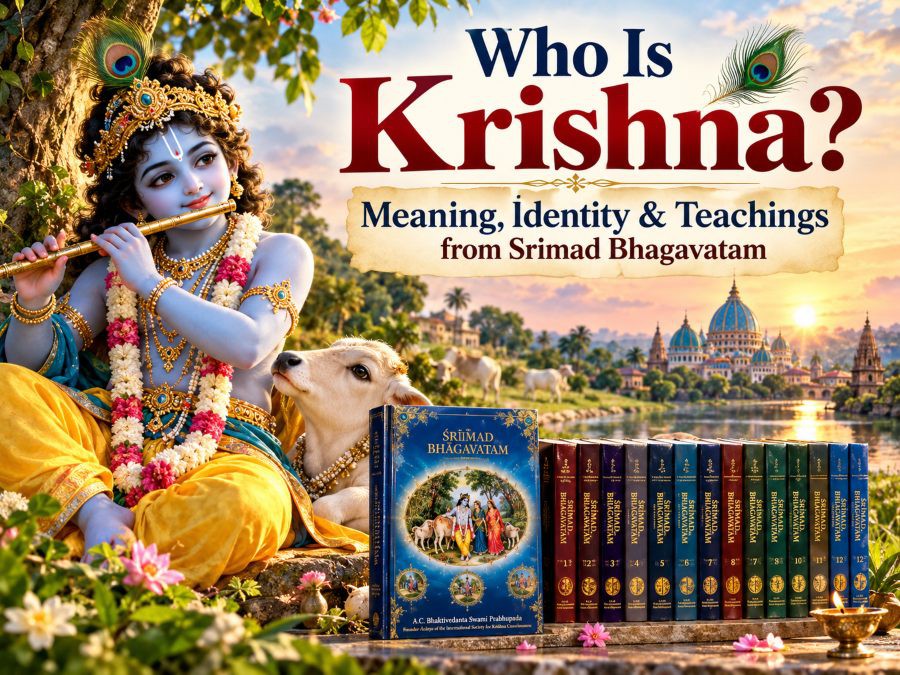 Who Is Lord Krishna? His Meaning, Teachings and Pastimes ExplainedRead more
Discover who Krishna is according to Srimad Bhagavatam, including His divine identity, childhood pastimes, teachings,...
-
 Incense in Islam: Bakhoor, Agarbatti and What Tradition SaysRead more
Is burning fragrance part of Muslim tradition? Explore incense in Islam, from the Prophetic practice of fumigating...
-
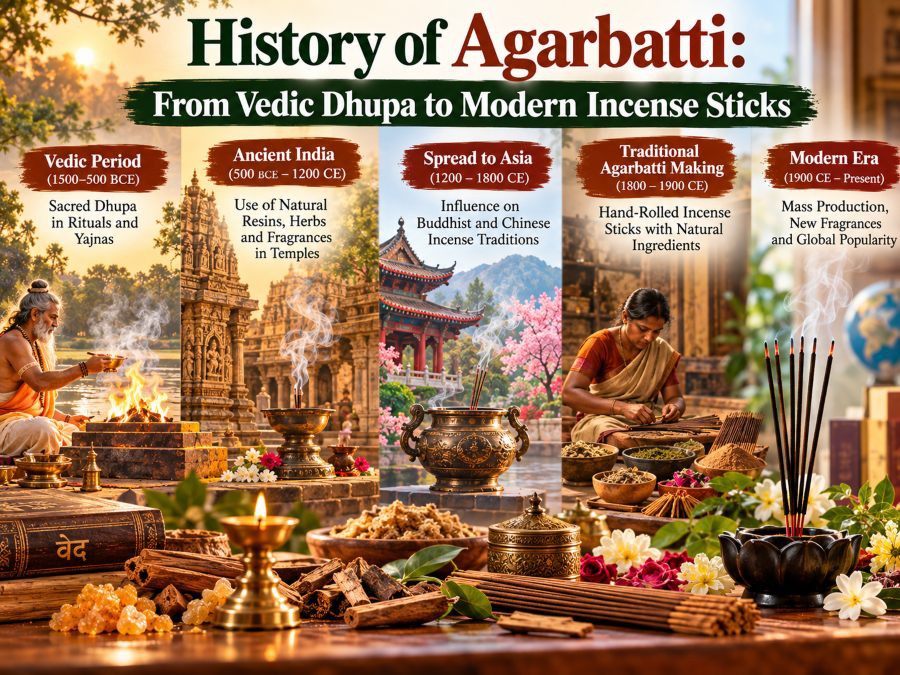 History of Agarbatti: From Vedic Dhupa to Modern Incense SticksRead more
Where did agarbatti really come from? Follow the history of agarbatti from Vedic fire rituals and temple dhupa to...
Blog categories
- Default category (0)
- MUSICAL INSTRUMENT (1)
- BOOK (5)
- DEVOTIONAL GIFT (0)
- Blog (30) click
- CHANDAN (12)
- Bhagavatam Wisdom Series (68)
- Krishna Consciousness (14)
- Mridangam Musical Instrument (6)
- Bhagavad Gita for Beginners (13)
- Bhagavad Gita As It Is (37) click
- Bhagavad Gita As It Is Telugu (0)
- Bhagavad Gita As It Is Marathi (0)
- Bhagavad Gita As It Is In Hindi (0)
- Bhagavad Gita As It Is In English (0)
- Bhagavad Gita As It Is In Bengali (8)
- Bhagavad Gita As It Is In Kannada (0)
- Bhagavad Gita As It Is In Gujarati (0)
- Bhagavad Gita As It Is In Panjabi (0)
- Bhagavad Gita As It Is In Tamil (0)
- Bhagavad Gita As It Is Odia (0)
- BHAGAVAD GITA As It Is GERMAN (0)
- Bhagavad Gita As It Is In French (0)
- Bhagavad Gita As It Is In Nepali (0)
- Bhagavad Gita As It Is In Assamese (0)
- Incense or Agarbatti (38)
- Lord Chaitanya Mahaprabhu (3)
- Vedic Temple Mayapur (14)
- kalki (15)
- Mahabharata – Dharma & Destiny (27)
- Vaishnava Scriptures (4)
- healthy product (4)
- chaitanya mahaprabhu (5)
- Tulsi Mala Guide (17)
Search in blog
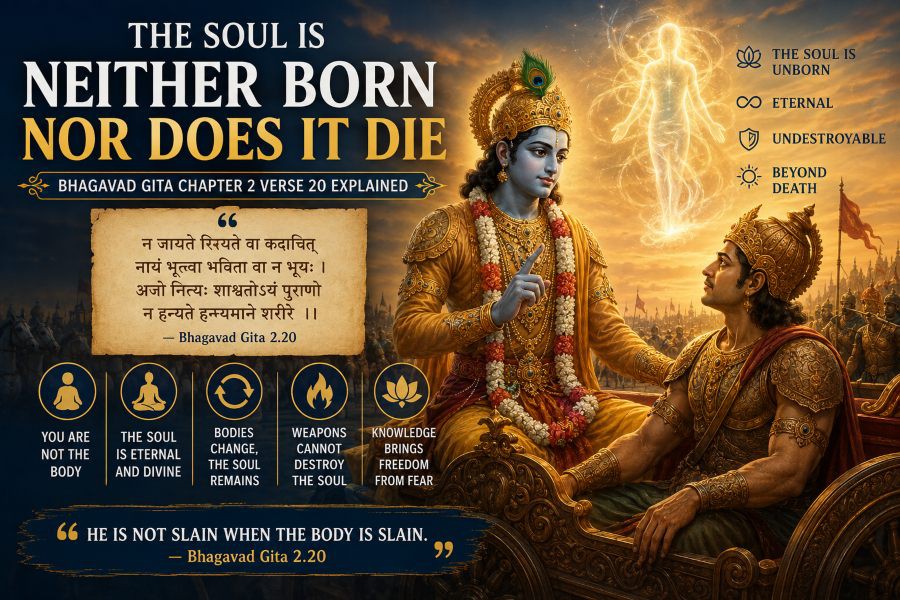
The Soul Is Neither Born Nor Does It Die — Bhagavad Gita 2.20 Explained
“The Soul Is Neither Born Nor Does It Die” — Bhagavad Gita Chapter 2 Verse 20 Explained
What if the deepest part of you has never actually been born—and therefore can never truly die? That is the startling idea at the heart of Bhagavad Gita Chapter 2 Verse 20, one of the most powerful teachings Krishna gives Arjuna on the battlefield of Kurukshetra. If you want to explore this teaching alongside the complete scripture, the ISKCON Bhagavad Gita Book offers the Sanskrit verses, translations, and detailed explanations in a traditional presentation.
At first, Bhagavad Gita 2.20 can sound almost impossible to understand. We watch people being born. We watch bodies grow old. We experience illness, loss, and eventually death. So how can Krishna say that the soul is unborn, eternal, ever-existing, and never destroyed?
The answer begins with a distinction that runs through the entire Bhagavad Gita:
You are not merely the body you inhabit.
The body changes. The person within it—the conscious self, or soul—is described by Krishna as something fundamentally different.
And once that distinction becomes clear, Chapter 2 of the Bhagavad Gita begins to look very different. Krishna is not simply trying to comfort Arjuna because he is afraid of death. He is trying to change Arjuna's entire understanding of life.
The Famous Bhagavad Gita 2.20 Quote
Krishna says:
“For the soul there is never birth nor death. Nor, having once been, does he ever cease to be. He is unborn, eternal, ever-existing, undying and primeval. He is not slain when the body is slain.”
The Sanskrit verse is:
na jāyate mriyate vā kadācin
nāyaṁ bhūtvā bhavitā vā na bhūyaḥ
ajo nityaḥ śāśvato 'yaṁ purāṇo
na hanyate hanyamāne śarīre
— Bhagavad Gita 2.20
This verse describes the soul through a series of powerful ideas: unborn, eternal, ever-existing, ancient, and indestructible. The verse also makes an important distinction between the destruction of the body and the continued existence of the soul.
But reading those words is one thing.
Understanding what Krishna actually means is another.
Why Does Krishna Talk About Death at the Beginning of Chapter 2?
To understand Bhagavad Gita 2.20, we have to return to the moment when Krishna speaks it.
Arjuna is standing on the battlefield of Kurukshetra. He has weapons in his hands, but his confidence has collapsed.
He sees teachers, relatives, friends, elders, and people he loves on the opposite side. Suddenly, the war is no longer an abstract battle between two armies. It has become intensely personal.
Arjuna begins to question everything.
What is victory worth if the people he loves must die?
What kind of happiness could come from defeating his own relatives?
Wouldn't it be better to walk away?
His crisis is not simply fear.
It is a crisis of identity, responsibility, morality, and his understanding of life and death.
Krishna responds by teaching him about the ātman, the eternal self.
That is why Bhagavad Gita Chapter 2 is so important. Before Krishna explains karma, meditation, knowledge, action, and devotion in greater detail, he first addresses the most basic question:
Who are you?
“You Are Not the Body” — The Central Idea Behind Bhagavad Gita 2.20
Most of us naturally identify ourselves with the body.
We say:
“I am young.”
“I am old.”
“I am sick.”
“I am strong.”
“I am beautiful.”
“I am tired.”
But notice something strange.
The body you had as a child is not the body you have today.
Your cells have changed. Your appearance has changed. Your abilities have changed. Your opinions have changed.
Yet there is a continuous sense of “I” running through all those changes.
The child you remember and the adult reading this article are physically very different, but you still experience them as different stages of the same life.
Krishna uses this broader idea to explain the soul.
The body changes.
The conscious self remains.
And death, according to Krishna's teaching, is another change of bodily condition rather than the destruction of the conscious self.
This idea appears immediately around Bhagavad Gita 2.20. Earlier, in Chapter 2, Krishna explains that just as the embodied self passes from childhood to youth to old age, it also passes onward at death.
That is the foundation for understanding the verse.
The Body Changes, But the “I” Continues
Think about an old photograph of yourself.
You may barely resemble that younger person.
The hairstyle is different. The face is different. The clothes are different. Your entire life may be different.
Yet you look at the photograph and say:
“That is me.”
What makes that continuity possible?
The Bhagavad Gita's answer is not simply memory.
Krishna points toward something deeper: the enduring self.
This doesn't mean the body is meaningless.
The body matters.
It is the vehicle through which we act, learn, serve, love, and experience the world.
But the body is not the whole story.
The Bhagavad Gita asks us to look beyond the temporary form toward the consciousness inhabiting it.
What Does “The Soul Is Unborn” Actually Mean?
The word aja in Bhagavad Gita 2.20 means unborn.
That is a profound statement.
Everything material appears to have a beginning.
A building is constructed.
A tree grows from a seed.
A child is born.
A star forms.
A product is manufactured.
A body comes into existence.
But Krishna says the soul does not begin in this way.
The soul is not something manufactured at the moment the body is born.
From the Gita's perspective, the soul already exists.
This changes the way we think about human existence.
Birth is not the beginning of the soul.
It is the beginning of a particular embodied experience.
That distinction is subtle, but it changes everything.
If the Soul Does Not Die, What Happens at Death?
This is where the teaching becomes even more interesting.
Krishna does not deny that bodies die.
He openly acknowledges bodily death.
The battlefield itself makes that impossible to ignore.
What Krishna rejects is the idea that the destruction of the body means the destruction of the soul.
The verse says:
“He is not slain when the body is slain.”
The body can be injured.
The body can age.
The body can stop functioning.
But according to the Bhagavad Gita, the soul itself cannot be destroyed by physical force.
This is why Krishna's teaching is not simply, “Don't worry about death.”
He is saying something much deeper:
You are worrying about the destruction of something that, at the deepest level, cannot be destroyed.
That does not make grief fake.
It does not mean loss doesn't hurt.
It means grief has to be understood within a larger view of existence.
Why This Teaching Is Not an Excuse to Ignore Death
There is a common misunderstanding here.
Someone hears, “The soul never dies,” and concludes:
“Then death doesn't matter.”
That is not what Krishna teaches.
Death matters enormously on the human level.
When someone we love dies, the relationship changes. Their physical presence is gone. We feel the absence. Memories can hurt. Families change. Daily routines change.
The Bhagavad Gita does not ask us to pretend otherwise.
Instead, it asks us to hold two truths at once:
The loss of the body is real.
The soul is not destroyed by that loss.
That distinction creates space for grief without turning grief into hopelessness.
You can mourn someone and still believe that their deepest identity has not been annihilated.
The Five Powerful Descriptions of the Soul in Bhagavad Gita 2.20
Krishna does not use just one word to describe the soul.
He gives several descriptions.
Each one adds another layer.
1. Unborn
The soul does not come into existence when the body is born.
2. Eternal
The soul is not temporary.
It does not exist for a limited period and then disappear.
3. Ever-existing
The soul's existence does not depend upon the changing condition of the body.
4. Primeval
The soul is ancient. It is not a newly manufactured object.
5. Undying
The soul cannot be destroyed when the physical body dies.
Put these ideas together and Krishna is presenting a radical picture of identity.
Your physical biography has a beginning and an ending. Your spiritual identity does not.
What Does “Primeval” Mean?
The word purāṇa in this context points toward something ancient or primeval.
But “ancient” here doesn't mean merely very old.
Something that is 10,000 years old still had a beginning.
Krishna is pointing toward a different category of existence.
The soul isn't simply an extremely old object.
It belongs to a dimension of existence where ordinary material measurements of beginning and ending don't apply in the same way.
This is one reason the Bhagavad Gita's concept of the soul can feel difficult to grasp.
We are trained to think in terms of objects.
Objects appear.
Objects change.
Objects disappear.
Krishna is describing the self as something fundamentally different from an object.
Why Bhagavad Gita 2.20 Matters When We Lose Someone
Imagine receiving a phone call you've been dreading.
Someone you love has died.
At that moment, philosophical arguments can feel very distant.
You don't think about Sanskrit vocabulary.
You think about a face.
A voice.
A conversation.
A memory.
A chair that is suddenly empty.
So what can a verse about the immortal soul possibly offer?
Not a quick escape from grief.
Something better: a larger framework for grief.
The Bhagavad Gita suggests that death is not the final definition of a person.
The body has ended, but the conscious self has not been destroyed.
That belief can transform the way a person approaches loss.
Instead of thinking:
“They are completely gone.”
The teaching encourages:
“Their physical form has ended, but the soul itself has not been destroyed.”
For a person who accepts the Bhagavad Gita's spiritual worldview, this can provide a foundation for hope without denying sadness.
The Bhagavad Gita and the Fear of Our Own Death
Now bring the teaching closer to yourself.
One day, your body will change beyond recognition.
Age will alter your appearance.
Your strength will decline.
Your possessions will belong to someone else.
People who know you today may eventually remember you as someone from another generation.
That thought can be uncomfortable.
We usually respond by trying not to think about it.
Krishna takes the opposite approach.
Look directly at mortality.
Then ask a deeper question:
What exactly is it that dies?
The body?
Yes.
The soul?
According to Bhagavad Gita 2.20, no.
This is why the verse is not simply a lesson about death.
It is a lesson about identity.
If you believe you are only the body, death appears to be total destruction.
If you understand yourself as an eternal soul temporarily connected with a body, death becomes a transition in the soul's journey.
That is an entirely different way of seeing existence.
What You Learn When You Read Bhagavad Gita Online
A person searching for bhagavad gita online may initially be looking for a verse, translation, or quick explanation. But Bhagavad Gita 2.20 becomes much richer when read alongside the verses around it.
Krishna doesn't introduce the soul's immortality as an isolated philosophical statement.
He builds an argument.
First, he points out that the embodied self moves through different stages of life.
Then he explains that temporary experiences come and go.
Then he discusses the distinction between the body and the enduring self.
Then Bhagavad Gita 2.20 pushes the idea further: the soul is not born and does not die.
This progression matters.
If you read only one sentence—“the soul never dies”—you might interpret it as a comforting slogan.
If you read Chapter 2 as a whole, you begin to see that Krishna is constructing a complete philosophy of identity, action, responsibility, and spiritual knowledge.
That is one reason studying the Bhagavad Gita verse by verse can be more meaningful than collecting isolated inspirational quotes.
Does Bhagavad Gita 2.20 Mean We Should Not Care About the Body?
No.
The Gita does not teach hatred of the body.
The body is part of human experience.
We should care for it.
We should feed it properly, protect it, keep it healthy, and use it responsibly.
But the Bhagavad Gita warns against confusing the temporary vehicle with the eternal self.
A car is useful.
But you are not the car.
A house is important.
But you are not the house.
A phone can contain photographs of your life.
But you are not your phone.
In the same way, the body is deeply connected with our current experience, yet Krishna says the self is deeper than the physical body.
That distinction is the practical heart of this teaching.
The Real Problem Is Not Death—It Is Misidentification
This may be the most important insight in Bhagavad Gita Chapter 2.
Krishna's deeper concern is not simply that Arjuna is afraid of death.
Arjuna has misunderstood who he is.
If he thinks bodily existence is the whole of reality, then death becomes the ultimate disaster.
But if he understands himself as an eternal soul, his perspective changes.
This does not automatically make difficult decisions easy.
It does something more useful.
It gives him a different foundation from which to make those decisions.
The same idea can apply to ordinary life.
We often suffer because we attach our identity to temporary things:
· Our job
· Our social status
· Our appearance
· Our wealth
· Our relationships
· Our achievements
· Our failures
· Other people's opinions
When those things change, our entire sense of self can collapse.
The Bhagavad Gita offers another possibility:
You have roles, but you are deeper than your roles.
You have possessions, but you are not your possessions.
You have a body, but you are not limited to the body.
You experience success and failure, but neither one completely defines you.
“I Am More Than What Happens to Me”
This is where an ancient spiritual teaching becomes surprisingly practical.
Suppose you lose your job.
Your role changes.
You are still you.
Suppose your appearance changes with age.
Your body changes.
You are still you.
Suppose your financial situation collapses.
Your circumstances change.
You are still you.
Suppose people stop praising you.
Their opinions change.
You are still you.
The Bhagavad Gita does not promise that circumstances will remain stable.
Quite the opposite.
It teaches us that material circumstances are naturally temporary.
What it offers is a deeper identity that isn't destroyed every time circumstances shift.
That is one reason Bhagavad Gita 2.20 remains relevant thousands of years after it was spoken.
How the Soul Teaching Changes the Meaning of Success
If you believe your identity is entirely physical, success can become a desperate race.
More money.
More recognition.
More influence.
More possessions.
More achievements.
Why?
Because the ego keeps asking:
“What do I have to prove?”
But when the self is understood as spiritual and eternal, external achievement begins to lose its power to define your worth.
You can still work hard.
You can still build a business.
You can still become highly skilled.
You can still pursue excellence.
But your identity doesn't have to depend entirely on the result.
This connects Bhagavad Gita 2.20 with another major teaching from Chapter 2: acting responsibly while remaining less attached to temporary outcomes.
The Gita isn't asking you to become passive.
It is asking you to become inwardly stable.
Why Krishna Teaches Immortality Before Teaching Action
This order is fascinating.
Krishna could have simply told Arjuna:
“Go fight.”
He doesn't.
First, he changes Arjuna's understanding of the self.
Why?
Because action without understanding can become mechanical, while understanding can transform the quality of action.
If you believe your entire existence is limited to temporary circumstances, fear can control your decisions.
If you understand yourself as an eternal soul, your priorities can change.
You may become less obsessed with reputation.
Less terrified of temporary failure.
Less consumed by comparison.
More willing to act according to principle.
This is why Bhagavad Gita 2.20 should not be separated from the larger message of Chapter 2.
Krishna is preparing Arjuna to act from knowledge rather than panic.
Does the Soul Have a Beginning?
According to Bhagavad Gita 2.20, no.
The soul is described as aja, unborn.
That means the soul is not created in the ordinary material sense.
This idea is one of the biggest differences between the Gita's view of the self and a purely material understanding of human identity.
A materialist explanation might say consciousness emerges from physical processes.
The Bhagavad Gita reverses the direction.
Consciousness is associated with the living self, while the body is temporary.
From this perspective, consciousness is not simply an accidental product of matter.
The body is the temporary field through which the soul experiences the material world.
This philosophical question remains one of the deepest issues raised by the Bhagavad Gita:
Are we physical beings who happen to experience consciousness, or conscious beings who are temporarily experiencing physical existence?
Krishna's answer is unmistakable.
The self is spiritual.
What Happens to the Soul After Death?
Bhagavad Gita 2.20 establishes that the soul is not destroyed by bodily death.
The broader Bhagavad Gita goes further and explains the soul's continuing journey.
Krishna later describes the process of leaving one body and receiving another, comparing it to a person changing worn-out clothes for new ones.
The important point is that the soul continues while the external body changes.
This gives death a different meaning.
It is not presented as absolute annihilation.
It is a transition.
Of course, this teaching belongs to a specific spiritual worldview, and readers from different philosophical or religious backgrounds may interpret it differently.
The value of studying the verse is not that everyone must immediately accept every claim.
It is that the Bhagavad Gita asks us to seriously examine an assumption most people rarely question:
What if death changes the body but does not destroy the person?
That question alone can transform how we think about life.
The Soul Cannot Be Destroyed by Material Weapons
The Bhagavad Gita continues the discussion in the following verses.
Krishna explains that the soul cannot be cut by weapons, burned by fire, moistened by water, or dried by wind.
These images are powerful because they move through the major forces that destroy physical things.
A sword can cut flesh.
Fire can burn wood.
Water can dissolve or damage objects.
Wind can dry them out.
But none of these forces can destroy the soul.
The point is not to describe the soul as an unusually durable physical substance.
The point is precisely the opposite.
The soul is not material.
Therefore, material methods of destruction cannot destroy it.
This is why Bhagavad Gita 2.20 should be read philosophically rather than merely literally.
Krishna is drawing a line between two categories of existence.
The body belongs to the temporary material world.
The soul belongs to a different order of reality.
A Simple Example: The Actor and the Costume
Imagine an actor performing on stage.
During one scene, the actor wears the clothes of a king.
In another scene, the same actor may wear the clothes of a poor traveler.
The costume changes.
The actor remains.
Now imagine becoming so absorbed in the costume that you forget the person wearing it.
The Bhagavad Gita uses a similar conceptual distinction.
The body is temporary.
The soul is the conscious self within it.
We identify so strongly with the body that we forget the deeper identity Krishna is trying to reveal.
The analogy isn't perfect, but it helps explain why the Gita repeatedly distinguishes the person from the physical form.
What Bhagavad Gita 2.20 Can Teach Us About Aging
Nobody escapes aging.
Even people who spend enormous amounts of money trying to slow it eventually face the same reality.
Hair changes.
Skin changes.
Muscles weaken.
Memory may change.
The body becomes less capable.
If identity is completely tied to the body, aging can feel like a gradual loss of self.
But Krishna offers another interpretation.
The body is changing because that is what material bodies do.
The deeper self is not defined by the body's age.
This doesn't mean we should ignore aging.
It means we don't have to interpret aging as the destruction of our essential identity.
There is something deeply freeing about that.
How to Apply This Teaching Without Escaping Real Life
The Bhagavad Gita is not asking us to stop caring about family, work, health, or society.
It asks us to engage with them from a deeper understanding.
Here are a few practical ways to apply Bhagavad Gita 2.20.
1. Remember that circumstances are temporary
When something goes wrong, tell yourself:
“This is happening to my current situation. It does not define the whole of who I am.”
That small distinction can create emotional space.
2. Don't make your achievements your identity
You can celebrate success without becoming dependent on it.
3. Don't let failure become your identity
A failed business, rejected application, broken relationship, or disappointing result is an event.
It is not your eternal identity.
4. Treat the body with respect
The body is temporary, but that doesn't make it worthless.
Use it well.
Care for it.
Serve through it.
5. Reflect on mortality
Instead of constantly avoiding the subject, occasionally sit quietly and ask:
“If my body is temporary, what is the deeper self Krishna is describing?”
That question can become a doorway to serious spiritual study.
A Powerful Daily Reflection From Bhagavad Gita 2.20
Try this simple exercise.
Sit quietly for five minutes.
Notice your body.
Your breathing.
Your hands.
Your face.
Your thoughts.
Then ask:
“Am I aware of my body?”
Yes.
Then:
“If I am aware of my body, am I identical to the body—or am I the conscious self experiencing it?”
Don't rush to answer.
Just observe.
Then think about your childhood.
Your body changed.
Your thoughts changed.
Your circumstances changed.
Yet there was a continuous “I” throughout the process.
Finally, bring Bhagavad Gita 2.20 to mind:
The soul is unborn, eternal, ever-existing, and undying.
You don't have to force an emotional experience.
Just allow the idea to sit with you.
Sometimes a profound teaching becomes clearer when we stop trying to make it immediately useful.
Why This One Verse Can Change the Way You See Life
Bhagavad Gita 2.20 begins with death but ultimately points toward life.
If the soul is eternal, then every human being has a dimension of existence deeper than temporary circumstances.
That can change how you see yourself.
It can change how you see other people.
It can change how you understand grief.
It can change your relationship with aging.
It can change your attitude toward success and failure.
And perhaps most importantly, it can change the question you ask.
Instead of:
“How can I make my temporary life perfect?”
you begin asking:
“How can I understand who I really am?”
That is a much bigger question.
The Bhagavad Gita Is Not Asking You to Fear Death Less—It Is Asking You to Understand Life More Deeply
There is a subtle difference.
Many motivational teachings tell us not to fear death.
Krishna does something more profound.
He investigates the identity of the person who fears death.
That is why Bhagavad Gita Chapter 2 Verse 20 remains so powerful.
It doesn't simply say:
“Don't worry.”
It says:
Understand the self.
Understand that the body is temporary.
Understand that material circumstances change.
Understand that the soul is not destroyed with the body.
Then live according to that knowledge.
The teaching is not an invitation to become detached from human life in a cold or careless way.
It is an invitation to participate in life without forgetting its deeper spiritual dimension.
Final Reflection: What If You Are More Than Your Story?
Your name is temporary.
Your job is temporary.
Your possessions are temporary.
Your appearance is temporary.
Your relationships, roles, successes, and failures all exist within time.
But the Bhagavad Gita asks us to look beneath all of them.
Chapter 2, Verse 20 gives a startling answer:
The deepest self is not born when the body is born, and it does not die when the body dies.
That idea can be difficult to accept.
It can also be difficult to ignore.
If Krishna is right, then death is not the end of the soul.
Aging is not the destruction of the self.
Failure is not the destruction of the self.
Loss is not the destruction of the self.
And even the most dramatic changes in our temporary lives cannot touch the deepest identity described in this verse.
Perhaps that is why this ancient teaching still speaks so strongly to people who are facing very modern problems.
We worry about careers.
Money.
Relationships.
Aging.
Reputation.
Failure.
Death.
Krishna takes us underneath all those worries and asks a more fundamental question:
Who is the person experiencing all of this?
Bhagavad Gita 2.20 answers:
The soul is unborn. The soul is eternal. The soul is never destroyed.
And if we begin to live from that understanding, the goal is not to abandon the world.
It is to move through the world with greater clarity.
To work without believing that achievement defines our worth.
To love without forgetting that bodies are temporary.
To grieve without believing that existence has been annihilated.
To care for the body without mistaking it for the whole self.
And to face death not with denial, but with knowledge.
That may be the real power of this verse.
The Bhagavad Gita does not merely tell us that the soul survives death. It asks us to discover the self that was never truly subject to birth or death in the first place.
Posted in: Bhagavad Gita As It Is
Related posts
-
 Why the Bhagavad Gita Feels Like a Personal Conversation with KrishnaThe Bhagavad Gita feels like a personal conversation with Krishna because its timeless wisdom directly addresses our...Read more
 -
 Shrimad Bhagwat Geeta: The Forgotten Life Manual for Modern StressShrimad Bhagwat Geeta is more than a sacred scripture—it’s a forgotten life manual that offers timeless solutions for...Read more
 -
 Who Wrote the Bhagavad Gita? Discover the true authorship of the Bhagavad Gita—exploring Ved Vyasa’s role as the compiler, Lord Krishna’s divine...Read more
 -
 How Many Shlokas in Bhagavad Gita? Complete Chapter-Wise Breakdown & MeaningDiscover how many shlokas are in the Bhagavad Gita, with a complete chapter-wise breakdown, variations in verse...Read more
 -
 How to Read Bhagavad Gita: A Complete Step-by-Step Guide for BeginnersDiscover how to read the Bhagavad Gita step by step—learn the right mindset, chapter order, and tips to understand...Read more
Leave a comment