
Why did Krishna run to embrace a poor brahmin in rags? Read the Sudama story from the Bhagavatam and learn how a...
Latest posts
-
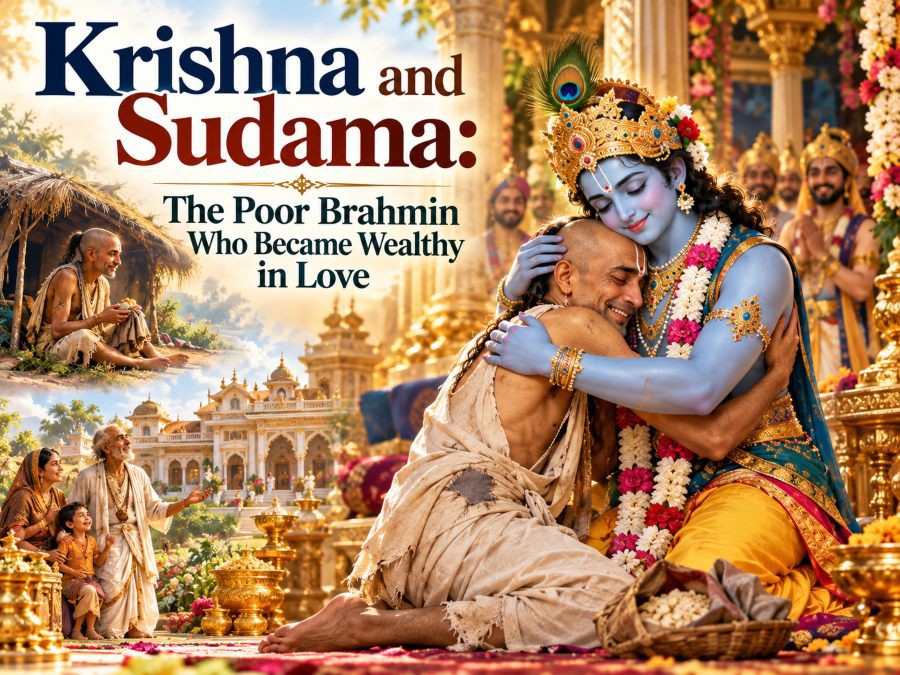 Krishna and Sudama: The Poor Brahmin Who Became Wealthy in LoveRead more
 -
 Vamana Avatar: How Three Steps Humbled Bali MaharajaRead more
Why did a powerful king give away three worlds to a boy asking for three steps? Learn the Vamana avatar story from...
-
 The Bhagavatam on Marriage: Duty, Love and Spiritual PartnershipRead more
What does the Bhagavatam say about marriage? Through the stories of Kardama and Devahuti, Rukmini's secret letter and...
-
 What Is Prema? The Bhagavatam's Highest Stage of Love for GodRead more
Prema is love for God with no "because" attached. Learn how the Bhagavatam describes it, the nine steps from faith to...
-
 Is Shiva Parvati Kalyana Mentioned in Srimad Bhagavatam? What the Scripture Really SaysRead more
Looking for Shiva and Parvati's wedding in the Srimad Bhagavatam? Find out what the scripture actually describes,...
-
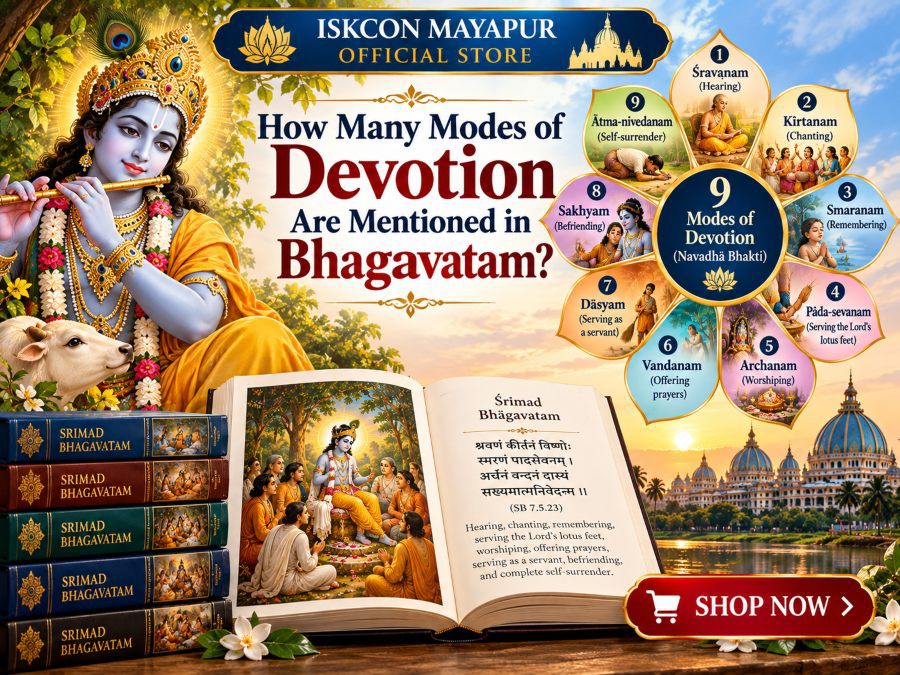 How Many Modes of Devotion Are Mentioned in Bhagavatam?Read more
A young boy named Prahlada listed nine ways to serve God, and the Bhagavatam keeps them as its answer. Learn what the...
-
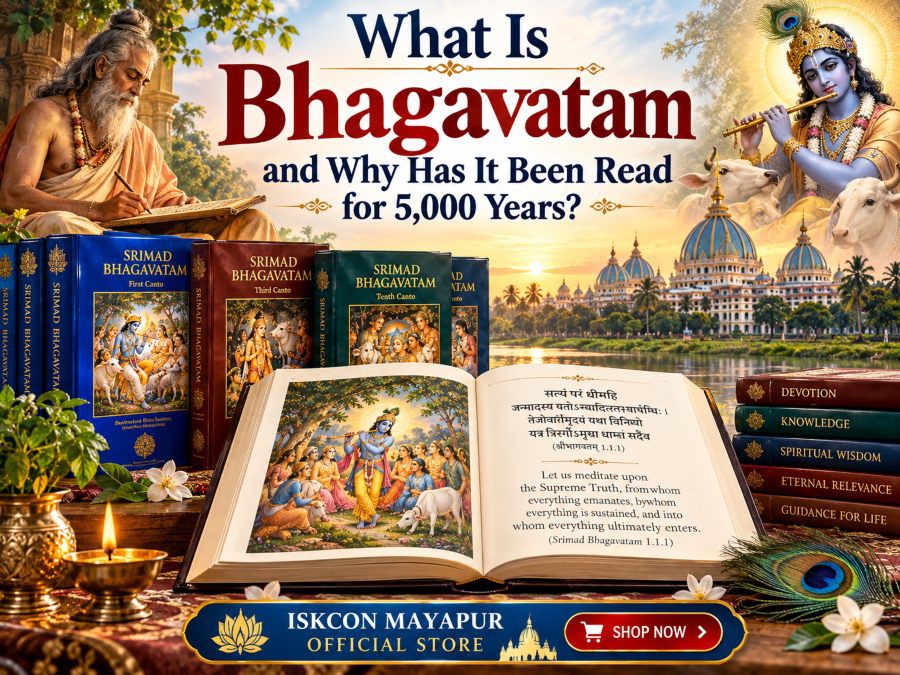 What Is Bhagavatam and Why Has It Been Read for 5,000 Years?Read more
A dying king asked one question, and the answer became the Bhagavatam. Learn what this Sanskrit scripture contains,...
-
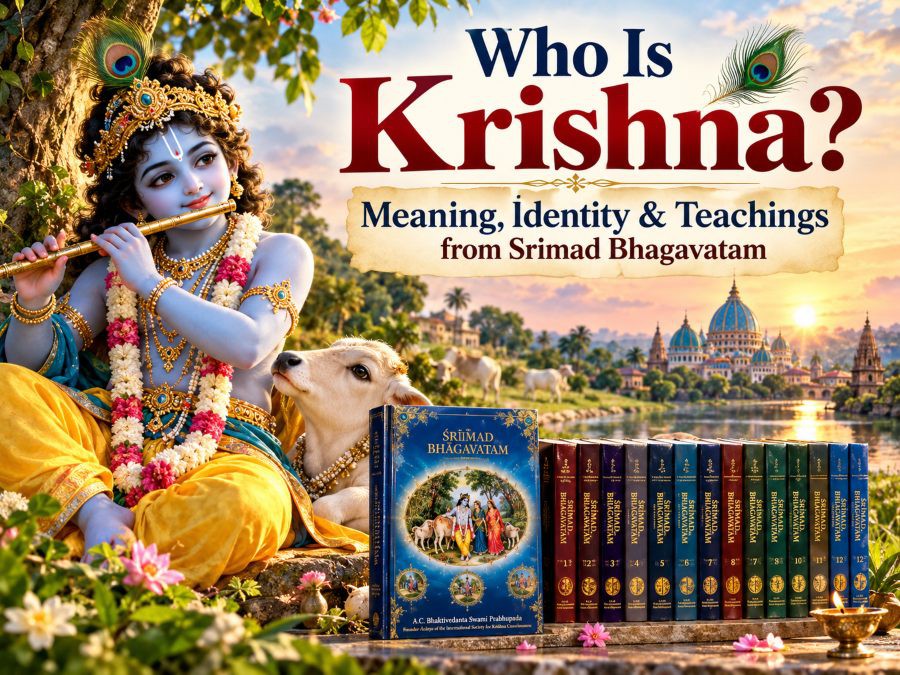 Who Is Lord Krishna? His Meaning, Teachings and Pastimes ExplainedRead more
Discover who Krishna is according to Srimad Bhagavatam, including His divine identity, childhood pastimes, teachings,...
-
 Incense in Islam: Bakhoor, Agarbatti and What Tradition SaysRead more
Is burning fragrance part of Muslim tradition? Explore incense in Islam, from the Prophetic practice of fumigating...
-
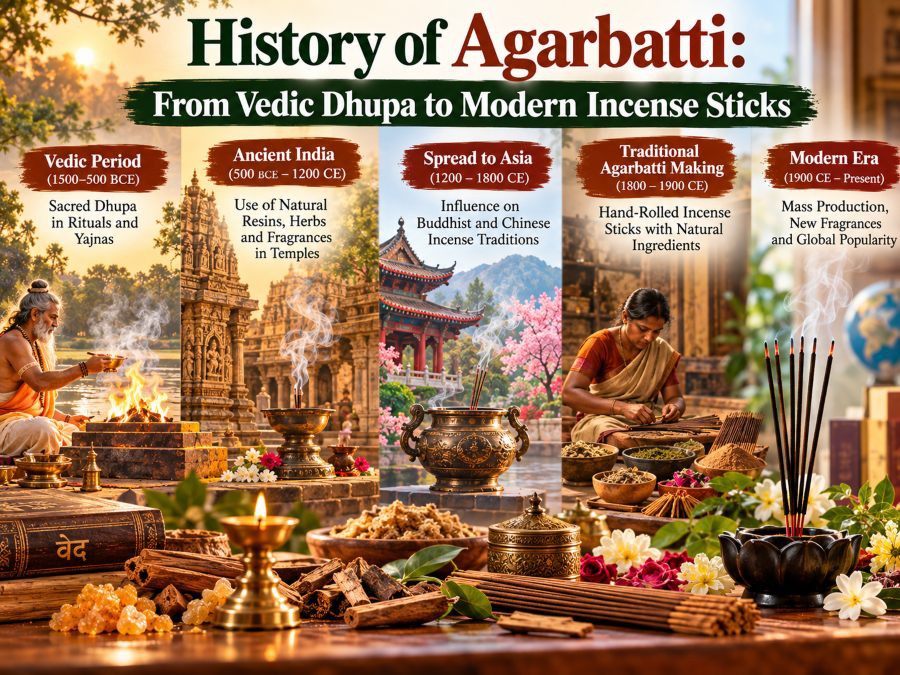 History of Agarbatti: From Vedic Dhupa to Modern Incense SticksRead more
Where did agarbatti really come from? Follow the history of agarbatti from Vedic fire rituals and temple dhupa to...
Blog categories
- Default category (0)
- MUSICAL INSTRUMENT (1)
- BOOK (5)
- DEVOTIONAL GIFT (0)
- Blog (30) click
- CHANDAN (12)
- Bhagavatam Wisdom Series (68)
- Krishna Consciousness (14)
- Mridangam Musical Instrument (6)
- Bhagavad Gita for Beginners (13)
- Bhagavad Gita As It Is (37) click
- Bhagavad Gita As It Is Telugu (0)
- Bhagavad Gita As It Is Marathi (0)
- Bhagavad Gita As It Is In Hindi (0)
- Bhagavad Gita As It Is In English (0)
- Bhagavad Gita As It Is In Bengali (8)
- Bhagavad Gita As It Is In Kannada (0)
- Bhagavad Gita As It Is In Gujarati (0)
- Bhagavad Gita As It Is In Panjabi (0)
- Bhagavad Gita As It Is In Tamil (0)
- Bhagavad Gita As It Is Odia (0)
- BHAGAVAD GITA As It Is GERMAN (0)
- Bhagavad Gita As It Is In French (0)
- Bhagavad Gita As It Is In Nepali (0)
- Bhagavad Gita As It Is In Assamese (0)
- Incense or Agarbatti (38)
- Lord Chaitanya Mahaprabhu (3)
- Vedic Temple Mayapur (14)
- kalki (15)
- Mahabharata – Dharma & Destiny (27)
- Vaishnava Scriptures (4)
- healthy product (4)
- chaitanya mahaprabhu (5)
- Tulsi Mala Guide (17)
Search in blog
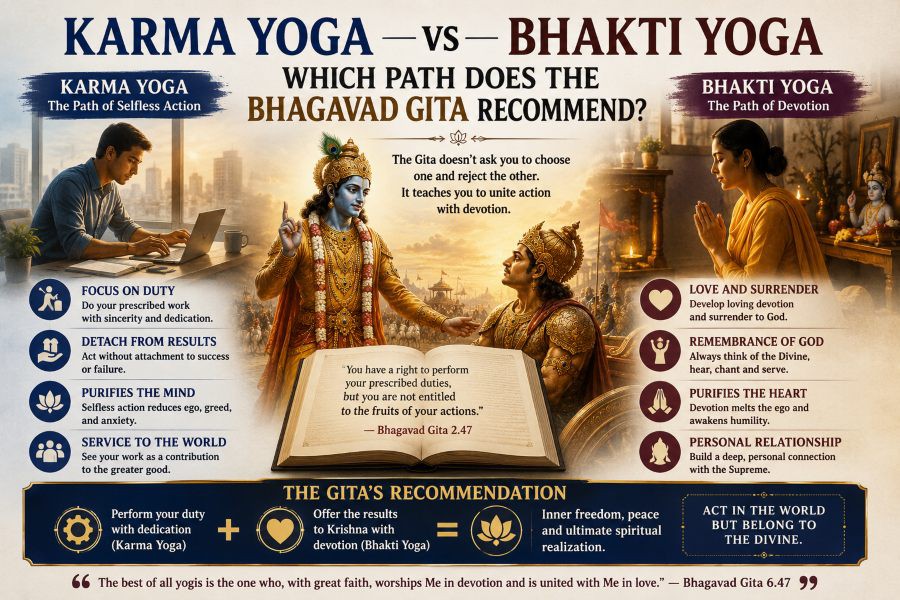
Karma Yoga vs Bhakti Yoga: Which Path Does the Bhagavad Gita Recommend?
Karma Yoga vs Bhakti Yoga: Which Path Does the Gita Recommend?
What if the biggest mistake in spiritual life is thinking you have to choose between action and devotion? One person believes spirituality means working selflessly, while another feels that surrendering to God is the highest path. Yet when we read the Bhagavad Gita carefully, Krishna's message is more nuanced. He does not simply place Karma Yoga and Bhakti Yoga on opposite sides and ask everyone to pick one. He shows how action, knowledge, devotion, and surrender can gradually lead the seeker toward the same spiritual goal. For readers looking to explore the teachings in greater depth, www.mayapur.store offers resources connected with the Vaishnava tradition and spiritual practice.
So, which path does the Bhagavad Gita actually recommend?
The short answer is: Krishna emphasizes both, but Bhakti becomes the heart of the spiritual journey, while selfless action prepares and purifies the mind.
Understanding why requires looking beyond the labels.
Karma Yoga and Bhakti Yoga: Two Paths That Seem Different
At first glance, Karma Yoga and Bhakti Yoga appear to ask for completely different things.
Karma Yoga focuses on action.
You work. You perform your responsibilities. You serve others. But instead of becoming obsessed with personal rewards, you offer the results of your actions to a higher purpose.
Bhakti Yoga focuses on devotion.
You cultivate a relationship with the Supreme, remember Krishna, hear about Him, chant His names, offer your activities to Him, and gradually develop loving devotion.
One sounds practical.
The other sounds deeply spiritual.
But the Bhagavad Gita doesn't create such a rigid division.
Krishna repeatedly connects the two.
A person can perform ordinary duties while cultivating devotion. A devotee can serve through action. And someone practicing Karma Yoga can gradually become less attached to temporary rewards, making the mind more receptive to spiritual realization.
The paths can overlap.
What Exactly Is Karma Yoga?
Karma Yoga is often translated as the yoga of action, but that phrase can be misleading.
It doesn't simply mean “work hard.”
Most people already work hard.
The distinctive feature of Karma Yoga is the consciousness behind the action.
Krishna teaches Arjuna to perform his duty without becoming enslaved by the results.
That changes the question.
Instead of asking:
“What will I get from this?”
the Karma Yogi asks:
“What is the right thing to do, and how can I perform it properly?”
This doesn't mean results are irrelevant.
A farmer still wants a good harvest. A student still wants to learn. A business owner still wants the business to succeed.
The difference is psychological.
The person acts sincerely but doesn't allow the expected outcome to control his entire emotional state.
That is the spirit of Karma Yoga.
The Gita's Famous Teaching on Action
One of the best-known verses of the Bhagavad Gita appears in Chapter 2, Verse 47:
“You have a right to perform your prescribed duties, but you are not entitled to the fruits of your actions.”
Krishna isn't telling Arjuna to become careless.
He is warning him against attachment to results.
There is an enormous difference.
Detachment does not mean lack of effort.
It means giving your best without making the outcome the foundation of your identity.
You can work intensely and still remain inwardly free.
That is Karma Yoga.
Then What Is Bhakti Yoga?
Bhakti Yoga is the path of loving devotion to the Supreme.
Instead of seeing spiritual life mainly as controlling desire or understanding philosophical truths, Bhakti places relationship at the center.
The practitioner develops remembrance, affection, service, prayer, chanting, and surrender.
In the Bhagavad Gita, Krishna repeatedly invites Arjuna to think of Him, devote himself to Him, worship Him, and offer his actions to Him.
One of the clearest examples comes in Chapter 9, Verse 34:
“Always think of Me, become My devotee, worship Me and offer your homage unto Me.”
The important word here is not simply “worship.”
It is relationship.
Bhakti isn't merely following a religious routine.
At its deepest level, it means allowing one's consciousness to become oriented toward Krishna with genuine love.
Why the Shrimad Bhagavad Gita Doesn't Treat Work and Devotion as Enemies
If you study the shrimad bhagavad gita carefully, something interesting becomes obvious: Krishna doesn't tell Arjuna to abandon action in order to become spiritual.
That would have been an easy answer.
Arjuna could simply put down his weapons and walk away.
Krishna doesn't recommend that.
Instead, He teaches Arjuna how to transform the consciousness behind his actions.
This is one of the most practical ideas in the entire Gita.
Spiritual life doesn't necessarily begin when ordinary responsibilities end.
It can begin when ordinary responsibilities are performed with a different purpose.
Cooking can become service.
Working can become service.
Teaching can become service.
Running a business can become service.
Caring for a family can become service.
Creating something useful can become service.
The external activity may look ordinary.
The inner intention changes everything.
Which Path Does Krishna Recommend?
Now we reach the heart of the question.
Does Krishna recommend Karma Yoga or Bhakti Yoga?
The Bhagavad Gita gives a layered answer.
Krishna certainly praises Karma Yoga. He repeatedly instructs Arjuna to act according to his duty without attachment.
But as the Gita progresses, devotion becomes increasingly central.
Krishna doesn't merely want Arjuna to perform action without attachment.
He wants Arjuna to offer those actions to Him.
That's a major distinction.
Karma Yoga can teach:
“Do your duty without selfish attachment.”
Bhakti Yoga takes the next step:
“Do your duty as an offering to Krishna.”
The action may remain the same.
The consciousness becomes different.
Karma Yoga Can Prepare the Heart for Bhakti
Imagine someone whose mind is constantly chasing rewards.
Money.
Praise.
Recognition.
Status.
Success.
Such a mind finds devotion difficult.
Why?
Because attention is always being pulled outward.
“What will I get?”
“Will people appreciate me?”
“Did I win?”
“Did I lose?”
“Am I ahead?”
Karma Yoga gradually loosens that grip.
When you repeatedly act without demanding personal rewards, you begin to notice how much of your anxiety came from attachment to outcomes.
The mind becomes steadier.
And a steadier mind can turn toward spiritual subjects more naturally.
This is why Karma Yoga shouldn't be dismissed as merely an introductory path.
It can transform the inner habits that prevent deeper devotion.
Bhakti Gives Karma Yoga a Deeper Purpose
Now reverse the picture.
Suppose someone performs work without attachment but has no higher purpose.
That can certainly produce calmness.
But Krishna's teaching goes beyond psychological detachment.
He encourages Arjuna to connect action with the Supreme.
This is where Bhakti gives Karma Yoga a deeper direction.
Instead of simply thinking:
“I don't care about the result.”
the devotee thinks:
“I will do this sincerely and offer the result to Krishna.”
That is much warmer.
It isn't indifference.
It is dedication.
The devotee still cares about doing the work properly because the work is being offered as service.
Does Bhakti Mean Giving Up Your Career and Family?
Absolutely not.
This is one of the most common misunderstandings.
You don't need to abandon your profession, family, education, or responsibilities to practice Bhakti Yoga.
The Bhagavad Gita was spoken to a warrior who was standing in the middle of a battlefield.
Krishna's instruction was not:
“Escape your responsibilities.”
It was:
“Transform the consciousness with which you perform them.”
That makes the Gita surprisingly relevant to modern life.
A person can practice devotion while working a regular job.
A parent can practice devotion while raising children.
A student can practice devotion while studying.
An entrepreneur can practice devotion while building a company.
The external situation may differ.
The principle remains the same.
The Difference Between Doing Something for Yourself and Offering It to Krishna
Consider two people doing exactly the same job.
Both work eight hours.
Both complete their responsibilities.
Both receive the same salary.
Externally, their lives may look identical.
Internally, however, their motivations could be completely different.
One thinks:
“How much can I gain from this?”
The other thinks:
“How can I perform this work honestly and offer the results in service to Krishna?”
The action looks similar.
The consciousness isn't.
That is the subtle power of the Bhagavad Gita.
It doesn't always require changing what you do.
Sometimes it asks you to change why you do it.
Bhakti Yoga Is Not Just Emotion
Some people hear “devotion” and imagine sentimental religious emotion.
Bhakti is deeper than that.
Real devotion includes:
· Remembrance of Krishna
· Service
· Humility
· Sincere prayer
· Hearing spiritual teachings
· Chanting
· Offering one's activities
· Developing dependence on the Supreme
Emotion may naturally grow from these practices, but Bhakti isn't dependent on constantly feeling inspired.
There will be ordinary days.
There will be distracted days.
There will be difficult days.
A genuine devotional practice continues anyway.
That consistency is part of spiritual maturity.
What About People Who Prefer Philosophy?
The Bhagavad Gita also recognizes that people have different temperaments.
Some are naturally analytical.
Some are action-oriented.
Some are devotional.
Some begin with discipline and gradually develop deeper spiritual understanding.
Krishna doesn't force everyone into the same psychological mold.
Yet He repeatedly brings the discussion back toward devotion and surrender.
This is important.
The Gita is not saying:
“Only one personality type can approach God.”
It is showing different ways consciousness can become purified and directed toward the Supreme.
Karma Yoga Without Bhakti Can Become Another Form of Ego
Here's a subtle trap.
A person may say:
“I don't care about results. I'm completely detached.”
But secretly, he may become proud of his detachment.
Now the ego has simply changed clothes.
Instead of:
“Look how successful I am.”
it becomes:
“Look how spiritually advanced I am.”
The Bhagavad Gita's approach is more demanding.
True spiritual action is not about creating a more sophisticated version of the ego.
It is about moving beyond the ego's demand to be the center of everything.
Bhakti helps because devotion naturally shifts attention from “What can I get?” toward “How can I serve?”
That is a profound change.
Why Krishna's Personal Teaching Matters
One of the distinctive features of the Bhagavad Gita is that Krishna doesn't merely present an abstract spiritual principle.
He presents Himself as the object of devotion.
That makes Bhakti personal.
The goal isn't simply:
“Become detached.”
It is:
“Become connected with Me.”
That difference matters.
Detachment removes unhealthy dependence on temporary things.
Devotion replaces that dependence with a higher relationship.
You don't simply empty the heart.
You redirect it.
The Gita's Strongest Message: Integrate, Don't Fragment
Perhaps the most useful way to compare Karma Yoga and Bhakti Yoga is to stop treating them as competing systems.
Think of them as two dimensions of spiritual life.
Karma Yoga teaches you how to act.
Bhakti Yoga teaches you whom and what to act for.
Karma Yoga can reduce selfish attachment.
Bhakti Yoga can fill that space with devotion.
Karma Yoga disciplines action.
Bhakti Yoga gives action a loving purpose.
Karma Yoga says:
“Don't become a slave to the result.”
Bhakti says:
“Offer the result to Krishna.”
Together, they create a much richer spiritual practice.
So, Which Path Should You Follow?
If you're genuinely asking what the Bhagavad Gita recommends, the answer depends partly on where you are starting.
If you're constantly stressed about results
Begin by applying Karma Yoga.
Do your work carefully, but stop allowing every result to determine your happiness.
If you already feel naturally drawn toward Krishna
Develop Bhakti through remembrance, prayer, chanting, study, and service.
If you are highly intellectual
Study the philosophy deeply, but don't assume intellectual understanding alone is the final destination.
If you feel devotional but struggle with discipline
Bring Bhakti into your daily actions.
Don't separate “spiritual time” from the rest of your life.
If you're searching for a complete approach
Combine them.
Work sincerely. Give up selfish attachment. Remember Krishna. Offer your actions to Him.
That approach reflects the broad movement of the Bhagavad Gita.
A Simple Way to Practice Both Paths Every Day
You don't need an elaborate routine to begin.
Try this:
Before work:
Take a moment to remember Krishna and consciously dedicate your day's activities.
During work:
Focus on the task instead of constantly imagining the reward.
When success comes:
Be grateful rather than becoming arrogant.
When failure comes:
Learn from it without allowing it to destroy your sense of identity.
At the end of the day:
Reflect on whether your actions were performed selfishly or as service.
Before sleeping:
Spend a few quiet minutes remembering Krishna.
It sounds simple.
It is.
But simple practices repeated sincerely can reshape consciousness.
The Deeper Answer Krishna Gives Arjuna
The real question isn't:
“Should I choose Karma Yoga or Bhakti Yoga?”
The deeper question is:
“How can my actions become an expression of spiritual purpose?”
That is where the two paths meet.
Karma Yoga teaches us not to become imprisoned by results.
Bhakti Yoga teaches us to direct our heart toward Krishna.
When action becomes service, work becomes spiritually meaningful.
When devotion enters action, ordinary responsibilities can become part of one's spiritual journey.
And when attachment to personal reward decreases, the mind becomes freer to experience genuine devotion.
Karma Yoga or Bhakti Yoga? The Gita's Answer in One Sentence
If we had to reduce the entire discussion to one sentence, it would be this:
The Bhagavad Gita does not ask us to choose between meaningful action and loving devotion; it teaches us to perform our duties without selfish attachment and gradually offer those actions to Krishna.
Karma Yoga and Bhakti Yoga are therefore not enemies.
They can function together.
One purifies the way we act.
The other transforms the purpose behind those actions.
And Krishna's message to Arjuna points beyond both labels toward a life in which action becomes service, knowledge becomes understanding, and devotion becomes the center of consciousness.
That is why the Bhagavad Gita remains so relevant.
It doesn't tell us that spiritual life begins after ordinary life is finished.
It asks us to transform ordinary life itself.
Do your work.
Don't become owned by its results.
Remember the Supreme.
Offer what you do with sincerity.
And gradually, the distinction between “my work” and “my spiritual life” begins to disappear.
Posted in: Bhagavad Gita As It Is
Related posts
-
 Why the Bhagavad Gita Feels Like a Personal Conversation with KrishnaThe Bhagavad Gita feels like a personal conversation with Krishna because its timeless wisdom directly addresses our...Read more
 -
 Shrimad Bhagwat Geeta: The Forgotten Life Manual for Modern StressShrimad Bhagwat Geeta is more than a sacred scripture—it’s a forgotten life manual that offers timeless solutions for...Read more
 -
 Who Wrote the Bhagavad Gita? Discover the true authorship of the Bhagavad Gita—exploring Ved Vyasa’s role as the compiler, Lord Krishna’s divine...Read more
 -
 How Many Shlokas in Bhagavad Gita? Complete Chapter-Wise Breakdown & MeaningDiscover how many shlokas are in the Bhagavad Gita, with a complete chapter-wise breakdown, variations in verse...Read more
 -
 How to Read Bhagavad Gita: A Complete Step-by-Step Guide for BeginnersDiscover how to read the Bhagavad Gita step by step—learn the right mindset, chapter order, and tips to understand...Read more
Leave a comment