
Why did Krishna run to embrace a poor brahmin in rags? Read the Sudama story from the Bhagavatam and learn how a...
Latest posts
-
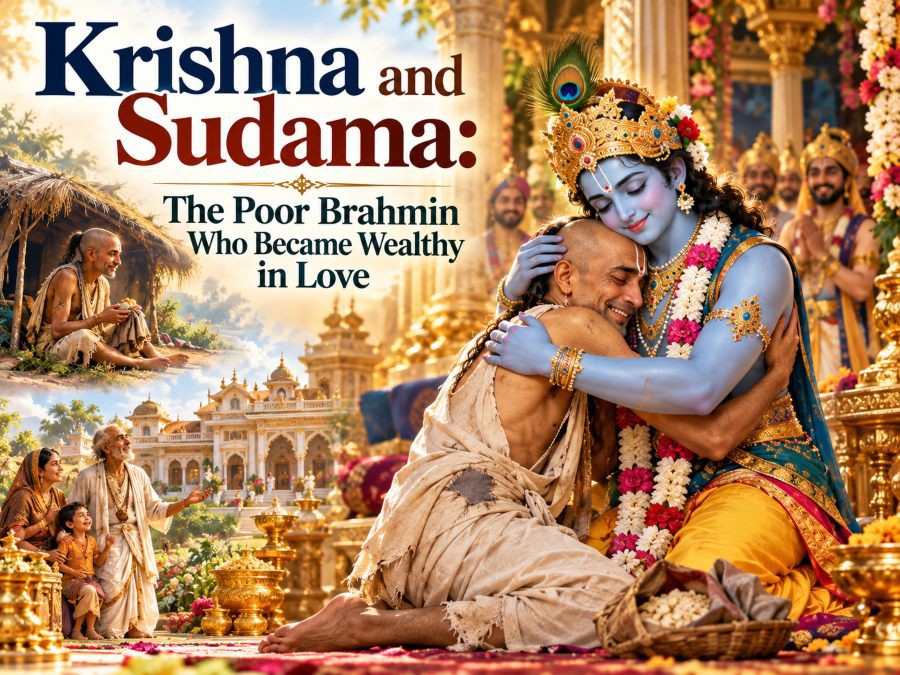 Krishna and Sudama: The Poor Brahmin Who Became Wealthy in LoveRead more
 -
 Vamana Avatar: How Three Steps Humbled Bali MaharajaRead more
Why did a powerful king give away three worlds to a boy asking for three steps? Learn the Vamana avatar story from...
-
 The Bhagavatam on Marriage: Duty, Love and Spiritual PartnershipRead more
What does the Bhagavatam say about marriage? Through the stories of Kardama and Devahuti, Rukmini's secret letter and...
-
 What Is Prema? The Bhagavatam's Highest Stage of Love for GodRead more
Prema is love for God with no "because" attached. Learn how the Bhagavatam describes it, the nine steps from faith to...
-
 Is Shiva Parvati Kalyana Mentioned in Srimad Bhagavatam? What the Scripture Really SaysRead more
Looking for Shiva and Parvati's wedding in the Srimad Bhagavatam? Find out what the scripture actually describes,...
-
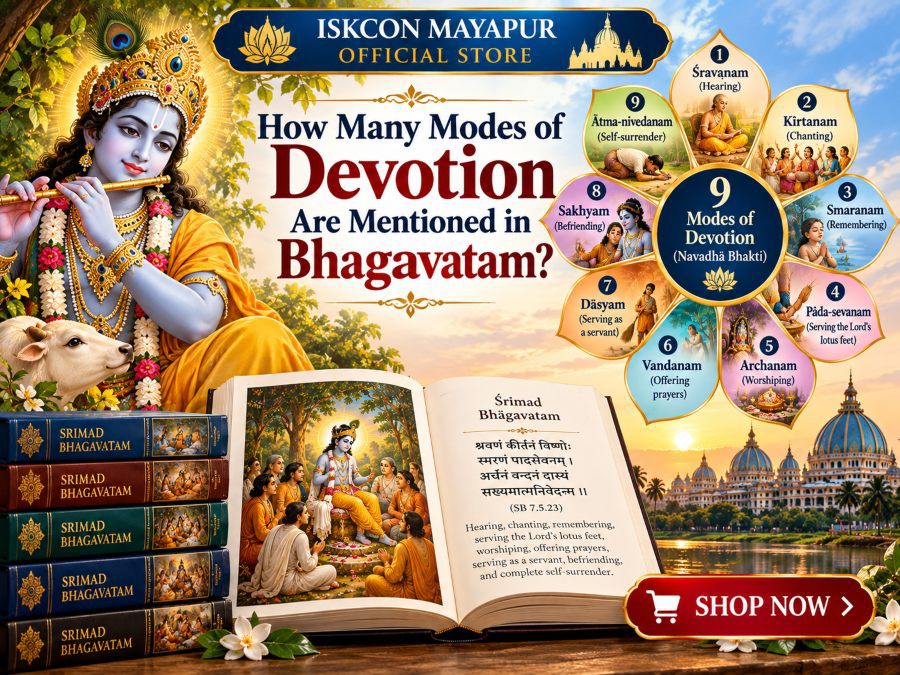 How Many Modes of Devotion Are Mentioned in Bhagavatam?Read more
A young boy named Prahlada listed nine ways to serve God, and the Bhagavatam keeps them as its answer. Learn what the...
-
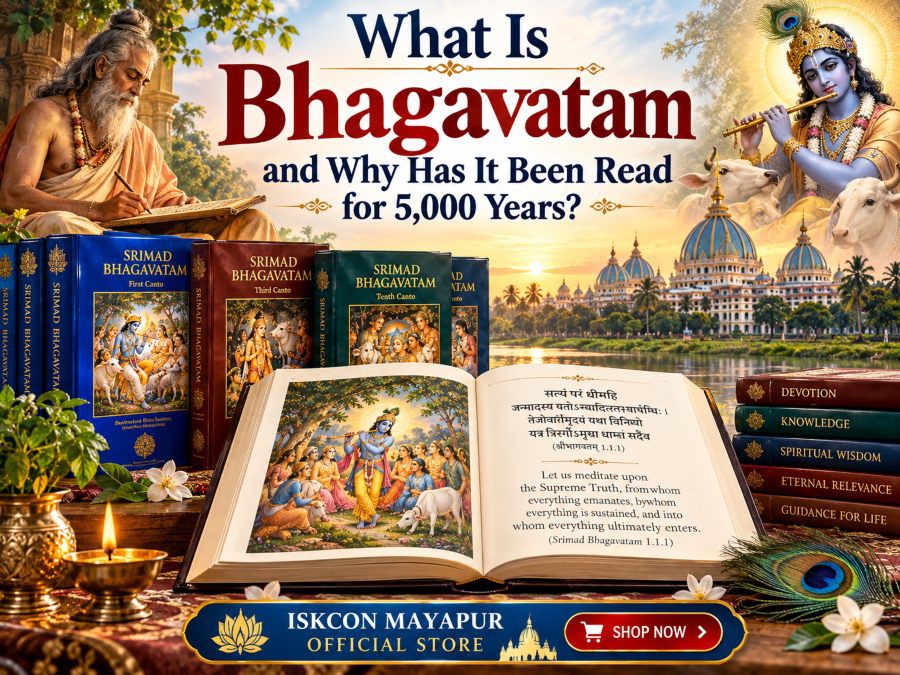 What Is Bhagavatam and Why Has It Been Read for 5,000 Years?Read more
A dying king asked one question, and the answer became the Bhagavatam. Learn what this Sanskrit scripture contains,...
-
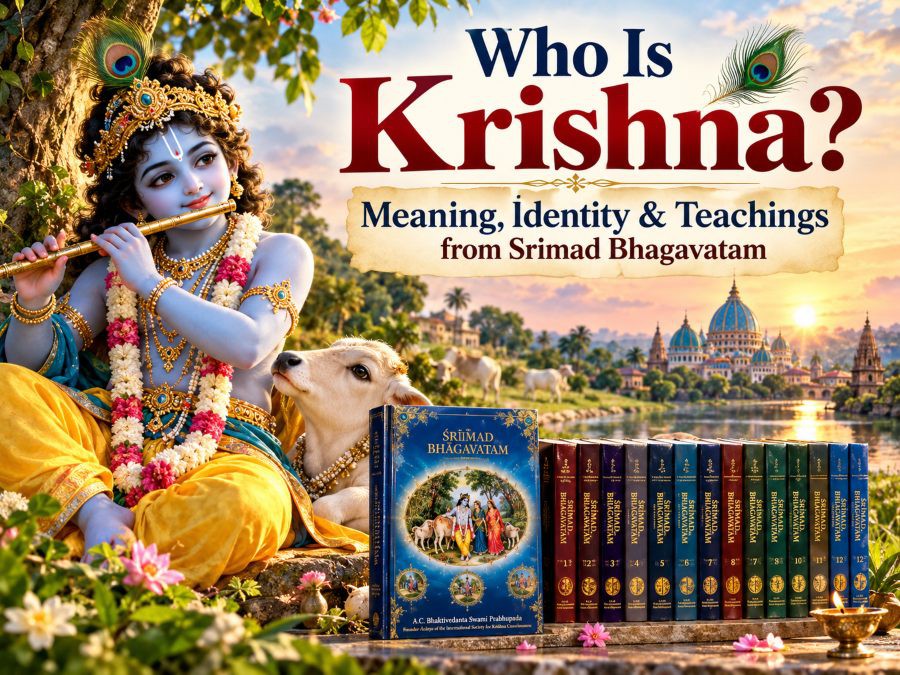 Who Is Lord Krishna? His Meaning, Teachings and Pastimes ExplainedRead more
Discover who Krishna is according to Srimad Bhagavatam, including His divine identity, childhood pastimes, teachings,...
-
 Incense in Islam: Bakhoor, Agarbatti and What Tradition SaysRead more
Is burning fragrance part of Muslim tradition? Explore incense in Islam, from the Prophetic practice of fumigating...
-
 History of Agarbatti: From Vedic Dhupa to Modern Incense SticksRead more
Where did agarbatti really come from? Follow the history of agarbatti from Vedic fire rituals and temple dhupa to...
Blog categories
- Default category (0)
- MUSICAL INSTRUMENT (1)
- BOOK (5)
- DEVOTIONAL GIFT (0)
- Blog (30) click
- CHANDAN (12)
- Bhagavatam Wisdom Series (68)
- Krishna Consciousness (14)
- Mridangam Musical Instrument (6)
- Bhagavad Gita for Beginners (13)
- Bhagavad Gita As It Is (37) click
- Bhagavad Gita As It Is Telugu (0)
- Bhagavad Gita As It Is Marathi (0)
- Bhagavad Gita As It Is In Hindi (0)
- Bhagavad Gita As It Is In English (0)
- Bhagavad Gita As It Is In Bengali (8)
- Bhagavad Gita As It Is In Kannada (0)
- Bhagavad Gita As It Is In Gujarati (0)
- Bhagavad Gita As It Is In Panjabi (0)
- Bhagavad Gita As It Is In Tamil (0)
- Bhagavad Gita As It Is Odia (0)
- BHAGAVAD GITA As It Is GERMAN (0)
- Bhagavad Gita As It Is In French (0)
- Bhagavad Gita As It Is In Nepali (0)
- Bhagavad Gita As It Is In Assamese (0)
- Incense or Agarbatti (38)
- Lord Chaitanya Mahaprabhu (3)
- Vedic Temple Mayapur (14)
- kalki (15)
- Mahabharata – Dharma & Destiny (27)
- Vaishnava Scriptures (4)
- healthy product (4)
- chaitanya mahaprabhu (5)
- Tulsi Mala Guide (17)
Search in blog
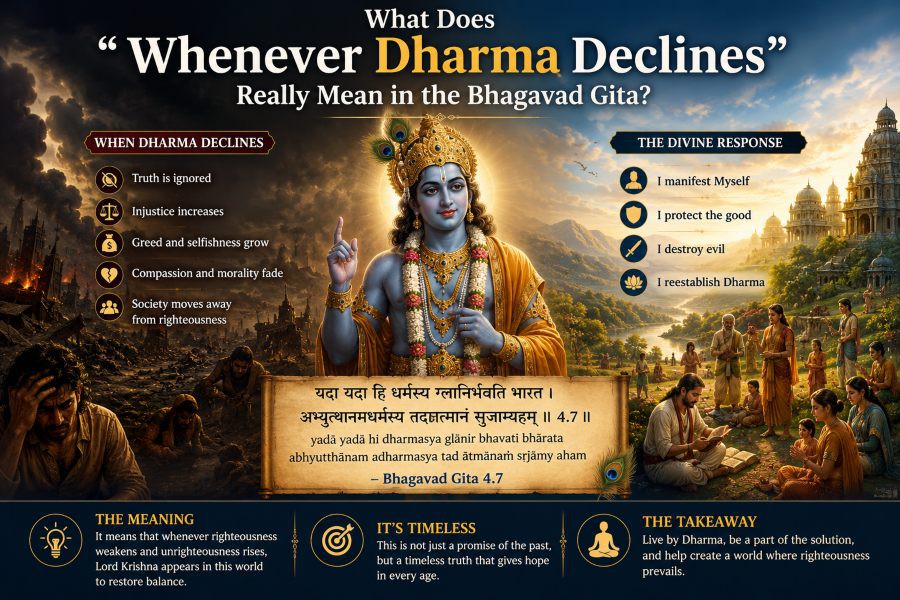
What Does "Whenever Dharma Declines" Really Mean in the Bhagavad Gita?
What Does "Whenever Dharma Declines" Really Mean in the Bhagavad Gita?
What if the universe came with a built-in alarm system — one that has already gone off more times than history bothered to record?
That's essentially the promise tucked inside one of the most quoted verses of the Bhagavad Gita. You've probably seen it on a poster, a WhatsApp forward, or stitched into the opening credits of some devotional film: "Whenever dharma declines, I appear." It sounds poetic. It sounds comforting. But most people who repeat it have never actually sat with what it's asking of them. If you want the full text and commentary in hand rather than piecing it together from quotes online, www.mayapur.store carries authentic ISKCON editions with the original Sanskrit, transliteration, and Srila Prabhupada's purports side by side — which honestly makes this whole conversation easier to follow.
Let's actually unpack the line instead of just admiring it.
The Verse Everyone Quotes and Almost Nobody Explains
The words come from Chapter 4, verses 7 and 8, where Krishna tells Arjuna:
"Whenever and wherever there is a decline in dharma and a rise in adharma, O descendant of Bharata, at that time I manifest myself."
He follows it with a second line that's just as important but gets quoted far less often: he appears "to deliver the pious, annihilate the miscreants, and reestablish the principles of dharma."
Notice the structure. It's not a vague spiritual sentiment. It's closer to a law of physics stated in theological language — cause, condition, and response. When X happens, Y follows. That's a bold claim for any scripture to make, and it's worth asking what "X" actually is before assuming we understand "Y."
Dharma Isn't "Religion" — Stop Translating It That Way
Here's where most casual readings go wrong immediately. English translations lazily render dharma as "religion," and that single word choice quietly wrecks the whole verse for modern readers. Religion, in the way most people use the term today, means a set of rituals, an institution, a label you check on a form.
Dharma is something else entirely. It's closer to the natural order of things functioning as they're meant to — a river flowing downhill, fire giving heat, a mother protecting her child, a society organized around duty rather than pure self-interest. When the Gita talks about dharma declining, it isn't describing empty temples. It's describing a world where things have stopped working the way they should — where cruelty gets rewarded, honesty gets punished, and people forget what they owe each other.
Adharma, its opposite, isn't "sin" in the guilt-ridden Sunday-school sense either. It's closer to systemic disorder. Think less "someone broke a rule" and more "the whole machine is grinding itself apart because everyone stopped doing their part."
That reframing changes everything about how you read the rest of the verse.
So When Exactly Does Dharma "Decline"?
The Gita doesn't hand you a checklist, and that's deliberate. But looking across the tradition's stories — the Mahabharata itself being the backdrop for this very conversation — a few recurring patterns show up whenever things reach a breaking point:
- Power stops answering to responsibility. Kings, institutions, or individuals hold authority but abandon the duties that were supposed to justify it.
- Truth becomes negotiable. Not just lying, but a culture where lying stops carrying any real cost.
- Protection of the vulnerable collapses. The old, the weak, and the dependent are left exposed because those meant to shield them are looking elsewhere.
- People confuse cleverness for wisdom. Manipulation gets celebrated as skill rather than condemned as corrosion.
Arjuna's own crisis on the battlefield is a case study. His cousins have already broken every rule of fair conduct — cheating at dice, humiliating a woman in open court, plotting murder. The war isn't really about land. It's what happens after a society has quietly agreed that none of the old rules apply anymore.
Why This Isn't a One-Time Historical Event
Here's the part that trips people up. If you think Krishna's promise was a single historical guarantee — "I showed up 5,000 years ago at Kurukshetra, mission accomplished, see you never" — you've missed the pattern the verse is actually describing.
The Sanskrit is written in the present continuous sense: whenever, wherever. Not "once." Not "back then." The claim is structural, not historical. Every tradition that has engaged seriously with the Gita — going back centuries within Gaudiya Vaishnavism itself — reads this as a recurring principle, not a closed chapter.
That's a genuinely uncomfortable idea if you sit with it. It means the "alarm system" isn't a museum piece. It's active right now, in whatever era you happen to be reading this in.
Buy ISKCON Bhagavad Gita — Because the Purport Matters More Than the Verse Alone
This is exactly where most modern readers get stuck, and it's worth being honest about why. Reading a single translated verse out of context — the way it usually circulates on social media — strips away everything that makes the teaching useful. Srila Prabhupada's purports were written precisely to close that gap, connecting each verse back to the broader philosophy of the Gita rather than leaving it as an isolated quote to admire.
If you'd rather study this properly than keep bumping into fragments online, you can Buy ISKCON Bhagavad Gita with the full commentary intact. It's the difference between owning a single brick and understanding the building it belongs to.
Why Krishna Chooses a Personal Form Instead of Just Fixing Things Remotely
Here's a detail that rarely gets asked, and it's a good one: if the whole point is restoring order, why does Krishna insist on appearing personally rather than simply arranging events from behind the scenes? Plenty of traditions describe divine influence working invisibly, through circumstance and coincidence. This verse makes a different, sharper claim — direct, embodied presence.
The Gaudiya Vaishnava reading of this is worth sitting with. A purely impersonal correction — laws of karma quietly reshuffling outcomes — might restore balance mechanically, but it wouldn't restore relationship. And relationship, in this tradition, is treated as the actual point of existence, not a side effect of it. Krishna doesn't just want the machine running again; he wants people to remember who they're connected to and why that connection matters. A distant force fixing a broken system from a control room somewhere doesn't accomplish that. A teacher standing on a battlefield, speaking directly to a frightened friend, does.
That's part of why the Gita reads less like a rulebook and more like a conversation. The medium carries as much meaning as the message.
A Quick Reality Check: This Verse Isn't a Free Pass to Do Nothing
There's a lazy shortcut some people take with this teaching, and it deserves to be called out directly. If divine intervention is guaranteed "whenever dharma declines," why bother resisting corruption, cruelty, or injustice yourself? Why not just wait it out?
That logic collapses the moment you look at who Krishna is actually talking to. He isn't addressing a passive bystander hoping for rescue — he's addressing a warrior standing in the middle of the crisis, urging him to act now, without delay, without waiting for cosmic timing to sort itself out. The promise of eventual restoration was never meant to excuse present-day inaction. If anything, treating it that way inverts the entire message of the chapter.
There's also a subtler trap here worth naming: assuming the "miscreants" the verse refers to are always other people, somewhere else, doing something dramatic. The more searching reading turns the question inward. Where has your own conduct quietly tilted toward adharma — cutting a corner, staying silent when speaking up mattered, protecting your own comfort over someone else's need? The verse isn't only a promise about cosmic intervention; it's also, uncomfortably, a mirror held up to daily choices.
The Uncomfortable Question: Who's Responsible for the Decline?
There's a temptation — a very human one — to read this verse passively. Dharma declines, we wait, someone divine shows up, problems get solved. Sit back, watch the show.
But that reading ignores something the Gita hammers home repeatedly in the surrounding chapters: individual action is never optional. Krishna spends the entire conversation with Arjuna insisting that he must act, must fight, must fulfill his own dharma rather than waiting for rescue. The promise of divine intervention isn't a substitute for personal responsibility. If anything, it's the opposite — a reminder that dharma is maintained through the daily, unglamorous choices of ordinary people, and it only reaches crisis point when enough individuals abandon their share of the work.
Put bluntly: the "decline" the verse describes isn't something that happens to a society from outside. It's something a society does to itself, one small compromise at a time.
What "Reestablishing Dharma" Actually Looks Like
Krishna's stated purpose has three parts, and people usually only remember the dramatic middle one — destroying the wicked. But look at the full sentence again: deliver the pious, annihilate the miscreants, and reestablish dharma.
That third piece is the actual point. Destruction without restoration is just chaos wearing a different mask. The goal was never punishment for its own sake — it was recalibration, putting the "machine" back into working order so ordinary life could function again with fairness intact.
This matters because it reframes what spiritual or moral "crisis response" should look like in any era, including ours. It's not about identifying villains and cheering their downfall. It's about actively rebuilding the conditions where honesty, protection of the vulnerable, and responsible use of power become normal again — not exceptional.
A Perspective Worth Sitting With
Maybe the most practical way to read this verse isn't as a prophecy about some future cosmic rescue. Maybe it's closer to a mirror.
Every time you choose honesty when a lie would be easier, every time you protect someone with less power than you instead of exploiting the gap, every time you refuse to let cleverness substitute for integrity — you're participating in the exact mechanism the verse describes. Dharma doesn't decline or rise in some abstract cosmic ledger far removed from daily life. It rises and falls in kitchens, workplaces, courtrooms, and classrooms, one decision at a time.
Krishna's appearance in the Gita is dramatic, divine, unmistakable. But the underlying principle scales down to something far more ordinary and far more demanding: the world stays in balance only as long as enough people keep doing their part, quietly, without waiting for someone else to fix what they could have fixed themselves.
Final Thought
The next time you see this verse quoted — on a poster, a reel, a WhatsApp status — it's worth pausing before scrolling past. It isn't a slogan. It's a description of how imbalance builds, verse by verse, choice by choice, and what it actually takes to correct it.
Read alongside its full context, the teaching stops being a comforting abstraction and starts becoming something closer to a personal challenge. That's probably exactly what it was meant to be.
Posted in: Bhagavad Gita As It Is
Related posts
-
 Why the Bhagavad Gita Feels Like a Personal Conversation with KrishnaThe Bhagavad Gita feels like a personal conversation with Krishna because its timeless wisdom directly addresses our...Read more
 -
 Shrimad Bhagwat Geeta: The Forgotten Life Manual for Modern StressShrimad Bhagwat Geeta is more than a sacred scripture—it’s a forgotten life manual that offers timeless solutions for...Read more
 -
 Who Wrote the Bhagavad Gita? Discover the true authorship of the Bhagavad Gita—exploring Ved Vyasa’s role as the compiler, Lord Krishna’s divine...Read more
 -
 How Many Shlokas in Bhagavad Gita? Complete Chapter-Wise Breakdown & MeaningDiscover how many shlokas are in the Bhagavad Gita, with a complete chapter-wise breakdown, variations in verse...Read more
 -
 How to Read Bhagavad Gita: A Complete Step-by-Step Guide for BeginnersDiscover how to read the Bhagavad Gita step by step—learn the right mindset, chapter order, and tips to understand...Read more
Leave a comment