
Why did Krishna run to embrace a poor brahmin in rags? Read the Sudama story from the Bhagavatam and learn how a...
Latest posts
-
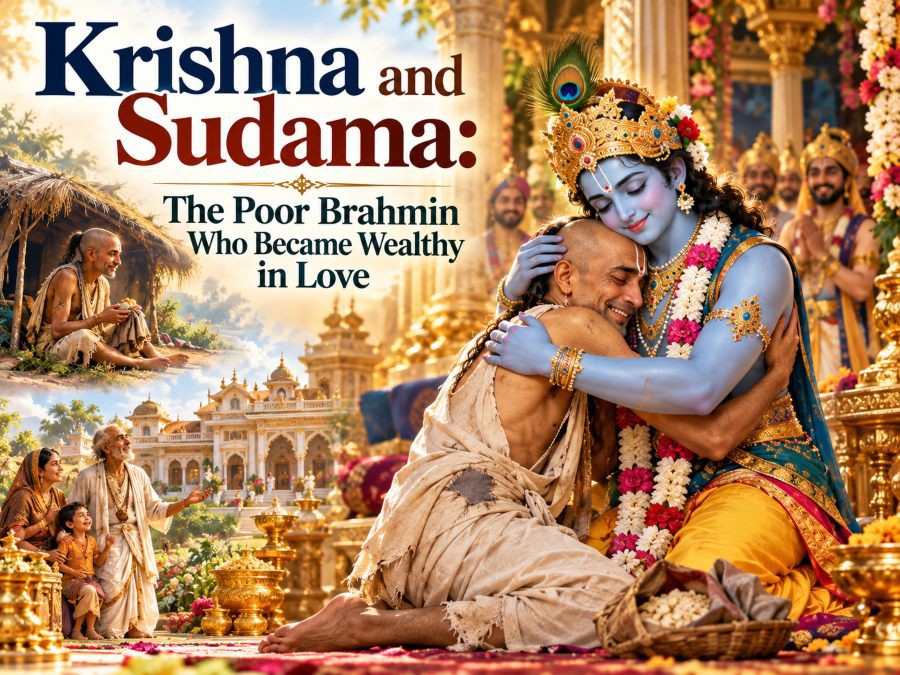 Krishna and Sudama: The Poor Brahmin Who Became Wealthy in LoveRead more
 -
 Vamana Avatar: How Three Steps Humbled Bali MaharajaRead more
Why did a powerful king give away three worlds to a boy asking for three steps? Learn the Vamana avatar story from...
-
 The Bhagavatam on Marriage: Duty, Love and Spiritual PartnershipRead more
What does the Bhagavatam say about marriage? Through the stories of Kardama and Devahuti, Rukmini's secret letter and...
-
 What Is Prema? The Bhagavatam's Highest Stage of Love for GodRead more
Prema is love for God with no "because" attached. Learn how the Bhagavatam describes it, the nine steps from faith to...
-
 Is Shiva Parvati Kalyana Mentioned in Srimad Bhagavatam? What the Scripture Really SaysRead more
Looking for Shiva and Parvati's wedding in the Srimad Bhagavatam? Find out what the scripture actually describes,...
-
 How Many Modes of Devotion Are Mentioned in Bhagavatam?Read more
A young boy named Prahlada listed nine ways to serve God, and the Bhagavatam keeps them as its answer. Learn what the...
-
 What Is Bhagavatam and Why Has It Been Read for 5,000 Years?Read more
A dying king asked one question, and the answer became the Bhagavatam. Learn what this Sanskrit scripture contains,...
-
 Who Is Lord Krishna? His Meaning, Teachings and Pastimes ExplainedRead more
Discover who Krishna is according to Srimad Bhagavatam, including His divine identity, childhood pastimes, teachings,...
-
 Incense in Islam: Bakhoor, Agarbatti and What Tradition SaysRead more
Is burning fragrance part of Muslim tradition? Explore incense in Islam, from the Prophetic practice of fumigating...
-
 History of Agarbatti: From Vedic Dhupa to Modern Incense SticksRead more
Where did agarbatti really come from? Follow the history of agarbatti from Vedic fire rituals and temple dhupa to...
Blog categories
- Default category (0)
- MUSICAL INSTRUMENT (1)
- BOOK (5)
- DEVOTIONAL GIFT (0)
- Blog (30) click
- CHANDAN (12)
- Bhagavatam Wisdom Series (68)
- Krishna Consciousness (14)
- Mridangam Musical Instrument (6)
- Bhagavad Gita for Beginners (13)
- Bhagavad Gita As It Is (37) click
- Bhagavad Gita As It Is Telugu (0)
- Bhagavad Gita As It Is Marathi (0)
- Bhagavad Gita As It Is In Hindi (0)
- Bhagavad Gita As It Is In English (0)
- Bhagavad Gita As It Is In Bengali (8)
- Bhagavad Gita As It Is In Kannada (0)
- Bhagavad Gita As It Is In Gujarati (0)
- Bhagavad Gita As It Is In Panjabi (0)
- Bhagavad Gita As It Is In Tamil (0)
- Bhagavad Gita As It Is Odia (0)
- BHAGAVAD GITA As It Is GERMAN (0)
- Bhagavad Gita As It Is In French (0)
- Bhagavad Gita As It Is In Nepali (0)
- Bhagavad Gita As It Is In Assamese (0)
- Incense or Agarbatti (38)
- Lord Chaitanya Mahaprabhu (3)
- Vedic Temple Mayapur (14)
- kalki (15)
- Mahabharata – Dharma & Destiny (27)
- Vaishnava Scriptures (4)
- healthy product (4)
- chaitanya mahaprabhu (5)
- Tulsi Mala Guide (17)
Search in blog
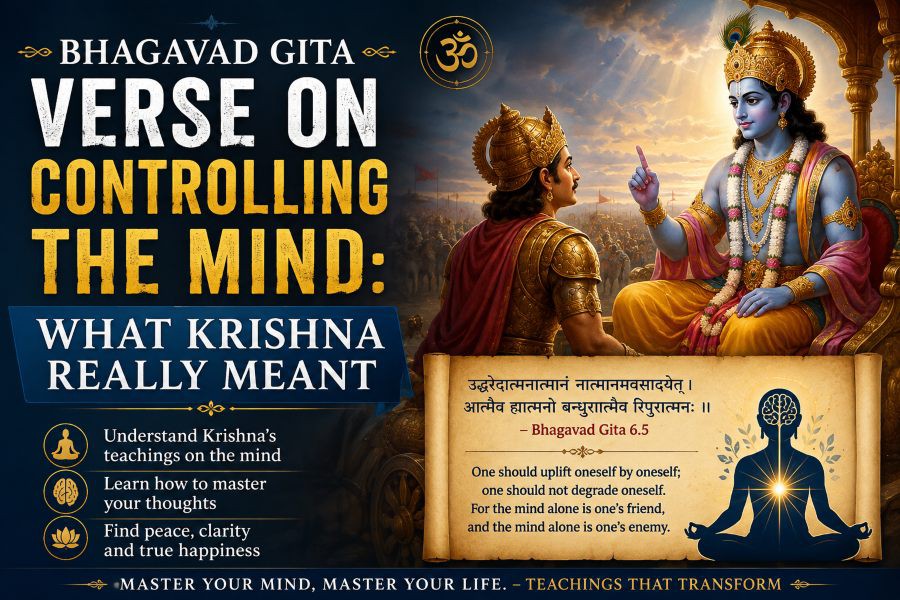
Bhagavad Gita Verse on Controlling the Mind: What Krishna Really Meant
Bhagavad Gita Verse on Controlling the Mind: What Krishna Really Meant
Try this for thirty seconds: sit still and think about absolutely nothing. Not the notification you just felt buzz. Not the thing you forgot to reply to. Nothing.
Couldn't do it, could you? Almost nobody can. And that small, humbling failure is exactly the problem Arjuna throws at Krishna in the middle of the Bhagavad Gita — a problem so relatable that a text written thousands of years ago still reads like it was written for someone doom-scrolling at 1 a.m. If you want to actually sit with the full conversation rather than a stray quote, it's worth checking the bhagavad gita book price at mayapur.store, since the complete commentary is where this teaching actually earns its weight.
Let's get into what Krishna actually said — and what most summaries quietly leave out.
Arjuna Says What Everyone's Been Thinking
Chapter 6 of the Gita gets philosophical fast, describing meditation, self-control, and inner discipline. And right when Krishna finishes laying out this elevated picture of a steady, controlled mind, Arjuna basically interrupts him with the most human response imaginable.
He says, in effect: this all sounds great, but the mind is restless, turbulent, obstinate, and incredibly strong. Trying to control it feels about as realistic as trying to control the wind.
That's not a minor objection. That's the entire self-help industry summarized in one verse, written before the concept of a "to-do list" even existed. Krishna doesn't dismiss the complaint either — which is worth noticing, because plenty of teachers would've just repeated the previous advice louder. Instead, he validates it completely: yes, the mind is restless and hard to control. Then he adds the part everyone forgets to quote: but through practice and detachment, it can be done.
Two Words That Do All the Heavy Lifting
The Sanskrit here is abhyasa and vairagya — practice and detachment. Miss these two words, and the entire teaching turns into vague spiritual encouragement. Understand them, and it becomes something closer to a functional method.
Abhyasa isn't a one-time decision. It's repetition — showing up again and again, even after failing the day before. Krishna isn't describing a switch you flip once. He's describing a muscle you build slowly, the same way nobody benches their max weight on day one at the gym.
Vairagya gets mistranslated constantly as "giving things up" or worse, "not caring about anything." That's a lazy reading, and it misses the actual mechanism. Detachment here means loosening the mind's grip on outcomes — not disengaging from life, but disengaging from the anxious need to control every result. You can care deeply about doing something well without being enslaved to whether it turns out exactly as planned. That distinction is the whole trick.
Put them together and you get a genuinely practical formula: consistent effort, paired with an internal shift in how tightly you're gripping the outcome. Neither one works alone. Practice without detachment turns into obsessive striving. Detachment without practice turns into passive avoidance dressed up as wisdom.
Why "Control the Mind" Is the Wrong Way to Frame It
Here's where a lot of modern interpretations quietly go sideways. People hear "controlling the mind" and picture something like suppression — clamping down on thoughts, forcing silence, treating the mind like an unruly employee who needs discipline.
Krishna's own comparison undercuts that image directly. He compares the untrained mind to wind — powerful, unpredictable, impossible to grab hold of with your bare hands. You don't control wind by fighting it head-on. You control it by building something that channels it: a sail, a windmill, a structure designed to work with the force rather than against it.
That reframes the entire exercise. The goal was never to silence thought or achieve some blank, robotic stillness. The goal is direction — giving the mind's enormous natural energy somewhere useful to go instead of letting it scatter in fifty directions at once. A restless mind isn't a defective mind. It's an undirected one.
The Mind as Friend or Enemy — Your Choice, Apparently
Later in the same chapter, Krishna drops a line that deserves way more attention than it usually gets: for one who has conquered the mind, the mind is the best of friends; but for one who has failed to do so, the mind will act as the greatest enemy.
Sit with that for a second. Same mind. Same brain. Two completely opposite roles, depending entirely on whether it's been trained or left to run wild. That's a strikingly modern-sounding idea dressed in ancient language — the notion that your own thoughts aren't automatically working for you by default. They have to be earned into cooperation.
Anyone who's dealt with anxious spiraling, self-sabotage, or that specific 3 a.m. brand of catastrophic thinking already knows this intuitively. The mind doesn't need permission to turn against you. Left untrained, it does that on its own, without malice, just by defaulting to habit and fear.
Practical Signs You're Actually Applying This (Not Just Reading About It)
Philosophy is easy to admire and hard to live. So what does abhyasa and vairagya actually look like outside of a textbook?
A few honest markers:
- You notice the spiral before it finishes spiraling. Not perfect awareness — just catching it a little earlier than last month.
- You can want something without falling apart if it doesn't happen. That's detachment in action, not indifference.
- You return to the same discipline after breaking it. Missing a day of meditation, exercise, or focused work isn't the failure. Quitting after missing it is.
- You stop needing external chaos to explain internal chaos. The mind's turbulence starts being recognized as something you're working with, not something the world is doing to you.
None of these require monk-level detachment from ordinary life. They're small, repeatable, and — importantly — available to literally anyone, not just people with hours of free time for formal meditation.
The Chariot Analogy Nobody Explains Properly
There's another image tied to this same theme that gets mentioned constantly and explained rarely — the comparison of the body to a chariot, the senses to horses, the intellect to the driver, and the mind to the reins. It shows up elsewhere in the broader Vedic tradition, and it fits so naturally with Krishna's teaching in this chapter that it's worth unpacking properly instead of leaving it as decoration.
Horses left without reins don't stop moving. They just go wherever instinct and stimulus happen to pull them — toward whatever's loudest, brightest, or most immediately rewarding. That's a strikingly accurate description of an untrained mind chasing notifications, cravings, and passing moods without any sense of destination.
The reins don't fight the horses. A skilled driver doesn't yank and wrestle constantly — that exhausts both driver and horse and rarely ends well. The reins guide. They redirect momentum that already exists rather than trying to eliminate it. That's the same logic behind abhyasa and vairagya: not suppression, but direction. You're not trying to make the horses stop being horses. You're trying to make sure the chariot actually goes somewhere worth going.
Why This Verse Keeps Resurfacing in Every Generation
It's worth asking why a verse about mental restlessness, written in a completely different era with none of today's technology, keeps getting rediscovered by people who feel like their attention span is a uniquely modern crisis. The honest answer is a little deflating: it isn't modern at all. Arjuna, a warrior with elite discipline by any standard of his time, described the exact same struggle thousands of years before the first smartphone existed.
What's changed isn't the difficulty of the problem — it's the volume of stimulus competing for the same untrained mind. More inputs, same underlying restlessness, same underlying solution. That's oddly reassuring once you sit with it. The struggle you're having with focus, distraction, or an anxious internal monologue isn't a personal defect unique to your generation or your circumstances. It's the standard condition Krishna was addressing directly, and the tools he offered weren't dependent on the century they'd be applied in.
There's a reason this teaching has survived intact for so many centuries rather than fading into forgotten philosophy: it was never meant to be studied in isolation. In the Gaudiya Vaishnava tradition, the practical application of abhyasa comes through structured spiritual practice — chanting, study, and disciplined routine — rather than abstract willpower alone.
If you're looking to actually build this kind of practice rather than just admire the theory, you can Buy ISKCON Mayapur Store items designed specifically to support that — from the Gita itself to japa beads used for the repetitive, focused chanting practice this chapter is essentially describing in different language.
What Krishna Didn't Say (And Why That Matters Too)
It's worth pointing out what's conspicuously absent from this teaching, because the gap says as much as the content itself. Krishna never promises instant mastery. He never suggests the mind becomes fully obedient after some single breakthrough moment. He doesn't even claim it gets easy — only that it becomes possible.
That's a strangely honest admission for a text often treated as offering perfect answers. The Gita isn't selling a shortcut. It's describing a long, occasionally frustrating process that requires showing up on the days motivation is completely absent — which, if you've tried to build any discipline at all, sounds less like ancient scripture and more like lived experience.
A Different Way to Read "Restless Mind" Going Forward
Maybe the most useful shift here isn't learning a new technique at all. It's dropping the assumption that a wandering, chattering, distractible mind means something has gone wrong with you personally. Krishna's own student — Arjuna, a trained warrior known for extraordinary discipline — made the exact same complaint. If anything, the restlessness is the baseline condition, not a personal failure.
What separates people isn't the absence of mental noise. It's whether they've built any structure — any abhyasa, any vairagya — around that noise, or whether they've simply let it drive.
The wind never stops blowing. The question the Gita actually asks isn't how to make it stop. It's whether you've built a sail.
And that's really the quiet reassurance buried inside this whole exchange between Arjuna and Krishna. Nobody arrives at stillness by accident, and nobody who's ever achieved it started out calm. They started out exactly where you might be right now — frustrated, distracted, half-convinced the whole project is unrealistic. The difference was simply choosing to keep showing up anyway, one imperfect attempt at a time, until practice quietly did what willpower alone never could.
Posted in: Bhagavad Gita As It Is
Related posts
-
 Why the Bhagavad Gita Feels Like a Personal Conversation with KrishnaThe Bhagavad Gita feels like a personal conversation with Krishna because its timeless wisdom directly addresses our...Read more
 -
 Shrimad Bhagwat Geeta: The Forgotten Life Manual for Modern StressShrimad Bhagwat Geeta is more than a sacred scripture—it’s a forgotten life manual that offers timeless solutions for...Read more
 -
 Who Wrote the Bhagavad Gita? Discover the true authorship of the Bhagavad Gita—exploring Ved Vyasa’s role as the compiler, Lord Krishna’s divine...Read more
 -
 How Many Shlokas in Bhagavad Gita? Complete Chapter-Wise Breakdown & MeaningDiscover how many shlokas are in the Bhagavad Gita, with a complete chapter-wise breakdown, variations in verse...Read more
 -
 How to Read Bhagavad Gita: A Complete Step-by-Step Guide for BeginnersDiscover how to read the Bhagavad Gita step by step—learn the right mindset, chapter order, and tips to understand...Read more
Leave a comment