
Why did Krishna run to embrace a poor brahmin in rags? Read the Sudama story from the Bhagavatam and learn how a...
Latest posts
-
 Krishna and Sudama: The Poor Brahmin Who Became Wealthy in LoveRead more
 -
 Vamana Avatar: How Three Steps Humbled Bali MaharajaRead more
Why did a powerful king give away three worlds to a boy asking for three steps? Learn the Vamana avatar story from...
-
 The Bhagavatam on Marriage: Duty, Love and Spiritual PartnershipRead more
What does the Bhagavatam say about marriage? Through the stories of Kardama and Devahuti, Rukmini's secret letter and...
-
 What Is Prema? The Bhagavatam's Highest Stage of Love for GodRead more
Prema is love for God with no "because" attached. Learn how the Bhagavatam describes it, the nine steps from faith to...
-
 Is Shiva Parvati Kalyana Mentioned in Srimad Bhagavatam? What the Scripture Really SaysRead more
Looking for Shiva and Parvati's wedding in the Srimad Bhagavatam? Find out what the scripture actually describes,...
-
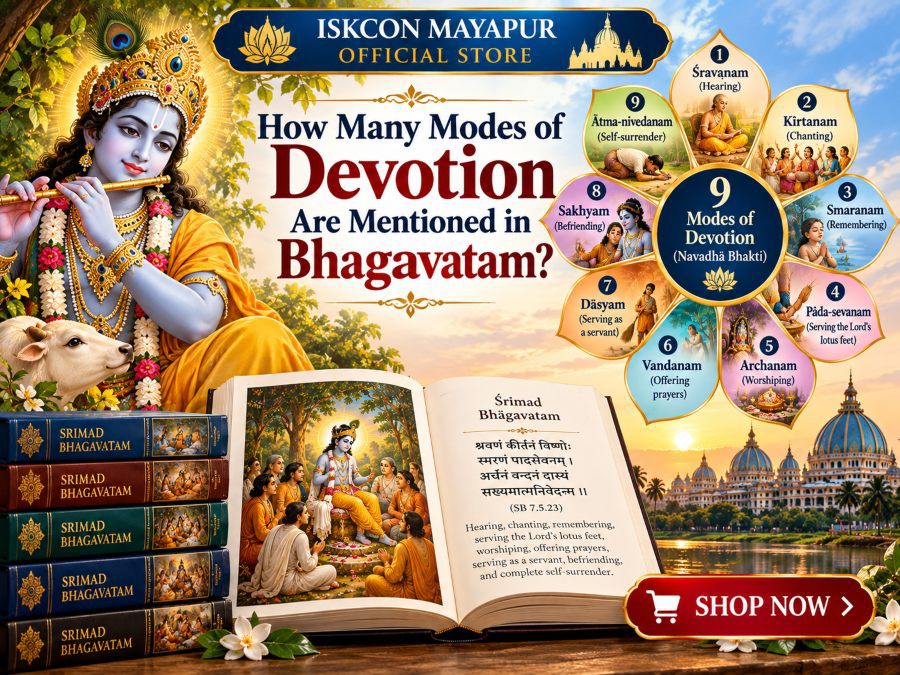 How Many Modes of Devotion Are Mentioned in Bhagavatam?Read more
A young boy named Prahlada listed nine ways to serve God, and the Bhagavatam keeps them as its answer. Learn what the...
-
 What Is Bhagavatam and Why Has It Been Read for 5,000 Years?Read more
A dying king asked one question, and the answer became the Bhagavatam. Learn what this Sanskrit scripture contains,...
-
 Who Is Lord Krishna? His Meaning, Teachings and Pastimes ExplainedRead more
Discover who Krishna is according to Srimad Bhagavatam, including His divine identity, childhood pastimes, teachings,...
-
 Incense in Islam: Bakhoor, Agarbatti and What Tradition SaysRead more
Is burning fragrance part of Muslim tradition? Explore incense in Islam, from the Prophetic practice of fumigating...
-
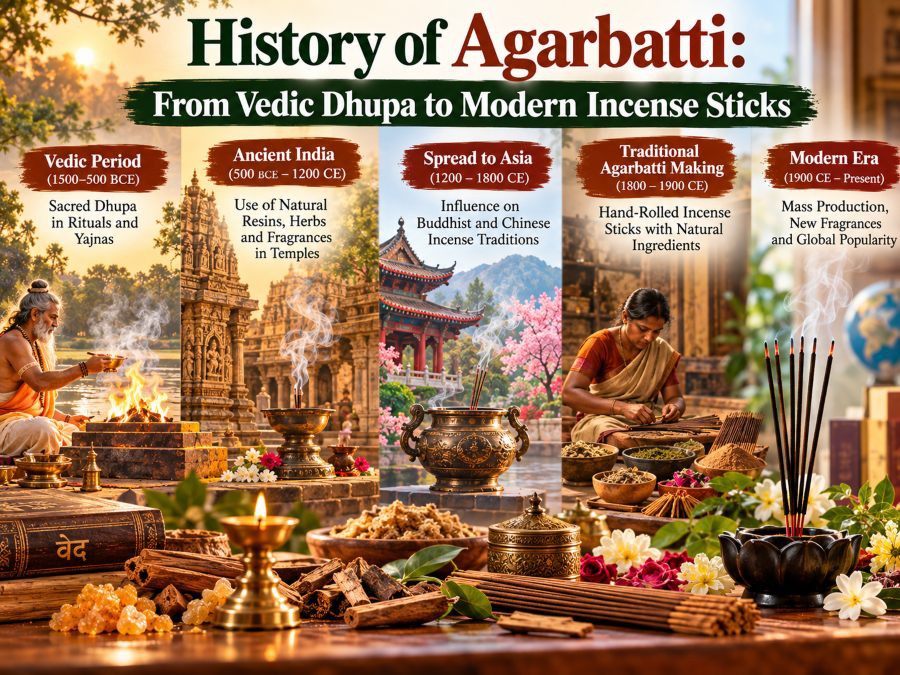 History of Agarbatti: From Vedic Dhupa to Modern Incense SticksRead more
Where did agarbatti really come from? Follow the history of agarbatti from Vedic fire rituals and temple dhupa to...
Blog categories
- Default category (0)
- MUSICAL INSTRUMENT (1)
- BOOK (5)
- DEVOTIONAL GIFT (0)
- Blog (30) click
- CHANDAN (12)
- Bhagavatam Wisdom Series (68)
- Krishna Consciousness (14)
- Mridangam Musical Instrument (6)
- Bhagavad Gita for Beginners (13)
- Bhagavad Gita As It Is (37) click
- Bhagavad Gita As It Is Telugu (0)
- Bhagavad Gita As It Is Marathi (0)
- Bhagavad Gita As It Is In Hindi (0)
- Bhagavad Gita As It Is In English (0)
- Bhagavad Gita As It Is In Bengali (8)
- Bhagavad Gita As It Is In Kannada (0)
- Bhagavad Gita As It Is In Gujarati (0)
- Bhagavad Gita As It Is In Panjabi (0)
- Bhagavad Gita As It Is In Tamil (0)
- Bhagavad Gita As It Is Odia (0)
- BHAGAVAD GITA As It Is GERMAN (0)
- Bhagavad Gita As It Is In French (0)
- Bhagavad Gita As It Is In Nepali (0)
- Bhagavad Gita As It Is In Assamese (0)
- Incense or Agarbatti (38)
- Lord Chaitanya Mahaprabhu (3)
- Vedic Temple Mayapur (14)
- kalki (15)
- Mahabharata – Dharma & Destiny (27)
- Vaishnava Scriptures (4)
- healthy product (4)
- chaitanya mahaprabhu (5)
- Tulsi Mala Guide (17)
Search in blog
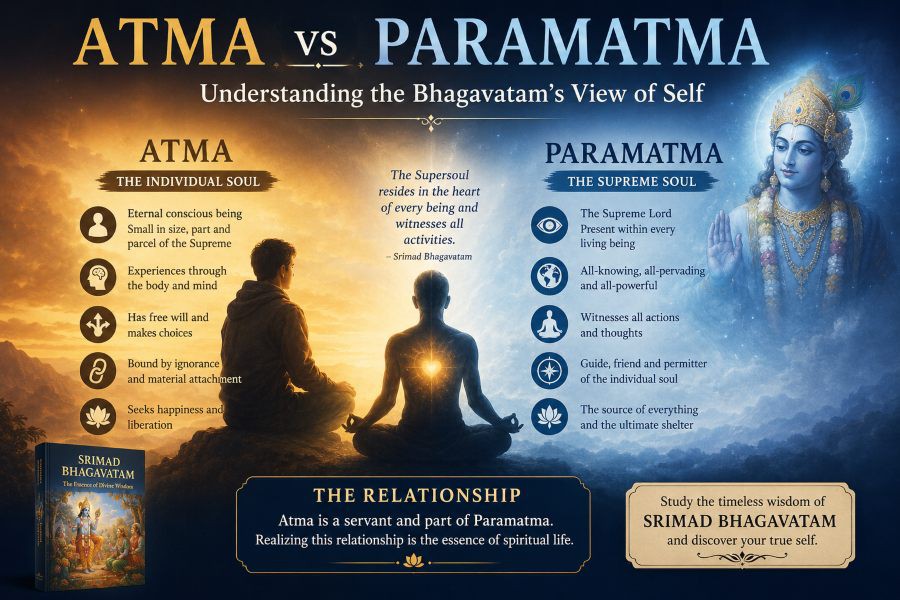
Atma vs Paramatma: Understanding the Bhagavatam’s View of the Self
Atma vs Paramatma: Understanding the Bhagavatam’s View of the Self
What if the person you spend your entire life trying to understand is not the body you see in the mirror—but the conscious self living within it? This question sits at the heart of spiritual inquiry, and the srimad bhagavatam offers a remarkably precise answer. For readers looking to explore authentic Vaishnava teachings, the Official ISKCON Mayapur Store provides access to editions of sacred literature, including the Srimad Bhagavatam, that can help turn philosophical questions into a deeper study of the self.
The words atma and Paramatma sound similar, and both refer to spiritual reality. That similarity, however, can create confusion. Is the individual soul the same as God? Is Paramatma simply another name for the soul? If both are spiritual, what actually separates them?
The Srimad Bhagavatam approaches these questions with unusual clarity. It describes the individual living being as an eternal conscious person while also explaining the presence of the Supreme Person, Paramatma, within the heart. The two are intimately connected, yet they are not identical.
Understanding that distinction changes the way we think about identity, free will, suffering, morality, and even the purpose of spiritual life.
The First Mistake: “I Am This Body”
Before discussing the difference between atma and Paramatma, we have to address a more basic problem: Who am I?
Most of us answer that question without thinking.
“I am Indian.”
“I am a parent.”
“I am a businessman.”
“I am young.”
“I am old.”
“I am successful.”
“I am sick.”
These statements describe circumstances surrounding us, but the Bhagavatam asks us to look deeper.
The body changes constantly. A child becomes a teenager, the teenager becomes an adult, and the adult eventually becomes elderly. Yet there is a continuous sense of “I” throughout those changes.
The body changes.
The mind changes.
Our preferences change.
Our relationships change.
But the conscious observer remains.
This observer is described as the jiva or atma, the individual self.
The Srimad Bhagavatam identifies the science of the self as atma-tattva. It explains that both the Supreme Lord and the living entity can be referred to as atma because both are spiritual, but they should not be placed on the same level. The individual soul is called jivatma, while the Supreme Soul is called Paramatma.
That distinction is easy to overlook, but it is the foundation of the entire discussion.
What Is Atma According to the Srimad Bhagavatam?
The atma is the individual conscious self.
You are not conscious merely because your body is made of chemicals. The body is an extraordinarily complicated physical structure, but the Bhagavatam points toward something deeper: the living being who experiences, desires, remembers, chooses, and identifies with the body.
The body can be compared to an instrument.
The atma is the conscious user of that instrument.
When the atma leaves the body, the physical structure remains, but the living personality is no longer present.
This helps explain why the Bhagavatam repeatedly challenges bodily identification. The body is temporary, while the soul is spiritual and enduring.
That doesn't mean the body is worthless. Quite the opposite. The body becomes valuable because it gives the soul an opportunity to act, learn, make choices, develop consciousness, and pursue spiritual realization.
But confusing the vehicle with the traveler creates problems.
Imagine spending an entire journey polishing your car while completely forgetting where you were supposed to go.
That is essentially the problem of material identification.
Then Who Is Paramatma?
Paramatma means Supersoul, or the Supreme Soul.
The Bhagavatam describes Paramatma as the presence of the Supreme Lord within the hearts of living beings. One striking passage explains that the Lord resides within everyone and that His Paramatma feature is present everywhere.
This creates a fascinating picture.
There are two conscious beings associated with the same body:
- The atma — the individual living entity.
- The Paramatma — the Supreme Lord accompanying the individual from within.
The atma experiences the particular body it inhabits.
Paramatma is not limited in that way.
The individual soul has limited awareness. I can know what is happening within my own body, but I cannot directly experience everything happening inside another person's body. The Bhagavatam explains that Paramatma, being present within everyone, has a form of consciousness beyond the limitations of the individual soul.
That is the real difference.
It is not simply that one soul is “bigger” and another is “smaller.”
The distinction is qualitative in terms of capacity, position, knowledge, and sovereignty.
Atma and Paramatma: Close, But Not the Same
This is where the Bhagavatam becomes especially interesting.
The individual soul and Paramatma are both spiritual, but spiritual does not automatically mean identical.
A spark and a fire are both fiery. Yet a spark cannot perform everything a massive fire can do.
Likewise, the individual soul possesses consciousness, but that consciousness is limited. Paramatma is described as the Supreme conscious presence.
The Bhagavatam makes this distinction explicitly. In Srimad Bhagavatam 3.28.41, the Supreme Lord is described as the seer who is different from the individual living entity associated with the senses, elements, and consciousness.
This gives us a useful way to understand the relationship:
Atma: “I am experiencing.”
Paramatma: “I am witnessing and accompanying you.”
Atma: “I make choices within my limitations.”
Paramatma: “I am the Supreme witness and guide.”
Atma: “I know something.”
Paramatma: “I am the source and knower beyond individual limitation.”
The relationship is intimate without being identical.
The Bhagavatam’s Powerful Image: Two Presences Within
One of the most beautiful ideas in Vaishnava philosophy is that we are never spiritually alone.
Even when someone feels isolated, the Bhagavatam says that the Supreme Lord is present within the heart as Paramatma.
This is not presented merely as poetic symbolism.
The text describes the Lord as residing within all living beings. Kunti, for example, glorifies Lord Krishna as the soul within all beings, and the Bhagavatam repeatedly presents the Lord's internal presence as a real feature of divine existence.
Think about what that means.
Every decision takes place in the presence of Paramatma.
Every desire arises within a world that the Supreme already knows.
Every struggle is witnessed.
Every sincere attempt to understand spiritual truth is known from within.
This doesn't mean Paramatma forces every decision. The individual soul retains agency. Rather, the Supreme Lord accompanies the living being while remaining the ultimate controller and witness.
That relationship between individual freedom and divine presence is one of the deepest themes in the Bhagavatam.
Why Do We Forget the Atma?
If the atma is spiritual, why don't we naturally experience ourselves that way?
Because consciousness becomes absorbed in matter.
From childhood, we are trained to think primarily in terms of bodily identity.
“My body.”
“My possessions.”
“My career.”
“My family.”
“My reputation.”
“My achievements.”
The word “my” quietly reveals something important.
If I say “my body,” then who is the “I” possessing the body?
The Bhagavatam asks us to notice this distinction.
The problem isn't simply having possessions or relationships. The problem begins when temporary things become the foundation of our identity.
A person can use a phone without believing, “I am my phone.”
But human beings often treat the body differently.
The body becomes the center of identity.
From that identification come fear, pride, envy, anxiety, attachment, and endless competition.
Spiritual knowledge begins when the question changes from:
“How can I make my temporary identity more comfortable?”
to:
“Who am I beyond this temporary identity?”
Paramatma Is Not Just an Inner Voice
People sometimes say, “Paramatma is simply your conscience.”
That explanation is incomplete.
Conscience may be influenced by upbringing, culture, memory, personal experience, and social conditioning. Paramatma, according to the Bhagavatam, is not merely a psychological mechanism.
Paramatma is the Supreme Person accompanying the living entity.
The Bhagavatam describes the Lord as present within the heart and as the source of spiritual guidance. It presents Him as someone the individual soul can ultimately approach through purified consciousness and devotion.
This distinction matters.
If Paramatma were simply our own mind, spiritual realization would mean becoming completely absorbed in our existing thoughts.
But the Bhagavatam teaches almost the opposite.
Spiritual growth requires learning to distinguish the self from the mind, and then recognizing the Supreme Person beyond both.
The mind is an instrument.
The atma is the conscious self.
Paramatma is the Supreme conscious presence.
What Happens When the Mind Becomes Quiet?
This is where meditation and bhakti enter the discussion.
When the mind is constantly chasing pleasure, recognition, fear, and memories, the deeper spiritual relationship remains difficult to perceive.
But as consciousness becomes purified, the individual begins to recognize that happiness does not come simply from controlling external circumstances.
The Bhagavatam describes spiritual practice as a movement toward purified consciousness, where the mind becomes detached from material impulses and directed toward the Supreme. The teachings of Kapila in the Third Canto particularly describe meditation, devotion, and purification as means of perceiving the Supreme presence.
This is why bhakti is not merely emotional worship.
It is a method of reorienting consciousness.
Instead of asking, “How can everything serve me?”
the practitioner gradually begins asking:
“How can I serve the Supreme?”
That change sounds simple.
It can transform an entire life.
Why Reading the Bhagavatam Matters
Philosophy can remain abstract when it is discussed only through definitions.
Reading the Srimad Bhagavatam places these ideas into stories, conversations, prayers, conflicts, mistakes, realizations, and relationships.
You don't merely encounter a definition of devotion.
You see characters struggle with attachment.
You see kings confront mortality.
You see devotees respond to suffering.
You see sages question reality.
You see the Supreme Lord interact with living beings in profoundly personal ways.
For someone who wants to study these teachings seriously, choosing an authentic edition matters. Readers interested in exploring the text can Buy Bhagavatam and study its teachings directly rather than relying entirely on second-hand summaries.
The goal isn't simply to collect another spiritual book.
It is to spend time with a text that repeatedly asks a difficult question:
What remains when everything temporary is taken away?
The Bhagavatam Goes Beyond “Know Yourself”
Modern spirituality often uses the phrase “know yourself.”
The Bhagavatam agrees—but it takes the idea much further.
Knowing yourself means recognizing that you are not merely the body.
Then comes another realization: you are not the Supreme Lord simply because you are spiritual.
And then comes the relational question:
If I am an eternal conscious being, what is my relationship with the Supreme conscious being?
This is where bhakti becomes central.
The individual soul is not presented as an isolated spiritual particle whose ultimate destiny is simply to disappear into an undifferentiated existence. The Bhagavatam repeatedly points toward relationship with the Supreme Person.
In Srimad Bhagavatam 3.29.36, the Supreme Personality of Godhead is described as the ultimate form underlying the Brahman and Paramatma realizations.
That gives the Bhagavatam's teaching a clear direction:
Brahman reveals spiritual reality.
Paramatma reveals the Supreme presence within and throughout creation.
Bhagavan reveals the Supreme Person in fullness.
These are not three unrelated gods or three competing philosophies. They are connected ways of understanding the Supreme Reality.
Atma vs Paramatma: A Simple Comparison
Atma | Paramatma |
Individual living being | Supreme Soul |
Eternal spiritual self | Eternal Supreme Person |
Present within one particular body | Present within all living beings |
Has limited consciousness | Possesses unlimited consciousness |
Experiences the results of material life | Witnesses and accompanies the living being |
Can become covered by material identification | Always transcendental |
Seeks spiritual realization | Guides the living entity toward realization |
Dependent | Supreme and independent |
The important point is that difference does not mean separation.
The atma is never independent of the Supreme.
Yet the atma also never becomes the Supreme simply by becoming spiritually awakened.
What This Means for Everyday Life
The atma–Paramatma distinction isn't only a philosophical debate.
It can change how we live.
If I understand that I am more than my body, I may become less obsessed with temporary praise.
If I understand that Paramatma is present within every living being, I may become more respectful toward others.
If I recognize that the Supreme Lord is the ultimate witness, I may become more honest even when nobody else is watching.
If I understand that material circumstances are temporary, success becomes less intoxicating and failure becomes less devastating.
And if I begin seeing myself as an eternal servant of Krishna rather than the ultimate owner of everything around me, my priorities begin to shift.
The external world may look the same.
The person looking at it has changed.
The Real Question Is Not “Which One Am I?”
The deepest lesson of the Srimad Bhagavatam is not simply that atma and Paramatma are different.
It is that knowing the difference helps us understand our relationship with the Supreme.
The atma is eternal.
Paramatma is eternal.
Both are spiritual.
But their positions are not the same.
The individual soul is a conscious participant in material existence, while Paramatma accompanies, witnesses, and guides from within. The Bhagavatam uses this relationship to move us beyond bodily identification and toward a personal understanding of spiritual life.
That may be the most practical lesson of all.
We spend years trying to control the world outside us. The Bhagavatam first asks us to understand the world within.
Who is experiencing?
Who is witnessing?
Who is guiding?
And ultimately, who am I in relation to Krishna?
Those questions don't become less important with age.
They become more important.
Because when temporary identities fall away, the question of the eternal self is the one that remains.
Posted in: Bhagavatam Wisdom Series
Related posts
-
 Why to read srimad bhagavatamReading the Srimad Bhagavatam fosters deep spiritual growth by narrating the life and teachings of Lord Krishna,...Read more
 -
 When was srimad bhagavatam written?The Srimad Bhagavatam is believed to have been written around 9th-10th century CE, though its oral traditions date...Read more
 -
 How many chapters are there in srimad bhagavatam?The Srimad Bhagavatam consists of 12 cantos (books) containing 335 chapters in total. Each canto covers various...Read more
 -
 How many skandhas are there in srimad bhagavatamThe Srimad Bhagavatam is divided into 12 skandhas (cantos or books). Each skandha explores different themes,...Read more
 -
 How many slokas in srimad bhagavatamThe Srimad Bhagavatam contains approximately 18,000 shlokas (verses). These verses are spread across its 12 skandhas...Read more
Leave a comment