
Why did Krishna run to embrace a poor brahmin in rags? Read the Sudama story from the Bhagavatam and learn how a...
Latest posts
-
 Krishna and Sudama: The Poor Brahmin Who Became Wealthy in LoveRead more
 -
 Vamana Avatar: How Three Steps Humbled Bali MaharajaRead more
Why did a powerful king give away three worlds to a boy asking for three steps? Learn the Vamana avatar story from...
-
 The Bhagavatam on Marriage: Duty, Love and Spiritual PartnershipRead more
What does the Bhagavatam say about marriage? Through the stories of Kardama and Devahuti, Rukmini's secret letter and...
-
 What Is Prema? The Bhagavatam's Highest Stage of Love for GodRead more
Prema is love for God with no "because" attached. Learn how the Bhagavatam describes it, the nine steps from faith to...
-
 Is Shiva Parvati Kalyana Mentioned in Srimad Bhagavatam? What the Scripture Really SaysRead more
Looking for Shiva and Parvati's wedding in the Srimad Bhagavatam? Find out what the scripture actually describes,...
-
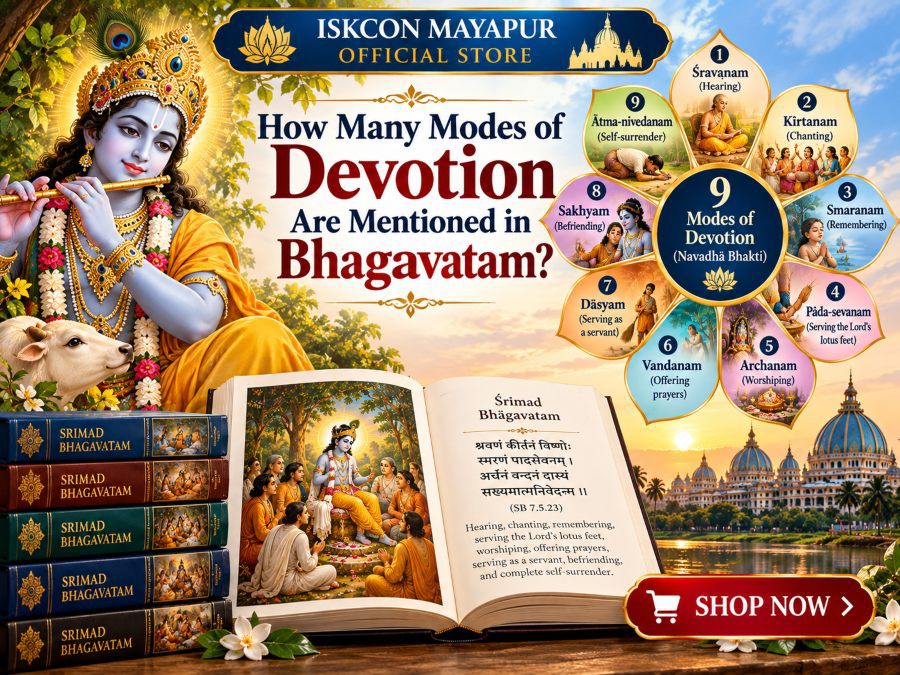 How Many Modes of Devotion Are Mentioned in Bhagavatam?Read more
A young boy named Prahlada listed nine ways to serve God, and the Bhagavatam keeps them as its answer. Learn what the...
-
 What Is Bhagavatam and Why Has It Been Read for 5,000 Years?Read more
A dying king asked one question, and the answer became the Bhagavatam. Learn what this Sanskrit scripture contains,...
-
 Who Is Lord Krishna? His Meaning, Teachings and Pastimes ExplainedRead more
Discover who Krishna is according to Srimad Bhagavatam, including His divine identity, childhood pastimes, teachings,...
-
 Incense in Islam: Bakhoor, Agarbatti and What Tradition SaysRead more
Is burning fragrance part of Muslim tradition? Explore incense in Islam, from the Prophetic practice of fumigating...
-
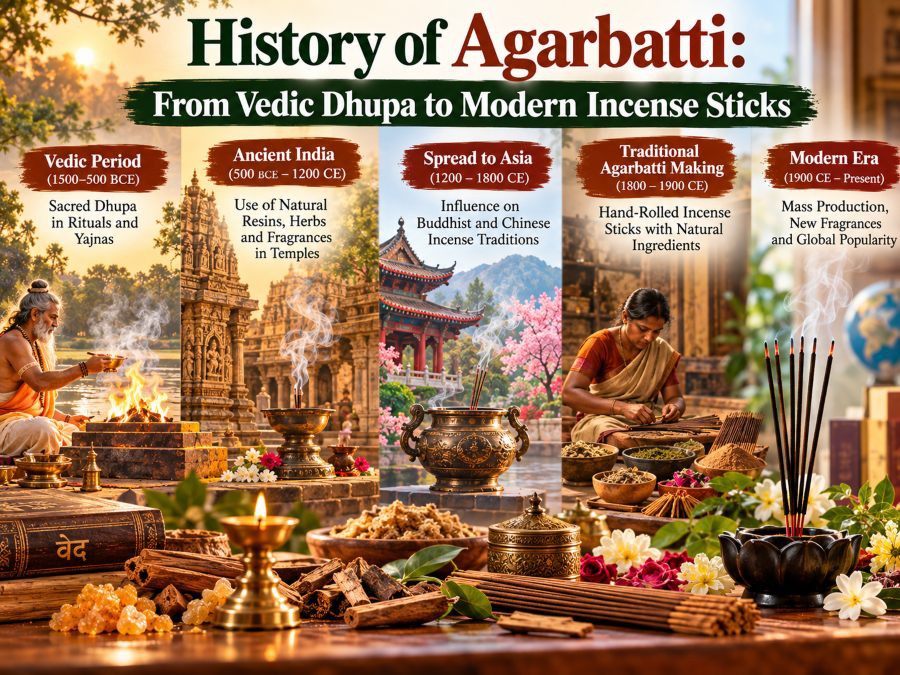 History of Agarbatti: From Vedic Dhupa to Modern Incense SticksRead more
Where did agarbatti really come from? Follow the history of agarbatti from Vedic fire rituals and temple dhupa to...
Blog categories
- Default category (0)
- MUSICAL INSTRUMENT (1)
- BOOK (5)
- DEVOTIONAL GIFT (0)
- Blog (30) click
- CHANDAN (12)
- Bhagavatam Wisdom Series (68)
- Krishna Consciousness (14)
- Mridangam Musical Instrument (6)
- Bhagavad Gita for Beginners (13)
- Bhagavad Gita As It Is (37) click
- Bhagavad Gita As It Is Telugu (0)
- Bhagavad Gita As It Is Marathi (0)
- Bhagavad Gita As It Is In Hindi (0)
- Bhagavad Gita As It Is In English (0)
- Bhagavad Gita As It Is In Bengali (8)
- Bhagavad Gita As It Is In Kannada (0)
- Bhagavad Gita As It Is In Gujarati (0)
- Bhagavad Gita As It Is In Panjabi (0)
- Bhagavad Gita As It Is In Tamil (0)
- Bhagavad Gita As It Is Odia (0)
- BHAGAVAD GITA As It Is GERMAN (0)
- Bhagavad Gita As It Is In French (0)
- Bhagavad Gita As It Is In Nepali (0)
- Bhagavad Gita As It Is In Assamese (0)
- Incense or Agarbatti (38)
- Lord Chaitanya Mahaprabhu (3)
- Vedic Temple Mayapur (14)
- kalki (15)
- Mahabharata – Dharma & Destiny (27)
- Vaishnava Scriptures (4)
- healthy product (4)
- chaitanya mahaprabhu (5)
- Tulsi Mala Guide (17)
Search in blog
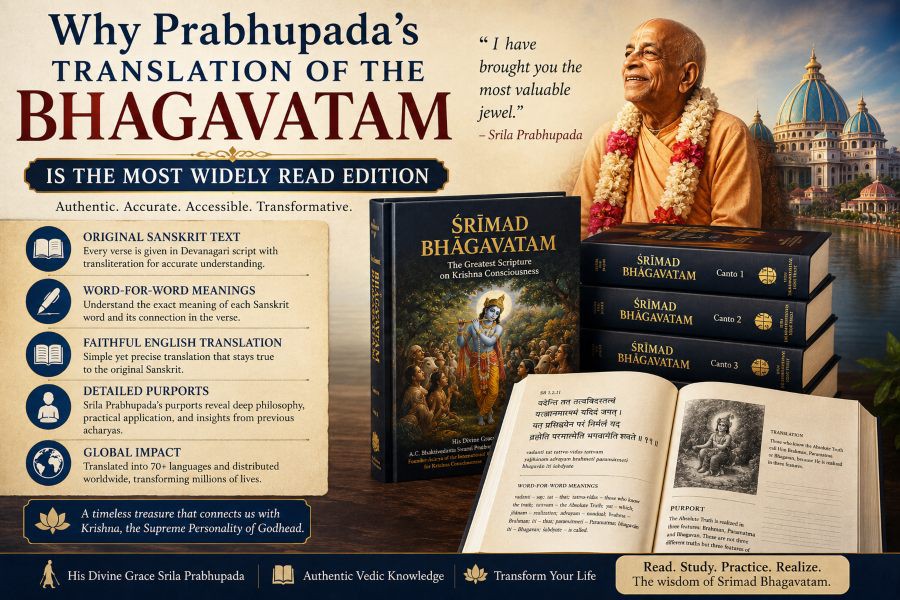
Why Prabhupada’s Translation of the Bhagavatam Is the Most Widely Read Edition
Why Prabhupada’s Translation of the Bhagavatam Is the Most Widely Read Edition
What makes one translation of an ancient Sanskrit scripture become the book that countless readers carry from temple libraries to university classrooms, from family homes to personal meditation spaces? The answer is not simply language. It is the way a translator preserves the original philosophy while making it understandable to someone encountering it for the first time. Srila Prabhupada’s ISKCON Srimad Bhagavatam Book has become one of the most widely read English presentations of the Srimad Bhagavatam, supported by decades of publication, study, and worldwide distribution.
The Srimad Bhagavatam is one of the central scriptures of the Vaishnava tradition. Traditionally associated with approximately 18,000 verses, it explores the nature of God, the soul, devotion, creation, karma, spiritual realization, and the lives of devotees. What makes Srila Prabhupada’s edition distinctive is that it does not treat these subjects as distant pieces of Indian history. His translation and commentary present them as living spiritual knowledge.
That approach has helped the book reach readers far beyond the Sanskrit-speaking world.
A Sanskrit Scripture With a Global Audience
Imagine opening a Sanskrit scripture without knowing Sanskrit.
You can see the beauty of the verses, but the meaning remains behind a locked door.
This was one of the challenges Srila Prabhupada faced when he began presenting Vedic literature to an international audience. His answer was not to remove the Sanskrit. Instead, he built a bridge around it.
His editions generally present the original Sanskrit verse, transliteration, word-for-word meanings, English translation, and purport. Srila Prabhupada himself explained that this structure was intended to give readers access to the text while also explaining its philosophical meaning.
That format matters.
A reader can see the original verse.
Then the reader can examine individual Sanskrit words.
Then comes the translation.
Finally, the purport opens the philosophical discussion.
It creates several layers of reading rather than reducing the scripture to a single paragraph of interpretation.
Prabhupada Was Not Trying to Write a Modern Self-Help Book
One reason the Srimad Bhagavatam remains distinctive in Prabhupada’s presentation is that he did not reshape the text simply to fit modern preferences.
He presented Krishna as the Supreme Personality of Godhead, devotion as the central path of spiritual life, and the soul as an eternal spiritual being.
That may sound straightforward to someone familiar with Vaishnava philosophy. For a modern reader approaching the Bhagavatam without that background, it can be quite different from the spirituality found in popular books.
Prabhupada did not say:
“Take whichever interpretation feels comfortable.”
He repeatedly encouraged readers to understand the scripture through the teachings of the previous acharyas and the established Vaishnava tradition.
This gives the translation a particular character.
It is not neutral in the modern academic sense.
It is a devotional translation with commentary, written from within the tradition it represents.
That is precisely what many readers are looking for.
Why the Purports Make Such a Difference
Suppose you read a verse describing devotional service.
Without commentary, you may understand the literal sentence but still wonder:
What does this mean in practical life?
How does it relate to the mind?
What does devotion actually involve?
Why is Krishna described in this particular way?
What does the verse mean according to earlier teachers?
The purport provides the missing conversation.
Prabhupada frequently connects a single verse with ideas found throughout the Bhagavad-gita, Upanishads, Puranas, and writings of earlier Vaishnava teachers.
The result is not simply translation.
It becomes guided study.
This is one of the strongest reasons his Srimad Bhagavatam edition became so influential. The reader isn't left alone with unfamiliar philosophical terminology.
The commentary explains the vocabulary, establishes context, raises questions, and repeatedly brings the discussion back to Krishna consciousness.
The Timing Was Extraordinary
There is another part of the story that is easy to underestimate.
Srila Prabhupada began building his international mission in the West during the 1960s, when the teachings of Indian spirituality were becoming increasingly interesting to Western readers. He founded ISKCON in New York in 1966 and spent the following years traveling extensively, establishing temples and presenting Krishna consciousness.
Then came a major publishing effort.
The Bhaktivedanta Book Trust, or BBT, was established in 1972. ISKCON's Governing Body Commission records the Srimad Bhagavatam among Prabhupada's major translation-with-commentary works, published in volumes from 1972 to 1977.
Think about the scale of that undertaking.
An ancient Sanskrit work.
Thousands of verses.
Multiple volumes.
A worldwide audience.
And a translator attempting to preserve not only the words but also the philosophical framework behind them.
It was an ambitious project.
Why Readers Connect With Prabhupada’s Language
Prabhupada’s English is distinctive.
It is not written like contemporary lifestyle journalism. Nor does it attempt to sound like a modern university textbook.
Sometimes the language is direct.
Sometimes it is surprisingly conversational.
At other moments, the writing becomes deeply philosophical.
That combination gives his books a recognizable voice.
A reader might encounter a complicated philosophical question and then find it explained through an ordinary example: a person identifying with the body, a traveler confusing a vehicle with himself, or someone becoming attached to temporary possessions.
These examples create a bridge between abstract philosophy and ordinary experience.
The result is important for a scripture as large as the Srimad Bhagavatam.
A book can contain extraordinary philosophy and still remain unread if readers cannot follow it.
Prabhupada's commentary constantly tries to bring the discussion back to something recognizable.
The Book Became Part of a Much Larger Movement
Prabhupada’s books did not spread independently.
They traveled alongside a growing spiritual movement.
ISKCON established temples, communities, educational programs, festivals, and book distribution networks across different countries. The organization describes book publication and distribution as part of its founding purposes, including the publication and distribution of books and other writings.
This matters when discussing why Prabhupada's Bhagavatam became so widely read.
A book needs readers.
ISKCON created a culture in which reading and distributing spiritual literature became central activities.
In the 1970s and 1980s, ISKCON members distributed millions of Prabhupada's books. The organization's historical records describe book distribution as a major form of outreach.
The Bhaktivedanta Book Trust eventually became a major publisher of Vaishnava literature. ISKCON currently states that the BBT has printed and distributed more than 620 million books and magazines across its publications.
That number includes many titles, not just the Srimad Bhagavatam. Still, it demonstrates the enormous publishing and distribution system through which Prabhupada's writings reached readers around the world.
A Book You Can Study, Not Just Read Once
This is perhaps one of the biggest differences between Prabhupada's Bhagavatam and many popular spiritual books.
You don't really finish it.
You return to it.
A verse that seems simple at twenty-five may feel completely different after years of work, relationships, disappointment, responsibility, or spiritual practice.
The same purport can reveal something new because the reader has changed.
This is one reason serious students often keep their Bhagavatam volumes close at hand.
The book functions almost like a reference library for spiritual questions.
You can open it when thinking about karma.
You can study it when trying to understand bhakti.
You can read about the nature of the soul.
You can explore the qualities of a devotee.
You can follow the stories of kings, sages, demons, devotees, and divine personalities.
And slowly, the individual stories begin forming a larger philosophical picture.
Why the Bhagavatam Does Not Feel Like a Collection of Stories
At first glance, the Srimad Bhagavatam contains an enormous number of stories.
Kings rise and fall.
Sages perform austerities.
Devotees face extraordinary circumstances.
The Supreme Lord appears in different forms.
There are cosmic descriptions, philosophical conversations, prayers, genealogies, and accounts of spiritual realization.
It can seem overwhelming.
But Prabhupada's commentary repeatedly brings the reader back to a central question:
What does this teach us about our relationship with Krishna?
That question gives the entire work direction.
The stories are not presented merely as entertainment.
They illustrate principles.
A king's attachment can teach us about material desire.
A devotee's patience can teach us about faith.
A person's downfall can reveal the consequences of uncontrolled senses.
A prayer can demonstrate genuine surrender.
A conversation can expose the difference between temporary knowledge and spiritual wisdom.
The stories become mirrors.
Why People Still Choose the Prabhupada Edition
The continued popularity of Prabhupada's books is not based on one single factor.
Several elements work together:
· Accessible English: Readers can approach difficult Sanskrit philosophy without already being Sanskrit scholars.
· Word-for-word translations: The structure allows students to examine individual Sanskrit terms.
· Detailed purports: Philosophical concepts receive extensive explanation.
· Traditional Vaishnava perspective: The commentary presents the text through the Gaudiya Vaishnava tradition.
· Cross-references: Ideas are frequently connected with other Vedic texts.
· Practical application: Spiritual philosophy is repeatedly connected with ordinary human problems.
· Global availability: Decades of publishing and distribution have made the books accessible in many countries and languages.
ISKCON's official biography of Srila Prabhupada describes his books as among his most significant contributions and notes that his writings have been translated into dozens of languages. It also identifies the 30-volume Srimad-Bhagavatam as one of his prominent works.
Where Can You Begin Your Bhagavatam Journey?
You don't need to read every volume immediately.
That can actually make the project feel intimidating.
Start with a manageable section.
Read one chapter.
Study a few verses.
Look carefully at the Sanskrit terms.
Read the translation slowly.
Then spend time with the purport.
If a particular volume or edition is difficult to find locally, readers can explore www.mayapur.store for access to devotional books and Srimad Bhagavatam editions associated with the ISKCON tradition.
The important thing is not speed.
It is familiarity.
A spiritual text becomes meaningful when it moves from the bookshelf into your daily thinking.
The Real Reason Prabhupada’s Bhagavatam Continues to Be Read
There is a temptation to explain the popularity of Prabhupada's Srimad Bhagavatam only through numbers.
That misses something important.
Millions of copies can tell us that a book has traveled widely.
They cannot tell us why someone keeps reading it.
A person may open the Bhagavatam because they are curious about Krishna.
Another may open it because life has suddenly become difficult.
Someone else may be studying Vaishnava philosophy.
A young reader may discover it through an ISKCON temple.
An experienced devotee may return to the same pages after decades.
The reasons are different.
But the attraction often comes down to one thing: the book speaks with conviction about questions that ordinary life leaves unanswered.
Who am I?
Why do I suffer?
What is consciousness?
Why do temporary pleasures never seem to provide permanent satisfaction?
What is the nature of God?
What does devotion actually mean?
What happens when the body dies?
And perhaps the most personal question of all:
What is my relationship with Krishna?
Prabhupada's translation does not treat these questions as intellectual curiosities.
It treats them as questions that deserve an answer—and as questions that can change the direction of a person's life.
A Living Tradition in Book Form
The enduring appeal of Prabhupada's Srimad Bhagavatam comes from the meeting of three things: an ancient Sanskrit scripture, a traditional devotional interpretation, and an unusually determined effort to make that knowledge available worldwide.
The Bhaktivedanta Book Trust was created in 1972, and Prabhupada's Srimad Bhagavatam appeared in a major sequence of volumes during the final years of his life. His broader publishing mission was never separated from his desire to make Krishna consciousness accessible to people beyond India.
That vision explains much of the book's reach.
Prabhupada did not simply translate an ancient work and place it on a shelf.
He created a way for new readers to enter the conversation.
And that conversation is still happening.
Someone opens the first volume today and encounters the same questions that have challenged spiritual seekers for centuries: the nature of the self, the meaning of devotion, the identity of the Supreme, and the purpose of human life.
That may be the strongest reason Prabhupada's edition of the srimad bhagavatam continues to be one of the most widely read English presentations of the text.
It doesn't merely tell readers what the Bhagavatam says. It invites them to ask what the Bhagavatam means for their own life.
Posted in: Bhagavatam Wisdom Series
Related posts
-
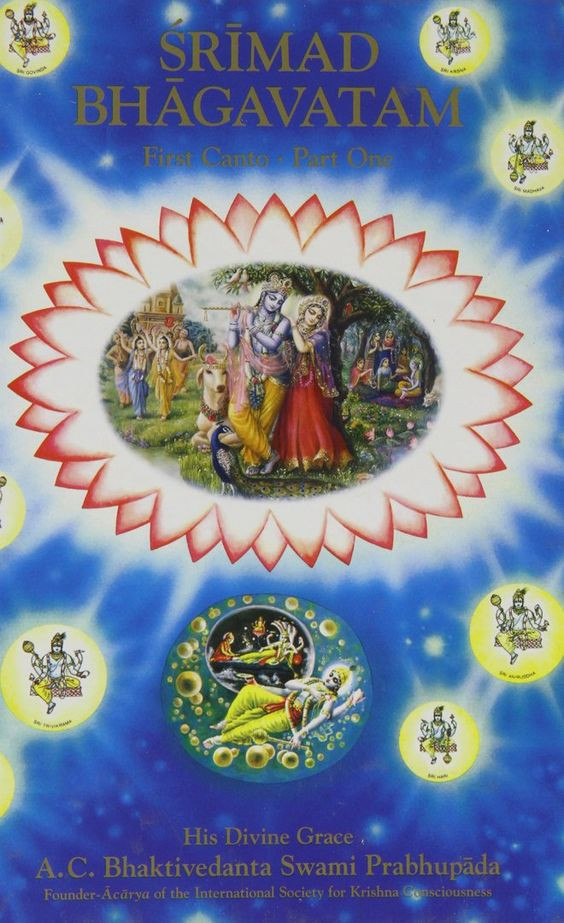 Why to read srimad bhagavatamReading the Srimad Bhagavatam fosters deep spiritual growth by narrating the life and teachings of Lord Krishna,...Read more
 -
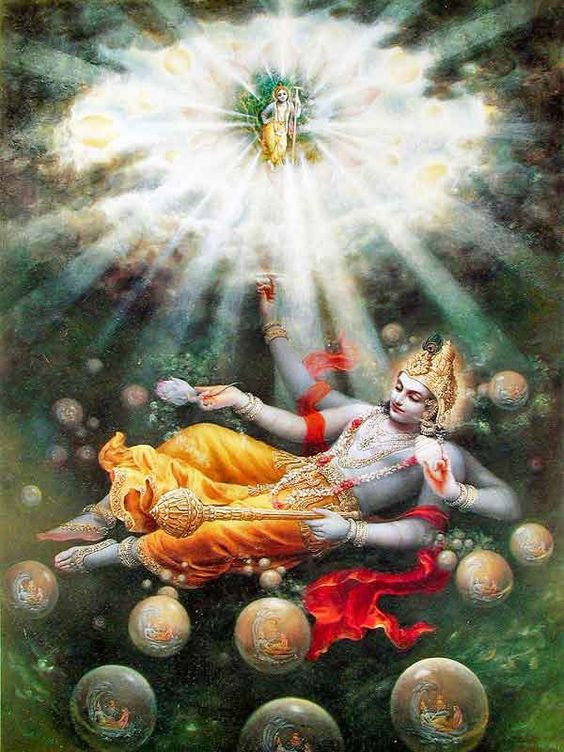 When was srimad bhagavatam written?The Srimad Bhagavatam is believed to have been written around 9th-10th century CE, though its oral traditions date...Read more
 -
 How many chapters are there in srimad bhagavatam?The Srimad Bhagavatam consists of 12 cantos (books) containing 335 chapters in total. Each canto covers various...Read more
 -
 How many skandhas are there in srimad bhagavatamThe Srimad Bhagavatam is divided into 12 skandhas (cantos or books). Each skandha explores different themes,...Read more
 -
 How many slokas in srimad bhagavatamThe Srimad Bhagavatam contains approximately 18,000 shlokas (verses). These verses are spread across its 12 skandhas...Read more
Leave a comment