
Why did Krishna run to embrace a poor brahmin in rags? Read the Sudama story from the Bhagavatam and learn how a...
Latest posts
-
 Krishna and Sudama: The Poor Brahmin Who Became Wealthy in LoveRead more
 -
 Vamana Avatar: How Three Steps Humbled Bali MaharajaRead more
Why did a powerful king give away three worlds to a boy asking for three steps? Learn the Vamana avatar story from...
-
 The Bhagavatam on Marriage: Duty, Love and Spiritual PartnershipRead more
What does the Bhagavatam say about marriage? Through the stories of Kardama and Devahuti, Rukmini's secret letter and...
-
 What Is Prema? The Bhagavatam's Highest Stage of Love for GodRead more
Prema is love for God with no "because" attached. Learn how the Bhagavatam describes it, the nine steps from faith to...
-
 Is Shiva Parvati Kalyana Mentioned in Srimad Bhagavatam? What the Scripture Really SaysRead more
Looking for Shiva and Parvati's wedding in the Srimad Bhagavatam? Find out what the scripture actually describes,...
-
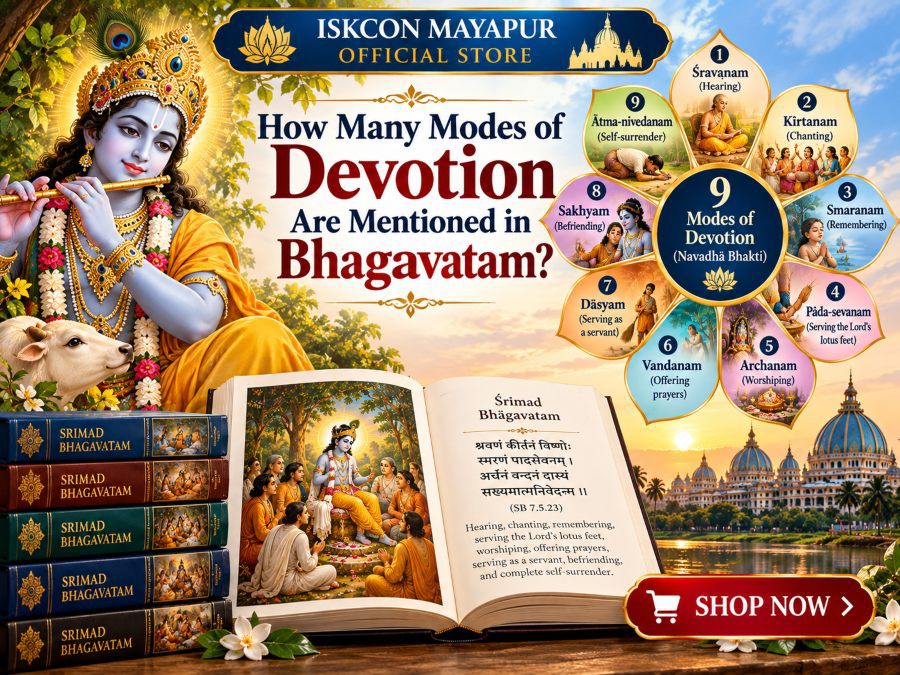 How Many Modes of Devotion Are Mentioned in Bhagavatam?Read more
A young boy named Prahlada listed nine ways to serve God, and the Bhagavatam keeps them as its answer. Learn what the...
-
 What Is Bhagavatam and Why Has It Been Read for 5,000 Years?Read more
A dying king asked one question, and the answer became the Bhagavatam. Learn what this Sanskrit scripture contains,...
-
 Who Is Lord Krishna? His Meaning, Teachings and Pastimes ExplainedRead more
Discover who Krishna is according to Srimad Bhagavatam, including His divine identity, childhood pastimes, teachings,...
-
 Incense in Islam: Bakhoor, Agarbatti and What Tradition SaysRead more
Is burning fragrance part of Muslim tradition? Explore incense in Islam, from the Prophetic practice of fumigating...
-
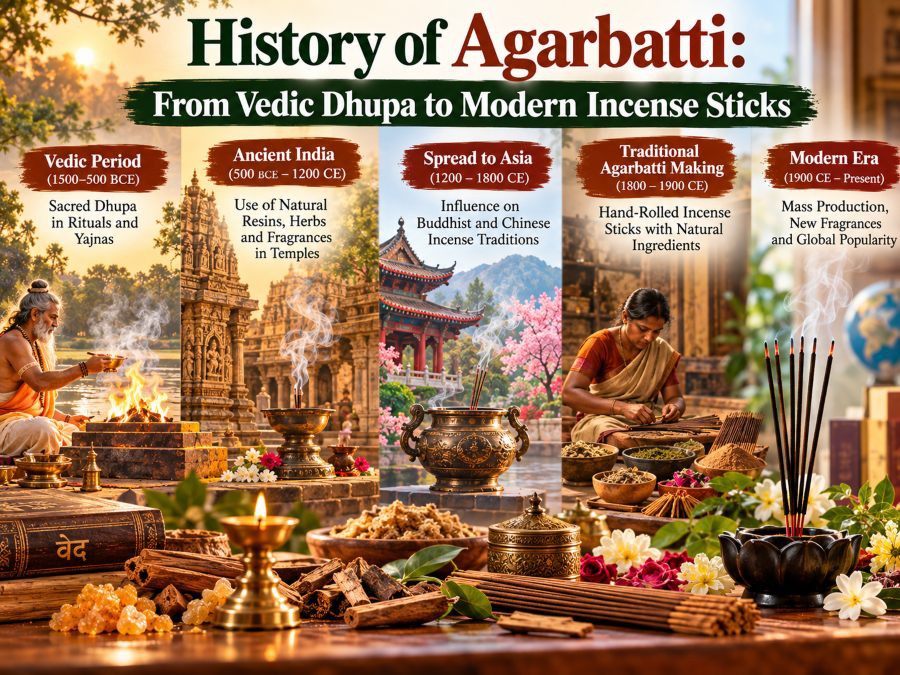 History of Agarbatti: From Vedic Dhupa to Modern Incense SticksRead more
Where did agarbatti really come from? Follow the history of agarbatti from Vedic fire rituals and temple dhupa to...
Blog categories
- Default category (0)
- MUSICAL INSTRUMENT (1)
- BOOK (5)
- DEVOTIONAL GIFT (0)
- Blog (30) click
- CHANDAN (12)
- Bhagavatam Wisdom Series (68)
- Krishna Consciousness (14)
- Mridangam Musical Instrument (6)
- Bhagavad Gita for Beginners (13)
- Bhagavad Gita As It Is (37) click
- Bhagavad Gita As It Is Telugu (0)
- Bhagavad Gita As It Is Marathi (0)
- Bhagavad Gita As It Is In Hindi (0)
- Bhagavad Gita As It Is In English (0)
- Bhagavad Gita As It Is In Bengali (8)
- Bhagavad Gita As It Is In Kannada (0)
- Bhagavad Gita As It Is In Gujarati (0)
- Bhagavad Gita As It Is In Panjabi (0)
- Bhagavad Gita As It Is In Tamil (0)
- Bhagavad Gita As It Is Odia (0)
- BHAGAVAD GITA As It Is GERMAN (0)
- Bhagavad Gita As It Is In French (0)
- Bhagavad Gita As It Is In Nepali (0)
- Bhagavad Gita As It Is In Assamese (0)
- Incense or Agarbatti (38)
- Lord Chaitanya Mahaprabhu (3)
- Vedic Temple Mayapur (14)
- kalki (15)
- Mahabharata – Dharma & Destiny (27)
- Vaishnava Scriptures (4)
- healthy product (4)
- chaitanya mahaprabhu (5)
- Tulsi Mala Guide (17)
Search in blog
Common Mistakes New Readers Make While Studying the Bhagavatam
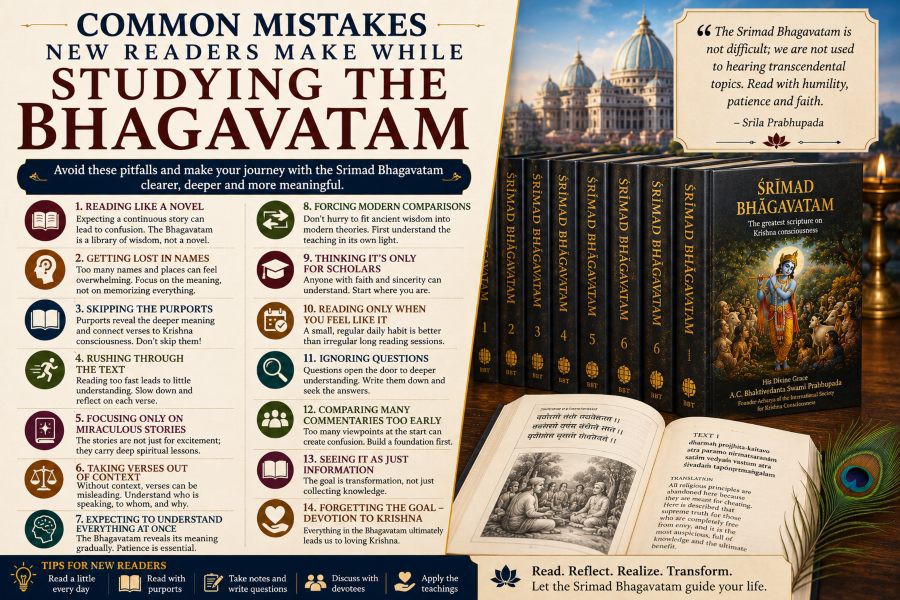
Common Mistakes New Readers Make While Studying the Bhagavatam
Have you ever opened the srimad bhagavatam with genuine enthusiasm, read several pages, and then quietly wondered, “Am I actually understanding this?” You are not alone. The Bhagavatam is a profound Sanskrit scripture filled with philosophy, history, devotional stories, cosmology, prayers, and conversations between sages and kings. For readers looking for authentic devotional books, resources are Available at Mayapur.store, but owning the book is only the beginning. Knowing how to approach it can make the difference between simply turning pages and actually absorbing its wisdom.
New readers often make a few predictable mistakes. None of them means they are doing something wrong or that the Bhagavatam is beyond their ability. Most mistakes happen because the text is being approached like an ordinary modern book.
It isn't.
The Bhagavatam rewards patience, reflection, context, and repeated reading. Once you understand that, the experience changes completely.
1. Trying to Read the Bhagavatam Like a Novel
This is probably the first mistake many beginners make.
A modern novel usually has a straightforward rhythm. You start at the beginning, follow the plot, and keep moving until you reach the final chapter.
The Bhagavatam doesn't work that way.
One section may describe a king. Another may discuss the nature of consciousness. A later passage may describe creation, devotional practice, a prayer, or the activities of the Supreme Lord.
If you expect every chapter to move like a continuous story, you may become confused.
Instead, think of the Bhagavatam as a spiritual library within a larger scripture.
Some sections are narrative.
Some are philosophical.
Some are devotional poetry.
Some are instructional.
Some provide historical or genealogical context.
The variety is intentional.
Don't rush through difficult passages simply because you feel you need to “finish the book.”
2. Getting Discouraged by Sanskrit Names
Let's be honest.
The first few chapters can contain a lot of unfamiliar names.
Kings.
Sages.
Dynasties.
Places.
Demigods.
Different Sanskrit terms.
For someone reading the Bhagavatam for the first time, this can feel like trying to remember the cast of a very large movie.
Don't worry about memorizing everything immediately.
You don't need to know the entire genealogy before understanding the spiritual lesson of a passage.
When a name appears repeatedly, you will naturally become familiar with it.
A useful approach is to keep a simple notebook or digital document where you record only the names that matter to the section you are studying.
Don't turn reading into a memory examination.
The goal is understanding.
3. Skipping the Purports
This is one of the biggest missed opportunities.
Some readers open the book, read the Sanskrit verse and English translation, and then skip directly to the next verse.
The translation gives you the basic meaning.
The purport gives you context.
In Srila Prabhupada's presentation, the purports connect Bhagavatam verses with broader Vaishnava philosophy and frequently explain how a particular teaching relates to Krishna consciousness, devotional service, the soul, material nature, and spiritual realization.
A verse may appear simple on its own.
Then the purport opens several layers of meaning.
Sometimes the opposite happens.
A verse may appear complicated, but the explanation suddenly makes the basic point clear.
For a new reader, the purports should not be treated as optional decoration.
They are part of the study experience.
4. Expecting to Understand Everything on the First Reading
Imagine reading a difficult philosophical book once and expecting to remember every idea.
That would be unrealistic.
The same is true of the Bhagavatam.
You may understand one passage today and discover another meaning when you return to it six months later.
Why?
Because the reader changes.
Your experiences change.
Your questions change.
Your ability to understand Sanskrit terminology improves.
Your understanding of bhakti develops.
A passage that once seemed abstract may suddenly become practical after you encounter a similar situation in your own life.
This is one reason experienced readers return to books they have studied many times.
The book hasn't necessarily changed.
You have.
5. Focusing Only on the Miraculous Stories
The Bhagavatam contains extraordinary stories.
There are powerful kings, divine appearances, unusual events, cosmic descriptions, demons, sages, celestial beings, and miraculous incidents.
It's natural to become fascinated by them.
But if you read only for the drama, you can miss the philosophy underneath.
Take a story involving a powerful king.
The obvious question might be:
What happened to the king?
The deeper questions are:
Why did he act that way?
What did his attachment teach?
What happened because of his desires?
What does the story reveal about karma?
What does it teach about devotion?
The Bhagavatam's stories are not merely entertainment.
They are vehicles for spiritual teaching.
Look beneath the event.
6. Treating Every Passage as if It Has the Same Purpose
Not every verse is trying to accomplish the same thing.
Some verses glorify the Supreme Lord.
Some describe devotional qualities.
Some explain philosophical principles.
Some establish context for a story.
Some contain prayers.
Some describe cosmic or historical subjects.
If you expect every passage to deliver an immediate practical lesson, certain sections may feel irrelevant.
Instead, ask:
“Why is this passage here?”
That single question can improve your reading dramatically.
Sometimes the answer is direct.
Sometimes the passage prepares you for something that appears later.
Sometimes it establishes a philosophical framework that another story depends upon.
Reading with this kind of curiosity turns difficult sections into puzzles worth solving.
7. Reading Too Fast
The Bhagavatam isn't a race.
If you read fifty pages in one sitting but remember almost nothing, the number of pages doesn't mean much.
A slower approach can be far more productive.
Try reading a manageable number of verses each day.
Then pause.
Ask yourself:
· What was the main idea?
· What did I learn about the soul?
· What did this passage teach about Krishna?
· What did I learn about devotion?
· Is there something here that challenges my current understanding?
Even five thoughtful minutes after reading can make a significant difference.
Reading slowly isn't falling behind.
It is studying properly.
8. Searching for Modern Equivalents Too Quickly
Another common mistake is forcing every Bhagavatam teaching into modern terminology.
Someone reads about karma and immediately compares it with psychology.
Someone reads about consciousness and turns it into neuroscience.
Someone reads about meditation and assumes it means exactly what modern wellness culture means by meditation.
Comparisons can sometimes be useful.
But they should come later.
First understand what the Bhagavatam itself is saying.
Only then ask how the idea compares with modern thought.
Otherwise, there is a risk of changing the original meaning before you've understood it.
Let the text speak in its own vocabulary first.
Then make comparisons.
9. Reading Without Any Context
A verse taken completely out of context can be surprisingly misleading.
Who is speaking?
Who is listening?
What happened immediately before this?
What problem is being discussed?
What comes afterward?
These questions matter.
For example, a statement made by a particular character may reflect that character's situation rather than functioning as a universal instruction.
This is why reading the surrounding verses and purports is so useful.
Context protects you from building an entire philosophy around one sentence.
10. Thinking the Bhagavatam Is Only for Scholars
The Sanskrit terminology can make the Bhagavatam look intimidating.
But you don't need to become a Sanskrit scholar before you can begin.
You need curiosity.
You need patience.
And you need a willingness to learn gradually.
A new reader may understand a passage through the English translation and commentary without knowing Sanskrit.
Later, the same reader may become interested in individual Sanskrit terms.
Then another concept.
Then another.
Learning develops naturally.
Don't create an imaginary entrance exam for yourself.
You are allowed to begin as a beginner.
11. Reading Only When You Feel Inspired
This sounds harmless.
“I'll read when I have time.”
“I'll read when I'm in the right mood.”
“I'll read when things become less busy.”
That can easily turn into not reading at all.
A small daily habit is often more effective.
Ten or fifteen minutes every morning can accomplish more over several months than an enthusiastic three-hour session followed by six weeks of silence.
You don't need an impressive routine.
You need a repeatable one.
Keep your book somewhere visible.
Choose a consistent time.
Read a small section.
Return tomorrow.
That simple rhythm can transform your relationship with the text.
12. Ignoring Questions That Bother You
Sometimes the Bhagavatam will challenge you.
You may encounter an idea that doesn't immediately make sense.
Don't hide that reaction.
Write down the question.
For example:
“Why does this character behave this way?”
“Why is devotion described as more powerful than material achievement?”
“What does this Sanskrit term actually mean?”
“How does karma work according to this section?”
“Why is Krishna described in this particular way?”
Questions are not obstacles to spiritual study.
They can become the doorway into deeper study.
The important thing is to investigate them carefully rather than forming an instant conclusion.
A Better Way to Approach Difficult Passages
When you encounter something confusing, try this five-step method:
Step 1: Read the verse again
Sometimes the first reading simply moved too quickly.
Step 2: Read the surrounding verses
The missing context may be nearby.
Step 3: Read the purport carefully
Look for the central argument rather than trying to remember every sentence.
Step 4: Identify unfamiliar terms
Write them down and learn their meanings gradually.
Step 5: Return later
Not every question needs to be solved immediately.
Sometimes understanding arrives after you've encountered the same concept somewhere else in the text.
For readers who want to examine editions, related devotional books, or other resources before choosing what to study next, see full details of the available collection and select material that matches your reading level and goals.
13. Comparing Different Interpretations Too Early
It can be useful to compare translations and commentaries.
But beginners can become overwhelmed if they start with five versions of the same verse.
One translation says this.
Another says that.
A third uses completely different terminology.
Suddenly the study becomes a comparison exercise instead of an attempt to understand the Bhagavatam.
A better approach is to become familiar with one established edition first.
Understand its terminology.
Understand its philosophical framework.
Then, once you have a foundation, comparisons become much more meaningful.
14. Forgetting That the Bhagavatam Is About Relationship
Perhaps the most important mistake is treating the Bhagavatam as a collection of information.
It contains enormous amounts of information.
But information isn't the final goal.
The text repeatedly brings the reader toward questions of relationship.
What is the relationship between the individual soul and the Supreme?
What is devotion?
What does it mean to remember Krishna?
What does a devotee's life look like?
Why does material attachment create suffering?
What does surrender actually mean?
These aren't merely academic questions.
They are personal.
The Bhagavatam repeatedly encourages the reader to move from hearing to reflection and from reflection toward transformation.
How to Build a Simple Bhagavatam Reading Habit
You don't need a complicated system.
Try this:
Choose a fixed time.
Morning can work well because the mind may be quieter.
Read a small section.
Consistency matters more than volume.
Keep a notebook.
Write down one idea and one question.
Read the purport.
Don't rush past the commentary.
Discuss what you read.
Conversation can reveal things you didn't notice alone.
Revisit important passages.
Repetition isn't wasted time.
After a few weeks, you may notice something interesting.
You're not simply “reading a book” anymore.
You're developing a relationship with the text.
The Bhagavatam Rewards the Patient Reader
The Srimad Bhagavatam is a large and sophisticated scripture. It can be challenging, especially for someone approaching it for the first time.
But difficulty isn't a sign that you should stop.
It may simply mean that the book requires a different reading style.
Don't race.
Don't obsess over remembering every name.
Don't skip every purport.
Don't reduce the stories to entertainment.
Don't force ancient concepts into modern categories before understanding them.
And don't expect yourself to understand everything immediately.
Instead, read patiently.
Ask honest questions.
Pay attention to context.
Return to passages that stay in your mind.
Most importantly, allow the text to challenge your assumptions.
The real value of the srimad bhagavatam isn't measured by how quickly you finish its volumes. It is measured by what happens to your understanding as you continue reading.
A single verse can stay with you for years.
A story you barely noticed the first time can suddenly become meaningful.
A philosophical idea can move from something you read on a page to something you recognize in your own life.
That is when study becomes more than reading.
The book begins to speak to the reader—and the reader begins to listen.
Posted in: Bhagavatam Wisdom Series
Related posts
-
 Why to read srimad bhagavatamReading the Srimad Bhagavatam fosters deep spiritual growth by narrating the life and teachings of Lord Krishna,...Read more
 -
 When was srimad bhagavatam written?The Srimad Bhagavatam is believed to have been written around 9th-10th century CE, though its oral traditions date...Read more
 -
 How many chapters are there in srimad bhagavatam?The Srimad Bhagavatam consists of 12 cantos (books) containing 335 chapters in total. Each canto covers various...Read more
 -
 How many skandhas are there in srimad bhagavatamThe Srimad Bhagavatam is divided into 12 skandhas (cantos or books). Each skandha explores different themes,...Read more
 -
 How many slokas in srimad bhagavatamThe Srimad Bhagavatam contains approximately 18,000 shlokas (verses). These verses are spread across its 12 skandhas...Read more
Leave a comment