
Why did Krishna run to embrace a poor brahmin in rags? Read the Sudama story from the Bhagavatam and learn how a...
Latest posts
-
 Krishna and Sudama: The Poor Brahmin Who Became Wealthy in LoveRead more
 -
 Vamana Avatar: How Three Steps Humbled Bali MaharajaRead more
Why did a powerful king give away three worlds to a boy asking for three steps? Learn the Vamana avatar story from...
-
 The Bhagavatam on Marriage: Duty, Love and Spiritual PartnershipRead more
What does the Bhagavatam say about marriage? Through the stories of Kardama and Devahuti, Rukmini's secret letter and...
-
 What Is Prema? The Bhagavatam's Highest Stage of Love for GodRead more
Prema is love for God with no "because" attached. Learn how the Bhagavatam describes it, the nine steps from faith to...
-
 Is Shiva Parvati Kalyana Mentioned in Srimad Bhagavatam? What the Scripture Really SaysRead more
Looking for Shiva and Parvati's wedding in the Srimad Bhagavatam? Find out what the scripture actually describes,...
-
 How Many Modes of Devotion Are Mentioned in Bhagavatam?Read more
A young boy named Prahlada listed nine ways to serve God, and the Bhagavatam keeps them as its answer. Learn what the...
-
 What Is Bhagavatam and Why Has It Been Read for 5,000 Years?Read more
A dying king asked one question, and the answer became the Bhagavatam. Learn what this Sanskrit scripture contains,...
-
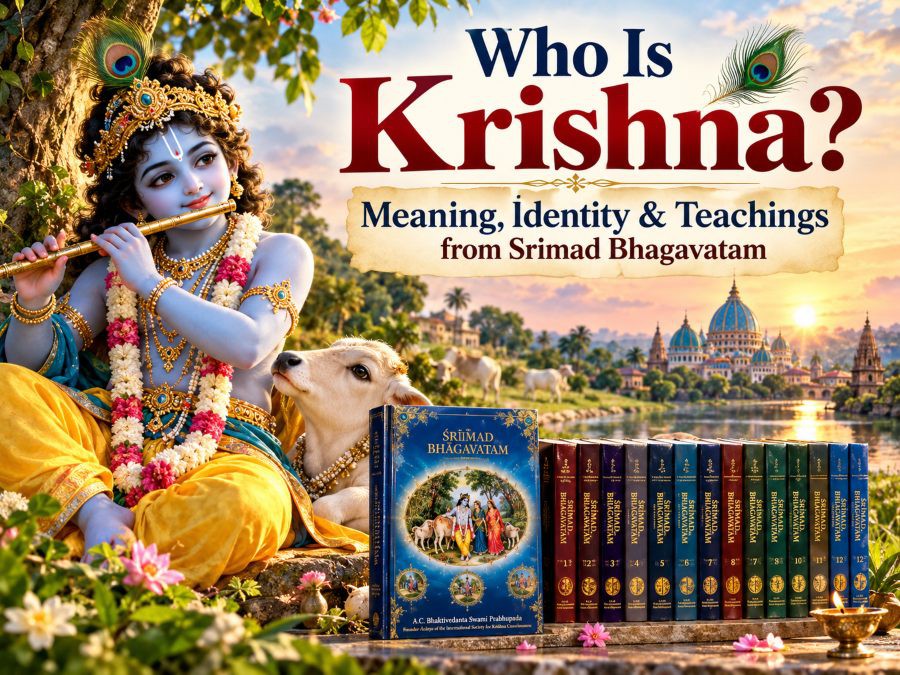 Who Is Lord Krishna? His Meaning, Teachings and Pastimes ExplainedRead more
Discover who Krishna is according to Srimad Bhagavatam, including His divine identity, childhood pastimes, teachings,...
-
 Incense in Islam: Bakhoor, Agarbatti and What Tradition SaysRead more
Is burning fragrance part of Muslim tradition? Explore incense in Islam, from the Prophetic practice of fumigating...
-
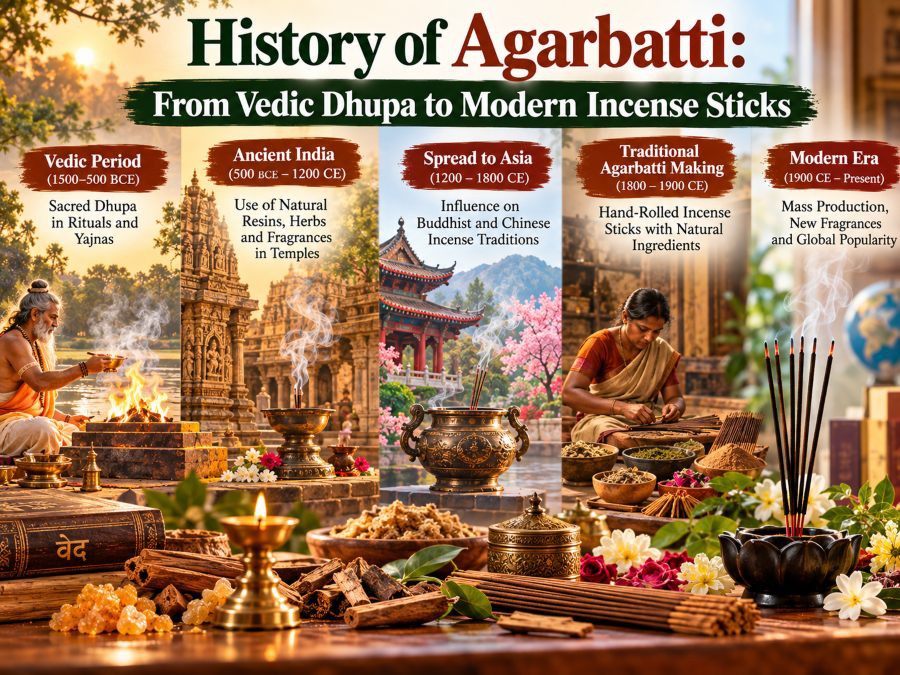 History of Agarbatti: From Vedic Dhupa to Modern Incense SticksRead more
Where did agarbatti really come from? Follow the history of agarbatti from Vedic fire rituals and temple dhupa to...
Blog categories
- Default category (0)
- MUSICAL INSTRUMENT (1)
- BOOK (5)
- DEVOTIONAL GIFT (0)
- Blog (30) click
- CHANDAN (12)
- Bhagavatam Wisdom Series (68)
- Krishna Consciousness (14)
- Mridangam Musical Instrument (6)
- Bhagavad Gita for Beginners (13)
- Bhagavad Gita As It Is (37) click
- Bhagavad Gita As It Is Telugu (0)
- Bhagavad Gita As It Is Marathi (0)
- Bhagavad Gita As It Is In Hindi (0)
- Bhagavad Gita As It Is In English (0)
- Bhagavad Gita As It Is In Bengali (8)
- Bhagavad Gita As It Is In Kannada (0)
- Bhagavad Gita As It Is In Gujarati (0)
- Bhagavad Gita As It Is In Panjabi (0)
- Bhagavad Gita As It Is In Tamil (0)
- Bhagavad Gita As It Is Odia (0)
- BHAGAVAD GITA As It Is GERMAN (0)
- Bhagavad Gita As It Is In French (0)
- Bhagavad Gita As It Is In Nepali (0)
- Bhagavad Gita As It Is In Assamese (0)
- Incense or Agarbatti (38)
- Lord Chaitanya Mahaprabhu (3)
- Vedic Temple Mayapur (14)
- kalki (15)
- Mahabharata – Dharma & Destiny (27)
- Vaishnava Scriptures (4)
- healthy product (4)
- chaitanya mahaprabhu (5)
- Tulsi Mala Guide (17)
Search in blog
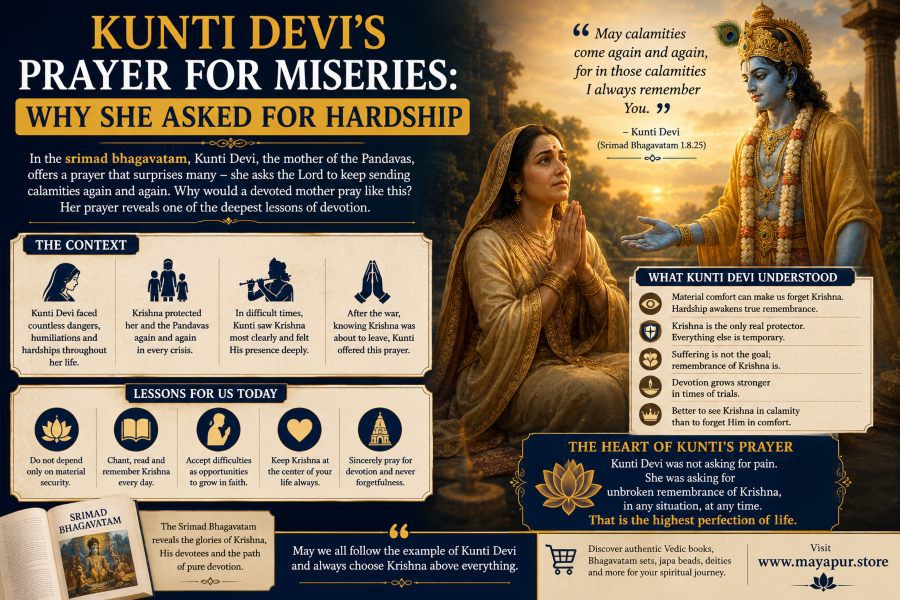
Kunti Devi’s Prayer for Miseries: Why She Asked for Hardship
Kunti Devi’s Prayer for Miseries: Why She Asked for Hardship
Why would anyone ask God for suffering when most of us spend our lives trying to avoid it? That startling question sits at the heart of Kunti Devi’s famous prayer in the srimad bhagavatam. For readers exploring Vedic literature for devotees, Kunti’s prayer can feel almost impossible to understand at first. She had already endured exile, political danger, the attempted murder of her children, humiliation, and repeated threats to her family. Yet after Krishna protected her and the Pandavas, she offered a prayer asking that calamities continue to come.
Her words sound strange.
Almost unreasonable.
But Kunti was not asking for pain because she enjoyed suffering. She was asking for something far deeper: the kind of consciousness that suffering had awakened within her.
That distinction changes the entire meaning of her prayer.
Who Was Kunti Devi?
Kunti Devi, also known as Pritha, was the mother of the Pandavas and one of the central personalities in the history narrated in the Srimad Bhagavatam and Mahabharata.
Her life was anything but comfortable.
She became the wife of King Pandu and the mother of Yudhishthira, Bhima, and Arjuna, while Nakula and Sahadeva were born through Madri. After Pandu’s death, Kunti became responsible for protecting the five Pandavas.
Their enemies, especially Duryodhana and his allies, repeatedly attempted to destroy them.
The Pandavas were poisoned.
They were sent into dangerous situations.
Their home was burned.
They experienced years of exile.
Their family suffered public humiliation.
Even after the Kurukshetra war, danger did not immediately disappear.
Kunti therefore wasn't speaking theoretically when she talked about suffering.
She knew it personally.
She had lived through it.
The Prayer That Sounds Almost Backward
One of Kunti Devi’s most famous prayers appears in the First Canto of the Srimad Bhagavatam, after the great war.
She addresses Krishna as the Lord of the universe and expresses a remarkable wish: may calamities come again and again, because during those difficult moments she and her family repeatedly saw Krishna.
This is the heart of her prayer.
She wasn't saying:
“I love suffering.”
She was saying:
“When suffering came, I remembered Krishna more intensely.”
That is a very different idea.
Kunti had discovered something that many people only understand after difficult experiences: comfort can sometimes make us forget our deepest priorities, while hardship can force us to ask what truly matters.
Why Would Kunti Want Calamity?
Let's imagine her situation.
The war is over.
Her family has survived.
Krishna is preparing to leave.
For an ordinary person, this should be the moment to say:
“Thank you, Krishna. Everything is finally peaceful. Please let life remain comfortable from now on.”
Kunti's prayer takes another direction.
Why?
Because she understood that material comfort is temporary.
Peaceful circumstances can change.
Health can change.
Relationships can change.
Political power can disappear.
Wealth can disappear.
Even the body eventually disappears.
Kunti had seen all of this firsthand.
But she had also seen Krishna repeatedly protect the Pandavas.
That became more valuable to her than temporary comfort.
Suffering Was Not the Goal
This point is easy to miss.
Kunti Devi's prayer should not be interpreted as a command to deliberately create suffering in our lives.
The Bhagavatam does not teach devotees to seek unnecessary pain.
There is a difference between accepting unavoidable hardship and creating hardship intentionally.
Kunti was not asking:
“Please make my life miserable.”
Her deeper prayer was closer to:
“Whatever happens, let me never lose sight of You.”
That distinction matters enormously.
The spiritual lesson isn't that pain is automatically good.
Pain can be painful.
Loss can be devastating.
Grief can be overwhelming.
The lesson is that even painful circumstances can become spiritually meaningful when they deepen one's relationship with Krishna.
The Pandavas Were Surrounded by Krishna's Protection
Kunti's family experienced one crisis after another.
Yet Krishna remained connected with them.
He protected them during extraordinary situations.
He guided Arjuna.
He helped the Pandavas navigate political conflict.
He protected Draupadi during her humiliation.
He intervened when Ashvatthama released a deadly weapon toward the unborn child of Uttara.
Again and again, the Pandavas experienced danger followed by divine protection.
For Kunti, those events created a powerful realization.
When everything appeared to be falling apart, Krishna became unmistakably present.
When circumstances were comfortable, that awareness could become less intense.
That is why her prayer seems so radical.
She valued Krishna's presence more than material security.
The Difference Between Comfort and Spiritual Security
Most people naturally want security.
We want enough money.
A safe home.
Healthy relationships.
A stable future.
There is nothing inherently wrong with these desires.
The problem begins when we assume that material stability can provide permanent security.
Kunti had enough experience to know better.
She had seen royal families collapse.
She had seen powerful people die.
She had seen plans fail.
She had watched history change dramatically.
Her faith therefore rested on something deeper than circumstances.
Her security was Krishna.
That is one of the most powerful ideas behind her prayer.
What Kunti Teaches About Fear
Fear often makes us focus on the future.
“What if something goes wrong?”
“What if I lose this?”
“What if my plans fail?”
“What if someone hurts me?”
Kunti Devi experienced genuine reasons to be afraid.
Yet her response gradually shifted.
Instead of asking only for the removal of danger, she learned to see danger as an opportunity to remember Krishna.
That doesn't mean she stopped caring about her family.
It means her consciousness was no longer completely controlled by circumstances.
This is an important distinction.
Spiritual maturity does not necessarily mean that frightening situations stop appearing.
It means fear does not have to become the final authority over the mind.
The Famous Lesson of Kunti's Calamities
Kunti's prayer contains a profound spiritual paradox:
When difficulty brought Krishna closer to her awareness, difficulty became spiritually valuable.
This is why the prayer has remained so influential.
It challenges our usual definition of a “good life.”
We usually define a good life through comfort.
Kunti defines the highest good through remembrance.
The question becomes less:
“Am I comfortable?”
and more:
“Am I remembering Krishna?”
That is a much deeper measure.
Why Comfort Can Become a Spiritual Distraction
Comfort isn't evil.
But comfort can become distracting.
When everything is going well, we may feel independent.
We may think:
“I have everything under control.”
We become absorbed in work.
Then entertainment.
Then possessions.
Then social status.
Then endless plans.
Spiritual questions move quietly into the background.
A crisis can interrupt that routine.
Suddenly we ask:
“Who can I depend on?”
“What actually matters?”
“Why am I here?”
“What remains when everything temporary changes?”
Kunti didn't need a philosophical lecture to understand these questions.
Life had already taught them to her.
Kunti's Prayer Is About Attachment
At the center of her prayer is the question of attachment.
Every human being becomes attached to something.
Family.
Money.
Career.
Reputation.
Comfort.
The body.
Pleasure.
Even personal plans.
These things can occupy so much mental space that spiritual remembrance becomes secondary.
Kunti's prayer turns the hierarchy upside down.
She wants attachment to Krishna to become stronger than attachment to temporary circumstances.
That is why her prayer is so powerful.
She is not celebrating suffering.
She is celebrating the spiritual awareness that arose through suffering.
The Bhagavatam Does Not Romanticize Pain
It's important not to turn Kunti's prayer into a simplistic slogan.
The Srimad Bhagavatam contains many stories of suffering, but it doesn't suggest that every painful event is pleasant or that devotees should ignore human emotions.
Devotees cry.
They grieve.
They experience fear.
They feel separation.
They struggle.
What changes is the direction of consciousness.
Instead of allowing suffering to produce permanent bitterness, a devotee can use hardship as an opportunity to deepen faith.
That process takes time.
It isn't always immediate.
And it certainly isn't easy.
A Powerful Lesson for Ordinary Life
Most of us will never experience the political dangers faced by Kunti and the Pandavas.
But we will experience smaller versions of uncertainty.
A job may disappear.
A relationship may change.
A plan may fail.
A person we love may become distant.
An unexpected expense may arrive.
A long-awaited opportunity may never come.
These events can shake us.
Kunti offers a different way of responding.
Rather than asking only:
“Why is this happening to me?”
we can also ask:
“What is this situation teaching me about dependence, attachment, faith, and remembrance?”
That question doesn't erase the difficulty.
But it can change our relationship with it.
Where the Story Fits in the Srimad Bhagavatam
Kunti's prayers appear early in the Srimad Bhagavatam, during a period when Krishna is preparing to leave the Pandavas.
The placement is meaningful.
The reader has just witnessed an enormous amount of conflict.
The war has ended.
The surviving family members are dealing with its consequences.
Krishna's presence has provided protection and guidance.
Then Kunti speaks.
Her prayer becomes a bridge between the dramatic events of the past and the spiritual teachings that follow.
She demonstrates what a mature devotee's consciousness can look like after experiencing extraordinary upheaval.
She does not simply thank Krishna for solving her problems.
She expresses gratitude for having seen Krishna during those problems.
That is the difference.
What Readers Can Learn From Kunti Today
Kunti's prayer can be applied without pretending that suffering is pleasant.
Here are several practical lessons.
1. Don't measure life only by comfort
A comfortable life can still be spiritually empty.
Ask whether your life is helping you remember what is eternal.
2. Let difficulties teach you
When something goes wrong, allow yourself to feel the pain. Then ask what the experience can teach you.
3. Notice where your mind runs during crisis
Do you become consumed by fear?
Do you become angry?
Do you immediately blame others?
Or can you gradually turn toward Krishna?
4. Don't create unnecessary suffering
Kunti's prayer is not an instruction to manufacture problems.
Accept what comes naturally and responsibly.
5. Build spiritual habits before difficulties arrive
Prayer, reading, chanting, association, and devotional service are easier to maintain during a crisis when they are already part of daily life.
Why Reading Kunti's Prayer in the Original Context Matters
A short quotation can sound strange when removed from its setting.
“May calamities come” can sound almost harsh.
But when you understand Kunti's entire story, the prayer becomes deeply personal.
She had seen Krishna protect her family.
She had witnessed danger repeatedly.
She had experienced the temporary nature of worldly security.
And she had discovered that remembrance of Krishna gave her something circumstances could not provide.
This is why studying the complete narrative matters.
For readers building a devotional library, the books and collections available through www.mayapur.store can provide access to texts that allow these stories to be studied in their wider context rather than through isolated quotations.
The context changes everything.
The Strange Freedom Hidden in Kunti's Prayer
There is a kind of freedom in Kunti's attitude.
If happiness depends entirely on circumstances, we become vulnerable to every change.
Good news makes us happy.
Bad news destroys our peace.
Success makes us confident.
Failure makes us miserable.
Praise lifts us.
Criticism crushes us.
Kunti's consciousness points toward something steadier.
She recognizes that circumstances are temporary.
Krishna is not.
That realization does not make difficulty disappear.
It changes what difficulty can do to us.
Instead of becoming only a source of bitterness, hardship can become a reminder.
Instead of pushing us away from spiritual life, it can bring us closer.
Kunti and the Meaning of Gratitude
Gratitude is often associated with good things.
We say thank you for health.
Thank you for success.
Thank you for a new opportunity.
Kunti introduces a more difficult form of gratitude.
She is grateful for the presence of Krishna revealed during hardship.
That is not ordinary gratitude.
It requires a deeper understanding of life.
She isn't grateful for being hurt.
She is grateful that hardship revealed something she considered more valuable than comfort.
This distinction can transform the way we think about difficult experiences.
Why Kunti's Prayer Still Touches People
Centuries later, readers continue returning to Kunti's prayer because it addresses something almost everyone understands.
We want life to be predictable.
We want to avoid suffering.
We want our loved ones to be safe.
We want our plans to work.
And when those things fail, we wonder where God is.
Kunti offers a startling answer.
Sometimes the very moment when life feels least secure can become the moment when our relationship with God becomes most real.
That doesn't mean God causes every painful event for our benefit.
It means devotion can transform the way we experience events we cannot control.
That is a far more mature idea.
Kunti's Prayer and the Fear of Losing Krishna
There is another layer beneath her words.
Kunti is not merely worried about future suffering.
She is worried about losing Krishna's presence.
Krishna has been beside the Pandavas through years of crisis.
Now peace has returned.
And Krishna is preparing to leave.
For Kunti, this creates a painful paradox.
The family has finally achieved relative safety.
But the person she considers most valuable is about to depart.
So what appears to be a prayer for hardship can also be understood as a prayer for continued remembrance.
She would rather experience difficulty while seeing Krishna than enjoy comfort while forgetting Him.
That is the spiritual standard she places before herself.
The Real Question Behind Her Prayer
Kunti's prayer eventually forces us to ask a personal question.
What do we value most?
If we had to choose between perfect material comfort and deeper spiritual remembrance, which would we choose?
It's easy to answer when sitting comfortably with a book.
Life makes the question harder.
That's why Kunti's example matters.
She wasn't speaking from theory.
She had already paid the price.
Her faith had been tested by circumstances that would overwhelm most people.
And after all of it, she still chose Krishna.
A Different Way to Look at Difficult Times
The next time life becomes difficult, Kunti's prayer doesn't require you to pretend that everything is wonderful.
You can be disappointed.
You can cry.
You can ask for help.
You can seek practical solutions.
You can protect yourself and your family.
But alongside those responses, you can ask one more question:
“Can this situation bring me closer to Krishna rather than farther away?”
That question creates a different kind of spiritual space.
It turns suffering from an absolute definition of your life into one part of your journey.
The hardship may still be hard.
But it doesn't have to be meaningless.
The Lasting Message of Kunti Devi
Kunti Devi's famous prayer is difficult because it overturns our ordinary understanding of happiness.
She doesn't ask Krishna for a life without problems.
She asks for remembrance.
She values spiritual awareness over material comfort.
She understands that circumstances rise and fall.
She has seen wealth, power, danger, victory, loss, and grief.
And through all of it, she has seen one constant:
Krishna.
That is why her prayer remains one of the most memorable passages in the srimad bhagavatam.
Its message is not that suffering should be desired for its own sake.
Its message is much more profound:
When life brings difficulties we cannot avoid, we can choose what those difficulties do to our consciousness.
They can make us bitter.
They can make us fearful.
Or, through sincere spiritual practice, they can remind us where our deepest shelter lies.
Kunti Devi chose remembrance.
She discovered Krishna in the middle of uncertainty and learned to value His presence above the comfort she might have preferred.
That is why her prayer still challenges readers today.
We may not be ready to ask for calamities.
Most of us aren't.
But we can ask for something Kunti understood far better than most:
Whatever happens in life, may I never forget Krishna.
Posted in: Bhagavatam Wisdom Series
Related posts
-
 Why to read srimad bhagavatamReading the Srimad Bhagavatam fosters deep spiritual growth by narrating the life and teachings of Lord Krishna,...Read more
 -
 When was srimad bhagavatam written?The Srimad Bhagavatam is believed to have been written around 9th-10th century CE, though its oral traditions date...Read more
 -
 How many chapters are there in srimad bhagavatam?The Srimad Bhagavatam consists of 12 cantos (books) containing 335 chapters in total. Each canto covers various...Read more
 -
 How many skandhas are there in srimad bhagavatamThe Srimad Bhagavatam is divided into 12 skandhas (cantos or books). Each skandha explores different themes,...Read more
 -
 How many slokas in srimad bhagavatamThe Srimad Bhagavatam contains approximately 18,000 shlokas (verses). These verses are spread across its 12 skandhas...Read more
Leave a comment