
Why did Krishna run to embrace a poor brahmin in rags? Read the Sudama story from the Bhagavatam and learn how a...
Latest posts
-
 Krishna and Sudama: The Poor Brahmin Who Became Wealthy in LoveRead more
 -
 Vamana Avatar: How Three Steps Humbled Bali MaharajaRead more
Why did a powerful king give away three worlds to a boy asking for three steps? Learn the Vamana avatar story from...
-
 The Bhagavatam on Marriage: Duty, Love and Spiritual PartnershipRead more
What does the Bhagavatam say about marriage? Through the stories of Kardama and Devahuti, Rukmini's secret letter and...
-
 What Is Prema? The Bhagavatam's Highest Stage of Love for GodRead more
Prema is love for God with no "because" attached. Learn how the Bhagavatam describes it, the nine steps from faith to...
-
 Is Shiva Parvati Kalyana Mentioned in Srimad Bhagavatam? What the Scripture Really SaysRead more
Looking for Shiva and Parvati's wedding in the Srimad Bhagavatam? Find out what the scripture actually describes,...
-
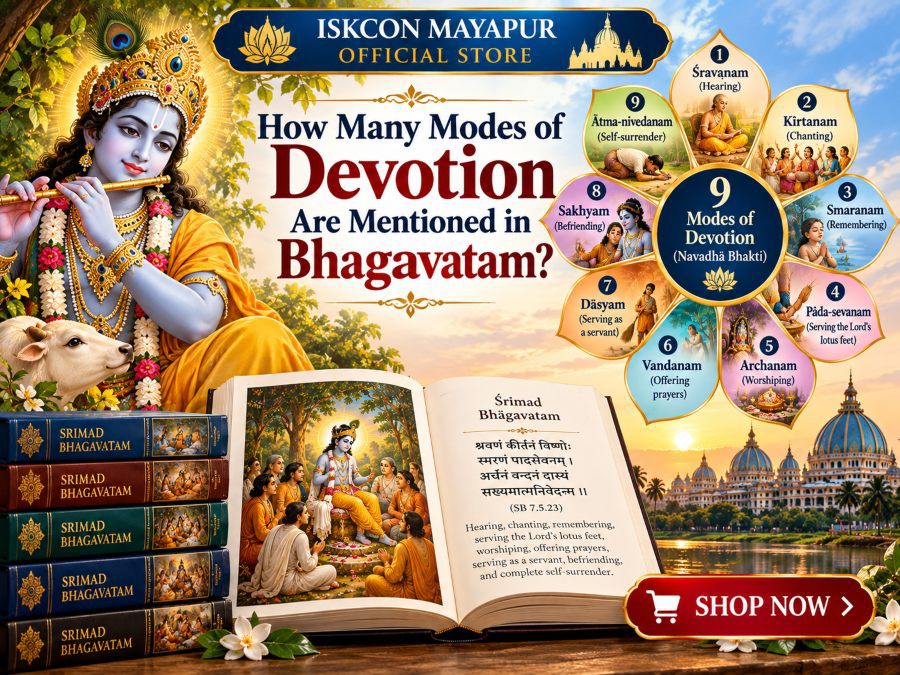 How Many Modes of Devotion Are Mentioned in Bhagavatam?Read more
A young boy named Prahlada listed nine ways to serve God, and the Bhagavatam keeps them as its answer. Learn what the...
-
 What Is Bhagavatam and Why Has It Been Read for 5,000 Years?Read more
A dying king asked one question, and the answer became the Bhagavatam. Learn what this Sanskrit scripture contains,...
-
 Who Is Lord Krishna? His Meaning, Teachings and Pastimes ExplainedRead more
Discover who Krishna is according to Srimad Bhagavatam, including His divine identity, childhood pastimes, teachings,...
-
 Incense in Islam: Bakhoor, Agarbatti and What Tradition SaysRead more
Is burning fragrance part of Muslim tradition? Explore incense in Islam, from the Prophetic practice of fumigating...
-
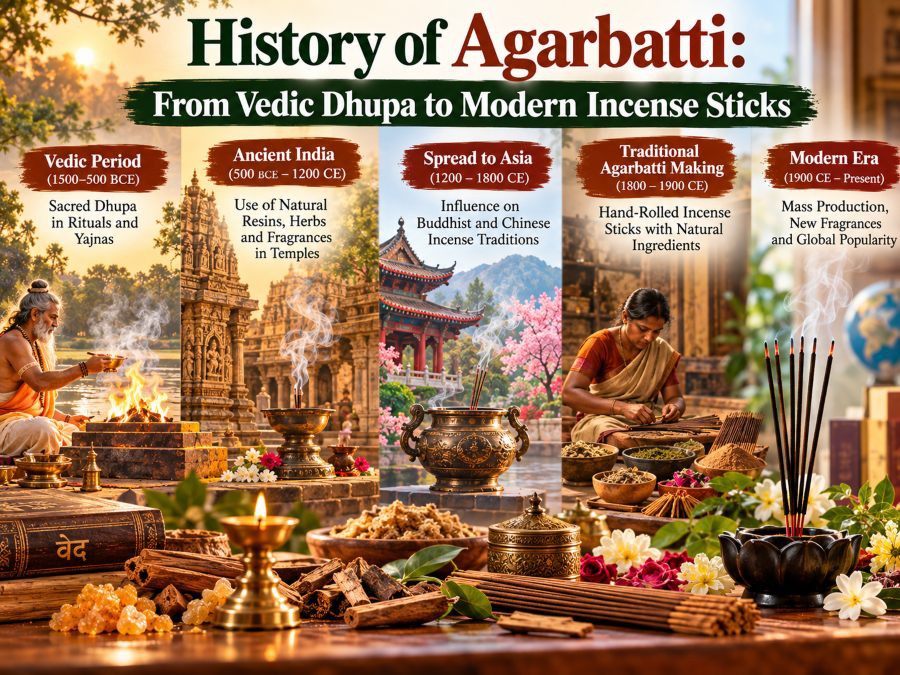 History of Agarbatti: From Vedic Dhupa to Modern Incense SticksRead more
Where did agarbatti really come from? Follow the history of agarbatti from Vedic fire rituals and temple dhupa to...
Blog categories
- Default category (0)
- MUSICAL INSTRUMENT (1)
- BOOK (5)
- DEVOTIONAL GIFT (0)
- Blog (30) click
- CHANDAN (12)
- Bhagavatam Wisdom Series (68)
- Krishna Consciousness (14)
- Mridangam Musical Instrument (6)
- Bhagavad Gita for Beginners (13)
- Bhagavad Gita As It Is (37) click
- Bhagavad Gita As It Is Telugu (0)
- Bhagavad Gita As It Is Marathi (0)
- Bhagavad Gita As It Is In Hindi (0)
- Bhagavad Gita As It Is In English (0)
- Bhagavad Gita As It Is In Bengali (8)
- Bhagavad Gita As It Is In Kannada (0)
- Bhagavad Gita As It Is In Gujarati (0)
- Bhagavad Gita As It Is In Panjabi (0)
- Bhagavad Gita As It Is In Tamil (0)
- Bhagavad Gita As It Is Odia (0)
- BHAGAVAD GITA As It Is GERMAN (0)
- Bhagavad Gita As It Is In French (0)
- Bhagavad Gita As It Is In Nepali (0)
- Bhagavad Gita As It Is In Assamese (0)
- Incense or Agarbatti (38)
- Lord Chaitanya Mahaprabhu (3)
- Vedic Temple Mayapur (14)
- kalki (15)
- Mahabharata – Dharma & Destiny (27)
- Vaishnava Scriptures (4)
- healthy product (4)
- chaitanya mahaprabhu (5)
- Tulsi Mala Guide (17)
Search in blog
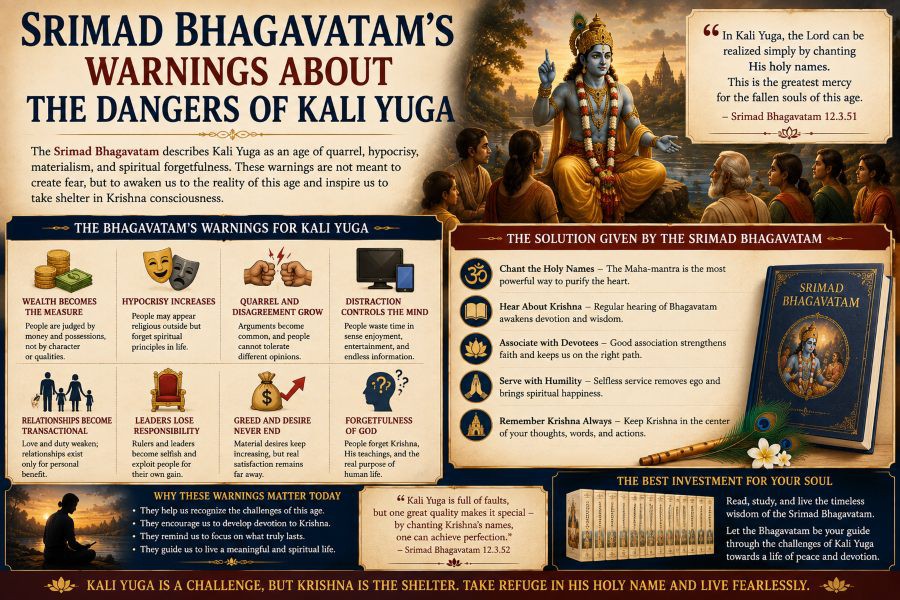
Srimad Bhagavatam’s Warnings About the Dangers of Kali Yuga
Srimad Bhagavatam's Warnings About the Dangers of Kali Yuga
What happens to a civilization when truth becomes negotiable, relationships become transactional, and people begin measuring success almost entirely through money and status? The srimad bhagavatam raises these questions thousands of years ago while describing the difficult age known as Kali Yuga. Readers who want to study these predictions in their broader scriptural context can turn to the complete Bhagavatam volumes, where the characteristics of Kali Yuga are presented alongside teachings about devotion, human behavior, dharma, and spiritual liberation.
Kali Yuga is often described as an age of quarrel, hypocrisy, confusion, and declining spiritual awareness. Yet the Bhagavatam's message is not simply a frightening prediction about the future.
It is also a warning.
And a warning has a purpose: to help us recognize danger before it controls our lives.
The remarkable thing about the Bhagavatam is how many of its observations feel familiar. The text describes people becoming increasingly distracted by material concerns, leaders becoming less responsible, relationships becoming weaker, and genuine values becoming harder to recognize.
But it also gives a way forward.
What Is Kali Yuga?
According to Vedic tradition, time moves through recurring ages known as yugas. Kali Yuga is the final and most difficult of the four commonly described ages.
The four yugas are:
· Satya Yuga, associated with truthfulness and spiritual discipline
· Treta Yuga, when virtue begins to decline
· Dvapara Yuga, when spiritual standards decline further
· Kali Yuga, marked by quarrel, hypocrisy, and weakened spiritual practice
The Srimad Bhagavatam describes Kali Yuga in considerable detail, especially in the Twelfth Canto.
The important point is that Kali Yuga is not merely a historical period.
It represents a particular condition of human consciousness.
People become increasingly absorbed in temporary goals while losing sight of deeper questions.
Who am I?
What is the purpose of life?
What is the difference between the body and the self?
What is real happiness?
What is my relationship with the Supreme?
When those questions disappear, material life can become extremely sophisticated while spiritual understanding becomes increasingly shallow.
The First Warning: Wealth Becomes a Measure of Worth
One of the Bhagavatam's striking observations about Kali Yuga concerns wealth.
Material possessions gradually become a major measure of social standing.
Someone may be judged by how much money they have, what they own, where they live, or how visibly successful they appear.
This is easy to recognize today.
A person's character is difficult to measure.
A bank balance is easy to display.
A person's humility cannot be photographed.
Compassion doesn't always produce impressive statistics.
Wisdom rarely comes with a luxury label.
The Bhagavatam's warning is not that money itself is evil.
Money can be used responsibly.
The danger begins when wealth becomes the primary measurement of human value.
Once that happens, people may sacrifice honesty, relationships, principles, and even peace of mind simply to accumulate more.
When Appearance Matters More Than Character
Kali Yuga also brings an increasing emphasis on appearance.
People may learn how to look spiritual without becoming genuinely spiritual.
They may speak beautifully while behaving selfishly.
They may display religious symbols while ignoring ethical principles.
They may create an impressive public image while their private life tells a different story.
This is one reason the Bhagavatam repeatedly emphasizes character over external appearance.
Real spiritual development should influence behavior.
It should produce qualities such as:
· Humility
· Truthfulness
· Self-control
· Compassion
· Cleanliness
· Patience
· Respect for others
· Devotion to Krishna
The warning is simple:
Don't confuse presentation with transformation.
A person can look impressive and still be spiritually immature.
The Decline of Truthfulness
Truthfulness is another quality that the Bhagavatam associates with declining spiritual standards.
In Kali Yuga, truth can become inconvenient.
People may tell the truth when it benefits them and hide it when honesty becomes costly.
This creates a strange social environment.
Everyone wants to be trusted.
Few people want the responsibility that comes with being trustworthy.
The Bhagavatam's answer is not complicated.
Truthfulness has to become a personal principle rather than something dependent on convenience.
That applies to business.
Family.
Friendship.
Spiritual communities.
Even private thoughts.
A culture becomes dishonest one individual decision at a time.
The same is true of honesty.
Relationships Can Become Transactional
The Bhagavatam also describes changes in family and social relationships during Kali Yuga.
Relationships may increasingly depend on personal benefit.
People can remain close as long as there is something to gain.
Once the benefit disappears, the relationship may weaken.
That observation feels remarkably relevant.
Modern relationships can sometimes become highly transactional:
“What can you do for me?”
“How useful is this person?”
“What status does this relationship give me?”
“What advantage will I receive?”
The Bhagavatam presents a different vision.
Real relationships should involve duty, affection, sacrifice, loyalty, and service.
These qualities require effort.
They cannot be reduced to convenience.
The Problem With Endless Material Desire
Perhaps one of Kali Yuga's greatest dangers is the expansion of desire.
One purchase creates another desire.
One achievement creates the need for another.
One level of success becomes the starting point for the next.
There is nothing wrong with improving one's life.
The problem is believing that the next material achievement will finally produce permanent satisfaction.
The Bhagavatam challenges this idea.
Material enjoyment is temporary.
The mind adjusts quickly.
What once seemed extraordinary becomes ordinary.
Then we want something else.
This cycle can continue indefinitely.
A person can spend an entire life chasing satisfaction without asking whether the strategy itself is flawed.
Technology Can Increase Distraction Without Creating Wisdom
The Bhagavatam obviously predates smartphones, social media, streaming platforms, and digital advertising.
Yet its warnings about distraction can be applied surprisingly well to modern life.
We now have access to more information than any previous generation.
But access to information is not the same as wisdom.
A person can spend hours consuming content and still avoid meaningful reflection.
The mind jumps from one subject to another.
A notification arrives.
Then another.
A video ends.
Another begins.
A message appears.
Another headline demands attention.
The result can be a mind that is constantly stimulated but rarely peaceful.
The Bhagavatam encourages a different use of attention.
Hear something spiritually meaningful. Reflect on it. Remember it. Apply it.
That process requires concentration.
Why Kali Yuga Makes Spiritual Life Difficult
Traditional spiritual disciplines can demand considerable effort.
Meditation requires concentration.
Study requires patience.
Self-control requires discipline.
Renunciation requires strength.
In Kali Yuga, the mind is described as particularly disturbed by distraction and conflict.
That is why the Bhagavatam gives special importance to hearing and chanting the holy names of Krishna.
The practice is accessible.
You don't need to own a palace.
You don't need extraordinary wealth.
You don't need political influence.
You don't need to retire from ordinary responsibilities.
You can chant.
You can hear.
You can remember.
You can associate with devotees.
You can study scripture.
The spiritual method is therefore adapted to the difficult conditions of the age.
The Middle of the Bhagavatam's Warning: Why Study the Complete Text?
Reading a few quotations about Kali Yuga can be interesting, but it doesn't give the full picture.
The warnings make more sense when read alongside the Bhagavatam's broader teachings about the soul, karma, dharma, devotional service, Krishna, and liberation.
For readers who want a more complete study experience, choosing to buy 18 books edition of Srimad Bhagavata can provide a structured way to explore the scripture across its cantos rather than relying only on isolated passages.
The goal isn't simply to collect volumes.
It is to understand the relationship between the warnings and the solution.
The Bhagavatam says, in effect:
Here is the problem. Here is what human beings are becoming attached to. And here is how consciousness can be redirected.
That complete picture is much more useful than fear alone.
The Rise of Quarrel
The name Kali itself is associated with conflict and quarrel.
The Bhagavatam describes an age in which disagreement becomes common.
Look at how quickly ordinary differences can become personal battles.
People argue about politics.
Religion.
Money.
Lifestyle.
Social status.
Personal choices.
Even small disagreements can become emotionally charged.
The deeper problem isn't disagreement itself.
Healthy disagreement can be useful.
The danger is attachment to being right.
Once winning becomes more important than truth, conversation turns into competition.
The Bhagavatam encourages humility and hearing.
Sometimes the wisest response is not the loudest one.
Leaders Can Lose Their Sense of Duty
Another warning concerns leadership.
A ruler or leader is supposed to protect those under their care.
But when leadership becomes centered on personal enjoyment, exploitation can follow.
The Bhagavatam describes the decline of responsible governance during Kali Yuga.
This teaching applies beyond kings and governments.
Leadership exists everywhere.
A parent leads a family.
A manager leads a team.
A teacher influences students.
A community leader influences members.
Even a person leading their own life has a responsibility.
The question is:
Do I use authority to serve, or do I use it to control?
The Bhagavatam favors leadership rooted in responsibility and dharma.
People Become More Anxious and Less Satisfied
Another consequence of Kali Yuga is inner instability.
People may have more possessions while experiencing less peace.
They may have more entertainment but less contentment.
They may communicate constantly while feeling lonely.
They may have countless choices while struggling to know what actually matters.
This is where the Bhagavatam's spiritual psychology becomes relevant.
External abundance cannot automatically produce internal satisfaction.
The mind needs direction.
Without a higher purpose, more options can simply mean more distractions.
The Body Becomes the Center of Identity
The Bhagavatam repeatedly teaches that the living being is not merely the physical body.
Yet in Kali Yuga, identification with the body becomes increasingly strong.
People define themselves through appearance, age, physical ability, social identity, possessions, and status.
Of course, the body matters.
We should care for it.
But caring for the body is different from believing that the body is the entirety of who we are.
The Bhagavatam invites the reader to look deeper.
I have a body, but am I only this body?
That question changes the direction of spiritual inquiry.
Kali Yuga Does Not Mean Everyone Is Doomed
This is an important point.
The Bhagavatam's descriptions of Kali Yuga can sound pessimistic if read without the surrounding teachings.
But the text doesn't leave humanity without hope.
Quite the opposite.
The age has serious disadvantages, but it also offers a direct spiritual opportunity through harinama sankirtana and remembrance of Krishna.
The practice of chanting the holy name does not depend on social status.
It does not require enormous wealth.
It can be practiced by ordinary people.
This accessibility is one of the most hopeful parts of the Bhagavatam's discussion of Kali Yuga.
The Holy Name as a Spiritual Shelter
Why does chanting receive so much emphasis?
Because sound directly engages consciousness.
When the names of Krishna are repeatedly heard and spoken, the mind receives a spiritual object for attention.
Instead of constantly chasing external stimulation, consciousness can turn inward and upward.
The familiar maha-mantra is:
Hare Krishna Hare Krishna, Krishna Krishna Hare Hare
Hare Rama Hare Rama, Rama Rama Hare Hare
For practitioners, chanting is not simply repetition.
It is a form of prayer and remembrance.
The purpose is to reconnect consciousness with Krishna.
Kali Yuga Can Become a Wake-Up Call
There is another way to read the Bhagavatam's warnings.
Instead of asking:
“When will society become worse?”
we can ask:
“Where am I participating in these tendencies?”
That question is much more useful.
Do I judge people mainly by money?
Do I care more about appearance than character?
Do I become angry when someone disagrees with me?
Do I consume information without reflecting on it?
Do I place temporary pleasures above spiritual responsibilities?
Do I postpone spiritual life?
These questions bring the Bhagavatam's warnings into personal territory.
And that is where scripture becomes transformative.
What Should We Do in Kali Yuga?
The Bhagavatam does not suggest that we can escape Kali Yuga geographically.
Running away from society is not the main answer.
The deeper answer is to change how we live within the age.
A practical spiritual routine might include:
Read regularly
Even a small amount of Bhagavatam reading every day can build continuity.
Hear Krishna's teachings
Choose meaningful spiritual content rather than allowing the mind to consume endless noise.
Chant the holy names
Make chanting part of your daily routine.
Keep good association
People influence habits, values, and consciousness.
Practice simplicity
Ask whether every desire deserves to become an obligation.
Serve others
Service weakens excessive self-centeredness.
Question material definitions of success
Money matters, but it cannot answer every question about life.
The Bhagavatam's Warning Is Really an Invitation
At first, the descriptions of Kali Yuga can sound like a list of everything wrong with human society.
But there is another way to understand them.
They are an invitation to become more conscious.
If we know that distraction is powerful, we can protect our attention.
If we know that greed can grow, we can practice contentment.
If we know that relationships can become transactional, we can practice genuine service.
If we know that pride can distort judgment, we can cultivate humility.
If we know that spiritual life can be postponed indefinitely, we can begin today.
The warning becomes useful when it changes behavior.
Why the Srimad Bhagavatam Remains Relevant
The Srimad Bhagavatam does not promise that Kali Yuga will suddenly become comfortable.
Its purpose is different.
It teaches us how to live spiritually during a difficult age.
The world may become increasingly noisy.
We can become more attentive.
People may become increasingly materialistic.
We can cultivate devotion.
Arguments may become more common.
We can practice humility.
Distractions may multiply.
We can protect our attention.
Material desires may increase.
We can learn contentment.
This is the practical side of the Bhagavatam's warning.
We cannot control the entire age.
But we can influence our own consciousness.
The Final Question: What Will We Choose?
The warnings about Kali Yuga are not meant to make us hopeless.
They are meant to make us alert.
The srimad bhagavatam describes an age in which truth can become weaker, wealth can become a measure of status, relationships can become transactional, leaders can neglect their responsibilities, and people can become increasingly distracted from spiritual questions.
But it also gives a clear spiritual direction.
Hear about Krishna.
Chant His holy names.
Remember Him.
Associate with devotees.
Serve with sincerity.
Study sacred texts.
Develop humility.
And gradually move beyond the temporary identities that keep consciousness tied to material life.
Kali Yuga may be an age of confusion, but confusion does not have to become our identity.
The world may encourage endless consumption.
We can choose meaningful hearing.
The world may reward pride.
We can choose humility.
The world may constantly demand more.
We can learn to be satisfied with what genuinely supports spiritual life.
That is why the Bhagavatam's warnings remain powerful.
They are not simply predictions about a difficult age.
They are reminders about how easily human consciousness can drift—and how deliberately it can be brought back.
The real question is not whether Kali Yuga is becoming difficult.
The real question is:
What are we doing with our consciousness while we are living in it?
That is where the Bhagavatam's warning becomes a personal spiritual call.
Posted in: Bhagavatam Wisdom Series
Related posts
-
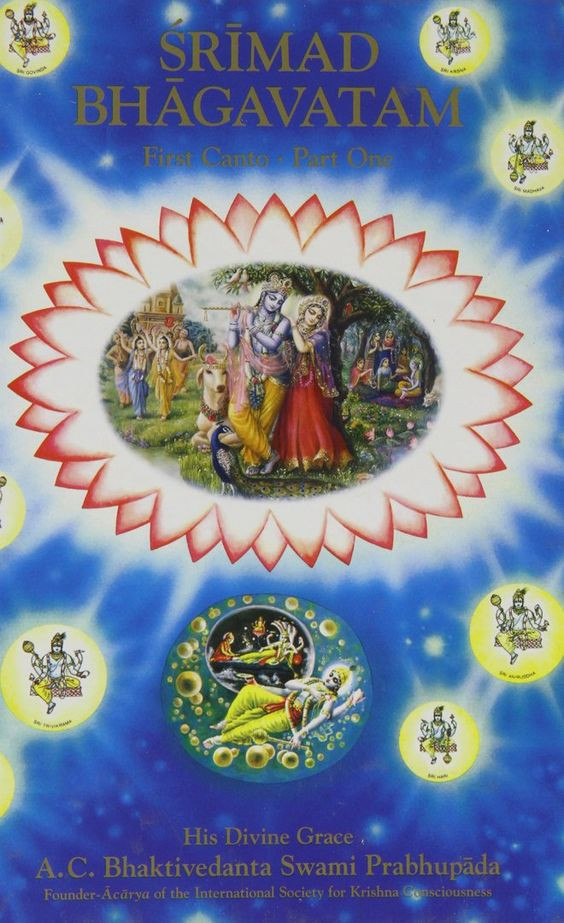 Why to read srimad bhagavatamReading the Srimad Bhagavatam fosters deep spiritual growth by narrating the life and teachings of Lord Krishna,...Read more
 -
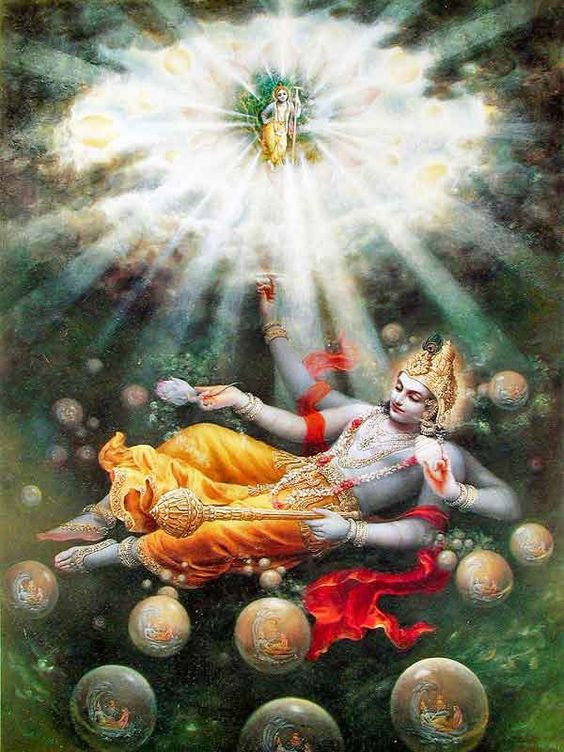 When was srimad bhagavatam written?The Srimad Bhagavatam is believed to have been written around 9th-10th century CE, though its oral traditions date...Read more
 -
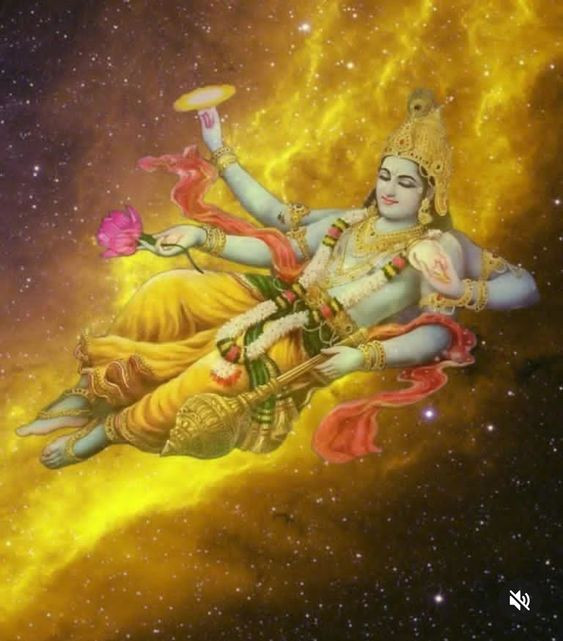 How many chapters are there in srimad bhagavatam?The Srimad Bhagavatam consists of 12 cantos (books) containing 335 chapters in total. Each canto covers various...Read more
 -
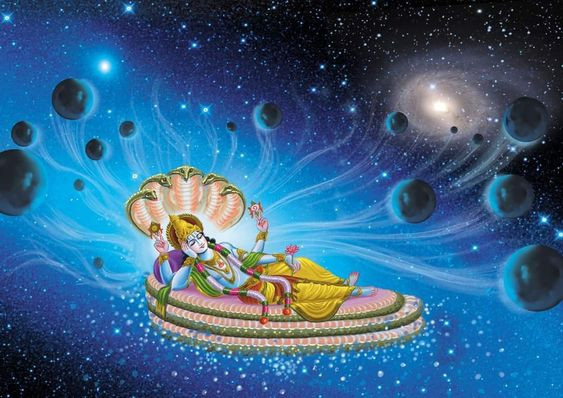 How many skandhas are there in srimad bhagavatamThe Srimad Bhagavatam is divided into 12 skandhas (cantos or books). Each skandha explores different themes,...Read more
 -
 How many slokas in srimad bhagavatamThe Srimad Bhagavatam contains approximately 18,000 shlokas (verses). These verses are spread across its 12 skandhas...Read more
Leave a comment