
Why did Krishna run to embrace a poor brahmin in rags? Read the Sudama story from the Bhagavatam and learn how a...
Latest posts
-
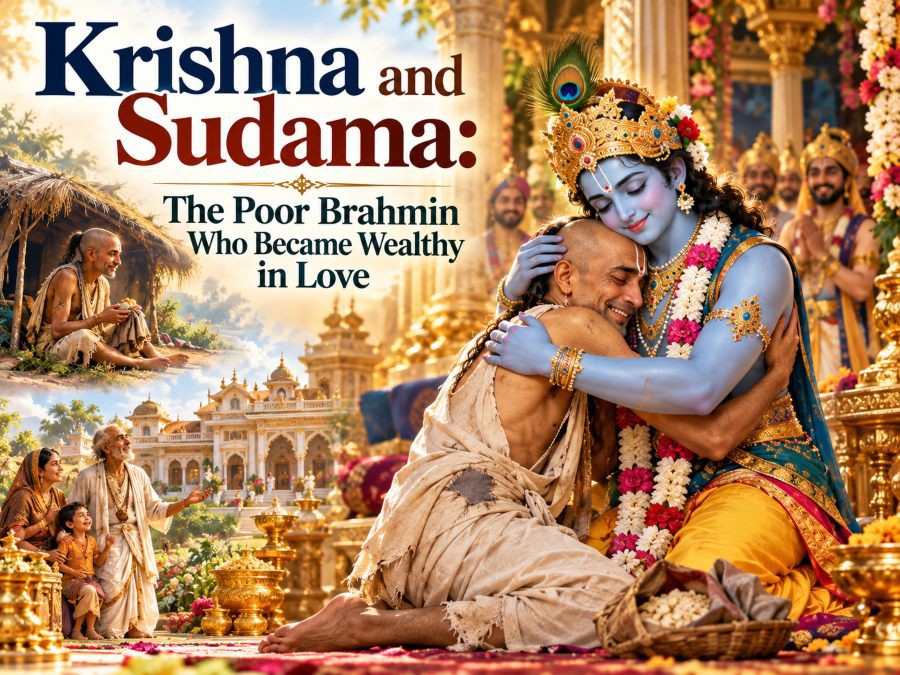 Krishna and Sudama: The Poor Brahmin Who Became Wealthy in LoveRead more
 -
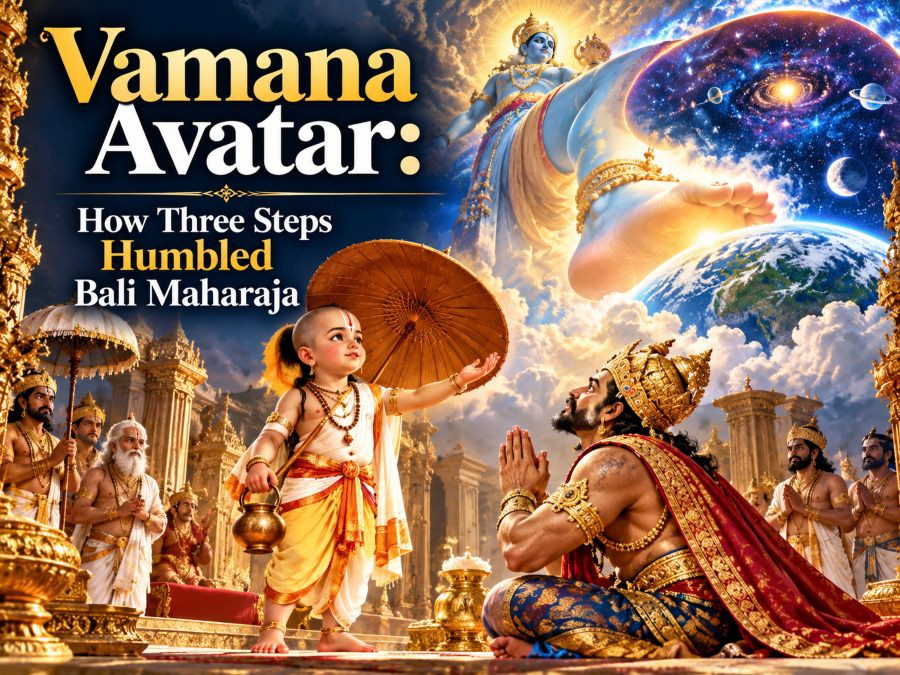 Vamana Avatar: How Three Steps Humbled Bali MaharajaRead more
Why did a powerful king give away three worlds to a boy asking for three steps? Learn the Vamana avatar story from...
-
 The Bhagavatam on Marriage: Duty, Love and Spiritual PartnershipRead more
What does the Bhagavatam say about marriage? Through the stories of Kardama and Devahuti, Rukmini's secret letter and...
-
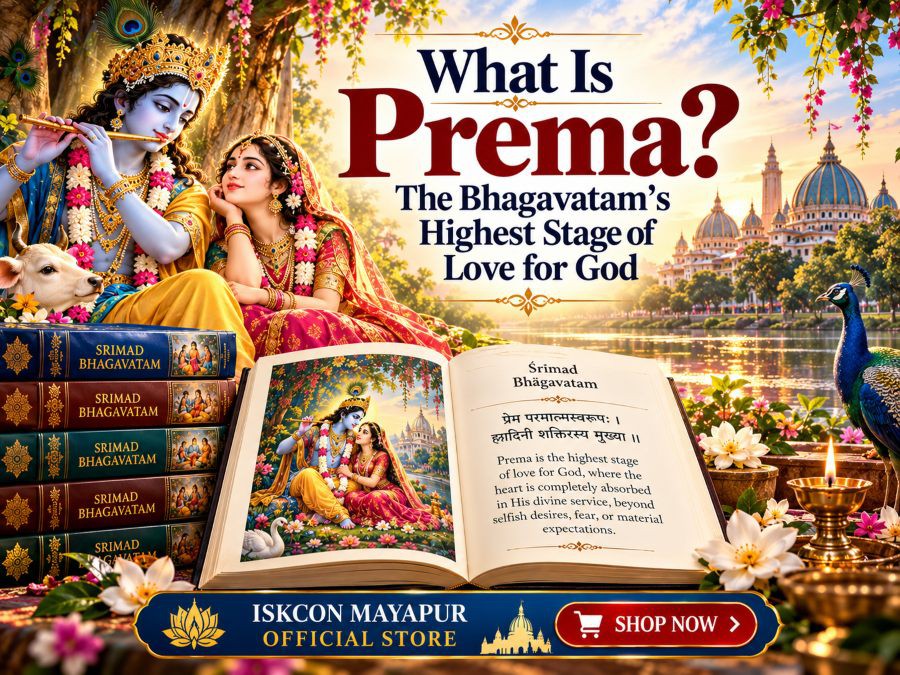 What Is Prema? The Bhagavatam's Highest Stage of Love for GodRead more
Prema is love for God with no "because" attached. Learn how the Bhagavatam describes it, the nine steps from faith to...
-
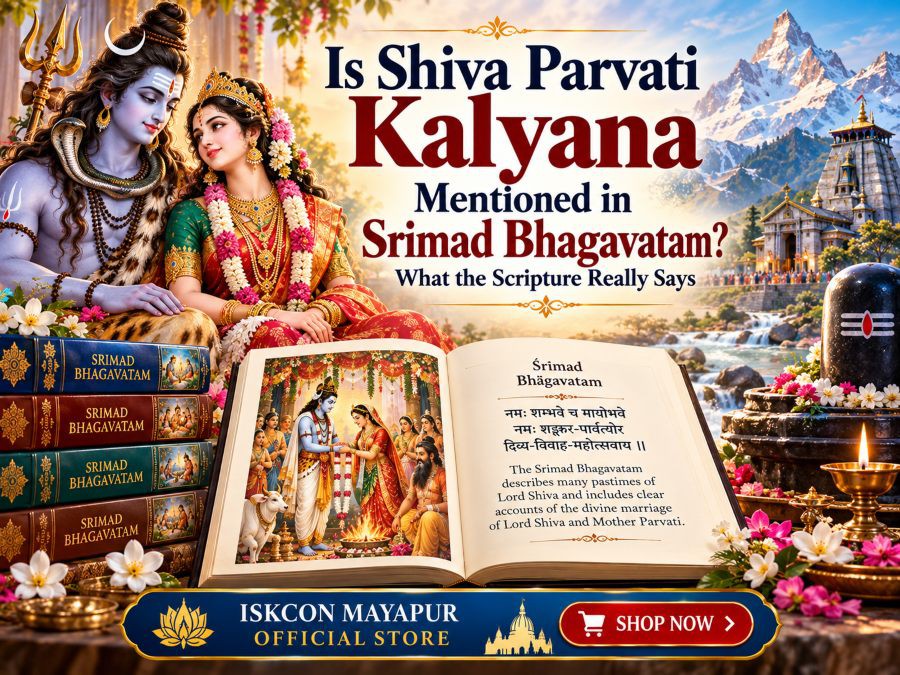 Is Shiva Parvati Kalyana Mentioned in Srimad Bhagavatam? What the Scripture Really SaysRead more
Looking for Shiva and Parvati's wedding in the Srimad Bhagavatam? Find out what the scripture actually describes,...
-
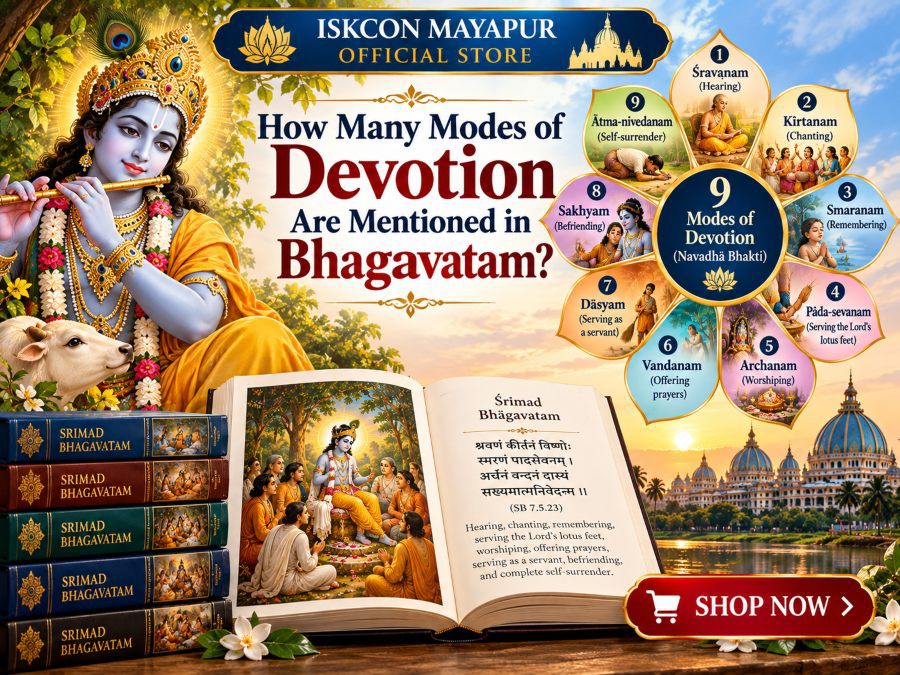 How Many Modes of Devotion Are Mentioned in Bhagavatam?Read more
A young boy named Prahlada listed nine ways to serve God, and the Bhagavatam keeps them as its answer. Learn what the...
-
 What Is Bhagavatam and Why Has It Been Read for 5,000 Years?Read more
A dying king asked one question, and the answer became the Bhagavatam. Learn what this Sanskrit scripture contains,...
-
 Who Is Lord Krishna? His Meaning, Teachings and Pastimes ExplainedRead more
Discover who Krishna is according to Srimad Bhagavatam, including His divine identity, childhood pastimes, teachings,...
-
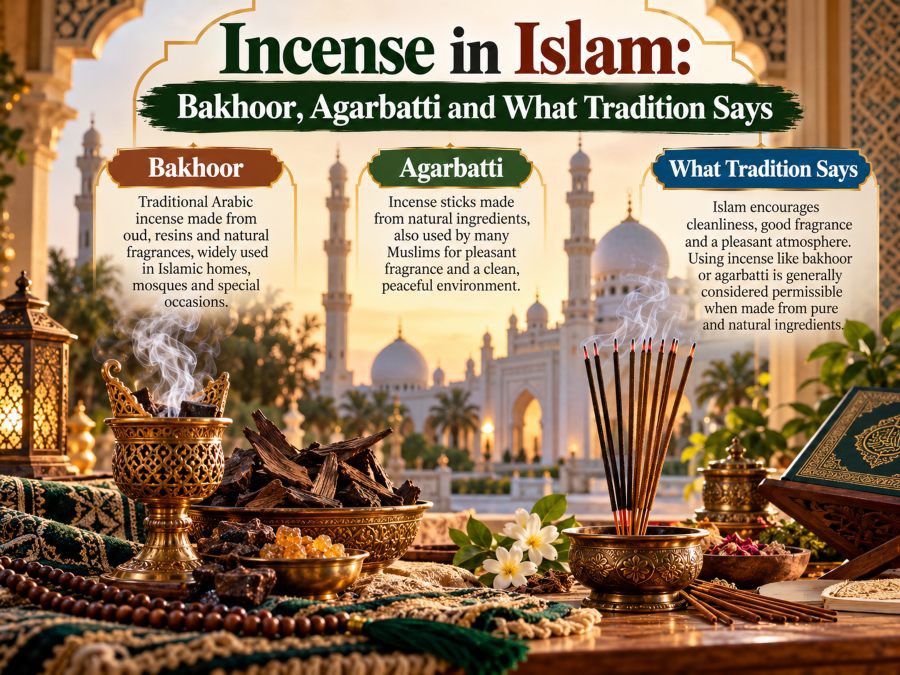 Incense in Islam: Bakhoor, Agarbatti and What Tradition SaysRead more
Is burning fragrance part of Muslim tradition? Explore incense in Islam, from the Prophetic practice of fumigating...
-
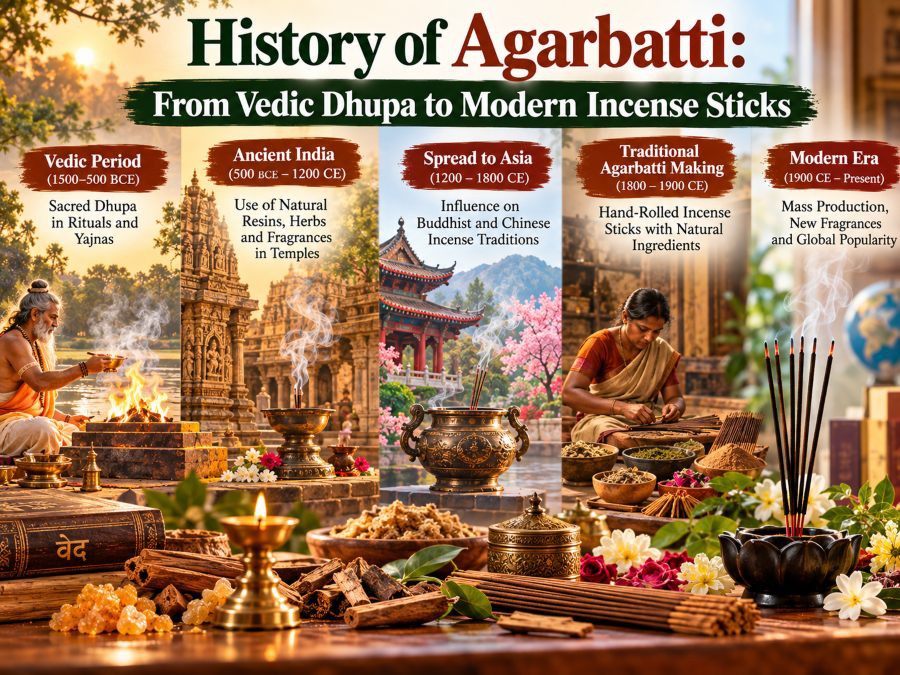 History of Agarbatti: From Vedic Dhupa to Modern Incense SticksRead more
Where did agarbatti really come from? Follow the history of agarbatti from Vedic fire rituals and temple dhupa to...
Blog categories
- Default category (0)
- MUSICAL INSTRUMENT (1)
- BOOK (5)
- DEVOTIONAL GIFT (0)
- Blog (30) click
- CHANDAN (12)
- Bhagavatam Wisdom Series (68)
- Krishna Consciousness (14)
- Mridangam Musical Instrument (6)
- Bhagavad Gita for Beginners (13)
- Bhagavad Gita As It Is (37) click
- Bhagavad Gita As It Is Telugu (0)
- Bhagavad Gita As It Is Marathi (0)
- Bhagavad Gita As It Is In Hindi (0)
- Bhagavad Gita As It Is In English (0)
- Bhagavad Gita As It Is In Bengali (8)
- Bhagavad Gita As It Is In Kannada (0)
- Bhagavad Gita As It Is In Gujarati (0)
- Bhagavad Gita As It Is In Panjabi (0)
- Bhagavad Gita As It Is In Tamil (0)
- Bhagavad Gita As It Is Odia (0)
- BHAGAVAD GITA As It Is GERMAN (0)
- Bhagavad Gita As It Is In French (0)
- Bhagavad Gita As It Is In Nepali (0)
- Bhagavad Gita As It Is In Assamese (0)
- Incense or Agarbatti (38)
- Lord Chaitanya Mahaprabhu (3)
- Vedic Temple Mayapur (14)
- kalki (15)
- Mahabharata – Dharma & Destiny (27)
- Vaishnava Scriptures (4)
- healthy product (4)
- chaitanya mahaprabhu (5)
- Tulsi Mala Guide (17)
Search in blog
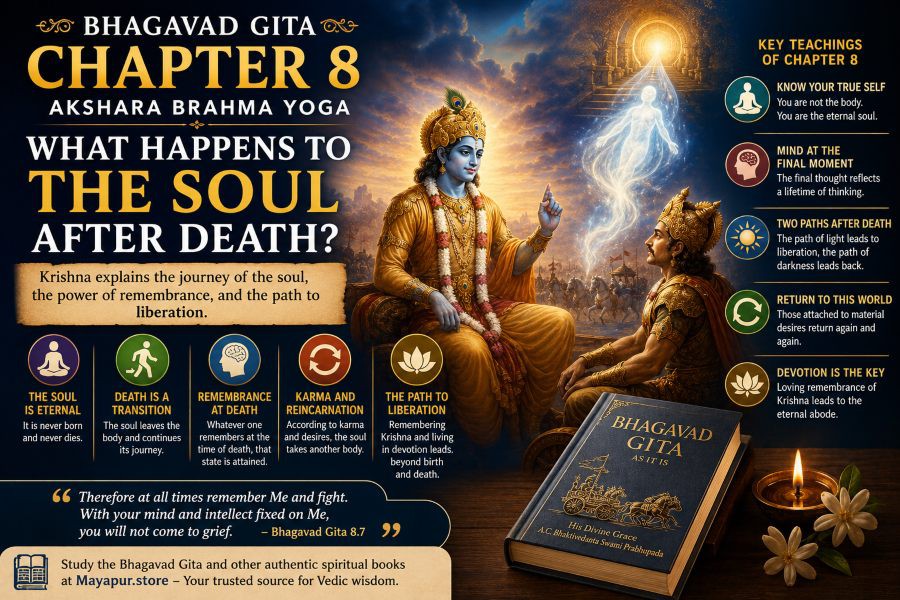
Bhagavad Gita Chapter 8: What Happens to the Soul After Death?
Bhagavad Gita Chapter 8: What Happens to the Soul After Death?
What happens to us when the body stops breathing? Is death the end of consciousness, or is it simply a doorway into another stage of existence? The bhagavad gita approaches these questions directly in Chapter 8, known as Akshara Brahma Yoga, where Krishna explains the eternal nature of the soul, the process of death, remembrance, rebirth, and the possibility of reaching the Supreme. Readers interested in studying Krishna’s teachings through authentic devotional books can also explore Bhagavad Gita books at Mayapur.store and other spiritual works.
Chapter 8 is one of the Gita's most thought-provoking sections because it deals with something every human being eventually faces: death.
Yet Krishna does not discuss death merely as a biological event.
He asks us to look deeper.
If the body changes throughout life—from childhood to youth to old age—what happens to the conscious self that experiences those changes? And if the soul is different from the temporary body, what determines where it goes after death?
The answers given in Chapter 8 form a spiritual framework that connects consciousness, remembrance, karma, devotion, and liberation.
Chapter 8 Begins With Questions About Life's Biggest Mysteries
Arjuna begins Chapter 8 by asking Krishna about several profound subjects, including Brahman, the self, action, the material world, and the Supreme Being.
These are not abstract questions for the sake of philosophy.
They are connected to one central concern:
What is the real nature of existence?
Krishna explains that the individual self is spiritual and distinct from the temporary material body. The body is subject to birth, change, decay, and death, while the soul is described as eternal.
This idea changes the way death is understood.
If we identify ourselves completely with the body, death appears to be total destruction.
If we understand ourselves as an eternal soul temporarily inhabiting a body, death becomes a transition.
That does not make losing someone emotionally easy. Grief remains real. But the philosophical understanding changes the meaning we attach to the event.
The Soul Is Not Destroyed When the Body Dies
One of the foundational teachings of the bhagavad gita is that the soul does not perish when the physical body perishes.
Krishna had already explained this idea earlier in the Gita, and Chapter 8 develops its implications further.
Think about the body you had as a child.
It is gone.
The cells, appearance, abilities, and even personality have changed considerably, yet there is a continuous sense of “I” that experiences those different stages.
According to Krishna's teaching, that conscious self is the soul.
The body changes.
The soul continues.
This distinction is central to understanding what Krishna says about death.
Death is therefore not described as the destruction of the soul. Instead, it marks the end of one bodily situation and the beginning of another, unless the soul reaches spiritual liberation.
What Determines the Soul's Next Destination?
This is where Chapter 8 becomes particularly interesting.
Krishna places enormous importance on consciousness at the time of death.
He explains that whatever state of being one remembers when leaving the body, that state is attained.
At first, this might sound as though someone can simply think of something for a few seconds at death and magically determine their destiny.
But the deeper message is about lifelong conditioning.
A person's final thoughts are unlikely to appear from nowhere.
What occupies the mind repeatedly during life tends to shape the mind itself.
A person who spends years thinking about wealth may naturally think about wealth during a crisis.
Someone deeply attached to family may instinctively think of loved ones during a final moment.
Someone who has cultivated devotion to Krishna may naturally remember Krishna.
The final moment therefore reflects a lifetime of habits.
What we repeatedly remember eventually influences what we become.
Why Krishna Emphasizes Remembrance
Krishna's instruction is not simply “remember Me when you die.”
He tells Arjuna to remember Him at all times while also performing his duty.
That distinction is important.
Spiritual life is not presented as an escape from responsibility.
Arjuna still has to act.
He still has to face difficult circumstances.
He still has to perform his responsibilities.
But Krishna wants his consciousness to remain connected with the Supreme while doing so.
This creates a practical spiritual principle:
Don't wait until the end of life to develop the consciousness you hope to have at death.
If remembrance of Krishna is the goal, it must become part of daily life.
Prayer, chanting, reading scripture, service, association with spiritually minded people, and devotional practices can gradually shape the mind.
The point is not to manufacture a dramatic spiritual experience at the last second.
The point is to live in such a way that remembrance becomes natural.
The Mind Carries Our Deepest Attachments
Our minds reveal what we value.
When something matters deeply to us, we remember it without much effort.
A parent may think constantly about their child.
An entrepreneur may wake up thinking about the business.
A student may repeatedly think about an upcoming examination.
A devotee may naturally think about Krishna.
This helps explain why Krishna's teaching about death is also a teaching about daily consciousness.
The question is not only:
“What will I think about when I die?”
A better question is:
“What am I training my mind to remember every day?”
That is a much more practical question.
If our attention is constantly absorbed by temporary possessions, status, competition, fear, and material achievement, those impressions become powerful.
The Gita encourages us to redirect that attention toward spiritual reality.
The Role of Bhakti in Chapter 8
Krishna does not present liberation as something achieved only through intellectual speculation.
Devotion has a central place.
The soul can cultivate a relationship with the Supreme through remembrance and bhakti.
This is one reason the bhagavad gita continues to be studied by people who want more than philosophical information. Its teachings connect knowledge with practice.
For readers building a personal spiritual library, Vedic literature for devotees can provide a broader context for understanding concepts such as the soul, karma, reincarnation, devotion, and liberation. The Gita itself serves as a foundation for exploring these themes more deeply through related Vedic and Vaishnava texts.
What Happens After Death According to the Gita?
According to Krishna's teachings, the soul's journey is connected with consciousness and karma.
For those who remain attached to material existence, death does not necessarily end the cycle of birth and death. The soul may take another body according to its previous actions and consciousness.
This is the basic idea behind reincarnation in the Gita.
The body changes from one life to another, while the soul remains eternal.
But Krishna also describes a different possibility.
A person who reaches the Supreme is not forced to return to the temporary cycle of birth and death.
This is liberation.
The goal, therefore, is not simply to obtain a better material body.
It is to go beyond the cycle altogether.
Krishna Describes Two Paths After Death
Chapter 8 also discusses two broad paths associated with departure from the material world.
The text describes a path connected with light, spiritual realization, and ultimate liberation, and another associated with darkness and continued return to material existence.
These passages have been interpreted in different ways within Hindu philosophical traditions.
Rather than reducing them to a simple timetable of supernatural events, it is useful to notice the larger point Krishna is making:
The soul's spiritual destination is connected with consciousness and realization.
The Gita repeatedly directs attention away from temporary material conditions and toward the eternal nature of the self and the Supreme.
The Gita's View of Time Is Much Bigger Than One Lifetime
Chapter 8 also gives Arjuna a broader vision of cosmic time.
Krishna describes immense cycles of creation and dissolution. Compared with these vast periods, an individual human lifetime is extremely brief.
That perspective can be uncomfortable—but also liberating.
We spend enormous amounts of energy worrying about temporary achievements.
Career status.
Money.
Possessions.
Recognition.
Competition.
Yet Chapter 8 asks us to consider a much larger question:
What happens to the self beyond this temporary life?
From the Gita's perspective, a meaningful life cannot be measured only by material accomplishments.
What matters is the development of consciousness.
Death Can Change the Way We Live
Paradoxically, thinking about death can make life more meaningful.
If we understand that the body is temporary, we may become less obsessed with possessions.
If we understand that consciousness matters, we may become more careful about what we repeatedly place in our minds.
If we understand that relationships are valuable but temporary in their present form, we may appreciate them more deeply.
And if we accept Krishna's teaching about the eternal soul, fear of death can gradually be replaced by spiritual inquiry.
The question changes from:
“How can I avoid death?”
to:
“How should I live knowing that this body is temporary?”
That is a far more transformative question.
How Can We Apply Chapter 8 in Daily Life?
The teachings of Chapter 8 are not limited to the final moments of life.
They can influence ordinary choices.
Practice conscious remembrance
Spend time each day remembering Krishna through prayer, chanting, meditation, or scriptural study.
Watch what occupies your mind
Your repeated thoughts shape your mental habits. Be selective about what you consume, discuss, and obsess over.
Perform your responsibilities
Krishna does not tell Arjuna to abandon his duties. Spiritual consciousness can be developed while living responsibly.
Reduce unhealthy attachment
Enjoy material responsibilities without making temporary things the foundation of your entire identity.
Study deeply
Don't rely on isolated quotations. Read the Gita as a complete conversation and explore related Vedic literature to understand its teachings in context.
Build spiritual habits early
If spiritual remembrance matters at the time of death, it makes sense to cultivate it throughout life rather than waiting until old age.
The Most Powerful Lesson of Chapter 8
Perhaps the most striking lesson of Chapter 8 is that the way we live prepares us for the way we die.
Death does not suddenly create a completely different consciousness.
Our habits, attachments, values, and spiritual practices have already been shaping us.
That makes every ordinary day meaningful.
When you choose what to think about, what to read, whom to associate with, how you respond to difficulty, and where you place your attention, you are gradually shaping your consciousness.
Krishna's teaching therefore turns the subject of death into a lesson about life.
The soul is eternal.
The body is temporary.
Consciousness matters.
Remembrance matters.
And spiritual practice is not something to postpone.
Final Thoughts
Bhagavad Gita Chapter 8 offers a profound answer to one of humanity's oldest questions: what happens to the soul after death?
According to Krishna, death is not the destruction of the self. The soul continues its journey, and its destination is connected with consciousness, karma, and spiritual realization. For those who remain bound to material existence, the cycle of birth and death continues. For one who develops genuine devotion and consciousness of the Supreme, Krishna describes the possibility of attaining the eternal spiritual realm.
The practical message is simple but demanding:
Prepare your consciousness now.
Don't wait for the final moment.
Every day gives us another opportunity to remember what is eternal, perform our responsibilities with sincerity, and gradually turn our attention toward Krishna.
That is perhaps the real gift of Chapter 8. It does not merely ask us to think about what comes after death.
It asks us to reconsider how we are living before death arrives.
Posted in: Bhagavad Gita As It Is
Related posts
-
 Why the Bhagavad Gita Feels Like a Personal Conversation with KrishnaThe Bhagavad Gita feels like a personal conversation with Krishna because its timeless wisdom directly addresses our...Read more
 -
 Shrimad Bhagwat Geeta: The Forgotten Life Manual for Modern StressShrimad Bhagwat Geeta is more than a sacred scripture—it’s a forgotten life manual that offers timeless solutions for...Read more
 -
 Who Wrote the Bhagavad Gita? Discover the true authorship of the Bhagavad Gita—exploring Ved Vyasa’s role as the compiler, Lord Krishna’s divine...Read more
 -
 How Many Shlokas in Bhagavad Gita? Complete Chapter-Wise Breakdown & MeaningDiscover how many shlokas are in the Bhagavad Gita, with a complete chapter-wise breakdown, variations in verse...Read more
 -
 How to Read Bhagavad Gita: A Complete Step-by-Step Guide for BeginnersDiscover how to read the Bhagavad Gita step by step—learn the right mindset, chapter order, and tips to understand...Read more
Leave a comment