
Why did Krishna run to embrace a poor brahmin in rags? Read the Sudama story from the Bhagavatam and learn how a...
Latest posts
-
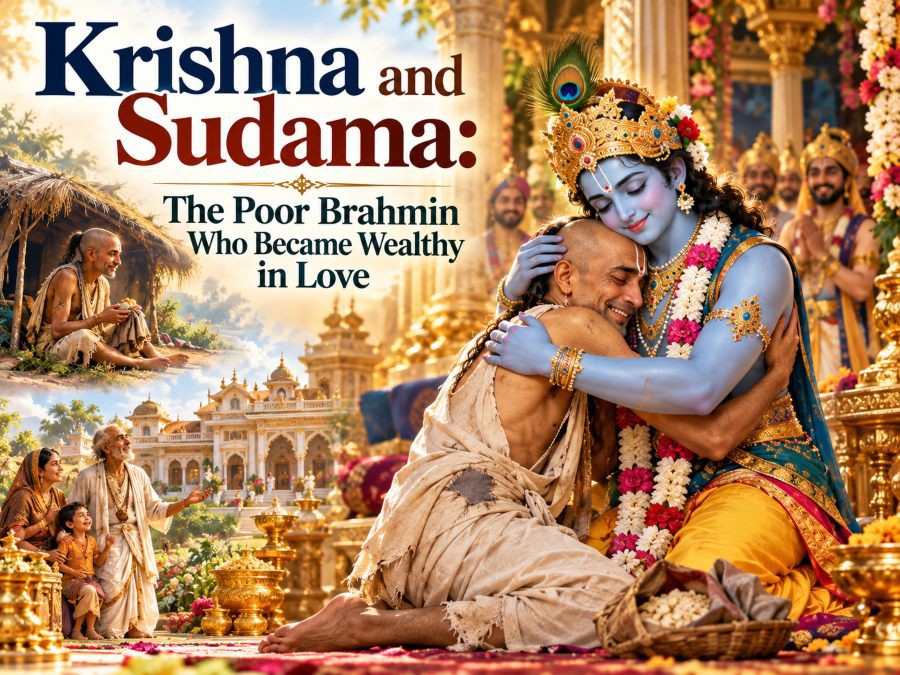 Krishna and Sudama: The Poor Brahmin Who Became Wealthy in LoveRead more
 -
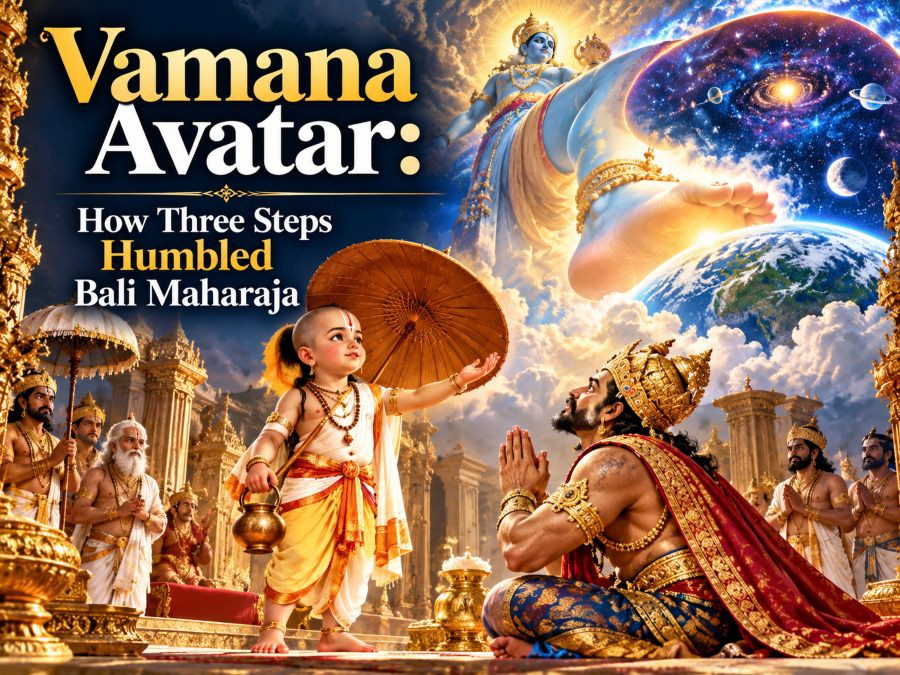 Vamana Avatar: How Three Steps Humbled Bali MaharajaRead more
Why did a powerful king give away three worlds to a boy asking for three steps? Learn the Vamana avatar story from...
-
 The Bhagavatam on Marriage: Duty, Love and Spiritual PartnershipRead more
What does the Bhagavatam say about marriage? Through the stories of Kardama and Devahuti, Rukmini's secret letter and...
-
 What Is Prema? The Bhagavatam's Highest Stage of Love for GodRead more
Prema is love for God with no "because" attached. Learn how the Bhagavatam describes it, the nine steps from faith to...
-
 Is Shiva Parvati Kalyana Mentioned in Srimad Bhagavatam? What the Scripture Really SaysRead more
Looking for Shiva and Parvati's wedding in the Srimad Bhagavatam? Find out what the scripture actually describes,...
-
 How Many Modes of Devotion Are Mentioned in Bhagavatam?Read more
A young boy named Prahlada listed nine ways to serve God, and the Bhagavatam keeps them as its answer. Learn what the...
-
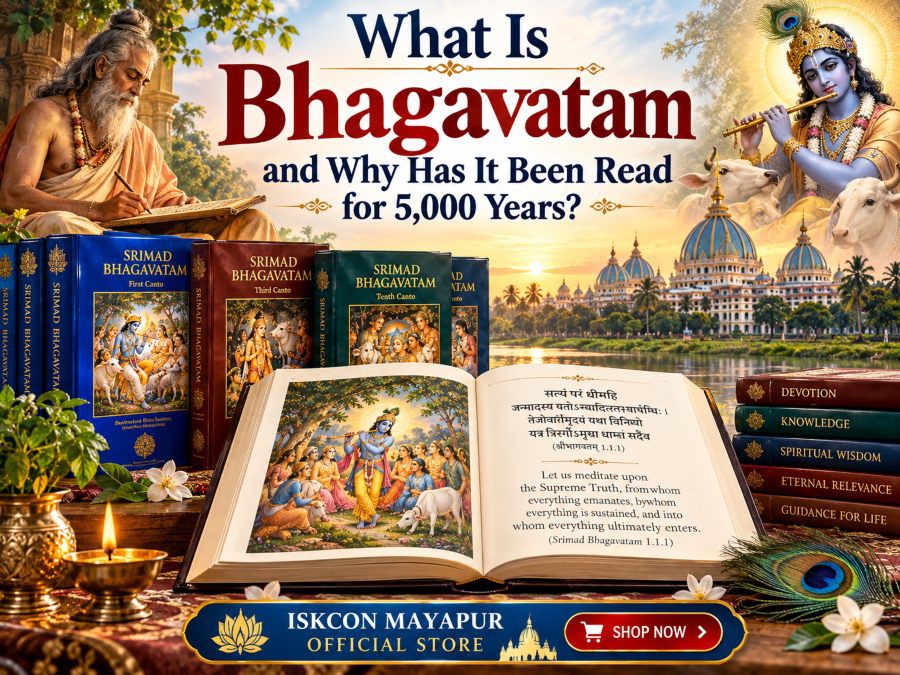 What Is Bhagavatam and Why Has It Been Read for 5,000 Years?Read more
A dying king asked one question, and the answer became the Bhagavatam. Learn what this Sanskrit scripture contains,...
-
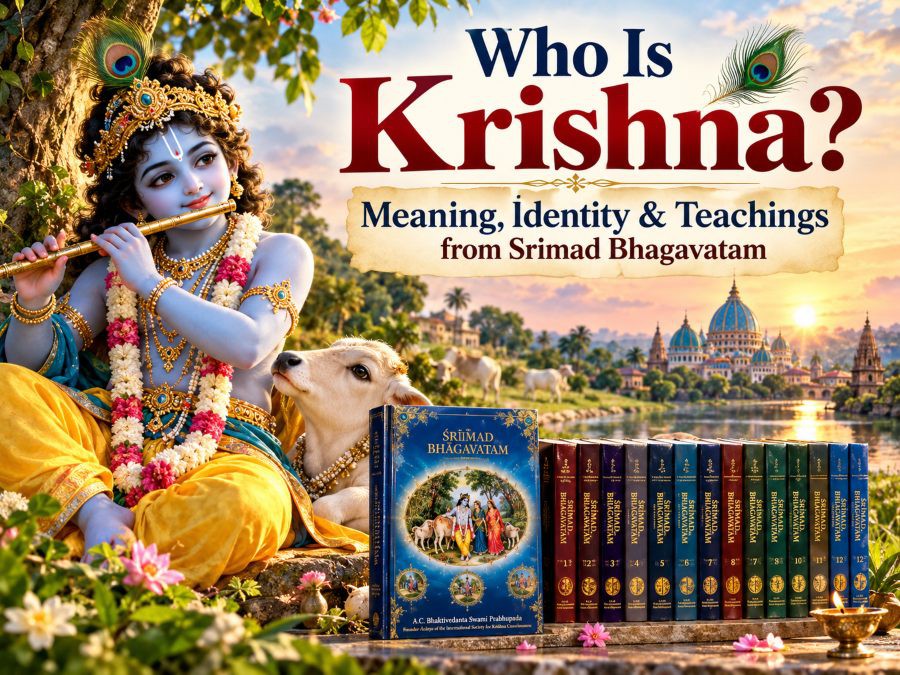 Who Is Lord Krishna? His Meaning, Teachings and Pastimes ExplainedRead more
Discover who Krishna is according to Srimad Bhagavatam, including His divine identity, childhood pastimes, teachings,...
-
 Incense in Islam: Bakhoor, Agarbatti and What Tradition SaysRead more
Is burning fragrance part of Muslim tradition? Explore incense in Islam, from the Prophetic practice of fumigating...
-
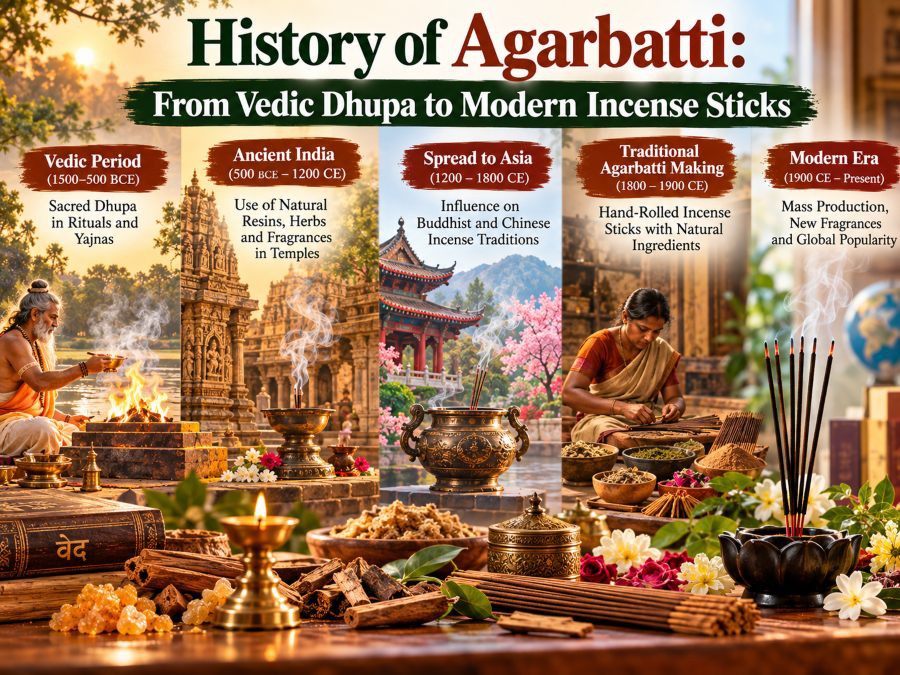 History of Agarbatti: From Vedic Dhupa to Modern Incense SticksRead more
Where did agarbatti really come from? Follow the history of agarbatti from Vedic fire rituals and temple dhupa to...
Blog categories
- Default category (0)
- MUSICAL INSTRUMENT (1)
- BOOK (5)
- DEVOTIONAL GIFT (0)
- Blog (30) click
- CHANDAN (12)
- Bhagavatam Wisdom Series (68)
- Krishna Consciousness (14)
- Mridangam Musical Instrument (6)
- Bhagavad Gita for Beginners (13)
- Bhagavad Gita As It Is (37) click
- Bhagavad Gita As It Is Telugu (0)
- Bhagavad Gita As It Is Marathi (0)
- Bhagavad Gita As It Is In Hindi (0)
- Bhagavad Gita As It Is In English (0)
- Bhagavad Gita As It Is In Bengali (8)
- Bhagavad Gita As It Is In Kannada (0)
- Bhagavad Gita As It Is In Gujarati (0)
- Bhagavad Gita As It Is In Panjabi (0)
- Bhagavad Gita As It Is In Tamil (0)
- Bhagavad Gita As It Is Odia (0)
- BHAGAVAD GITA As It Is GERMAN (0)
- Bhagavad Gita As It Is In French (0)
- Bhagavad Gita As It Is In Nepali (0)
- Bhagavad Gita As It Is In Assamese (0)
- Incense or Agarbatti (38)
- Lord Chaitanya Mahaprabhu (3)
- Vedic Temple Mayapur (14)
- kalki (15)
- Mahabharata – Dharma & Destiny (27)
- Vaishnava Scriptures (4)
- healthy product (4)
- chaitanya mahaprabhu (5)
- Tulsi Mala Guide (17)
Search in blog
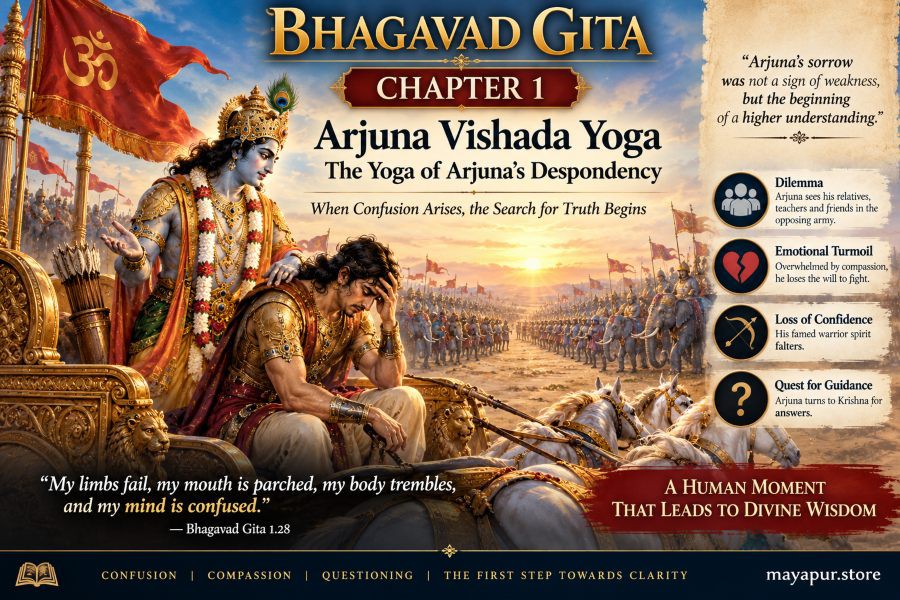
Bhagavad Gita Chapter 1: Arjuna Vishada Yoga – The Yoga of Arjuna's Despondency
Bhagavad Gita Chapter 1: Arjuna Vishada Yoga – The Yoga of Arjuna's Despondency
A Warrior Freezes on the Battlefield. What Would You Do?
Picture this: two armies stand ready, weapons drawn, war drums about to sound. And right at that moment, the greatest archer on the field throws down his bow and says, "I can't do this." That's not a Hollywood twist — that's how the Bhagavad Gita actually opens. Before Krishna speaks a single word of wisdom, before any talk of karma or dharma, we get a man falling apart in front of thousands of soldiers. If you've ever picked up a Bhagavad Gita book hoping for instant answers, Chapter 1 asks you to sit with the problem first. You can buy Bhagavad Gita book and follow along, but even without the text in hand, this opening scene is worth understanding on its own.
This first chapter, known as Arjuna Vishada Yoga — "The Yoga of Arjuna's Despondency" — doesn't teach a single spiritual lesson in the traditional sense. It's setup. It's the crisis that makes everything Krishna says afterward actually matter. Skip this chapter, and the rest of the Gita becomes abstract philosophy. Read it properly, and you realize the whole book is really about one person's breakdown — and by extension, everyone's.
Setting the Scene: Why Are They Even Fighting?
Let's back up. The battlefield is called Kurukshetra, and the two sides are cousins. On one side: the Pandavas, five brothers who've been cheated out of their kingdom through a rigged dice game and years of exile. On the other: the Kauravas, a hundred brothers led by the bitter, power-hungry Duryodhana, who refuses to give back so much as a needle's worth of land.
This isn't a war between strangers. It's a family feud that spiraled into something that will kill millions. Grandfathers, teachers, cousins, in-laws — everyone who matters to Arjuna is standing on one side of that field or the other, armed and ready to die for a cause that started with a card game.
The chapter opens with a blind king, Dhritarashtra, asking his secretary Sanjaya a simple but loaded question: what's happening on the battlefield? Sanjaya, gifted with a kind of divine television feed, describes the scene in detail — and that description is basically a military roll call. Names, titles, warriors, formations. It reads almost like a sports commentator hyping up a championship match.
But underneath that formality is dread. Duryodhana approaches his teacher Dronacharya and starts listing off the great warriors on both sides — not out of pride, but out of anxiety. He's counting swords because he's scared. That's a very human thing to do before a crisis: make lists, recite facts, keep busy so you don't have to feel the fear underneath.
The Moment Everything Changes: Arjuna Asks for a Closer Look
Here's where the chapter gets personal. Arjuna, positioned in his chariot with Krishna as his charioteer, asks Krishna to drive him between the two armies so he can see exactly who he's about to fight.
Bad idea, it turns out — at least for his nerves.
Because when Arjuna actually looks, really looks, he doesn't see enemy soldiers. He sees:
- His grandfather, Bhishma, who raised him
- His teacher, Dronacharya, who trained his hands to hold that very bow
- Uncles, cousins, in-laws, and childhood friends, all geared up to die
This is the turning point of the entire chapter. Up until now, war has been an abstract duty — something warriors do, something kings order. The moment Arjuna sees faces instead of formations, duty collides head-on with love. And love wins, at least for now.
Arjuna's Collapse: Not Weakness, But Honesty
What happens next is described with startling physical detail. Arjuna's limbs go weak. His mouth dries up. His body trembles, his skin burns, his bow — the legendary Gandiva — slips from his hand. He can't even stand steady.
This isn't melodrama for effect. It's one of the most accurate descriptions of acute anxiety ever written, thousands of years before psychology had a name for it. Anyone who's ever frozen before a hard decision — a resignation letter, a difficult conversation, an irreversible choice — knows exactly what Arjuna is going through.
And then he talks. He tells Krishna, essentially: I don't want any of this. He'd rather be killed unarmed than kill his own relatives for a kingdom. He questions what the point of victory even is if the people he loves are the casualties. He predicts — accurately, as it turns out — that this war will wipe out entire family lines, destroy social structures, and corrupt the moral fabric of society for generations.
There's a particularly sharp line in Arjuna's speech where he argues that the destruction of family creates a domino effect: traditions collapse, women lose protection, unwanted mixing of social duties occurs, and the ancestors themselves suffer because no one's left to perform proper rites for them. Whether or not you agree with every social assumption baked into that argument, the underlying fear is universal — the fear that violence, once unleashed, doesn't just kill people. It kills systems, memory, and meaning.
Is Arjuna a Coward, or Is He the Only Sane One in the Room?
Here's a question worth sitting with: is Arjuna wrong?
On the surface, his logic sounds noble. Why fight a war that guarantees mass death among people you love? Why not just walk away? Isn't nonviolence the higher path?
But dig one layer deeper, and you'll notice something interesting — Arjuna's grief isn't purely selfless. He talks about not wanting the "pleasures" of a kingdom bought with the blood of his teachers. He worries about his future, his legacy, his comfort with what he'll have to live with. It's grief, yes, but it's tangled up with self-interest and fear of judgment, not pure detachment.
This is exactly why Krishna doesn't respond to Arjuna's speech with sympathy in the next chapter — he responds with a challenge. Krishna essentially tells him: your logic sounds wise, but it's actually confusion dressed up as wisdom. That's a bold move on Krishna's part, and it sets the tone for the rest of the Bhagavad Gita: real answers don't come from avoiding hard choices, they come from understanding why you're making them.
Why Chapter 1 Matters More Than People Realize
A lot of readers treat Arjuna Vishada Yoga as filler — the boring intro before the "real" teachings start in Chapter 2. That's a mistake. Here's why this chapter is doing serious work:
- It makes the philosophy earned, not abstract. Krishna's later teachings on the soul, duty, and detachment only land because we've watched someone in genuine crisis. Wisdom that doesn't answer a real question is just trivia.
- It normalizes doubt. Arjuna isn't a background character — he's arguably the greatest warrior alive at that point, and even he breaks down. If he can be paralyzed by moral confusion, so can anyone.
- It frames the whole Gita as a dialogue, not a lecture. This isn't Krishna handing down commandments from a mountain. It's a response to a specific, desperate, deeply personal question from a friend.
If you're studying the full text — say, from a copy you found through https://mayapur.store/126-bhagavad-gita-book — pay close attention to how carefully structured Arjuna's breakdown is. Every physical symptom, every argument, every fear he raises gets addressed, directly or indirectly, somewhere later in the eighteen chapters. Nothing in Chapter 1 is wasted.
The Real Lesson Hidden in a Chapter With No "Lessons"
Ironically, a chapter titled "Yoga" doesn't describe any spiritual practice at all. No meditation, no breathing technique, no doctrine. Just a breakdown.
Maybe that's the point. Maybe the first step toward any kind of clarity — spiritual, personal, or otherwise — isn't confidence. It's admitting you're stuck. Arjuna doesn't fake strength in front of Krishna. He doesn't perform bravery for the soldiers watching. He says, plainly, "I won't fight," and waits for an answer he doesn't yet have.
That kind of honesty is rare, and it's arguably harder than fighting the war itself would have been.
The Small Details Everyone Skips Past
Most summaries of this chapter rush straight to Arjuna's breakdown, and in doing so, they skip over a few details that actually make the scene richer.
Take the moment before the fighting begins, when conch shells are blown from both sides. Each hero's conch has a name — Krishna's is Panchajanya, Arjuna's is Devadatta, Bhima's is Paundra. That's not decorative trivia. In a culture where sound itself was considered sacred and identity-bearing, naming your weapon's war-cry was a way of saying: this moment is significant enough to remember by name. The text is quietly telling us, before a single arrow flies, that everyone on that field already senses the weight of what's about to happen.
Then there's Bhishma, the grand old commander of the Kaurava side, who blows his conch first — loudly, almost theatrically — seemingly to boost morale. The Pandavas respond with their own blasts, described as so thunderous they "rent the hearts" of Dhritarashtra's sons. Two armies, trying to out-shout their own fear with noise. It's a very recognizable human strategy: when you can't out-argue your doubt, you try to drown it out.
Krishna's Silence Speaks Volumes
One detail that rarely gets enough attention: throughout Arjuna's entire speech — his fears, his arguments, his physical collapse — Krishna says almost nothing. He simply drives the chariot, watches, and listens.
That silence isn't passive. It's deliberate. Krishna doesn't interrupt Arjuna's grief to correct him mid-sentence, doesn't rush in with a tidy answer before Arjuna has even finished processing what he's feeling. He lets the crisis run its full course. There's something worth noticing here for anyone who has ever tried to comfort a friend in distress: sometimes the most respectful thing you can do is let someone finish falling apart before you try to help them stand back up.
This restraint from Krishna also sets up the dramatic shift in Chapter 2, where his tone changes almost instantly from silent charioteer to direct, even blunt, teacher. The contrast only works because Chapter 1 gave him — and us — the space to actually witness the depth of Arjuna's despair first.
A Story That Refuses to Pick an Easy Villain
One thing that makes Arjuna Vishada Yoga more sophisticated than most war narratives is that it refuses to hand you a clean villain to hate. Yes, Duryodhana is greedy and stubborn. But he's not framed as a cartoonish evil figure — he's framed as scared, insecure, and desperately trying to justify a war he half-knows is unjustifiable, which is exactly why he starts nervously counting warriors instead of speaking plainly.
Arjuna, meanwhile, isn't the flawless hero either. His hesitation, however sympathetic, comes wrapped in contradictions he hasn't fully examined. The text doesn't punish him for grieving, but it doesn't let him off the hook for confused reasoning either.
This moral complexity is part of why the Bhagavad Gita has survived as a text people return to again and again — not because it hands out simple verdicts, but because it forces you to sit in the same uncomfortable, unresolved space Arjuna is sitting in.
A Few Questions Worth Asking Yourself
Before moving on to Krishna's response in Chapter 2, it's worth pausing on a few things Arjuna's crisis brings up:
- Have you ever confused emotional overwhelm for moral clarity?
- Is walking away from a hard duty always the "peaceful" choice, or can it be its own kind of avoidance?
- How much of what we call "principles" is really just fear wearing a nicer outfit?
These aren't rhetorical flourishes — they're the actual questions the rest of the Gita is built to answer.
Where This Leaves Us
Arjuna Vishada Yoga ends without resolution. The bow is down, the warrior is in tears, and the armies are still standing on opposite sides of a field, waiting. Nothing about the war has changed. What's changed is that a question has finally been asked out loud, honestly, without pretense.
That's the whole function of Chapter 1: to earn the right to ask, "What do I do now?" Everything that follows in the Bhagavad Gita — the discussions on the soul, on duty, on detachment, on devotion — exists because one man had the courage to admit he didn't have it all figured out.
Posted in: Bhagavad Gita As It Is
Related posts
-
 Why the Bhagavad Gita Feels Like a Personal Conversation with KrishnaThe Bhagavad Gita feels like a personal conversation with Krishna because its timeless wisdom directly addresses our...Read more
 -
 Shrimad Bhagwat Geeta: The Forgotten Life Manual for Modern StressShrimad Bhagwat Geeta is more than a sacred scripture—it’s a forgotten life manual that offers timeless solutions for...Read more
 -
 Who Wrote the Bhagavad Gita? Discover the true authorship of the Bhagavad Gita—exploring Ved Vyasa’s role as the compiler, Lord Krishna’s divine...Read more
 -
 How Many Shlokas in Bhagavad Gita? Complete Chapter-Wise Breakdown & MeaningDiscover how many shlokas are in the Bhagavad Gita, with a complete chapter-wise breakdown, variations in verse...Read more
 -
 How to Read Bhagavad Gita: A Complete Step-by-Step Guide for BeginnersDiscover how to read the Bhagavad Gita step by step—learn the right mindset, chapter order, and tips to understand...Read more
Leave a comment