
Why did Krishna run to embrace a poor brahmin in rags? Read the Sudama story from the Bhagavatam and learn how a...
Latest posts
-
 Krishna and Sudama: The Poor Brahmin Who Became Wealthy in LoveRead more
 -
 Vamana Avatar: How Three Steps Humbled Bali MaharajaRead more
Why did a powerful king give away three worlds to a boy asking for three steps? Learn the Vamana avatar story from...
-
 The Bhagavatam on Marriage: Duty, Love and Spiritual PartnershipRead more
What does the Bhagavatam say about marriage? Through the stories of Kardama and Devahuti, Rukmini's secret letter and...
-
 What Is Prema? The Bhagavatam's Highest Stage of Love for GodRead more
Prema is love for God with no "because" attached. Learn how the Bhagavatam describes it, the nine steps from faith to...
-
 Is Shiva Parvati Kalyana Mentioned in Srimad Bhagavatam? What the Scripture Really SaysRead more
Looking for Shiva and Parvati's wedding in the Srimad Bhagavatam? Find out what the scripture actually describes,...
-
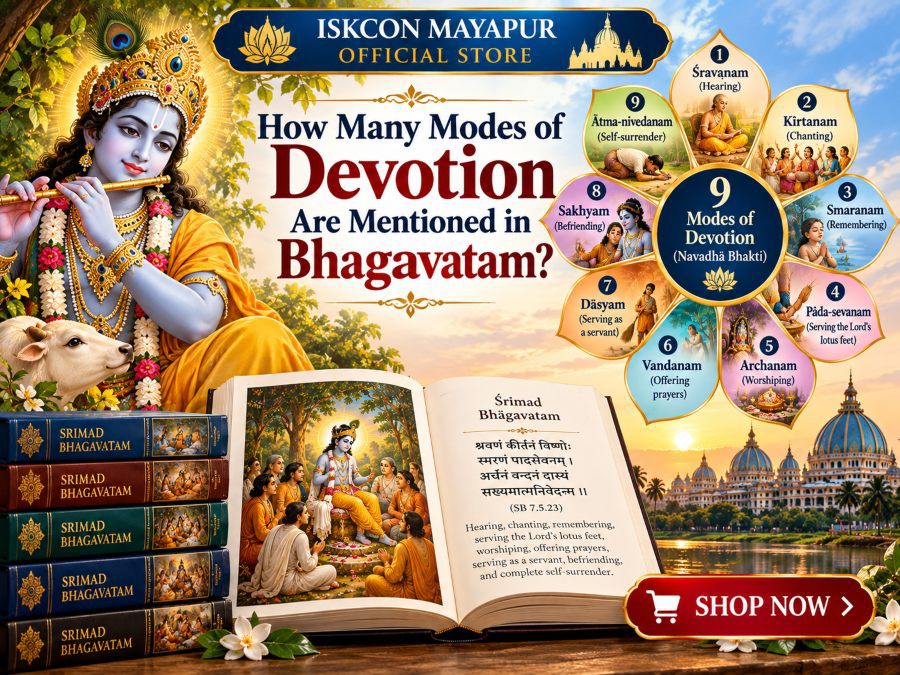 How Many Modes of Devotion Are Mentioned in Bhagavatam?Read more
A young boy named Prahlada listed nine ways to serve God, and the Bhagavatam keeps them as its answer. Learn what the...
-
 What Is Bhagavatam and Why Has It Been Read for 5,000 Years?Read more
A dying king asked one question, and the answer became the Bhagavatam. Learn what this Sanskrit scripture contains,...
-
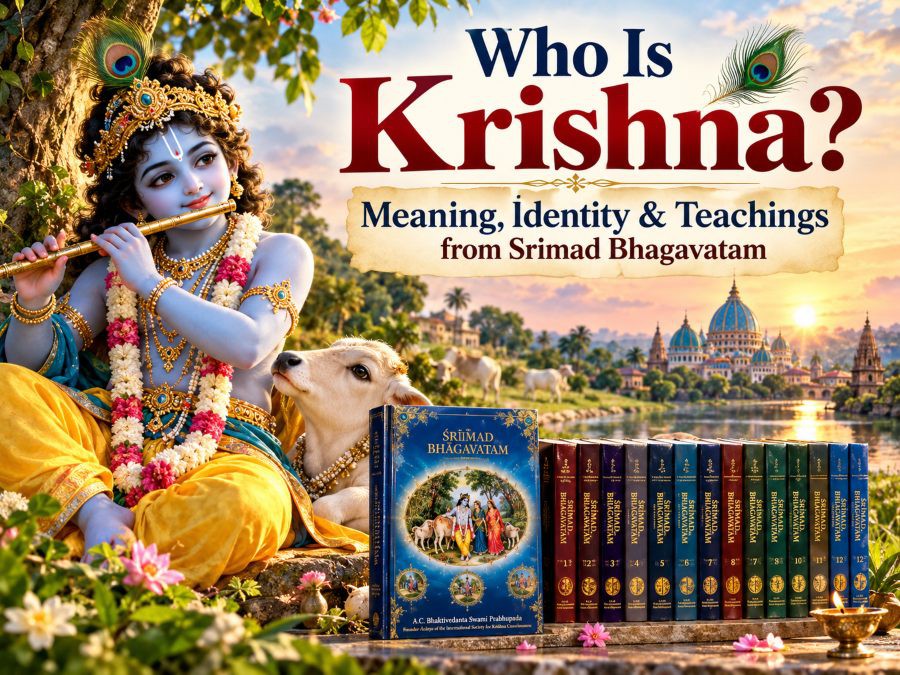 Who Is Lord Krishna? His Meaning, Teachings and Pastimes ExplainedRead more
Discover who Krishna is according to Srimad Bhagavatam, including His divine identity, childhood pastimes, teachings,...
-
 Incense in Islam: Bakhoor, Agarbatti and What Tradition SaysRead more
Is burning fragrance part of Muslim tradition? Explore incense in Islam, from the Prophetic practice of fumigating...
-
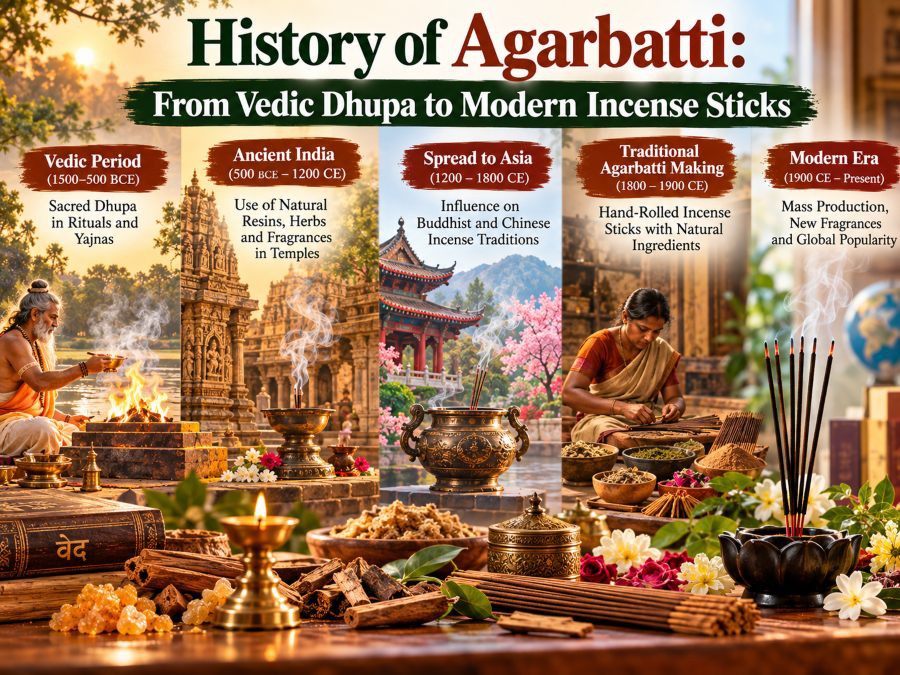 History of Agarbatti: From Vedic Dhupa to Modern Incense SticksRead more
Where did agarbatti really come from? Follow the history of agarbatti from Vedic fire rituals and temple dhupa to...
Blog categories
- Default category (0)
- MUSICAL INSTRUMENT (1)
- BOOK (5)
- DEVOTIONAL GIFT (0)
- Blog (30) click
- CHANDAN (12)
- Bhagavatam Wisdom Series (68)
- Krishna Consciousness (14)
- Mridangam Musical Instrument (6)
- Bhagavad Gita for Beginners (13)
- Bhagavad Gita As It Is (37) click
- Bhagavad Gita As It Is Telugu (0)
- Bhagavad Gita As It Is Marathi (0)
- Bhagavad Gita As It Is In Hindi (0)
- Bhagavad Gita As It Is In English (0)
- Bhagavad Gita As It Is In Bengali (8)
- Bhagavad Gita As It Is In Kannada (0)
- Bhagavad Gita As It Is In Gujarati (0)
- Bhagavad Gita As It Is In Panjabi (0)
- Bhagavad Gita As It Is In Tamil (0)
- Bhagavad Gita As It Is Odia (0)
- BHAGAVAD GITA As It Is GERMAN (0)
- Bhagavad Gita As It Is In French (0)
- Bhagavad Gita As It Is In Nepali (0)
- Bhagavad Gita As It Is In Assamese (0)
- Incense or Agarbatti (38)
- Lord Chaitanya Mahaprabhu (3)
- Vedic Temple Mayapur (14)
- kalki (15)
- Mahabharata – Dharma & Destiny (27)
- Vaishnava Scriptures (4)
- healthy product (4)
- chaitanya mahaprabhu (5)
- Tulsi Mala Guide (17)
Search in blog
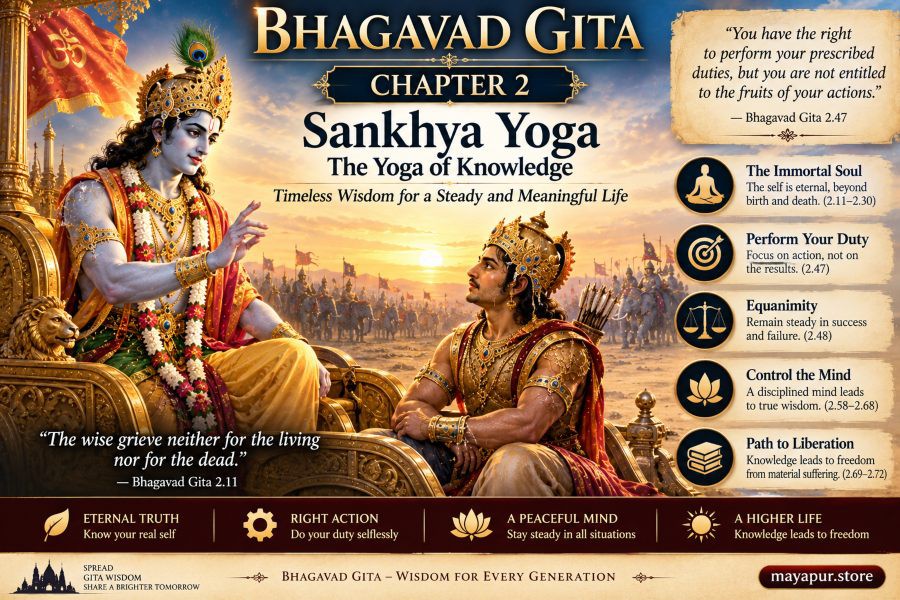
Bhagavad Gita Chapter 2: Sankhya Yoga – The Yoga of Knowledge
What Do You Say to Someone Who's Given Up?
Arjuna has just dropped his bow, sat down on his chariot, and told Krishna he'd rather beg on the streets than kill his own family for a kingdom. Most of us, faced with a grieving friend, would offer comfort. Krishna does the opposite. He calls it weakness. Not gently, either — he tells Arjuna, point blank, that his sorrow is unbecoming of someone who claims to understand life at all. That's how Chapter 2 of the Bhagavad Gita opens, and it's one of the boldest pivots in any spiritual text ever written. If you're working through a Bhagavad Gita book for the first time, this is the chapter where the actual teaching finally begins — everything before it was just the setup.
Sankhya Yoga, the name of this chapter, roughly translates to "the yoga of knowledge" or "the yoga of analysis." And true to that name, Krishna doesn't respond to Arjuna's grief with sympathy. He responds with an argument — a tightly reasoned one, built layer by layer, that dismantles nearly every assumption Arjuna's despair was resting on.
Krishna's Opening Move: Tough Love, Not Comfort
The first thing worth noticing is how unapologetically direct Krishna is. He doesn't ease into it. He essentially says: you're grieving for people you shouldn't be grieving for, and you're calling it wisdom when it's actually confusion.
This matters because it sets the tone for the rest of the Gita. Krishna isn't interested in making Arjuna feel better in the moment. He's interested in Arjuna understanding something correctly, even if that understanding is uncomfortable at first. That's a very different model of help than what most of us are used to — we tend to think comforting someone means agreeing with their emotional read on a situation. Krishna suggests something almost radical: sometimes the kindest thing you can do for someone is challenge the story they're telling themselves.
The Soul Doesn't Die — So What Exactly Are You Afraid Of?
Here's where the philosophy really kicks in, and it's worth slowing down on this part because it's the backbone of the entire Gita.
Krishna's core argument is this: the body is temporary, but the self inside it — what he calls the atman, or soul — is not. Bodies are born, age, and die. That's just what bodies do, the same way clothes wear out and get replaced. But the awareness that inhabits the body, according to Krishna, was never born and will never die. It simply moves from one body to the next, the way a person changes clothes.
If that's true, Krishna argues, then Arjuna's grief is misdirected. He's mourning the destruction of bodies — armor, flesh, faces he recognizes — but the actual person behind those faces, in the deepest sense, can't actually be destroyed by any weapon. Fire can't burn it. Water can't drown it. Wind can't dry it out.
That's a genuinely difficult claim to sit with, and Krishna knows it. He doesn't expect Arjuna to just accept it on faith — he builds toward it with logic:
- Something that exists cannot become nothing. What is real doesn't simply vanish; what is unreal never truly existed in the first place.
- Change is not the same as ending. A body moves through childhood, youth, and old age without the self inside it disappearing at each stage — so why assume death is any different?
- Certainty of death should reduce fear, not increase it. For something born, death is guaranteed; for something dead, rebirth is guaranteed. Grieving the inevitable, Krishna says, is like grieving the sunrise.
None of this is meant to make war casual or death meaningless. It's meant to strip away the specific illusion Arjuna is trapped in — the idea that he, a warrior, is somehow capable of destroying something indestructible.
Do Your Job, Release the Outcome
Once Krishna finishes the philosophical groundwork, he shifts to something much more practical, and arguably more famous: the idea of acting without attachment to results.
Arjuna's paralysis wasn't just about death — it was about consequences. What will happen to his reputation? What will happen to the kingdom? What will people think of him? Krishna's answer is almost shockingly simple: none of that is actually his to control.
He tells Arjuna to focus entirely on the action itself — fighting, in this case, because that's Arjuna's duty as a warrior — and to let go of any fixation on winning, losing, glory, or blame. This is the seed of what later becomes one of the most quoted ideas in the entire Gita: you have a right to your actions, never to the fruits of those actions.
Think about how differently that reframes anxiety. Most of our stress doesn't come from the task in front of us — it comes from obsessing over how it'll turn out. Krishna is essentially telling Arjuna: do the work with full sincerity, and then release your grip on the outcome, because your grip was never actually holding anything real to begin with.
The Steady Mind: What Krishna Actually Means by Wisdom
Toward the end of the chapter, Arjuna asks a sharp follow-up question: okay, but what does a person who's actually achieved this kind of clarity even look like? How do they behave?
Krishna's answer describes someone he calls sthitaprajna — a person of steady wisdom. This isn't someone who feels nothing. It's someone whose inner peace doesn't get hijacked by every wave of pleasure or pain that comes along. They're not chasing sensory highs, and they're not shattered by loss. Their contentment comes from within, not from circumstances lining up favorably.
A few things stand out about how Krishna describes this state:
- It's not about suppressing emotion. It's about not being controlled by it.
- Desire, left unchecked, is described as the real root of suffering — not because wanting things is inherently bad, but because uncontrolled craving distorts judgment and eventually destroys peace of mind.
- Senses are compared to horses. Left without direction, they pull the mind in a dozen directions at once. A disciplined mind, like a skilled charioteer, keeps them in check without being dragged along by them.
This isn't a call to become emotionless or detached from life. It's closer to describing someone who's found solid ground to stand on internally, so external chaos doesn't automatically become internal chaos.
The Warrior's Excuse Krishna Refuses to Accept
There's another layer to Krishna's argument that often gets glossed over: he doesn't just attack Arjuna's grief on philosophical grounds — he attacks it on practical ones too.
Arjuna is a kshatriya, a warrior by birth and training. Krishna points out that for someone in that position, fighting a just war is literally the highest duty available to him. Refusing to fight, especially out of fear dressed up as compassion, wouldn't be seen as noble by the people whose opinion Arjuna claims to care about — it would be seen as cowardice. Krishna even warns him bluntly that his enemies will spread stories about his fear for as long as those stories can be told, and that a warrior's reputation, once stained that way, is worse than death itself.
This part of the chapter can feel harsh to modern readers, and it's worth sitting with that discomfort rather than skipping past it. Krishna isn't glorifying violence for its own sake. He's pointing out something more specific: Arjuna isn't actually choosing peace here. He's choosing paralysis, and calling it peace to avoid facing a duty he's afraid of. There's a real difference between genuine nonviolence, chosen with clarity, and freezing up because a decision feels too heavy — and Krishna is determined not to let Arjuna confuse the two.
Why This Chapter Is the Real Foundation of the Gita
Chapters 3 through 18 of the Bhagavad Gita spend enormous energy expanding on ideas that are all first introduced here, in seed form, in Chapter 2. The nature of the soul, the discipline of selfless action, the steadiness of a wise mind — all of it traces back to this single conversation.
That's part of why Sankhya Yoga is sometimes treated as a stand-alone summary of the entire text. If someone only had time to study one chapter of the Gita, this would be the one most teachers would point to — not because the other seventeen chapters don't matter, but because this one lays out the blueprint everything else builds from.
A Question Worth Sitting With
Before moving further into the text, it's worth pausing on something Krishna is really asking Arjuna, and by extension, asking every reader:
How much of your anxiety right now is actually about the task in front of you — and how much of it is about an outcome you were never guaranteed to control in the first place?
That question doesn't get a neat answer in this chapter. But it's the exact question the rest of the Bhagavad Gita spends seventeen more chapters trying to help you sit with, instead of running from.
Posted in: Bhagavad Gita As It Is
Related posts
-
 Why the Bhagavad Gita Feels Like a Personal Conversation with KrishnaThe Bhagavad Gita feels like a personal conversation with Krishna because its timeless wisdom directly addresses our...Read more
 -
 Shrimad Bhagwat Geeta: The Forgotten Life Manual for Modern StressShrimad Bhagwat Geeta is more than a sacred scripture—it’s a forgotten life manual that offers timeless solutions for...Read more
 -
 Who Wrote the Bhagavad Gita? Discover the true authorship of the Bhagavad Gita—exploring Ved Vyasa’s role as the compiler, Lord Krishna’s divine...Read more
 -
 How Many Shlokas in Bhagavad Gita? Complete Chapter-Wise Breakdown & MeaningDiscover how many shlokas are in the Bhagavad Gita, with a complete chapter-wise breakdown, variations in verse...Read more
 -
 How to Read Bhagavad Gita: A Complete Step-by-Step Guide for BeginnersDiscover how to read the Bhagavad Gita step by step—learn the right mindset, chapter order, and tips to understand...Read more
Leave a comment