
Why did Krishna run to embrace a poor brahmin in rags? Read the Sudama story from the Bhagavatam and learn how a...
Latest posts
-
 Krishna and Sudama: The Poor Brahmin Who Became Wealthy in LoveRead more
 -
 Vamana Avatar: How Three Steps Humbled Bali MaharajaRead more
Why did a powerful king give away three worlds to a boy asking for three steps? Learn the Vamana avatar story from...
-
 The Bhagavatam on Marriage: Duty, Love and Spiritual PartnershipRead more
What does the Bhagavatam say about marriage? Through the stories of Kardama and Devahuti, Rukmini's secret letter and...
-
 What Is Prema? The Bhagavatam's Highest Stage of Love for GodRead more
Prema is love for God with no "because" attached. Learn how the Bhagavatam describes it, the nine steps from faith to...
-
 Is Shiva Parvati Kalyana Mentioned in Srimad Bhagavatam? What the Scripture Really SaysRead more
Looking for Shiva and Parvati's wedding in the Srimad Bhagavatam? Find out what the scripture actually describes,...
-
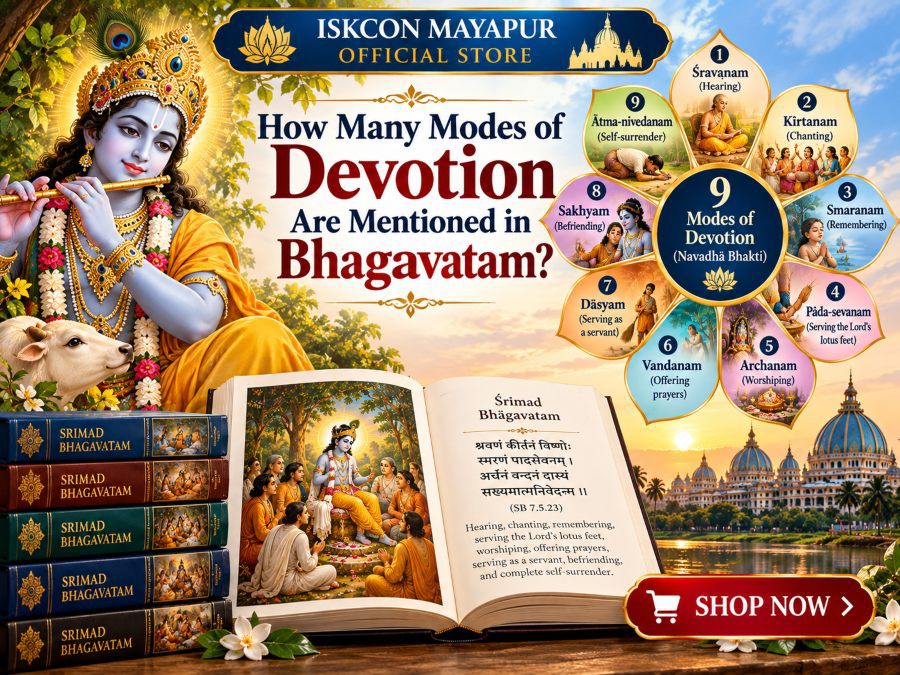 How Many Modes of Devotion Are Mentioned in Bhagavatam?Read more
A young boy named Prahlada listed nine ways to serve God, and the Bhagavatam keeps them as its answer. Learn what the...
-
 What Is Bhagavatam and Why Has It Been Read for 5,000 Years?Read more
A dying king asked one question, and the answer became the Bhagavatam. Learn what this Sanskrit scripture contains,...
-
 Who Is Lord Krishna? His Meaning, Teachings and Pastimes ExplainedRead more
Discover who Krishna is according to Srimad Bhagavatam, including His divine identity, childhood pastimes, teachings,...
-
 Incense in Islam: Bakhoor, Agarbatti and What Tradition SaysRead more
Is burning fragrance part of Muslim tradition? Explore incense in Islam, from the Prophetic practice of fumigating...
-
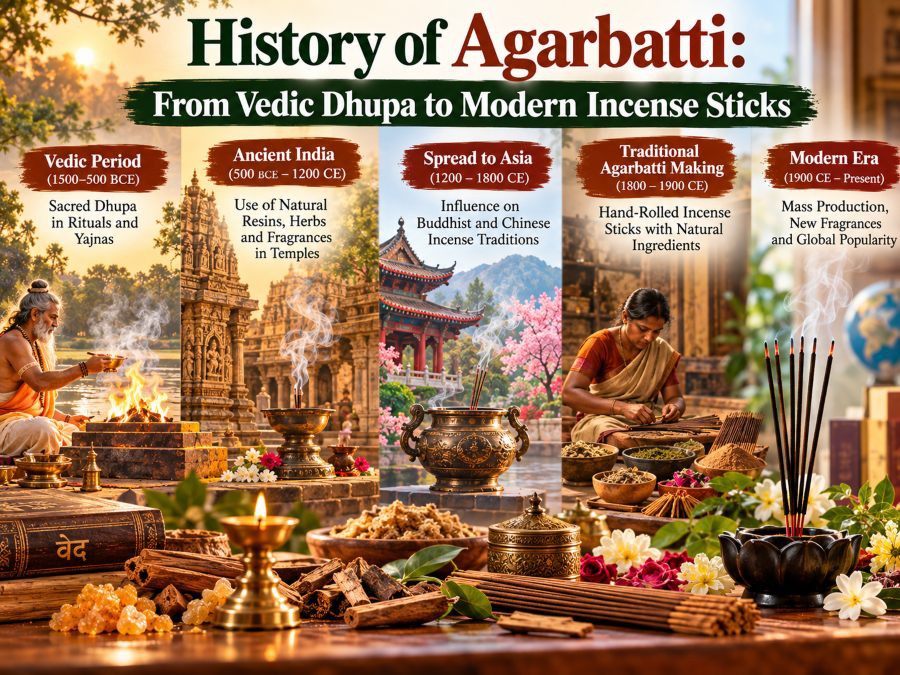 History of Agarbatti: From Vedic Dhupa to Modern Incense SticksRead more
Where did agarbatti really come from? Follow the history of agarbatti from Vedic fire rituals and temple dhupa to...
Blog categories
- Default category (0)
- MUSICAL INSTRUMENT (1)
- BOOK (5)
- DEVOTIONAL GIFT (0)
- Blog (30) click
- CHANDAN (12)
- Bhagavatam Wisdom Series (68)
- Krishna Consciousness (14)
- Mridangam Musical Instrument (6)
- Bhagavad Gita for Beginners (13)
- Bhagavad Gita As It Is (37) click
- Bhagavad Gita As It Is Telugu (0)
- Bhagavad Gita As It Is Marathi (0)
- Bhagavad Gita As It Is In Hindi (0)
- Bhagavad Gita As It Is In English (0)
- Bhagavad Gita As It Is In Bengali (8)
- Bhagavad Gita As It Is In Kannada (0)
- Bhagavad Gita As It Is In Gujarati (0)
- Bhagavad Gita As It Is In Panjabi (0)
- Bhagavad Gita As It Is In Tamil (0)
- Bhagavad Gita As It Is Odia (0)
- BHAGAVAD GITA As It Is GERMAN (0)
- Bhagavad Gita As It Is In French (0)
- Bhagavad Gita As It Is In Nepali (0)
- Bhagavad Gita As It Is In Assamese (0)
- Incense or Agarbatti (38)
- Lord Chaitanya Mahaprabhu (3)
- Vedic Temple Mayapur (14)
- kalki (15)
- Mahabharata – Dharma & Destiny (27)
- Vaishnava Scriptures (4)
- healthy product (4)
- chaitanya mahaprabhu (5)
- Tulsi Mala Guide (17)
Search in blog
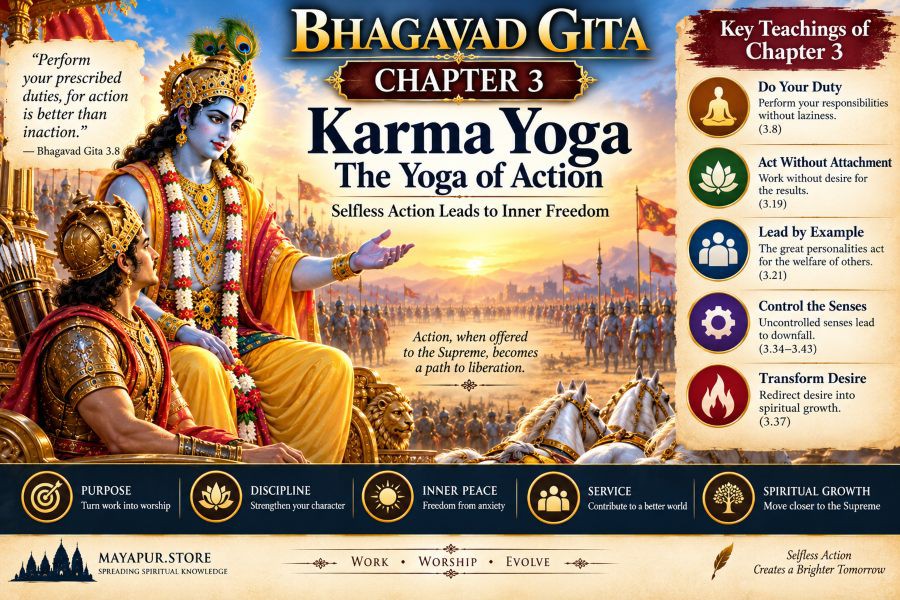
Bhagavad Gita Chapter 3: Karma Yoga – The Yoga of Action
If Knowledge Is So Great, Why Not Just Sit and Think Forever?
Here's a fair question: if the whole point of Chapter 2 was that the soul is eternal and the body is just temporary clothing, why bother doing anything at all? Why not just retreat into contemplation, skip the mess of action entirely, and let the world sort itself out? Arjuna asks Krishna almost exactly this, and it's a sharp question — the kind that exposes a real gap in logic if it isn't answered well. That gap is exactly what the Bhagavad Gita addresses head-on in Chapter 3, and Krishna's answer is more demanding than most people expect.
This chapter is called Karma Yoga, the discipline of action. But don't let the simplicity of that title fool you. Krishna isn't handing Arjuna a motivational speech about hard work. He's making an argument that action is not optional for anyone alive — and that trying to escape it through passivity is actually a form of self-deception.
You Can't Actually Opt Out of Doing Something
Krishna's first move is almost mathematical in its bluntness: no one, he says, can remain completely inactive, even for a moment. The body itself is constantly in motion — breathing, digesting, aging — driven by nature's own forces whether you consent to it or not. Even someone sitting cross-legged, eyes closed, pretending to meditate, is still doing something with their mind, even if that something is just quietly rehearsing the desires they claim to have renounced.
This is a genuinely clever point, and worth pausing on. Krishna isn't saying action is good and inaction is bad in some simplistic moral sense. He's pointing out that "inaction" as most people imagine it doesn't actually exist. What we call withdrawal from the world is often just a disguised, more subtle form of engagement with it — minus the honesty of admitting you're still involved.
So the real choice was never between acting and not acting. It was always between acting with awareness and acting on autopilot, pretending you've transcended something you haven't.
Doing Your Duty Isn't About You
Once Krishna establishes that action is unavoidable, he pivots to the real question: how should a person act, then, if they can't escape action altogether?
His answer centers on a concept that gets repeated throughout the Gita — work performed as a duty, without personal attachment to the results. This isn't the same as working half-heartedly or not caring about quality. It means doing the work fully and sincerely, while releasing the mental grip on whether it succeeds, fails, earns praise, or invites blame.
Krishna even points to something surprising here: he says that even he himself, despite having nothing left to gain or achieve in any cosmic sense, continues to act — not out of necessity, but to set an example. If the people at the top simply stop engaging with the world responsibly, everyone below them loses direction. Leadership by example, Krishna argues, isn't optional either. People imitate what they see modeled, for better or worse.
A few threads worth pulling out of this section:
- Selfish inaction disguised as spirituality is called out directly. Krishna has little patience for people who use philosophy as an excuse to avoid responsibility.
- Your duty is tied to your role, not to some abstract universal standard. What's right for a teacher isn't automatically right for a soldier, and vice versa.
- Neglecting your own duty to imitate someone else's is treated as worse than doing your own imperfectly. Better to be an average version of yourself than a flawless copy of someone else.
The Real Enemy Isn't Action — It's Desire
Midway through the chapter, Arjuna asks something that a lot of readers privately wonder too: if the soul is pure and untouched by the material world, what actually pushes a person toward wrongdoing? What corrupts good intentions?
Krishna's answer is direct: desire, and its more aggressive cousin, anger. He describes desire as something that clouds judgment the way smoke clouds fire, the way dust covers a mirror, or the way a womb conceals an embryo — imperfect comparisons, maybe, but each one gets at the same idea: the thing being obscured hasn't been destroyed, just covered over.
This matters because it reframes the whole discussion of morality. Krishna isn't saying people are inherently corrupt. He's saying desire sits in the mind and senses like a residue, distorting perception until people can't tell their genuine interests apart from compulsive craving. And because desire is described as genuinely insatiable — feeding itself the more it's indulged — Krishna calls it one of the most persistent obstacles a person will ever face.
So How Do You Actually Deal With Desire?
Krishna doesn't leave this as an abstract warning. He gives Arjuna something closer to a practical hierarchy for managing it:
- The senses are powerful, but the mind that directs them is more powerful still.
- The mind is strong, but intelligence — the capacity for discernment — sits above it.
- Above intelligence is the self, the deepest part of a person's awareness, which Krishna says must be used to consciously restrain the lower impulses rather than being dragged along by them.
Think of it like a chain of command. Left unchecked, desire hijacks the senses, the senses hijack the mind, and the mind, if it's not anchored by clear discernment, ends up rationalizing almost anything. Krishna's advice isn't to suppress desire through brute force — that rarely works for long — but to use discernment actively, the way a skilled rider uses the reins, rather than assuming the horse will behave on its own.
A Small Test: Would You Recognize This in Yourself?
Before moving to the next chapter, it's worth turning Krishna's argument back on yourself for a moment. Think of a task you've been avoiding — not because you lack the ability, but because some part of you is scared of how it'll turn out. Maybe it's a conversation you keep postponing, or a project you keep "researching" instead of starting.
Karma Yoga would say that hesitation isn't really about the task. It's about attachment to a specific outcome — success, approval, avoiding embarrassment — and that attachment is quietly doing more damage than the task itself ever could. Krishna's fix isn't complicated to state, even if it's hard to practice: show up fully for the doing, and loosen your grip on how it's received.
Why This Chapter Refuses to Let You Off the Hook
What makes Karma Yoga uncomfortable, in a good way, is that it closes off every convenient exit Arjuna — or any reader — might be looking for.
- You can't claim inaction is a valid escape, because true inaction doesn't exist.
- You can't claim spiritual knowledge exempts you from responsibility, because even the wisest are shown continuing to act.
- You can't blame the world for corrupting you, because the real obstacle — desire — operates from inside your own mind, not from external circumstances.
This is a much harder message than "just do good things." It's closer to: stop looking for a loophole, and start acting with full engagement while holding your ego a little more loosely than you're used to.
It's also worth noting how this argument quietly undercuts a very modern habit — the habit of endlessly preparing instead of starting. Overthinking a decision, researching a project into the ground without ever launching it, waiting for the "right moment" that never quite arrives — Krishna would likely categorize all of that as the same disguised inaction he warned Arjuna about, just dressed up in more contemporary clothing.
The Real Takeaway Hiding in Plain Sight
There's a temptation to read Karma Yoga as a chapter about work ethic — do your job, don't slack off, contribute to society. That's not wrong, exactly, but it undersells what's actually happening here.
The deeper claim is this: the way you act reveals what you actually believe about yourself, whether you've examined those beliefs or not. Someone who avoids duty out of fear is quietly confessing that they believe outcomes define their worth. Someone who acts with full sincerity while releasing attachment to results is demonstrating something much rarer — a kind of internal steadiness that doesn't depend on the world cooperating.
That's the real bridge this chapter builds between the philosophy of Chapter 2 and the rest of the Bhagavad Gita. Knowledge alone was never going to be enough for Arjuna. He needed a way to actually live out that knowledge in the middle of an unavoidable, high-stakes decision — and Karma Yoga is Krishna's answer for exactly that.
Posted in: Bhagavad Gita As It Is
Related posts
-
 Why the Bhagavad Gita Feels Like a Personal Conversation with KrishnaThe Bhagavad Gita feels like a personal conversation with Krishna because its timeless wisdom directly addresses our...Read more
 -
 Shrimad Bhagwat Geeta: The Forgotten Life Manual for Modern StressShrimad Bhagwat Geeta is more than a sacred scripture—it’s a forgotten life manual that offers timeless solutions for...Read more
 -
 Who Wrote the Bhagavad Gita? Discover the true authorship of the Bhagavad Gita—exploring Ved Vyasa’s role as the compiler, Lord Krishna’s divine...Read more
 -
 How Many Shlokas in Bhagavad Gita? Complete Chapter-Wise Breakdown & MeaningDiscover how many shlokas are in the Bhagavad Gita, with a complete chapter-wise breakdown, variations in verse...Read more
 -
 How to Read Bhagavad Gita: A Complete Step-by-Step Guide for BeginnersDiscover how to read the Bhagavad Gita step by step—learn the right mindset, chapter order, and tips to understand...Read more
Leave a comment