
Why did Krishna run to embrace a poor brahmin in rags? Read the Sudama story from the Bhagavatam and learn how a...
Latest posts
-
 Krishna and Sudama: The Poor Brahmin Who Became Wealthy in LoveRead more
 -
 Vamana Avatar: How Three Steps Humbled Bali MaharajaRead more
Why did a powerful king give away three worlds to a boy asking for three steps? Learn the Vamana avatar story from...
-
 The Bhagavatam on Marriage: Duty, Love and Spiritual PartnershipRead more
What does the Bhagavatam say about marriage? Through the stories of Kardama and Devahuti, Rukmini's secret letter and...
-
 What Is Prema? The Bhagavatam's Highest Stage of Love for GodRead more
Prema is love for God with no "because" attached. Learn how the Bhagavatam describes it, the nine steps from faith to...
-
 Is Shiva Parvati Kalyana Mentioned in Srimad Bhagavatam? What the Scripture Really SaysRead more
Looking for Shiva and Parvati's wedding in the Srimad Bhagavatam? Find out what the scripture actually describes,...
-
 How Many Modes of Devotion Are Mentioned in Bhagavatam?Read more
A young boy named Prahlada listed nine ways to serve God, and the Bhagavatam keeps them as its answer. Learn what the...
-
 What Is Bhagavatam and Why Has It Been Read for 5,000 Years?Read more
A dying king asked one question, and the answer became the Bhagavatam. Learn what this Sanskrit scripture contains,...
-
 Who Is Lord Krishna? His Meaning, Teachings and Pastimes ExplainedRead more
Discover who Krishna is according to Srimad Bhagavatam, including His divine identity, childhood pastimes, teachings,...
-
 Incense in Islam: Bakhoor, Agarbatti and What Tradition SaysRead more
Is burning fragrance part of Muslim tradition? Explore incense in Islam, from the Prophetic practice of fumigating...
-
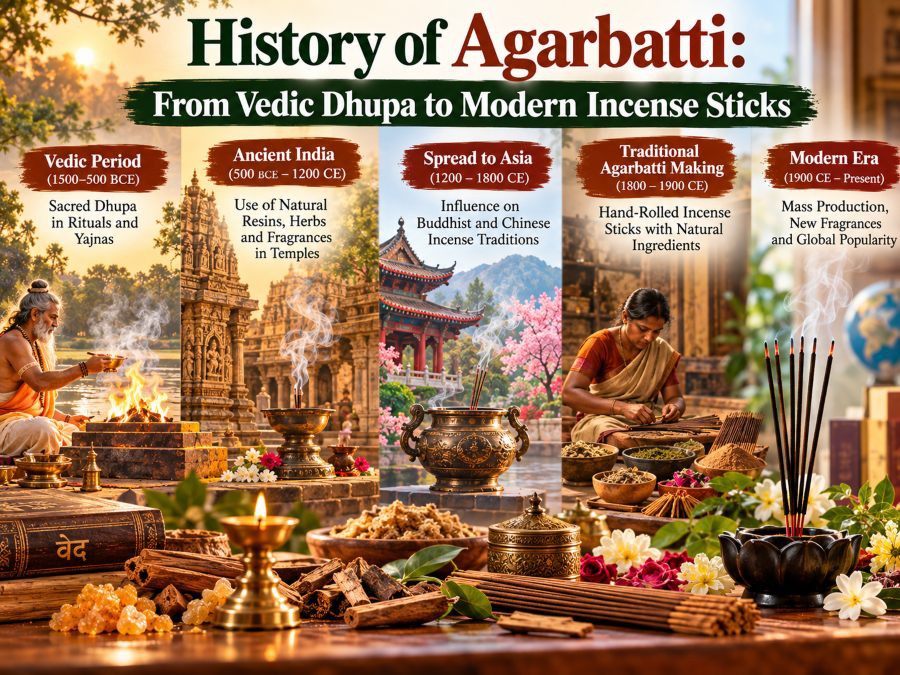 History of Agarbatti: From Vedic Dhupa to Modern Incense SticksRead more
Where did agarbatti really come from? Follow the history of agarbatti from Vedic fire rituals and temple dhupa to...
Blog categories
- Default category (0)
- MUSICAL INSTRUMENT (1)
- BOOK (5)
- DEVOTIONAL GIFT (0)
- Blog (30) click
- CHANDAN (12)
- Bhagavatam Wisdom Series (68)
- Krishna Consciousness (14)
- Mridangam Musical Instrument (6)
- Bhagavad Gita for Beginners (13)
- Bhagavad Gita As It Is (37) click
- Bhagavad Gita As It Is Telugu (0)
- Bhagavad Gita As It Is Marathi (0)
- Bhagavad Gita As It Is In Hindi (0)
- Bhagavad Gita As It Is In English (0)
- Bhagavad Gita As It Is In Bengali (8)
- Bhagavad Gita As It Is In Kannada (0)
- Bhagavad Gita As It Is In Gujarati (0)
- Bhagavad Gita As It Is In Panjabi (0)
- Bhagavad Gita As It Is In Tamil (0)
- Bhagavad Gita As It Is Odia (0)
- BHAGAVAD GITA As It Is GERMAN (0)
- Bhagavad Gita As It Is In French (0)
- Bhagavad Gita As It Is In Nepali (0)
- Bhagavad Gita As It Is In Assamese (0)
- Incense or Agarbatti (38)
- Lord Chaitanya Mahaprabhu (3)
- Vedic Temple Mayapur (14)
- kalki (15)
- Mahabharata – Dharma & Destiny (27)
- Vaishnava Scriptures (4)
- healthy product (4)
- chaitanya mahaprabhu (5)
- Tulsi Mala Guide (17)
Search in blog
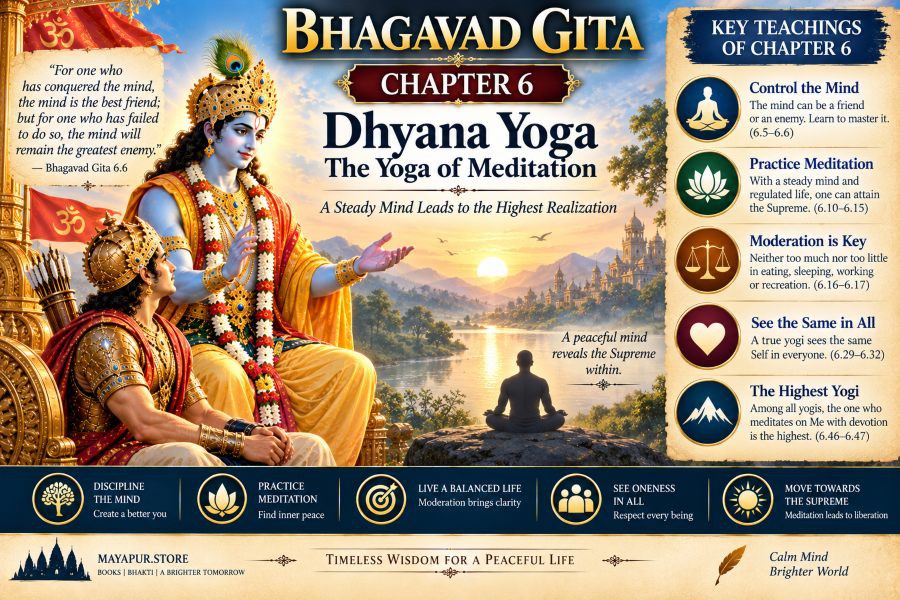
Bhagavad Gita Chapter 6: Dhyana Yoga – The Yoga of Meditation
What Happens If You Try to Meditate and Fail Completely?
Here's a question almost nobody asks out loud: what if you sit down to meditate, genuinely try, and your mind just refuses to cooperate? What if years pass, effort is spent, sincerity is real, and yet the stillness everyone talks about never quite arrives? Does all that effort simply vanish, wasted? Arjuna asks Krishna almost exactly this in Chapter 6, and it's one of the most relatable questions in the entire Bhagavad Gita — because most people who've ever attempted meditation, prayer, or any sustained inner discipline have wondered the same thing at some point. If you've picked up a copy to shop at Mayapur Store, and started working through the text chapter by chapter, this is the one that finally addresses the mechanics of meditation directly, rather than just talking around it.
Dhyana Yoga translates to "the yoga of meditation," and this chapter is Krishna's most detailed, practical instruction yet. Less abstract philosophy, more actual technique — posture, diet, mental discipline, and what to do when the whole practice seems to be failing.
Who Actually Qualifies as a Yogi, According to Krishna?
Before getting into technique, Krishna redefines a term that gets thrown around loosely: yogi. He says a true yogi isn't someone who has renounced fire and ceremonial rituals, nor is it necessarily someone who has given up all action. A yogi is someone who performs their duty without depending on the fruits of that action for their sense of peace.
This circles back to something established in earlier chapters, but Krishna sharpens it here into something closer to a working definition:
- A yogi acts, fully and sincerely, without waiting on results to determine their inner state.
- They're not defined by external markers — robes, rituals, withdrawal from society — but by their internal relationship to action and outcome.
- Someone who has genuinely achieved this balance is described as having "climbed" the path, no longer needing the ladder of effort that got them there in the first place.
This last point is worth pausing on. Krishna makes a distinction between someone working toward this state, for whom disciplined effort is still the primary tool, and someone who has already arrived, for whom the effort itself becomes less necessary because the internal steadiness has become natural rather than forced. It's the difference between someone learning to ride a bike, wobbling and correcting constantly, and someone who's been riding for decades and doesn't think about balance at all anymore.
Your Own Mind: Your Best Friend or Your Worst Enemy
One of the sharpest lines in this chapter is Krishna's insistence that a person must elevate themselves through their own mind, not degrade themselves through it — because the mind can act as either your friend or your enemy, and which one it becomes depends entirely on how it's been trained.
This is a genuinely useful reframe. Most people talk about "the mind" as if it's a fixed, external force acting upon them — something that happens to a person rather than something a person actively shapes. Krishna rejects that framing outright. The mind isn't a weather system you passively endure. It's more like a muscle or a habit, something that responds directly to how it's been conditioned over time.
For someone who has disciplined their mind, Krishna says, that same mind becomes their greatest asset — steady, cooperative, aligned with their deeper intentions. For someone who hasn't, the undisciplined mind works against them constantly, sabotaging exactly the goals the person consciously claims to want.
The Practical Instructions Krishna Actually Gives
Unlike some of the earlier chapters, which stayed mostly in the territory of abstract reasoning, Chapter 6 gets remarkably specific. Krishna lays out concrete guidance for anyone actually attempting sustained meditation:
- Find a clean, quiet place, not too high, not too low, with a stable seat made of natural materials.
- Sit with a steady, upright posture, body, neck, and head aligned, gaze neither wandering nor forcibly strained.
- Regulate diet and sleep. Krishna is explicit that this practice isn't for someone who overeats or starves themselves, nor for someone who sleeps too much or too little. Balance, not extremity, is the operating principle throughout.
- Fix the mind on a single point of focus, letting go of scattered desires and mental grasping, rather than trying to forcibly suppress every thought through sheer willpower.
That last instruction matters because it corrects a common misunderstanding about meditation — the idea that it means forcing the mind blank through effort. Krishna's actual guidance is closer to gently, repeatedly returning attention to a single point, accepting that distraction will happen, rather than treating every wandering thought as a personal failure.
Why Extremes Never Work
There's a recurring theme throughout this chapter that's easy to miss if you're only skimming for the meditation technique itself: Krishna keeps warning against extremes in every direction, not just extremes of indulgence.
He explicitly states that yoga isn't for someone who eats too much, and just as pointedly, isn't for someone who eats too little either. It isn't for someone who sleeps excessively, but it's equally unavailable to someone who deprives themselves of rest entirely, treating exhaustion as some kind of spiritual achievement.
This balance principle cuts against a very common assumption — that spiritual seriousness requires some form of self-punishment, deprivation, or extreme austerity to prove sincerity. Krishna explicitly rejects that model. The goal isn't suffering for its own sake. It's establishing exactly the kind of steady, sustainable equilibrium that allows sustained practice to actually happen over years, not just in short, unsustainable bursts of intensity followed by burnout.
The Restless Mind: Arjuna's Honest Objection
After Krishna finishes describing this practice, Arjuna pushes back with something refreshingly candid: the mind, he says, is restless, turbulent, strong, and obstinate — controlling it feels about as difficult as controlling the wind.
This objection lands because it's true for almost everyone who's ever attempted any kind of sustained mental discipline. Krishna doesn't dismiss the difficulty. He agrees the mind is indeed hard to control. But he offers a specific remedy rather than empty reassurance:
- Practice — repeated, sustained effort applied consistently over time
- Detachment — loosening the grip of craving that constantly pulls attention outward
Neither of these is presented as a quick fix. Krishna is explicit that this is genuinely difficult work, achieved gradually, not through a single moment of insight or a weekend retreat. What he pushes back against is the idea that difficulty means impossibility. Hard and impossible aren't the same category, and Krishna is careful to keep them separate.
The Big Question: What Happens If You Fail?
This brings the chapter back to its opening tension. Arjuna asks directly: what happens to someone who sincerely attempts this practice, has genuine faith, but doesn't achieve full mastery before death interrupts the process? Does all that effort simply evaporate?
Krishna's answer is reassuring in a way that feels almost countercultural compared to how spiritual failure gets framed elsewhere. He says explicitly that no sincere effort in this direction is ever wasted, in this life or any future one. Someone who falls short is not destroyed. Instead, they're described as being reborn into circumstances favorable to continuing the practice — either into a family that supports this kind of pursuit, or in the case of especially advanced practitioners, into a lineage specifically suited to picking up exactly where they left off.
This detail matters more than it might initially seem. It reframes spiritual practice as a long game, not a single-lifetime pass-or-fail exam. Effort accumulates. Nothing sincere is lost, even if the finish line isn't reached on the first, or even the fifth, attempt. Krishna even goes further, saying that a person who has made real progress on this path is placed above someone who is merely ritually pious, and above someone who is simply learned in scripture without practical application — practice and sustained sincerity outrank both.
Why This Chapter Matters More Than It Looks Like It Does
On the surface, Chapter 6 might read as a technical manual — posture instructions, dietary guidance, warnings about extremes. But underneath that practical surface is a much bigger reassurance running through the whole thing: sincere effort toward inner discipline is never pointless, and failure to achieve immediate mastery isn't the same as failure altogether.
That message matters for anyone approaching not just meditation, but any long, difficult, uncertain pursuit. Progress that isn't visible yet isn't the same as no progress at all. Krishna's insistence on this point, delivered directly to someone as anxious and results-oriented as Arjuna, suggests it's meant to land specifically for people who worry that incomplete effort somehow doesn't count.
The Middle Path Isn't Just About Food and Sleep
It's worth stretching Krishna's "no extremes" principle a little further than diet and rest, because the same logic applies to how people typically approach any new discipline. Someone starting a meditation practice often swings between two failure modes: either they attempt an unsustainable hour a day starting immediately, burn out within a week, and quit entirely — or they treat the practice so casually that it never actually builds any momentum at all.
Krishna's emphasis on balance suggests a third option that gets far less attention in most modern self-improvement conversations: consistency over intensity. A modest, sustainable daily practice, maintained for years, accomplishes more than dramatic short bursts of effort that collapse the moment enthusiasm fades. This isn't a particularly exciting message — it doesn't sell well, and it doesn't make for an inspiring montage — but it's arguably the most honest advice in the entire chapter.
Equanimity Toward Everyone, Not Just Inner Peace
Toward the latter part of the chapter, Krishna adds something that extends this discussion beyond personal discipline into how a steady person actually relates to others. He describes the accomplished yogi as someone who sees all beings with an equal eye — friend, enemy, neutral party, even someone actively hostile — treating all of them with the same fundamental regard.
This is a harder standard than it sounds. Most people manage equanimity reasonably well toward strangers who have no particular effect on their lives. The test comes with people who've actually wronged them, disappointed them, or worked against their interests. Krishna's description doesn't ask for pretending those wrongs didn't happen — it asks for a kind of internal steadiness that doesn't get hijacked by resentment, even when resentment would be an understandable response.
This connects directly back to the meditation instructions earlier in the chapter. A mind trained through consistent practice to hold steady during quiet, controlled conditions is the same mind that eventually becomes capable of holding steady during genuinely difficult interpersonal situations. The sitting practice isn't the end goal — it's training for something that gets tested constantly in ordinary life, off the cushion, in real relationships with real friction.
What Krishna Considers the Highest Form of Yoga
Near the very end of the chapter, Krishna makes a comparison that's easy to miss but actually reframes everything that came before it. He ranks the meditator above the ascetic who practices severe austerities, above the person devoted purely to ritual knowledge, and above the person focused solely on fruitive action. But then he adds a further qualification: among all yogis, the one who worships him with unwavering faith and inner devotion is considered the most united in yoga of all.
This detail matters because it prevents the chapter from being read as a purely technical, self-help style manual detached from any larger devotional context. The posture, the diet, the breath control, the mental discipline — all of it is presented as a means toward a particular end, not an end in itself. Technique without heart, in Krishna's framing, gets you partway there. Technique paired with genuine, faithful connection gets you the rest of the way.
Bringing It Back to the Bigger Picture
By the end of Dhyana Yoga, the conversation has moved from grand cosmic claims about Krishna's nature in Chapter 4, through the resolution of action versus renunciation in Chapter 5, and now into the granular, practical mechanics of training the mind itself. Each chapter has been narrowing the focus, moving from the widest possible view down to the specific daily discipline required to actually live out everything discussed so far.
Arjuna still hasn't picked up his bow. But he's been handed something considerably more useful than motivation — an actual method, along with the reassurance that imperfect practice, sustained honestly over time, still counts for something real.
Posted in: Bhagavad Gita As It Is
Related posts
-
 Why the Bhagavad Gita Feels Like a Personal Conversation with KrishnaThe Bhagavad Gita feels like a personal conversation with Krishna because its timeless wisdom directly addresses our...Read more
 -
 Shrimad Bhagwat Geeta: The Forgotten Life Manual for Modern StressShrimad Bhagwat Geeta is more than a sacred scripture—it’s a forgotten life manual that offers timeless solutions for...Read more
 -
 Who Wrote the Bhagavad Gita? Discover the true authorship of the Bhagavad Gita—exploring Ved Vyasa’s role as the compiler, Lord Krishna’s divine...Read more
 -
 How Many Shlokas in Bhagavad Gita? Complete Chapter-Wise Breakdown & MeaningDiscover how many shlokas are in the Bhagavad Gita, with a complete chapter-wise breakdown, variations in verse...Read more
 -
 How to Read Bhagavad Gita: A Complete Step-by-Step Guide for BeginnersDiscover how to read the Bhagavad Gita step by step—learn the right mindset, chapter order, and tips to understand...Read more
Leave a comment