
Why did Krishna run to embrace a poor brahmin in rags? Read the Sudama story from the Bhagavatam and learn how a...
Latest posts
-
 Krishna and Sudama: The Poor Brahmin Who Became Wealthy in LoveRead more
 -
 Vamana Avatar: How Three Steps Humbled Bali MaharajaRead more
Why did a powerful king give away three worlds to a boy asking for three steps? Learn the Vamana avatar story from...
-
 The Bhagavatam on Marriage: Duty, Love and Spiritual PartnershipRead more
What does the Bhagavatam say about marriage? Through the stories of Kardama and Devahuti, Rukmini's secret letter and...
-
 What Is Prema? The Bhagavatam's Highest Stage of Love for GodRead more
Prema is love for God with no "because" attached. Learn how the Bhagavatam describes it, the nine steps from faith to...
-
 Is Shiva Parvati Kalyana Mentioned in Srimad Bhagavatam? What the Scripture Really SaysRead more
Looking for Shiva and Parvati's wedding in the Srimad Bhagavatam? Find out what the scripture actually describes,...
-
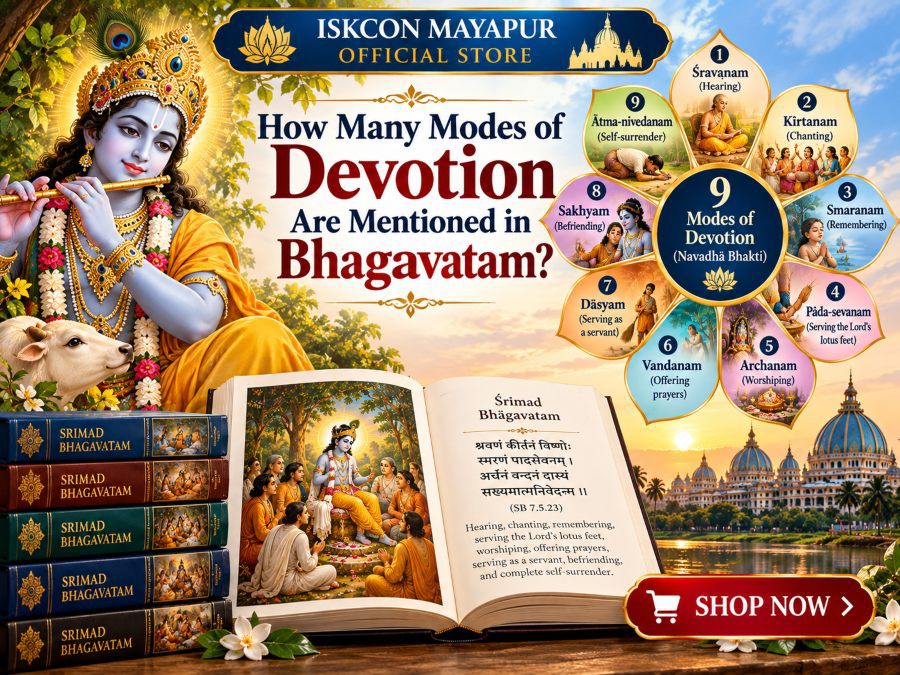 How Many Modes of Devotion Are Mentioned in Bhagavatam?Read more
A young boy named Prahlada listed nine ways to serve God, and the Bhagavatam keeps them as its answer. Learn what the...
-
 What Is Bhagavatam and Why Has It Been Read for 5,000 Years?Read more
A dying king asked one question, and the answer became the Bhagavatam. Learn what this Sanskrit scripture contains,...
-
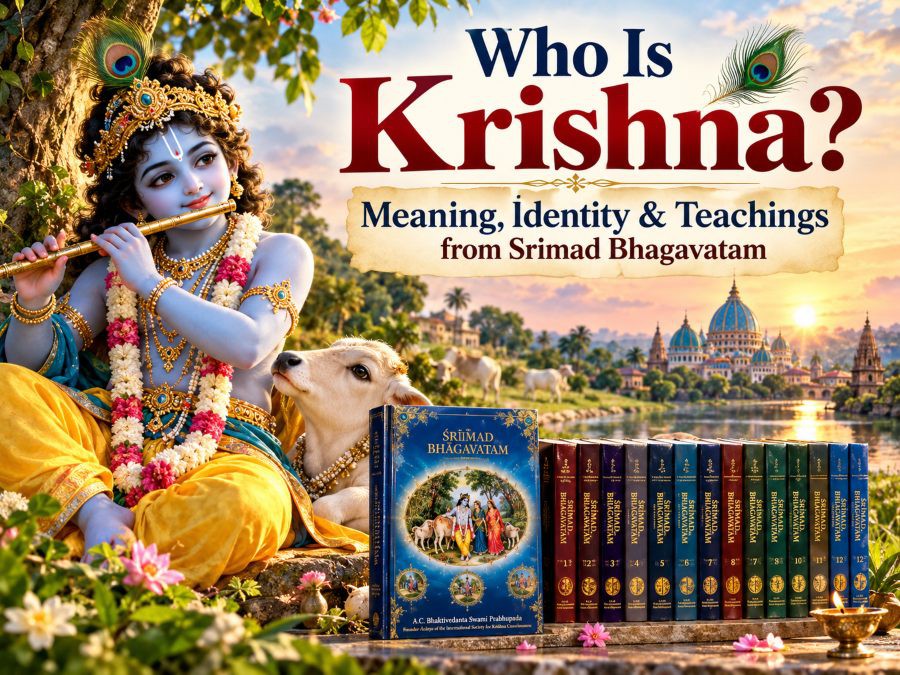 Who Is Lord Krishna? His Meaning, Teachings and Pastimes ExplainedRead more
Discover who Krishna is according to Srimad Bhagavatam, including His divine identity, childhood pastimes, teachings,...
-
 Incense in Islam: Bakhoor, Agarbatti and What Tradition SaysRead more
Is burning fragrance part of Muslim tradition? Explore incense in Islam, from the Prophetic practice of fumigating...
-
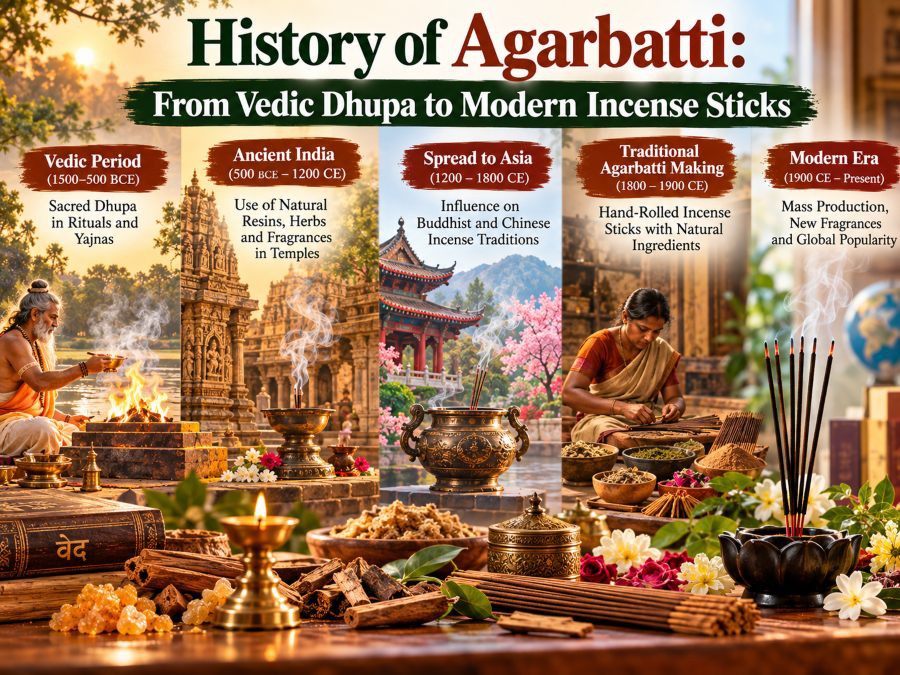 History of Agarbatti: From Vedic Dhupa to Modern Incense SticksRead more
Where did agarbatti really come from? Follow the history of agarbatti from Vedic fire rituals and temple dhupa to...
Blog categories
- Default category (0)
- MUSICAL INSTRUMENT (1)
- BOOK (5)
- DEVOTIONAL GIFT (0)
- Blog (30) click
- CHANDAN (12)
- Bhagavatam Wisdom Series (68)
- Krishna Consciousness (14)
- Mridangam Musical Instrument (6)
- Bhagavad Gita for Beginners (13)
- Bhagavad Gita As It Is (37) click
- Bhagavad Gita As It Is Telugu (0)
- Bhagavad Gita As It Is Marathi (0)
- Bhagavad Gita As It Is In Hindi (0)
- Bhagavad Gita As It Is In English (0)
- Bhagavad Gita As It Is In Bengali (8)
- Bhagavad Gita As It Is In Kannada (0)
- Bhagavad Gita As It Is In Gujarati (0)
- Bhagavad Gita As It Is In Panjabi (0)
- Bhagavad Gita As It Is In Tamil (0)
- Bhagavad Gita As It Is Odia (0)
- BHAGAVAD GITA As It Is GERMAN (0)
- Bhagavad Gita As It Is In French (0)
- Bhagavad Gita As It Is In Nepali (0)
- Bhagavad Gita As It Is In Assamese (0)
- Incense or Agarbatti (38)
- Lord Chaitanya Mahaprabhu (3)
- Vedic Temple Mayapur (14)
- kalki (15)
- Mahabharata – Dharma & Destiny (27)
- Vaishnava Scriptures (4)
- healthy product (4)
- chaitanya mahaprabhu (5)
- Tulsi Mala Guide (17)
Search in blog
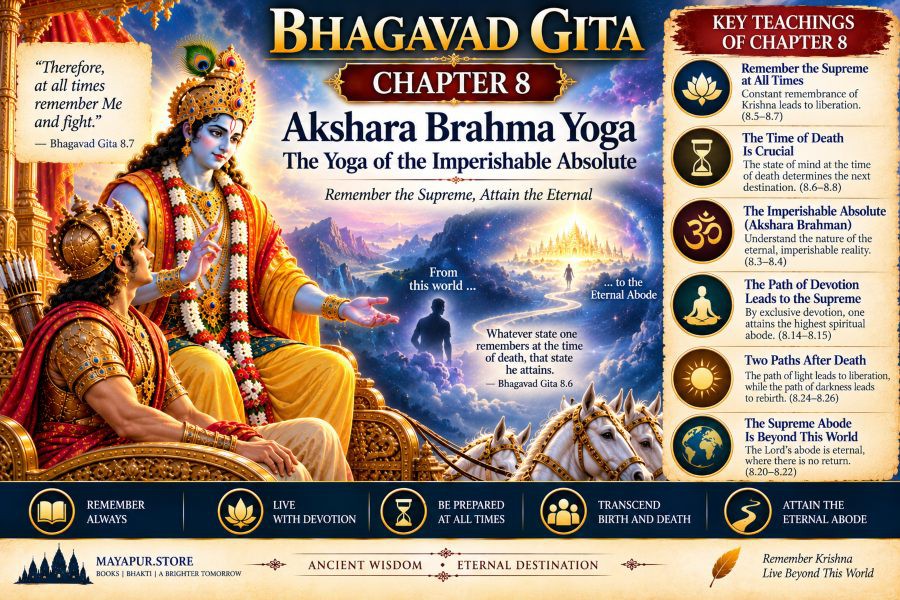
Bhagavad Gita Chapter 8: Akshara Brahma Yoga – The Yoga of the Imperishable Absolute
Bhagavad Gita Chapter 8: Akshara Brahma Yoga – The Yoga of the Imperishable Absolute
The Question Nobody Wants to Ask Out Loud
What do you think about in the final seconds before you die? Not what you'd like to think about, in some idealized version of your own death — what do you think you'd actually be thinking about, given how your mind operates right now, today, under ordinary pressure? It's an unsettling question, and most people avoid it entirely. Arjuna doesn't get that luxury. He asks Krishna directly about death, about what happens at that final moment, and about several dense philosophical terms Krishna dropped in the previous chapter without fully explaining. This is where Chapter 8 of the Bhagavad Gita picks up, and it turns out to be one of the most quietly urgent chapters in the whole text. If you've picked up a copy that's available at ISKCON Mayapur Store, this is the chapter that finally spells out why the state of your mind at the moment of death carries so much weight — and why that means the real work happens long before you ever get there.
Akshara Brahma Yoga translates to "the yoga of the imperishable Absolute," and it functions almost like a glossary chapter, where Krishna defines several heavy terms — Brahman, karma, adhyatma, adhibhuta, adhidaiva, adhiyajna — before pivoting into what remains the chapter's real emotional core: what actually happens when a person dies, and why it matters so much what they were thinking about right before.
Krishna Defines His Terms, One by One
Arjuna's opening questions in this chapter are almost like a student demanding clarity after a lecture full of unfamiliar vocabulary. What exactly is Brahman? What is the self? What is karma, really? Krishna answers each in turn, and while the definitions get dense, the gist of them matters:
- Brahman is described as the imperishable, the supreme, the transcendent reality underlying everything.
- The individual self (adhyatma) refers to one's own essential nature.
- Karma is defined here specifically as the creative force that brings beings into material existence — action understood at its most fundamental, generative level.
- Adhibhuta refers to the perishable nature of material existence — everything that comes into being and passes away.
- Adhidaiva refers to the cosmic form, the universal principle governing existence at a larger scale.
- Adhiyajna, Krishna says, is himself, present within the body as the one who receives and oversees all sacrifice.
None of this is meant to be memorized as trivia. It's groundwork for the real point Krishna is building toward: that all of this — the self, action, the material world, the cosmic order, and the divine presence overseeing it all — converges at exactly one moment with unusual intensity: the moment of death.
Why Your Last Thought Actually Matters
Here's the claim that gives this chapter its real weight: Krishna says that whatever state of being a person remembers when they leave the body at the time of death, that is the state they attain afterward. Thinking of Krishna specifically at that final moment, he says, leads to union with him. But the underlying principle is broader than just that specific case — whatever occupies a person's consciousness most intensely at death shapes what comes next.
This raises an obvious and slightly terrifying question: does that mean your entire spiritual fate hinges on a random, possibly panicked final thought, arriving after a lifetime that may or may not have prepared you for it?
Krishna's answer is essentially no — and the reasoning behind that "no" is the most practically useful part of the whole chapter.
The Real Point: You Don't Get to Improvise That Moment
Krishna makes clear that the state of mind at death isn't some random roll of the dice. It's the direct, almost mechanical result of what a person has practiced and focused on throughout their life. He states this directly: remember me at all times, and fight — because a mind and intelligence constantly absorbed in something will naturally gravitate toward that same thing when it matters most.
Think about how this works with any other skill under pressure. A musician doesn't suddenly play beautifully during a high-stakes performance if they haven't practiced for years beforehand. A person doesn't respond calmly to a sudden crisis if their nervous system hasn't been trained, gradually, to handle stress without panic. The moment of intense pressure doesn't create new capacities — it reveals whatever capacities were already built through consistent practice.
Death, in Krishna's framing, works exactly the same way. It's not a moment where a person suddenly gets access to spiritual clarity they never cultivated. It's the final, most intense test of whatever mental patterns were already deeply grooved in through years — or a whole lifetime — of habitual focus. That's precisely why Krishna keeps circling back to consistent remembrance and practice throughout the Gita, rather than treating spiritual life as something that can be crammed for at the last minute.
A Few Practical Implications Worth Sitting With
This reframes death anxiety in a genuinely useful way. A few things worth pulling out:
- The pressure isn't on the deathbed moment itself. It's on the ordinary days leading up to it, the ones that quietly shape what the mind defaults to under stress.
- Habitual focus compounds. What you think about repeatedly, calmly, on an unremarkable Tuesday afternoon, is training the same mental muscle that gets tested at the most extreme moment of your life.
- This isn't about performing devotion for show. It's about genuine, repeated, private orientation of attention — the kind that becomes so ingrained it doesn't require conscious effort to surface under pressure.
The Two Paths After Death
Krishna then moves into something more cosmological — a description of two distinct paths a soul can take after leaving the body, traditionally referred to as the path of light and the path of darkness, or sometimes the path of the gods and the path of the ancestors.
Without getting lost in the specific astronomical and ritual details Krishna references — certain fires, certain deities, certain periods of the cosmic calendar — the underlying distinction is this: one path leads toward liberation, a non-returning journey beyond the cycle of repeated birth and death. The other leads to a return, back into the material world for further experience and further opportunity.
What's notable here isn't the specific mechanics, which are genuinely dense and have been debated by commentators for centuries. It's the underlying claim that death isn't a single, uniform event for everyone. Where a person goes afterward correlates directly with the internal orientation they cultivated while alive — which loops right back to the chapter's central theme about consistent practice shaping the final outcome.
Time Itself Gets a Strange Reframing
One of the more mind-bending moments in this chapter involves Krishna describing cosmic time on a scale that dwarfs any ordinary human sense of duration — vast cycles of creation and dissolution, day and night measured not in hours but in what amounts to billions of years by conventional counting. Within these cycles, Krishna says, countless beings come into existence and dissolve back into an unmanifest state, repeatedly, endlessly.
But beyond even this vast cyclical process, Krishna points to something else — an unmanifest, imperishable reality that doesn't dissolve along with everything else, one that remains constant regardless of how many cosmic cycles pass. This is the "imperishable" the chapter's title refers to directly: not just personal immortality of the individual soul, discussed back in Chapter 2, but a deeper, unchanging ground of reality that exists prior to and beyond the entire cycle of cosmic creation and destruction altogether.
Why Krishna Keeps Repeating Himself in This Chapter
If you read this chapter closely, you'll notice Krishna circles back to the same core instruction — remember me, engage in your duty, don't let your focus drift — multiple times, almost as if he's worried Arjuna will nod along intellectually without actually internalizing it. That repetition isn't accidental, and it isn't sloppy writing either. It mirrors exactly the point being made: understanding a concept once, intellectually, is nowhere near the same as building the kind of deep, repeated familiarity that survives under pressure.
This is worth noticing because it's easy to read a chapter like this, agree with the logic, and quietly assume the agreement itself counts as progress. Krishna's repetition suggests otherwise. The instruction isn't "understand this," it's "practice this, repeatedly, until it's no longer something you have to consciously remember to do." Those are very different bars to clear, and the second one takes considerably longer than a single afternoon of reading.
A Modern Way to Think About This Without the Cosmology
Strip away the specific vocabulary — Brahman, adhyatma, adhidaiva — and Chapter 8 is making an argument that shows up constantly in modern discussions of habit formation and stress response, just dressed in different language. Athletes talk about this when they describe "muscle memory" under competition pressure. Emergency responders talk about this when they describe training so thoroughly that correct action becomes automatic during a crisis, bypassing the slower, more deliberative parts of decision-making entirely.
Krishna is making essentially the same claim, applied to the single most intense, unavoidable pressure test every person will eventually face. The state of mind at death isn't something you can strategize your way into at the last second, any more than a firefighter can improvise composure during an actual fire without having drilled for it beforehand. Whatever's been practiced consistently is what surfaces. Everything else — good intentions, vague spiritual curiosity, occasional interest — simply isn't strong enough to hold up under that particular pressure.
What This Chapter Quietly Corrects From Earlier in the Gita
There's also a subtle correction happening here relative to some of the earlier chapters. Chapters 2 through 6 spent considerable time on philosophy — the eternal soul, detached action, meditation technique. It would be easy to walk away from those chapters thinking spiritual progress is primarily an intellectual or even a technical achievement, something you can reason your way toward or perfect through correct posture and breathing.
Chapter 8 pushes back against that reading. Death doesn't ask what you understood. It reveals what you actually practiced. That's a meaningfully different standard, and it explains why Krishna keeps returning, chapter after chapter, to the same underlying instruction rather than treating each new philosophical concept as a box to check off once and move past.
Bringing This Chapter Back Down to Earth
It would be easy to get lost in the cosmic scale of this chapter and miss its actual, practical instruction, which is refreshingly simple compared to the scope of everything else being discussed: remember Krishna consistently, engage fully in your duties, and don't let your attention drift permanently away from this practice, because whatever the mind is trained to default to will surface precisely when it matters most.
That's a much more actionable takeaway than the vast cosmological descriptions might initially suggest. Chapter 8 isn't really asking readers to master the mechanics of cosmic time cycles or memorize the specific technical distinctions between different post-death paths. It's asking something more immediate: what is your mind actually practicing, day after day, right now — and are you comfortable with the idea that whatever that habitual focus is, it's exactly what will surface when the pressure is highest and there's no more time left to prepare?
Posted in: Bhagavad Gita As It Is
Related posts
-
 Why the Bhagavad Gita Feels Like a Personal Conversation with KrishnaThe Bhagavad Gita feels like a personal conversation with Krishna because its timeless wisdom directly addresses our...Read more
 -
 Shrimad Bhagwat Geeta: The Forgotten Life Manual for Modern StressShrimad Bhagwat Geeta is more than a sacred scripture—it’s a forgotten life manual that offers timeless solutions for...Read more
 -
 Who Wrote the Bhagavad Gita? Discover the true authorship of the Bhagavad Gita—exploring Ved Vyasa’s role as the compiler, Lord Krishna’s divine...Read more
 -
 How Many Shlokas in Bhagavad Gita? Complete Chapter-Wise Breakdown & MeaningDiscover how many shlokas are in the Bhagavad Gita, with a complete chapter-wise breakdown, variations in verse...Read more
 -
 How to Read Bhagavad Gita: A Complete Step-by-Step Guide for BeginnersDiscover how to read the Bhagavad Gita step by step—learn the right mindset, chapter order, and tips to understand...Read more
Leave a comment