
Why did Krishna run to embrace a poor brahmin in rags? Read the Sudama story from the Bhagavatam and learn how a...
Latest posts
-
 Krishna and Sudama: The Poor Brahmin Who Became Wealthy in LoveRead more
 -
 Vamana Avatar: How Three Steps Humbled Bali MaharajaRead more
Why did a powerful king give away three worlds to a boy asking for three steps? Learn the Vamana avatar story from...
-
 The Bhagavatam on Marriage: Duty, Love and Spiritual PartnershipRead more
What does the Bhagavatam say about marriage? Through the stories of Kardama and Devahuti, Rukmini's secret letter and...
-
 What Is Prema? The Bhagavatam's Highest Stage of Love for GodRead more
Prema is love for God with no "because" attached. Learn how the Bhagavatam describes it, the nine steps from faith to...
-
 Is Shiva Parvati Kalyana Mentioned in Srimad Bhagavatam? What the Scripture Really SaysRead more
Looking for Shiva and Parvati's wedding in the Srimad Bhagavatam? Find out what the scripture actually describes,...
-
 How Many Modes of Devotion Are Mentioned in Bhagavatam?Read more
A young boy named Prahlada listed nine ways to serve God, and the Bhagavatam keeps them as its answer. Learn what the...
-
 What Is Bhagavatam and Why Has It Been Read for 5,000 Years?Read more
A dying king asked one question, and the answer became the Bhagavatam. Learn what this Sanskrit scripture contains,...
-
 Who Is Lord Krishna? His Meaning, Teachings and Pastimes ExplainedRead more
Discover who Krishna is according to Srimad Bhagavatam, including His divine identity, childhood pastimes, teachings,...
-
 Incense in Islam: Bakhoor, Agarbatti and What Tradition SaysRead more
Is burning fragrance part of Muslim tradition? Explore incense in Islam, from the Prophetic practice of fumigating...
-
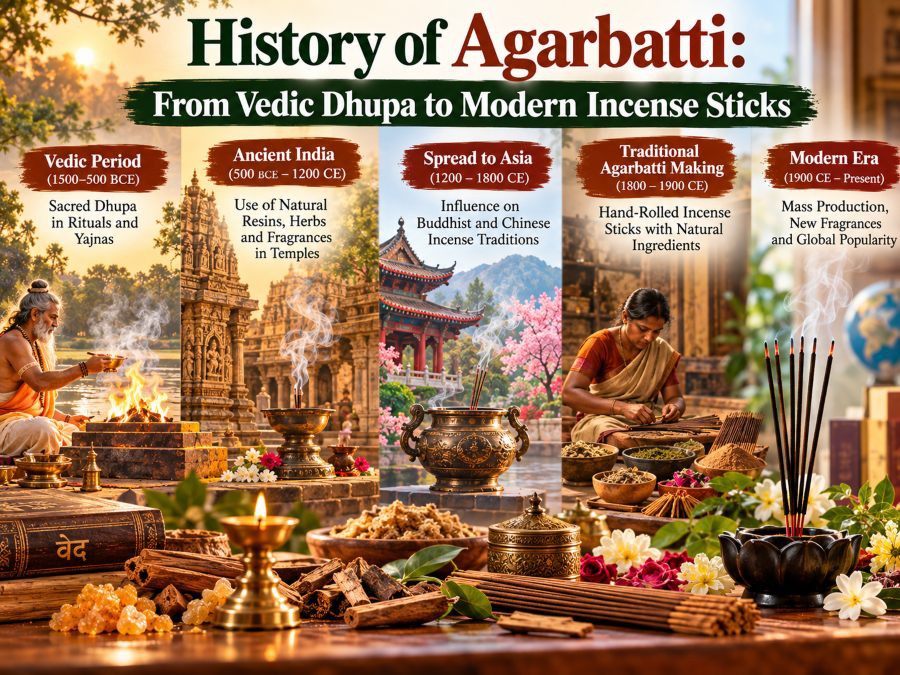 History of Agarbatti: From Vedic Dhupa to Modern Incense SticksRead more
Where did agarbatti really come from? Follow the history of agarbatti from Vedic fire rituals and temple dhupa to...
Blog categories
- Default category (0)
- MUSICAL INSTRUMENT (1)
- BOOK (5)
- DEVOTIONAL GIFT (0)
- Blog (30) click
- CHANDAN (12)
- Bhagavatam Wisdom Series (68)
- Krishna Consciousness (14)
- Mridangam Musical Instrument (6)
- Bhagavad Gita for Beginners (13)
- Bhagavad Gita As It Is (37) click
- Bhagavad Gita As It Is Telugu (0)
- Bhagavad Gita As It Is Marathi (0)
- Bhagavad Gita As It Is In Hindi (0)
- Bhagavad Gita As It Is In English (0)
- Bhagavad Gita As It Is In Bengali (8)
- Bhagavad Gita As It Is In Kannada (0)
- Bhagavad Gita As It Is In Gujarati (0)
- Bhagavad Gita As It Is In Panjabi (0)
- Bhagavad Gita As It Is In Tamil (0)
- Bhagavad Gita As It Is Odia (0)
- BHAGAVAD GITA As It Is GERMAN (0)
- Bhagavad Gita As It Is In French (0)
- Bhagavad Gita As It Is In Nepali (0)
- Bhagavad Gita As It Is In Assamese (0)
- Incense or Agarbatti (38)
- Lord Chaitanya Mahaprabhu (3)
- Vedic Temple Mayapur (14)
- kalki (15)
- Mahabharata – Dharma & Destiny (27)
- Vaishnava Scriptures (4)
- healthy product (4)
- chaitanya mahaprabhu (5)
- Tulsi Mala Guide (17)
Search in blog
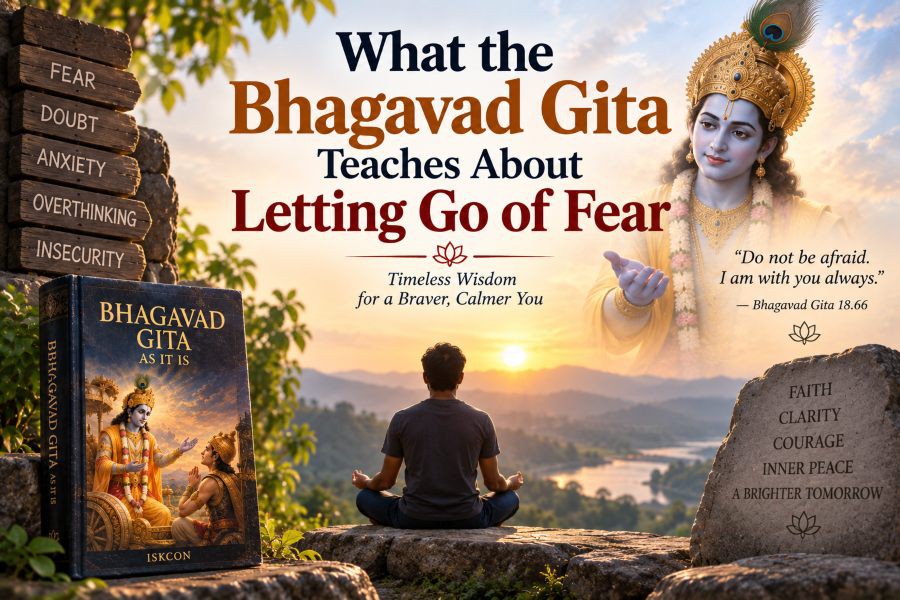
What the Bhagavad Gita Teaches About Letting Go of Fear
What the Bhagavad Gita Teaches About Letting Go of Fear
Your hands are shaking before a decision that hasn't even happened yet. Maybe it's a diagnosis you're waiting on, a conversation you've been avoiding for weeks, or a choice that could go badly wrong in ways you can already picture in vivid, unhelpful detail. Fear does this. It doesn't wait for the bad thing to arrive — it rehearses it for you, over and over, stealing the present moment to worry about a future that hasn't been written yet. Five thousand years ago, a warrior named Arjuna stood on a battlefield in exactly this state, his bow slipping from trembling hands, and the conversation that followed became one of humanity's most direct instructions on fear itself. If you're trying to understand the author of gita and why this particular text keeps getting handed to people in crisis, the answer is simple: nobody has ever described the mechanics of fear this precisely, or offered a way out that actually holds up under pressure.
A Warrior's Collapse, and Why It Matters to You
Picture the scene properly, because it's easy to skim past it as ancient set-dressing. Two armies stand facing each other on the plain of Kurukshetra. Arjuna, a legendary archer known for his composure under pressure, asks his charioteer Krishna to drive him between the ranks so he can survey the battlefield. What he sees breaks him. Cousins, teachers, in-laws, childhood friends — people he loves are standing on both sides, ready to kill and be killed. His body starts failing him first. His mouth goes dry. His skin burns. His famous bow, the Gandiva, slips from his fingers.
This isn't cowardice, and the text doesn't treat it that way. It's a complete physiological fear response — the kind you might recognize from a moment right before a job interview that actually mattered, or the seconds after a phone rings at an odd hour and you already suspect the news is bad. Fear this size doesn't stay in the mind. It takes over the whole body.
What makes this opening chapter so useful two thousand years later isn't the battlefield. It's the honesty. Most spiritual and self-help writing rushes past the fear to get to the fix. The Gita doesn't. It gives an entire chapter to Arjuna falling apart, describing his despair in physical, specific terms, before Krishna says a single word of guidance. That sequencing is deliberate, and it's the first real lesson here: you don't skip the fear to get to wisdom. You have to go through it, named honestly, before anything Krishna says will actually land.
Why Krishna Doesn't Try to Calm Arjuna Down First
Here's something that surprises people reading this for the first time. Krishna's opening response to a terrified, grieving man isn't comfort. It's almost blunt: this despondency doesn't suit you, get up and fight. No gentle reassurance. No "it's going to be okay." If a friend responded to your panic that way, you might feel dismissed.
But look closer at what Krishna is actually doing. He's not minimizing Arjuna's fear — he's refusing to let Arjuna's fear become the only voice in the room. There's a difference between validating someone's feelings and letting those feelings write the final decision. Krishna spends the rest of the text explaining why fear doesn't deserve the final word, but he starts by drawing a line: feeling afraid is human, but building your entire choice around that fear is a decision you're allowed to refuse.
This distinction matters more than it sounds:
- You can feel terrified about a medical test and still walk into the appointment
- You can feel your stomach drop at the thought of a hard conversation and still have it
- You can shake through an audition, a pitch, a difficult goodbye, and still do the thing
Fear as a visitor is unavoidable. Fear as a decision-maker is optional. Krishna's entire teaching rests on that gap.
The Root Cause Krishna Actually Diagnoses
Most people assume Arjuna's fear is about death — his own, or the deaths he's about to cause. Read the dialogue carefully, though, and the diagnosis is more specific and, frankly, more useful. Arjuna's fear is rooted in attachment: to outcomes, to relationships, to a version of the future he can't guarantee. He's not just afraid of fighting. He's afraid of what fighting will cost him, who he'll lose, what kind of man he'll become on the other side of the decision.
This reframe changes everything about how you can use this text. Almost nobody's fear is a pure, clean fear of a single physical threat. Fear of public speaking is really fear of humiliation and the social cost that follows. Fear of quitting a stable job is really fear of an unknown future you can't control. Fear of confronting someone is really fear of losing the relationship, or losing the version of yourself that avoids conflict.
Krishna's core insight, stripped down: fear grows in the gap between what you're doing and what you're desperately hoping the outcome will be. Close that gap — stop demanding a guaranteed result — and the fear loses most of its fuel.
This is why the most quoted line from the entire text lands the way it does: you have a right to your actions, never to the fruits of those actions. People treat this as a nice sentiment for a wall poster. It's actually a precise diagnostic tool. Ask yourself, next time fear grips you before a decision, whether you're afraid of the action itself or afraid of an outcome you were never going to be able to guarantee anyway. Nine times out of ten, it's the second one.
Three Practical Moves the Gita Offers (Not Just Philosophy)
It would be easy to treat all of this as abstract comfort, the kind of thing that sounds nice in a quote graphic and does nothing at 2 a.m. when your chest is tight and your mind is racing. But Krishna's teaching across the Bhagavad Gita's chapters actually breaks into usable moves, not just ideas to admire.
Move One: Separate the Feeling From the Command
Arjuna's fear tells him one thing clearly: don't do this. Krishna's first move is to treat that instruction as information, not law. Fear is data about how big the moment feels to you — it is not a reliable verdict on what you should do. The next time fear tells you to avoid something, try treating it the way you'd treat a loud but unreliable witness: worth hearing, not worth obeying automatically.
Move Two: Locate What You Actually Control
A huge amount of fear comes from trying to control things that were never yours to control — how someone reacts, whether a plan works out, what happens after a decision is made. Krishna keeps redirecting Arjuna back to the one thing genuinely his: the quality of the action itself, done with full attention and without the demand that it goes a specific way. Try this concrete filter when fear spikes:
- Is what scares me the action, or the outcome I can't control?
- If I separate those two things, does the action itself still feel doable?
- What's the smallest version of this action I can commit to right now?
Move Three: Remember the Part of You That Isn't at Risk
Chapter 2 introduces one of the most radical claims in the entire text — that the true self, the soul, is never born and never dies, untouched by the destruction of the body the way a person casts off worn clothing and puts on new ones. Whatever your metaphysical position on that claim, the psychological utility is real. Fear often convinces you that a single bad outcome will define you permanently. Krishna's argument is that the part of you doing the deciding was never actually on the line in the first place. The job might not define you. The rejection might not define you. The mistake might not define you. Something steadier sits underneath all of it.
What Modern Anxiety Has in Common With a 5,000-Year-Old Battlefield
Skeptics reasonably ask why a chariot conversation about literal warfare should say anything useful about a panic attack over an unanswered email. The honest answer is structural, not literal. Strip away the battlefield, and what's left is a person facing an irreversible decision, overwhelmed by imagined future consequences, physically unable to act because the fear has taken over the body before the mind gets a vote.
That structure repeats constantly in ordinary life:
- Career decisions — quitting a stable job for something uncertain triggers the same physiological fear response, just spread across weeks instead of minutes
- Relationship conflicts — confronting someone you love about a real problem can feel exactly as paralyzing as picking up a weapon against family
- Health scares — waiting on results activates the identical loop of imagined future catastrophe that Arjuna experiences before a single arrow is fired
- Public failure — the fear of humiliation in front of people who matter to you maps almost perfectly onto Arjuna's fear of what his community will think of his choice
None of these carry actual swords, but the nervous system doesn't know the difference. A racing heart and a dry mouth respond to imagined social death the same way they respond to imagined physical death. That's precisely why a battlefield conversation from millennia ago keeps getting quoted in therapy circles and leadership seminars that have nothing to do with religion.
The Verse People Misquote (And What It Actually Means)
If you've spent any time near spiritual social media, you've seen a line attributed to Krishna about how the soul cannot be pierced by weapons or burned by fire. It gets used constantly as a comforting meme, usually stripped of the argument building up to it. Read in context, it's not a throwaway comfort line. It's the closing argument in a very deliberate case Krishna builds across several verses: if the deepest part of you cannot actually be destroyed by the outcome you fear, then the fear, however real it feels, is operating on false information about what's actually at stake.
This is worth sitting with, because it reframes what "letting go of fear" even means. The Gita isn't asking you to pretend the fear isn't there, or to force calmness through sheer willpower. It's asking you to examine whether the fear's core premise — that this outcome will destroy something essential about you — is even true. Often, under close inspection, it isn't. You survive the humiliation. You survive the failed relationship. You survive the wrong choice. The part of you that keeps surviving is the part Krishna keeps pointing back to.
Detachment Isn't What Most People Think It Is
Anytime detachment comes up in this conversation, people flinch, assuming Krishna is asking Arjuna — and by extension, you — to stop caring. That misreading causes more confusion about this text than almost anything else. Krishna never once tells Arjuna to feel nothing. He tells him to act fully while releasing his white-knuckled grip on guaranteeing a specific result.
Real detachment, as this text describes it, looks like this in practice:
- Doing the difficult work without needing constant proof that it's paying off
- Loving someone completely while accepting you can't control every choice they make
- Speaking a hard truth without needing the other person to react exactly as you hoped
- Taking the medical test, sending the email, having the conversation — fully present, without pre-writing the worst-case outcome in your head first
Fear thrives on the opposite of this. It demands guarantees before it will let you move. Detachment, properly understood, is what lets you move without the guarantee, because you've stopped requiring one.
How the Structure of the Gita Mirrors an Actual Recovery From Fear
It's worth noticing that the text doesn't resolve Arjuna's fear in one dramatic sentence. It takes eighteen chapters, moving through different paths — action, knowledge, meditation, devotion — circling the same core anxiety from multiple angles because Krishna understands something therapists confirm constantly: a single insight rarely dissolves a deep fear. Repetition, examined from different directions, does.
This mirrors how actual fear recovery tends to work outside any spiritual framework. You don't hear one good argument and stop being afraid of flying, public speaking, or confrontation. You hear the argument, feel a little steadier, get scared again, hear a related argument from a different angle, feel a little steadier still. The Gita's insistence on layering karma yoga, jnana yoga, and bhakti yoga on top of each other isn't padding. It's an accurate model of how fear actually loosens its grip — slowly, from multiple directions, not all at once.
Chapter 9 makes a claim that deserves particular attention here, because it directly answers the fear that you have to earn your way out of a crisis through perfect performance. Krishna states plainly that all who take shelter in him — explicitly naming women, merchants, and laborers, groups the era's social hierarchy often dismissed — can reach the highest destination. The point of Bhagavad Gita 9.32 women isn't a footnote about social categories; it's a direct rebuttal of the fear that says you need special status, perfect credentials, or flawless composure before you're allowed to move past terror. Krishna is explicit that ordinary people, regardless of standing, get the same doorway out of fear that a warrior-prince does. That's a significant claim for a text built around a royal battlefield conversation, and it widens who this teaching is actually for.
A Simple Framework You Can Use This Week
You don't need to read all eighteen chapters to start applying this. Here's a compressed version of Krishna's approach to fear, built from the core moves already covered.
When fear shows up before a decision, try running through these steps:
1. Name what's actually happening in your body — racing heart, tight chest, dry mouth. Acknowledging the physical reality, the way the Gita spends an entire chapter doing with Arjuna, takes some of the power out of pretending you're fine.
2. Ask what you're actually attached to. Is it the action scaring you, or a specific outcome you can't guarantee anyway?
3. Identify the smallest true action available to you right now — not the whole decision, just the next honest step.
4. Remind yourself what survives regardless of outcome. Whatever happens, some steadier part of you continues past this moment. That's not denial. It's usually just true.
5. Act anyway, without demanding the result cooperate. This is the actual practice of detachment — not calmness first, action second, but action alongside whatever fear is still present.
Do this enough times, on small decisions, and it gets easier to apply on the larger ones — the health scare, the career pivot, the conversation you've been avoiding for months.
Why This Still Works When Everything Else Feels Exhausted
Most modern advice about fear treats it as a problem to optimize away — better breathing techniques, better routines, a supplement, an app. Some of that genuinely helps at the margins. But Krishna's approach cuts differently, because it doesn't promise the fear will vanish. It promises something more durable: that you can act rightly even while the fear is still present, because your peace was never supposed to depend on the fear disappearing first.
That reframe matters enormously if you've ever felt like a failure for still being scared despite doing "all the right things." The Gita never asks Arjuna to stop trembling before he's allowed to fight. It asks him to understand what's actually at stake, act from that clearer understanding, and let the trembling be there if it wants to be. Confidence, in this text, isn't the absence of fear. It's acting well in fear's presence, because you've stopped needing fear's permission first.
The Chapters That Carry This Argument, If You Want to Go Deeper
For anyone who wants to trace this argument through the source material directly rather than taking a summary's word for it, the fear-and-detachment thread runs mainly through the early Bhagavad Gita chapters — Arjuna's collapse in Chapter 1, the philosophical foundation of the eternal soul in Chapter 2, and the practical instructions on acting without attachment to outcomes that follow in Chapters 3 through 6. Later sections build on this base, returning to the theme from the angle of devotion and universal accessibility, but the core mechanics of letting go of fear are laid out early and then reinforced from different directions across the rest of the text. Readers who go looking for a single verse cure often come away disappointed; readers who follow the Bhagavad Gita adhyay as a sequence tend to find the argument builds exactly the way sustained fear recovery actually feels — gradual, layered, and cumulative rather than instant.
What Arjuna Picked Up Off the Ground
By the end of the conversation, Arjuna doesn't stand up because his fear vanished. He stands up because he finally understood what the fear was actually about, and decided it didn't get to make the final call. He picks his bow back up — the same hands that were shaking in Chapter 1 — not because Krishna performed some kind of magic trick, but because the ground underneath the fear had shifted. The outcome was never guaranteed either way. The part of him doing the choosing was never actually at risk the way the fear insisted it was. And the action, done fully and without the demand for a guaranteed result, turned out to be something he could actually do.
That's the real inheritance of this text for anyone dealing with fear today, whether it's a battlefield-sized decision or the smaller, quieter terror of an unanswered message sitting on your phone. The fear doesn't have to disappear first. You just have to stop letting it hold the only vote in the room.
Posted in: Bhagavad Gita As It Is
Related posts
-
 Why the Bhagavad Gita Feels Like a Personal Conversation with KrishnaThe Bhagavad Gita feels like a personal conversation with Krishna because its timeless wisdom directly addresses our...Read more
 -
 Shrimad Bhagwat Geeta: The Forgotten Life Manual for Modern StressShrimad Bhagwat Geeta is more than a sacred scripture—it’s a forgotten life manual that offers timeless solutions for...Read more
 -
 Who Wrote the Bhagavad Gita? Discover the true authorship of the Bhagavad Gita—exploring Ved Vyasa’s role as the compiler, Lord Krishna’s divine...Read more
 -
 How Many Shlokas in Bhagavad Gita? Complete Chapter-Wise Breakdown & MeaningDiscover how many shlokas are in the Bhagavad Gita, with a complete chapter-wise breakdown, variations in verse...Read more
 -
 How to Read Bhagavad Gita: A Complete Step-by-Step Guide for BeginnersDiscover how to read the Bhagavad Gita step by step—learn the right mindset, chapter order, and tips to understand...Read more
Leave a comment