
Explore Srimad Bhagavatam Canto 11, where Lord Krishna shares His final and most profound teachings with Uddhava on...
Latest posts
-
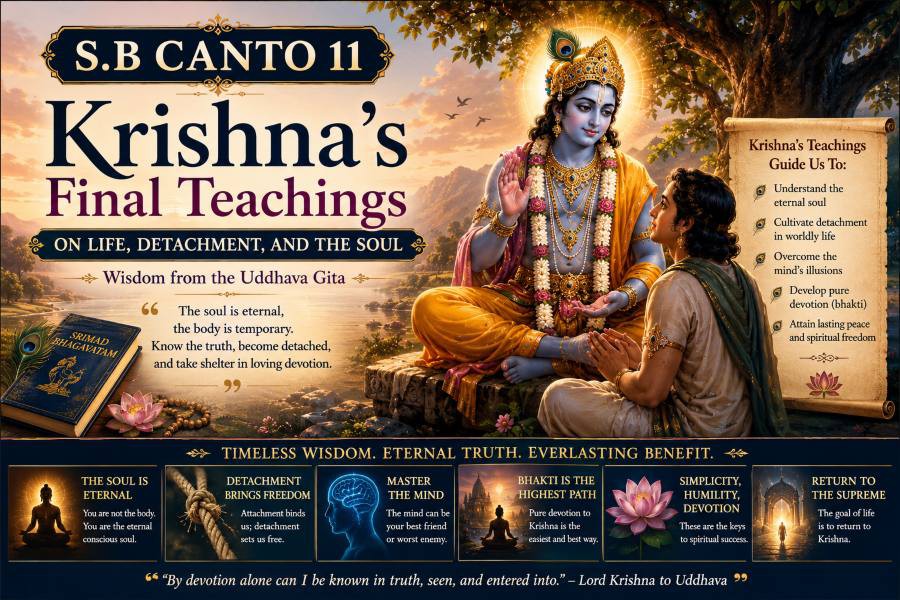 S.B Canto 11 — Krishna’s Final Teachings on Life, Detachment, and the SoulRead more
 -
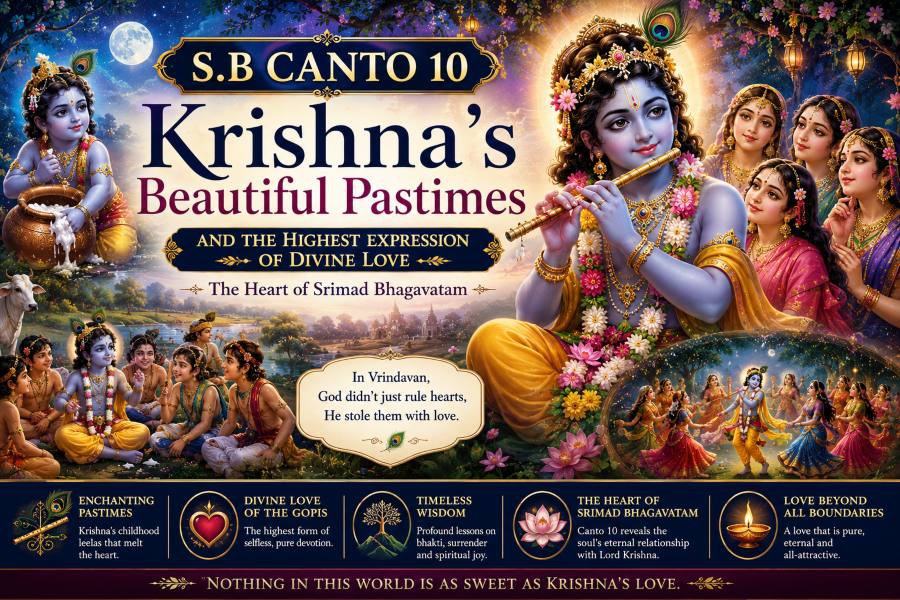 S.B Canto 10 — Krishna’s Beautiful Pastimes and the Highest Expression of Divine LoveRead more
Explore Srimad Bhagavatam Canto 10, the heart of the Bhagavatam, where Lord Krishna's enchanting childhood pastimes,...
-
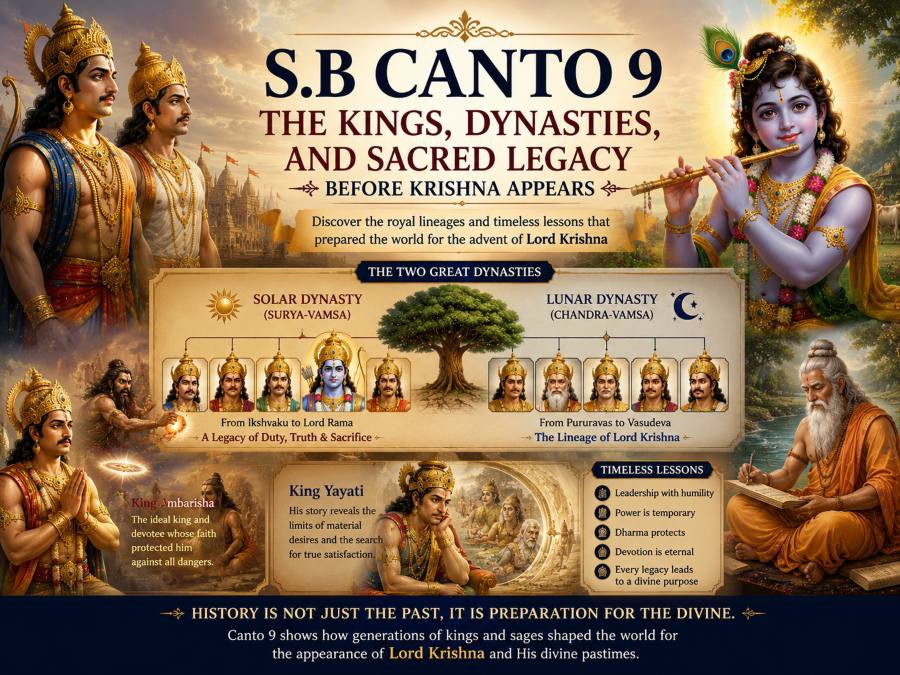 S.B Canto 9: The Kings, Dynasties, and Sacred Legacy Before Krishna AppearsRead more
Explore Srimad Bhagavatam Canto 9 and uncover the remarkable stories of ancient kings, royal dynasties, and sacred...
-
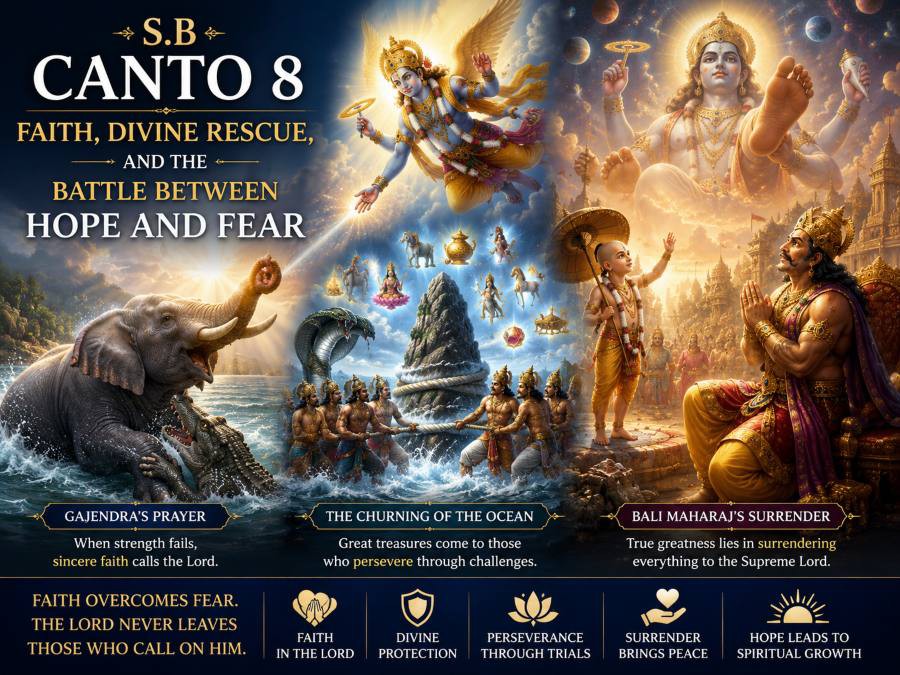 Srimad Bhagavatam Canto 8: How Faith Triumphs Over FearRead more
Explore Srimad Bhagavatam Canto 8, where the inspiring stories of Gajendra, the churning of the Milk Ocean, and Bali...
-
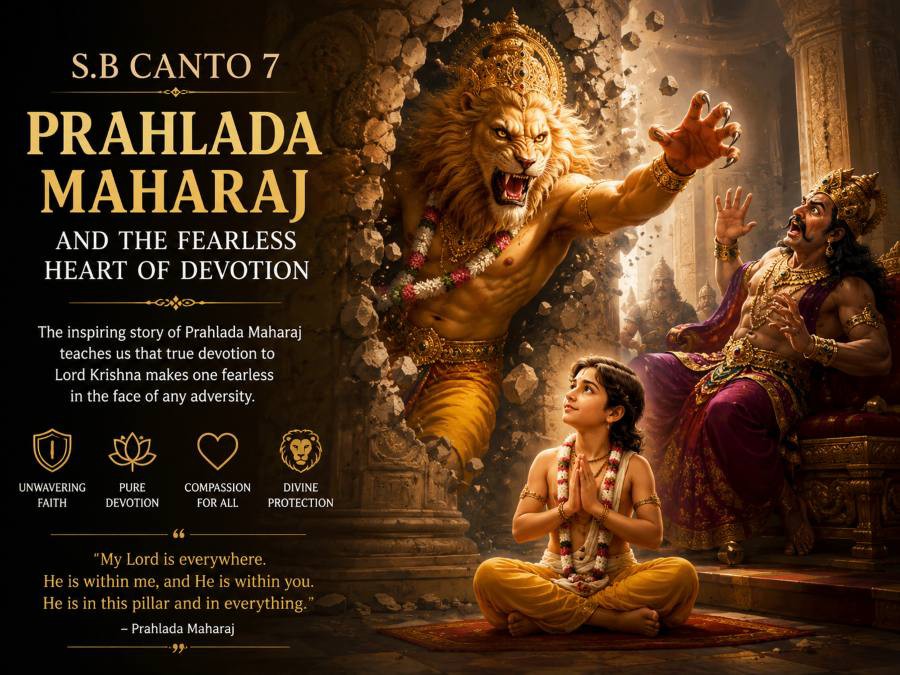 S.B Canto 7: Prahlada Maharaj and the Fearless Heart of DevotionRead more
Explore Srimad Bhagavatam Canto 7 and discover the inspiring story of Prahlada Maharaj, whose unwavering devotion to...
-
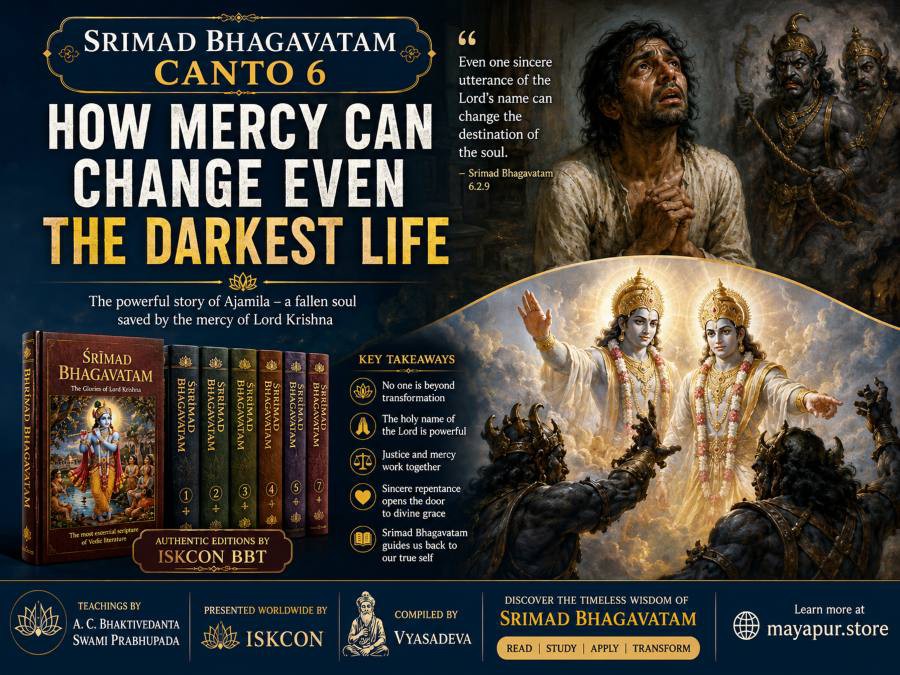 S.B Canto 6: How Mercy Can Change Even the Darkest LifeRead more
Discover the inspiring lessons of Srimad Bhagavatam Canto 6, where the story of Ajamila reveals how divine mercy,...
-
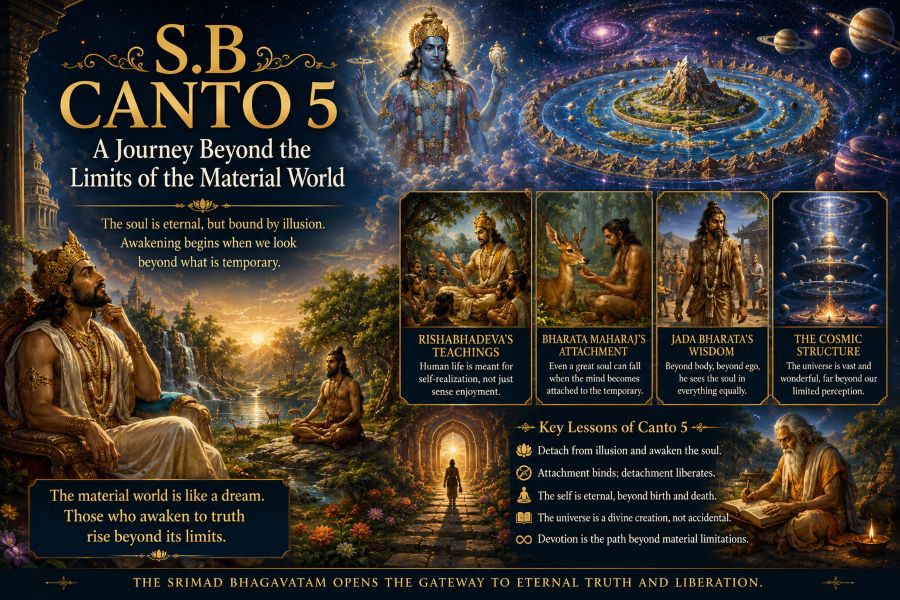 Srimad Bhagavatam Canto 5: A Journey Beyond the Limits of the Material WorldRead more
Discover how Srimad Bhagavatam Canto 5 explores cosmic creation, spiritual awakening, material illusion, and the...
-
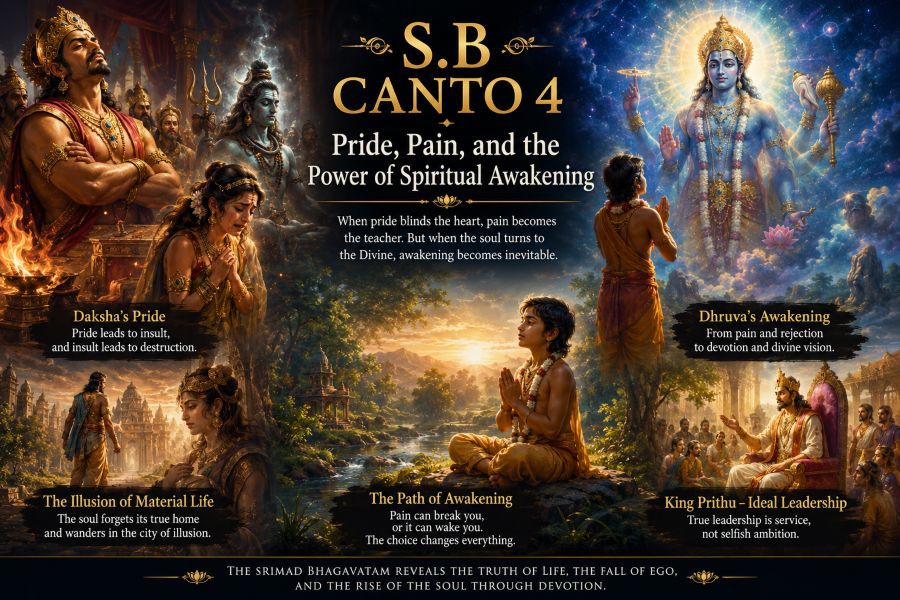 Srimad Bhagavatam Canto 4: The Pain of Pride and the Journey Back to the SoulRead more
Discover how Srimad Bhagavatam Canto 4 explores pride, rejection, devotion, spiritual awakening, and the emotional...
-
 Srimad Bhagavatam Canto 3: The Soul, Creation, and the Forgotten Truth of LifeRead more
Discover how Srimad Bhagavatam Canto 3 explains the soul, creation, consciousness, and the forgotten spiritual truth...
-
 Srimad Bhagavatam Canto 2: Seeing the Universe Through Divine EyesRead more
Discover how Srimad Bhagavatam Canto 2 explains the cosmic form of the Lord, spiritual vision, meditation, creation,...
Blog categories
- Default category (0)
- MUSICAL INSTRUMENT (1)
- BOOK (5)
- DEVOTIONAL GIFT (0)
- Blog (30) click
- CHANDAN (12)
- Bhagavatam Wisdom Series (43)
- Krishna Consciousness (5)
- Mridangam Musical Instrument (6)
- Bhagavad Gita for Beginners (13)
- Bhagavad Gita As It Is (13) click
- Bhagavad Gita As It Is Telugu (0)
- Bhagavad Gita As It Is Marathi (0)
- Bhagavad Gita As It Is In Hindi (0)
- Bhagavad Gita As It Is In English (0)
- Bhagavad Gita As It Is In Bengali (8)
- Bhagavad Gita As It Is In Kannada (0)
- Bhagavad Gita As It Is In Gujarati (0)
- Bhagavad Gita As It Is In Panjabi (0)
- Bhagavad Gita As It Is In Tamil (0)
- Bhagavad Gita As It Is Odia (0)
- BHAGAVAD GITA As It Is GERMAN (0)
- Bhagavad Gita As It Is In French (0)
- Bhagavad Gita As It Is In Nepali (0)
- Bhagavad Gita As It Is In Assamese (0)
- Incense or Agarbatti (6)
- Lord Chaitanya Mahaprabhu (3)
- Vedic Temple Mayapur (16)
- kalki (15)
- Mahabharata – Dharma & Destiny (27)
- Vaishnava Scriptures (4)
- healthy product (4)
- chaitanya mahaprabhu (5)
Search in blog
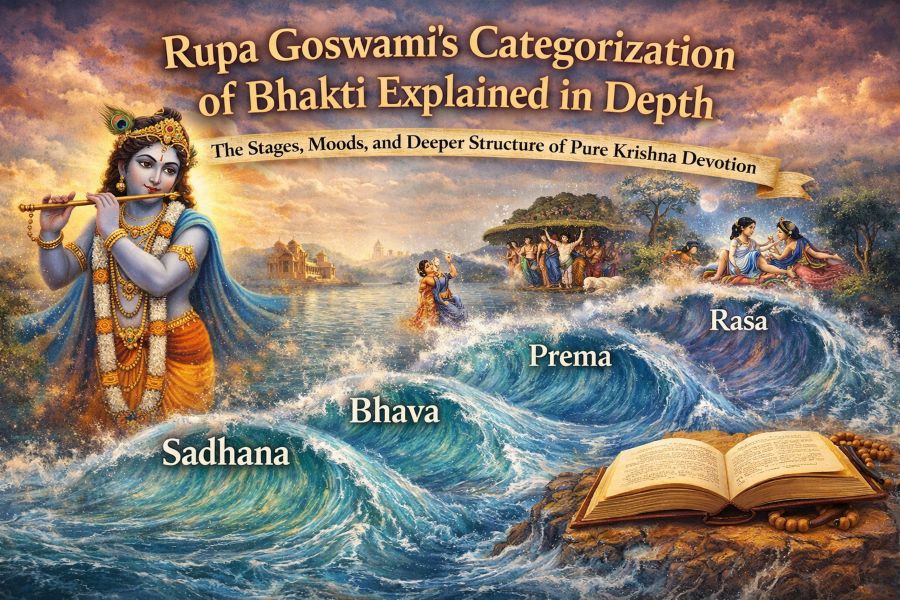
The Ocean of Bhakti and the Meaning of Its Spiritual Waves
The Waves of the Ocean of Bhakti: A Deep Dive into Rupa Goswami’s Categorization
In the vast heritage of Gaudiya Vaishnava theology, few works have shaped devotional understanding as deeply as the Masterpiece by Rupa Goswami known as Bhakti-rasamrita-sindhu. This extraordinary text does not present devotion as a loose emotion or a sentimental spiritual preference. Instead, it offers a carefully organized map of bhakti, showing how devotion begins, how it matures, how it is practiced, and how it ultimately flowers into the highest forms of divine love. For serious readers, this structure is one of the greatest strengths of the work. It transforms bhakti from a vague idea into a living spiritual science.
The title Bhakti-rasamrita-sindhu means “The Ocean of the Nectar of Devotion,” and that image is not ornamental. Rupa Goswami intentionally presents bhakti as an ocean because devotion is both deep and unlimited. Yet this ocean is not chaotic. It has internal order, movement, and flow. That is why the text is divided into sections often described as waves. Each wave carries the reader further into the understanding of devotion, revealing its qualities, stages, practices, moods, and ultimate perfection. This literary and theological organization makes the book one of the most refined devotional treatises ever written.
For modern readers, the categorization in Bhakti-rasamrita-sindhu is especially valuable because it gives clarity. Many people speak of devotion, but not everyone understands what devotion truly is, what distinguishes pure bhakti from mixed motives, or how spiritual emotion matures. Rupa Goswami answers these questions with elegance and precision.
Why Rupa Goswami Organizes Bhakti in Waves
One of the most fascinating aspects of Bhakti-rasamrita-sindhu is that it does not unfold like a random collection of teachings. It moves in a deliberate order. Rupa Goswami arranges the subject in what are often called waves because devotion is dynamic. It has motion, depth, progression, and expansion. The metaphor of waves suggests that bhakti is alive. It is something into which the practitioner enters more deeply over time.
This categorization also serves a practical purpose. Devotional life can be misunderstood if it is discussed only in broad emotional language. Someone may speak of love for Krishna without understanding the foundation of practice. Another may follow rituals without understanding the goal of divine love. Still another may confuse temporary emotion with spiritually mature bhava. Rupa Goswami’s structure prevents this confusion by showing that bhakti has recognizable forms, stages, and characteristics.
The wave-like arrangement also reflects the nature of spiritual absorption. One realization leads into another. Practice leads into purification. Purification leads into steadiness. Steadiness leads into taste. Taste leads into attachment. Attachment deepens into spiritual emotion and ultimately into prema, pure love of God. In this sense, the organization of the text mirrors the actual unfolding of devotional consciousness.
For readers today, this structure is more than literary beauty. It becomes a guide for self-understanding. It helps practitioners recognize where they are, what they need, and what lies ahead on the path of bhakti.
The Overall Structure of Bhakti-rasamrita-sindhu
Rupa Goswami’s categorization is not casual. The text is divided into major divisions, and within those divisions are carefully developed thematic sections. Traditionally, the work is arranged into four major parts, often compared to eastern, southern, western, and northern divisions of an ocean. Within those larger divisions are the waves that deal with specific aspects of devotion.
This arrangement itself is meaningful. By describing devotion as a boundless ocean with organized regions and waves, Rupa Goswami balances immensity with precision. Bhakti is infinite in spiritual richness, yet knowable through revealed categories. It is beyond material limitation, yet accessible through disciplined teaching.
The early portions of the work define bhakti and establish its superiority. They explain the nature of pure devotion, its primary characteristics, and its initial forms. Later sections move deeper into practice, then into devotional emotion, and finally into the subtleties of rasa, the spiritual flavors of relationship with Krishna. This progression is not merely academic. It takes the reader from foundation to culmination.
Understanding this structure is important because it shows that bhakti is complete. It includes philosophy, conduct, practice, psychology, theology, and the aesthetics of divine love. Few texts in world spirituality offer such a full-spectrum map of religious life. That is one reason Bhakti-rasamrita-sindhu remains indispensable in the Gaudiya tradition.
The First Great Category: Uttama-Bhakti
The starting point of Rupa Goswami’s analysis is one of the most famous definitions in devotional literature: the definition of uttama-bhakti, or pure devotional service. This is where the ocean begins. Before discussing advanced emotions or devotional flavors, he defines what true bhakti actually is.
This definition is crucial because spiritual life can easily become mixed with ulterior motives. People may approach religion for material success, emotional comfort, social identity, liberation, mystical experience, or philosophical prestige. Rupa Goswami cuts through these mixtures by explaining that pure devotion is favorable service to Krishna, free from extraneous desires and unobscured by karma, jnana, or other self-centered pursuits.
This category sets the standard for everything that follows. Without it, a practitioner may confuse religious activity with devotion. One may be disciplined, learned, emotional, or externally pious while still lacking pure bhakti. Uttama-bhakti establishes the heart of the matter: bhakti is centered on Krishna’s pleasure, not personal exploitation of the sacred.
This category also reveals the radical beauty of bhakti theology. In many paths, spiritual practice is valued for what it gives the practitioner. In Rupa Goswami’s presentation, devotion becomes pure when Krishna Himself becomes the goal. That reorientation changes the inner meaning of every practice. Hearing, chanting, worship, prayer, and service all become acts of love rather than spiritual self-management.
Sadhana-Bhakti: The Disciplined Beginning of the Journey
After defining pure devotion, Rupa Goswami turns to sadhana-bhakti, the stage of regulated practice. This is one of the most important categories in the entire work because it connects philosophy with lived spiritual life. It shows how devotion is cultivated before spontaneous realization fully awakens.
Sadhana-bhakti refers to devotional activities performed through conscious effort. The practitioner engages the senses and mind in Krishna’s service according to scriptural guidance and saintly instruction. This includes hearing about Krishna, chanting His holy names, remembering Him, worshiping the deity, offering prayers, serving devotees, and structuring life around devotional practice.
Rupa Goswami’s treatment of this stage is deeply practical. He does not romanticize spiritual life as a sudden emotional experience. Instead, he shows that mature devotion grows through discipline, association, and repeated engagement. This is immensely encouraging because it tells readers that devotion can be cultivated intentionally. One does not need to wait for mystical feelings before beginning.
He also classifies sadhana-bhakti into further distinctions, especially vaidhi-bhakti and raganuga-bhakti. This is one of the areas where his categorization becomes especially sophisticated and spiritually rich.
Vaidhi-Bhakti and Raganuga-Bhakti
Within sadhana-bhakti, Rupa Goswami distinguishes between two important forms: vaidhi-bhakti and raganuga-bhakti. This distinction is one of the most refined contributions of his theology because it shows that not all devotional practice is motivated in the same way.
Vaidhi-bhakti is devotion guided primarily by scriptural rule, reverence, and discipline. The practitioner follows devotional practices because scripture, guru, and saintly tradition instruct that these practices are beneficial and spiritually necessary. This stage is not inferior in a dismissive sense. It is noble, essential, and often foundational for spiritual life. Through vaidhi-bhakti, the heart becomes purified and steady.
Raganuga-bhakti, by contrast, is guided by deep attraction to Krishna and to the moods of His intimate devotees, especially those of Vrindavan. Here devotion is not driven mainly by obligation or rule-consciousness, but by spiritual longing and affectionate absorption. The practitioner follows in the wake of those whose love for Krishna is spontaneous and intimate.
This categorization is significant because it protects against imitation. A person may claim spontaneous devotion while still being ruled by unpurified desire or sentimentality. Rupa Goswami’s clarity shows that real raganuga arises from genuine spiritual attraction, not emotional performance. At the same time, he preserves the beauty of spontaneity by showing that disciplined practice can mature into deep internal longing.
For modern practitioners, this distinction helps balance reverence and intimacy. It teaches that rule-based practice is not opposed to love. It is often the ground from which deeper love emerges.
Bhava-Bhakti: The First Dawn of Spiritual Emotion
As the waves of bhakti deepen, Rupa Goswami arrives at bhava-bhakti, the first true dawn of spiritual emotion. This category marks a profound threshold. Devotion is no longer only practiced through discipline; it begins to manifest as genuine, spiritually awakened feeling.
Bhava is not ordinary emotion. It is not sentiment, mood fluctuation, or temporary enthusiasm. It is a stable, purified transformation of consciousness in which the heart becomes deeply softened and naturally oriented toward Krishna. Bhava is the beginning of direct spiritual taste. It is the first sprout of prema.
Rupa Goswami carefully describes the signs of bhava so that readers do not mistake lesser experiences for this exalted stage. This is another sign of his theological maturity. He understands that spiritual life can include emotion at many levels, but not all emotion is spiritually mature. Bhava has distinct characteristics, including deep humility, absorption in Krishna, detachment from worldly distraction, and a natural taste for devotion.
This categorization is spiritually protective as well as inspiring. It protects the practitioner from self-deception while keeping the true goal visible. It says, in effect, that devotion culminates not in dry duty but in transformed feeling. The heart is meant to awaken.
For serious readers, this section of Rupa Goswami’s work is deeply moving because it shows that divine love is not theoretical. It begins to reshape perception, desire, and identity in a real and experiential way.
Prema-Bhakti: The Full Flowering of Divine Love
If bhava is the dawn, prema is the full sunrise. In Rupa Goswami’s categorization, prema-bhakti is the mature and complete blossoming of divine love. This is the highest perfection of the devotional path, where all selfishness has vanished and the soul exists wholly in loving relation to Krishna.
Prema is not just intensity. It is purity plus intensity. Material passion may be intense, but it remains self-centered and unstable. Prema is completely different. It seeks only Krishna’s happiness. It is uninterrupted, causeless, and ever-expanding. It is beyond liberation, beyond duty, and beyond any material analogy in its full form.
This category matters because it defines the final goal of bhakti as love, not merely religious success or metaphysical freedom. Rupa Goswami’s vision is breathtaking here. He does not stop at salvation or transcendence in the abstract. He points toward a state of conscious, personal, ecstatic love for the Supreme Person.
For modern readers, this is a striking challenge to reductionist spirituality. In many settings, religion is treated as ethics, mental peace, or community identity. Rupa Goswami does not deny those benefits, but he insists that the true culmination is much greater. The soul is meant for prema.
By presenting prema as the summit of the ocean of bhakti, he also gives meaning to every earlier stage. Discipline, purification, association, remembrance, and emotional awakening are all movements toward divine love.
The Categorization of Rasa
One of the most famous and sophisticated aspects of Bhakti-rasamrita-sindhu is Rupa Goswami’s treatment of rasa. This is where his theological genius becomes especially visible. Rasa refers to the spiritual flavor or relational mood in which devotion is experienced and reciprocated between Krishna and His devotee.
Rupa Goswami does not treat love as a single undifferentiated feeling. He explains that devotion takes on distinct relational forms, each with its own beauty and psychology. The primary rasas include shanta, dasya, sakhya, vatsalya, and madhurya. These correspond broadly to peaceful adoration, servitude, friendship, parental affection, and conjugal love.
This categorization is not artificial classification. It reflects the richness of personal relationship with Krishna. Since Krishna is fully personal, the soul can relate to Him in more than one way. Rupa Goswami’s rasa theology reveals that divine love is not flat or abstract. It is relationally textured and infinitely beautiful.
Each rasa has its own emotional structure, its own ideal exemplars, and its own mode of intimacy. By organizing these categories so carefully, Rupa Goswami shows that bhakti includes not only obedience or reverence, but also the aesthetics of divine relationship. This is one reason his work remains unique in world theology. It unites doctrine with spiritual poetics.
Why This Categorization Matters Today
Some readers may wonder why such detailed categorization matters in modern life. The answer is simple: clarity protects devotion and deepens it. In a time when spirituality is often vague, self-designed, or emotionally inconsistent, Rupa Goswami offers a map. He shows what pure devotion is, how it grows, what distinguishes its stages, and what its final perfection looks like.
This matters because many people today are spiritually hungry but conceptually confused. They may value devotion without understanding its discipline. They may seek mystical feeling without purification. They may admire love of God without knowing the practices that nourish it. Rupa Goswami addresses all of this with precision and grace.
His categorization also guards against imitation and dilution. It teaches that advanced stages like bhava and prema are real, but they arise through genuine spiritual maturation, not performance. At the same time, it reassures ordinary practitioners that disciplined hearing, chanting, and service are not lesser acts. They are the waves through which one enters the ocean itself.
For those serious about bhakti, this structure becomes a mirror and a compass. It shows where one stands and where one is meant to go.
Conclusion
Rupa Goswami’s categorization in Bhakti-rasamrita-sindhu is one of the great achievements of devotional theology. By organizing bhakti into waves, stages, practices, emotions, and rasas, he transforms devotion into a complete spiritual science without draining it of sweetness. His structure is elegant, practical, and profoundly transformative.
The waves of this ocean are not merely topics on a page. They represent the living movement of the soul toward Krishna. Beginning with the definition of pure devotion, moving through sadhana, deepening into bhava, flowering into prema, and culminating in the rich world of rasa, Rupa Goswami offers readers a full map of the path of divine love.
That is why his work remains timeless. It speaks to scholars, practitioners, and seekers alike. It gives discipline to devotion, depth to emotion, and meaning to spiritual aspiration. Above all, it reveals that bhakti is not a fragment of religious life. It is an ocean, and every wave carries the soul deeper into Krishna’s love.
Posted in: Blog
Related posts
-
 Who is chaitanya mahaprabhu?Chaitanya Mahaprabhu (1486–1534) was a prominent saint and philosopher in India, widely recognized as an incarnation...Read more
 -
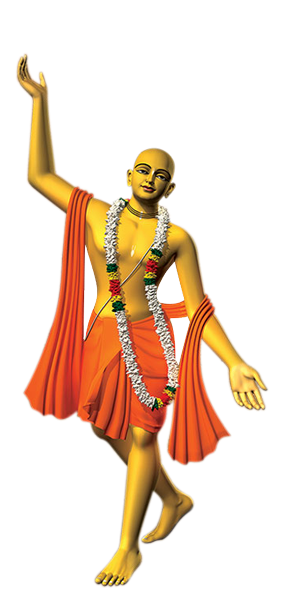 Chaitanya Mahaprabhu - The Avatar of VishnuChaitanya Mahaprabhu, revered as an incarnation of Lord Krishna, is one of the most significant spiritual figures in...Read more
 -
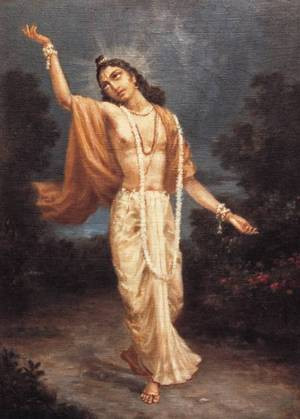 Was chaitanya mahaprabhu married?Chaitanya Mahaprabhu was married twice in his early life before he renounced the world to embrace the path of...Read more
 -
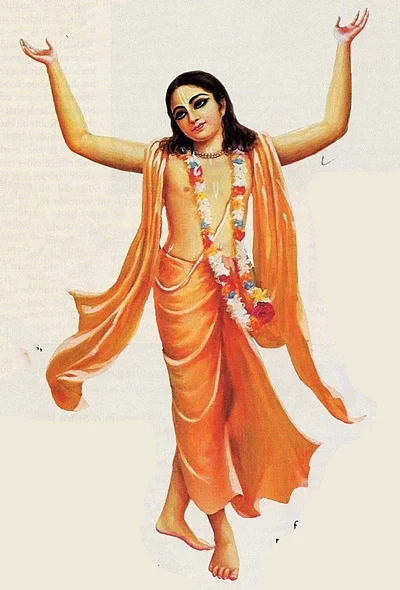 Why did chaitanya mahaprabhu appear?Chaitanya Mahaprabhu, considered by his followers as an incarnation of Lord Krishna, appeared on earth to revive and...Read more
 -
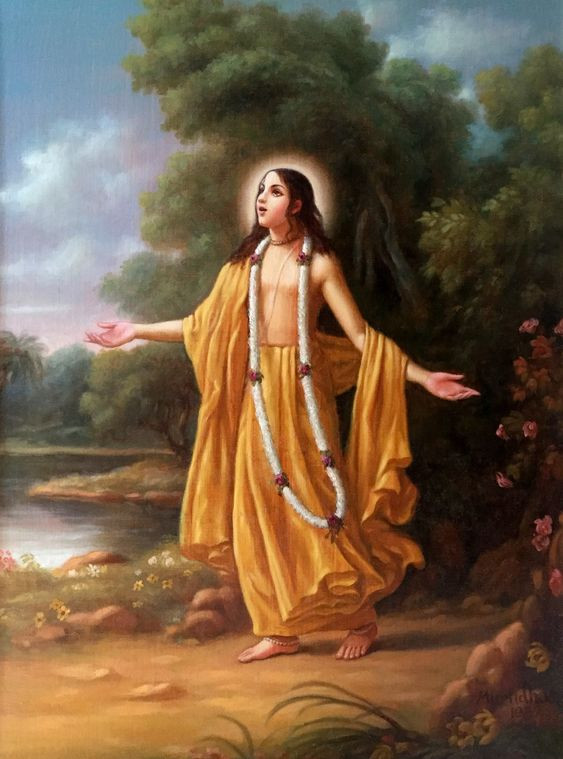 Who was chaitanya mahaprabhu wife?Chaitanya Mahaprabhu, one of the most revered spiritual leaders and mystics of India, was married twice in his early...Read more
Leave a comment