
Why did Krishna run to embrace a poor brahmin in rags? Read the Sudama story from the Bhagavatam and learn how a...
Latest posts
-
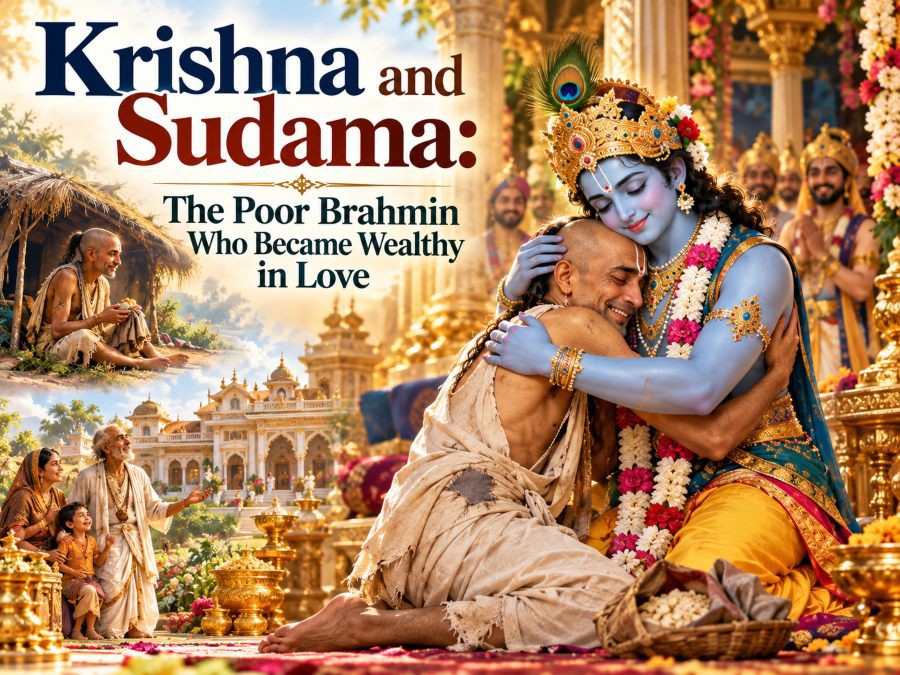 Krishna and Sudama: The Poor Brahmin Who Became Wealthy in LoveRead more
 -
 Vamana Avatar: How Three Steps Humbled Bali MaharajaRead more
Why did a powerful king give away three worlds to a boy asking for three steps? Learn the Vamana avatar story from...
-
 The Bhagavatam on Marriage: Duty, Love and Spiritual PartnershipRead more
What does the Bhagavatam say about marriage? Through the stories of Kardama and Devahuti, Rukmini's secret letter and...
-
 What Is Prema? The Bhagavatam's Highest Stage of Love for GodRead more
Prema is love for God with no "because" attached. Learn how the Bhagavatam describes it, the nine steps from faith to...
-
 Is Shiva Parvati Kalyana Mentioned in Srimad Bhagavatam? What the Scripture Really SaysRead more
Looking for Shiva and Parvati's wedding in the Srimad Bhagavatam? Find out what the scripture actually describes,...
-
 How Many Modes of Devotion Are Mentioned in Bhagavatam?Read more
A young boy named Prahlada listed nine ways to serve God, and the Bhagavatam keeps them as its answer. Learn what the...
-
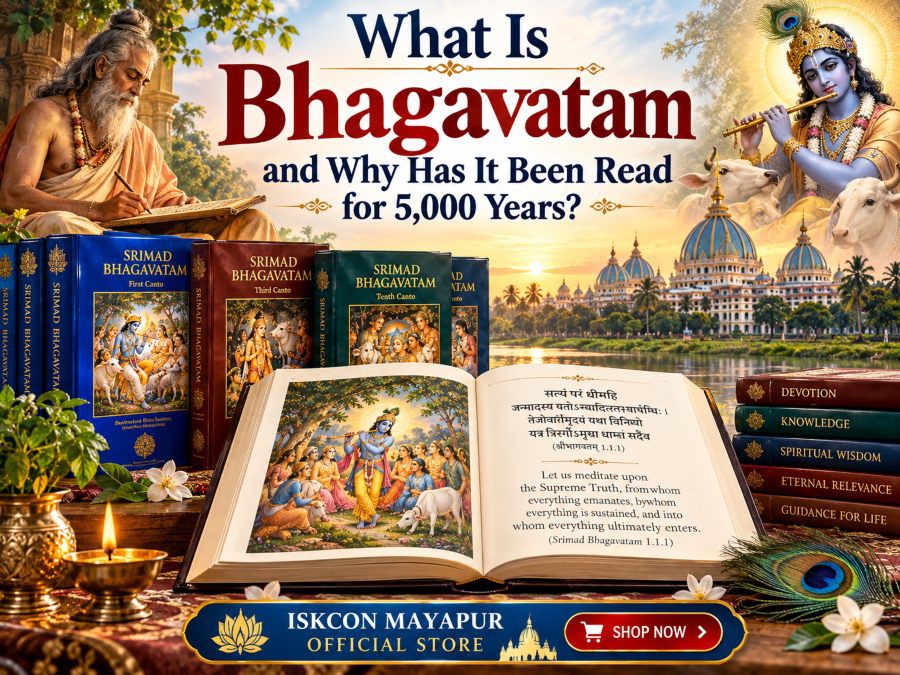 What Is Bhagavatam and Why Has It Been Read for 5,000 Years?Read more
A dying king asked one question, and the answer became the Bhagavatam. Learn what this Sanskrit scripture contains,...
-
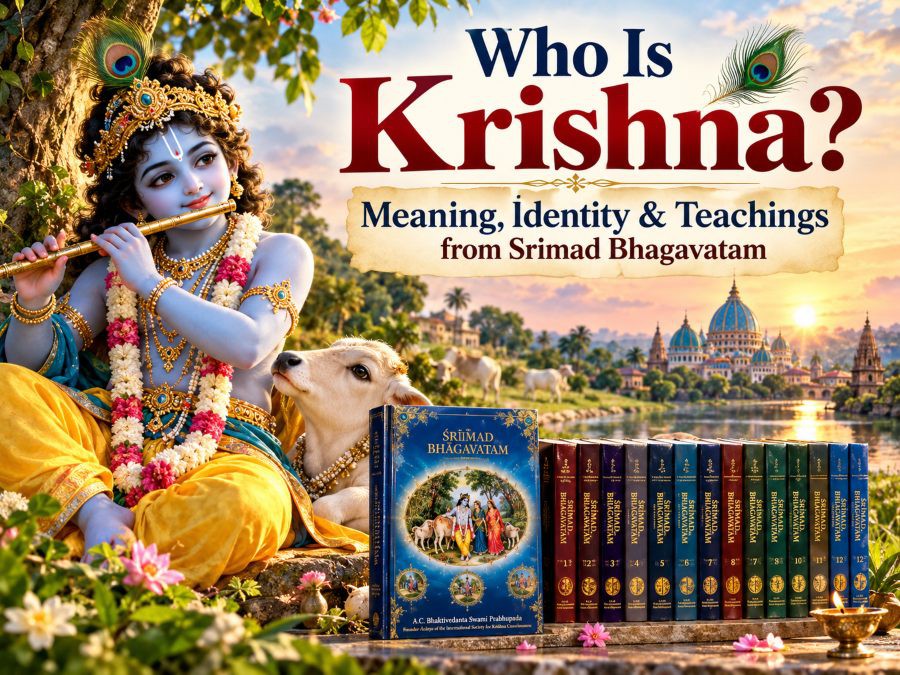 Who Is Lord Krishna? His Meaning, Teachings and Pastimes ExplainedRead more
Discover who Krishna is according to Srimad Bhagavatam, including His divine identity, childhood pastimes, teachings,...
-
 Incense in Islam: Bakhoor, Agarbatti and What Tradition SaysRead more
Is burning fragrance part of Muslim tradition? Explore incense in Islam, from the Prophetic practice of fumigating...
-
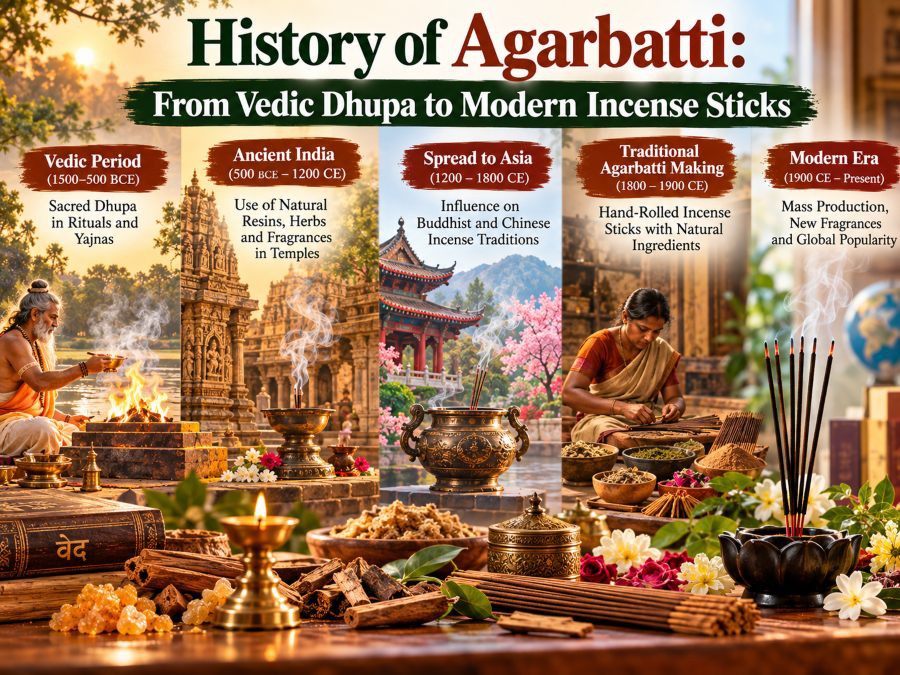 History of Agarbatti: From Vedic Dhupa to Modern Incense SticksRead more
Where did agarbatti really come from? Follow the history of agarbatti from Vedic fire rituals and temple dhupa to...
Blog categories
- Default category (0)
- MUSICAL INSTRUMENT (1)
- BOOK (5)
- DEVOTIONAL GIFT (0)
- Blog (30) click
- CHANDAN (12)
- Bhagavatam Wisdom Series (68)
- Krishna Consciousness (14)
- Mridangam Musical Instrument (6)
- Bhagavad Gita for Beginners (13)
- Bhagavad Gita As It Is (37) click
- Bhagavad Gita As It Is Telugu (0)
- Bhagavad Gita As It Is Marathi (0)
- Bhagavad Gita As It Is In Hindi (0)
- Bhagavad Gita As It Is In English (0)
- Bhagavad Gita As It Is In Bengali (8)
- Bhagavad Gita As It Is In Kannada (0)
- Bhagavad Gita As It Is In Gujarati (0)
- Bhagavad Gita As It Is In Panjabi (0)
- Bhagavad Gita As It Is In Tamil (0)
- Bhagavad Gita As It Is Odia (0)
- BHAGAVAD GITA As It Is GERMAN (0)
- Bhagavad Gita As It Is In French (0)
- Bhagavad Gita As It Is In Nepali (0)
- Bhagavad Gita As It Is In Assamese (0)
- Incense or Agarbatti (38)
- Lord Chaitanya Mahaprabhu (3)
- Vedic Temple Mayapur (14)
- kalki (15)
- Mahabharata – Dharma & Destiny (27)
- Vaishnava Scriptures (4)
- healthy product (4)
- chaitanya mahaprabhu (5)
- Tulsi Mala Guide (17)
Search in blog
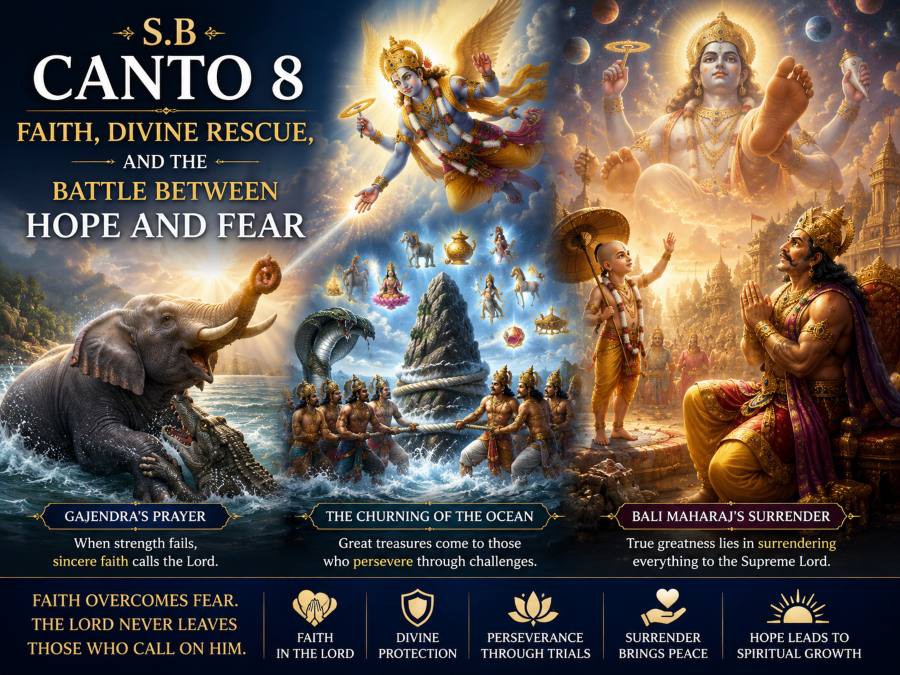
Srimad Bhagavatam Canto 8: How Faith Triumphs Over Fear
S.B Canto 8 — Faith, Divine Rescue, and the Battle Between Hope and Fear
Picture this.
You are struggling with a problem that seems impossible to solve. You try intelligence, strength, planning, and determination. Nothing works. Every option closes. Every solution disappears. The future suddenly feels uncertain.
What remains when all external support fails?
That question sits at the heart of Srimad Bhagavatam Canto 8.
This canto is filled with dramatic events, divine interventions, cosmic conflicts, and unforgettable personalities. Yet beneath the extraordinary stories lies a deeply human theme: the constant battle between hope and fear.
Every person experiences this battle.
Hope says there is a way forward.
Fear says there is not.
Hope trusts.
Fear doubts.
Hope sees possibilities.
Fear sees obstacles.
The teachings of Srimad Bhagavatam reveal that true faith is not blind optimism. It is the confidence that divine guidance exists even when circumstances appear overwhelming.
For readers interested in studying these timeless lessons in greater depth, the ISKCON Mayapur Bhagavatam collection provides authentic access to one of the world's most respected spiritual texts.
Compiled by Vyasadeva and shared globally through the efforts of A. C. Bhaktivedanta Swami Prabhupada and ISKCON, the Srimad Bhagavatam continues to inspire readers seeking wisdom, resilience, and spiritual clarity.
Why Canto 8 Feels Surprisingly Personal
At first glance, Canto 8 appears filled with stories far removed from modern life.
There are celestial beings, cosmic oceans, divine incarnations, and supernatural events.
Yet the emotional realities within these stories remain remarkably familiar.
People still face:
- Uncertainty
- Loss
- Failure
- Fear
- Hope
- Trust
- Desperation
- Renewal
The characters in Canto 8 encounter these same experiences on a grand scale.
That is why their stories continue to resonate.
The external details may differ from modern life, but the inner struggles remain the same.
Gajendra's Cry: When Strength Is No Longer Enough
One of the most beloved narratives in Canto 8 is the story of Gajendra, the king of elephants.
At the beginning of the story, Gajendra appears powerful.
He possesses physical strength.
He possesses influence.
He possesses confidence.
He seems unstoppable.
Then everything changes.
While enjoying himself near a beautiful lake, Gajendra is attacked by a crocodile.
At first, he fights with tremendous determination.
His strength appears superior.
Victory seems inevitable.
Yet the battle continues.
Hours pass.
Then days.
Then years.
Gradually, the situation reverses.
The crocodile becomes stronger.
Gajendra becomes weaker.
This detail contains an important lesson.
Many problems cannot be solved through strength alone.
People often assume that determination will overcome every obstacle.
Sometimes it does.
Sometimes it doesn't.
There are moments in life when effort alone is not enough.
Gajendra eventually reached that realization.
The Turning Point Nobody Expects
The most important moment in Gajendra's story occurs when he stops relying exclusively on his own power.
This does not mean he becomes passive.
It means he becomes aware.
He recognizes his limitations.
He understands that material strength has boundaries.
In that moment, he turns toward the Supreme Lord.
His prayer emerges not from convenience but from genuine surrender.
This distinction matters.
Many people remember spirituality only when difficulties appear.
Gajendra's prayer was different.
It came from deep realization.
He understood that lasting security cannot be found solely in temporary resources.
That understanding transformed his consciousness.
And it changed his destiny.
Why Gajendra's Prayer Still Inspires Readers
The prayer of Gajendra remains one of the most celebrated sections of the Srimad Bhagavatam.
Its beauty lies in its honesty.
There is no arrogance.
No demand.
No negotiation.
Only sincere dependence on divine mercy.
Readers connect with this prayer because everyone eventually encounters situations beyond personal control.
A health crisis.
A financial challenge.
A relationship breakdown.
A painful loss.
A period of uncertainty.
These experiences often force people to confront questions they previously ignored.
What truly provides security?
What remains when external support disappears?
Where can lasting shelter be found?
Gajendra's prayer addresses these questions with remarkable depth.
Divine Rescue Arrives
When Gajendra calls out with sincerity, the Supreme Lord responds.
The rescue does not occur because Gajendra is physically strong.
It does not occur because of social status.
It does not occur because of worldly achievement.
It occurs because of faith.
This is one of the most comforting teachings in Canto 8.
The Lord responds to sincere devotion.
The story reminds readers that divine compassion is not limited by material circumstances.
The external situation may appear hopeless.
The internal connection with the Divine can still remain strong.
This lesson has encouraged spiritual seekers for centuries.
The Churning of the Ocean: A Story About Life Itself
Another major section of Canto 8 describes the famous churning of the Milk Ocean.
At first, it appears to be a story about celestial beings searching for nectar.
The symbolism runs much deeper.
The devas and asuras work together to churn the ocean in search of immortality.
As the process unfolds, many unexpected things emerge.
Treasures appear.
Difficulties appear.
Opportunities appear.
Danger appears.
This resembles life itself.
People often pursue a worthy goal expecting a straightforward path.
Reality rarely works that way.
Growth usually involves:
- Challenges
- Delays
- Unexpected obstacles
- Surprising opportunities
- Difficult lessons
The churning of the ocean reminds readers that valuable outcomes often require patience and perseverance.
Not everything meaningful arrives immediately.
When Poison Appears Before Nectar
One of the most fascinating details in the churning narrative is that poison emerges before nectar.
Think about that.
The participants sought something wonderful.
The first major result was dangerous.
This pattern appears repeatedly in life.
People begin personal growth and encounter discomfort.
They start spiritual practice and face old habits.
They pursue meaningful goals and experience setbacks.
Many abandon the process too early because they mistake temporary difficulty for failure.
Canto 8 teaches a different perspective.
Sometimes poison appears before nectar.
Temporary struggle does not necessarily indicate that the journey is wrong.
It may simply be part of transformation.
The Hidden Battle Between Hope and Fear
Every major story in Canto 8 contains the same underlying theme.
Hope and fear exist side by side.
Gajendra faced fear.
Faith created hope.
The devas faced fear.
Trust created hope.
The participants in the cosmic churning faced uncertainty.
Perseverance created hope.
This pattern continues today.
Fear focuses on what might go wrong.
Faith focuses on what remains possible.
Fear narrows vision.
Faith expands it.
The Srimad Bhagavatam does not teach readers to ignore difficulties.
It teaches them to face difficulties without surrendering hope.
That distinction changes everything.
The Unexpected Hero: Why King Bali Still Inspires Millions
Among all the personalities in Srimad Bhagavatam Canto 8, King Bali stands out as one of the most fascinating.
At first glance, this may seem surprising.
After all, Bali belonged to the side traditionally considered opposed to the devas.
Yet the Srimad Bhagavatam does not present spirituality through simplistic labels.
Instead, it examines character.
And Bali's character shines brilliantly.
He was courageous.
He was generous.
He was determined.
Most importantly, he was willing to sacrifice everything for truth.
This willingness transformed him from a powerful ruler into one of the greatest examples of devotion.
When the Supreme Lord Appeared as a Dwarf
The story takes a dramatic turn when Lord Krishna appears as Vamana Deva, a dwarf brahmana.
King Bali was performing a magnificent sacrifice.
His influence had expanded throughout the universe.
His success seemed unstoppable.
Then a small brahmana boy arrived.
No army.
No weapons.
No visible power.
Only a simple request.
Vamana asked for three steps of land.
The request sounded insignificant.
Bali immediately agreed.
His spiritual teacher, however, recognized something unusual.
He warned Bali.
This was no ordinary visitor.
The dwarf brahmana was the Supreme Lord Himself.
Granting the request would cost Bali everything.
At that moment, Bali faced a decision.
Protect his possessions.
Or honor his word.
He chose integrity.
Why Bali's Decision Was So Extraordinary
Most people imagine sacrifice as giving away something they do not need.
Real sacrifice is different.
Real sacrifice involves giving up something valuable.
Bali knew the consequences.
He understood that accepting Vamana's request would result in losing wealth, influence, status, and power.
Yet he remained committed.
This is one reason spiritual teachers throughout history have praised King Bali.
His devotion was tested under pressure.
And it remained intact.
The Srimad Bhagavatam repeatedly emphasizes that genuine character becomes visible during difficult moments.
Anyone can appear virtuous when circumstances are favorable.
Challenges reveal what truly exists within the heart.
Bali passed that test magnificently.
When Three Steps Became the Entire Universe
After Bali granted the request, Vamana expanded into a universal form.
With one step, He covered the earth.
With another step, He covered the heavens.
Nothing remained.
The Lord then asked a question.
Where would the third step go?
Bali had nothing left.
No land.
No kingdom.
No possessions.
Only himself.
His answer revealed the depth of his realization.
He offered his own head.
This moment represents one of the most powerful examples of surrender found anywhere in the Srimad Bhagavatam.
True devotion is not merely offering objects.
It is offering oneself.
Faith Is Not Blind Belief
Modern discussions often misunderstand faith.
Some people assume faith means ignoring evidence or abandoning reason.
The teachings of Canto 8 present something different.
Faith is trust based on spiritual understanding.
Faith does not eliminate intelligence.
It directs intelligence toward a higher purpose.
Consider Gajendra.
His faith emerged after exhausting material solutions.
Consider Bali.
His faith emerged after recognizing the value of truth above temporary success.
Neither acted irrationally.
Both acted from spiritual clarity.
This distinction matters because authentic faith strengthens wisdom rather than replacing it.
Hope That Survives Difficulty
One reason Srimad Bhagavatam continues to inspire readers is its realistic portrayal of struggle.
The scripture does not promise a life without challenges.
Its heroes face enormous obstacles.
Gajendra suffered.
The devas struggled.
King Bali sacrificed everything.
Yet hope remained alive.
Why?
Because their confidence was rooted in something deeper than changing circumstances.
Modern culture often connects hope with favorable outcomes.
The Bhagavatam presents a richer understanding.
Hope is the confidence that spiritual growth remains possible regardless of external conditions.
That kind of hope survives disappointment.
It survives uncertainty.
It survives adversity.
The Difference Between Material Security and Divine Protection
One of the most important lessons in Canto 8 concerns security.
People naturally seek protection.
They seek it through:
· Wealth
· Career success
· Social connections
· Physical strength
· Reputation
These things can provide temporary benefits.
The stories in Canto 8 reveal their limitations.
Gajendra's strength could not save him.
The devas' position could not guarantee success.
Bali's kingdom could not remain permanent.
Material security has value, but it is never absolute.
Divine protection operates differently.
It focuses on the eternal well-being of the soul.
Sometimes that protection appears through rescue.
Sometimes it appears through guidance.
Sometimes it appears through transformation.
The Bhagavatam encourages readers to seek both practical responsibility and spiritual dependence.
Why Canto 8 Speaks So Clearly to Modern Life
Although these events occurred in a different age, their lessons remain remarkably relevant.
People still experience moments when they feel trapped like Gajendra.
People still struggle with uncertainty like the devas.
People still face difficult choices like Bali.
The details change.
The underlying challenges remain.
This is why the teachings continue to resonate.
They address universal aspects of human experience.
Fear.
Hope.
Trust.
Courage.
Surrender.
Growth.
These themes never become outdated.
Five Timeless Lessons From Srimad Bhagavatam Canto 8
1. Strength Alone Is Not Enough
Personal effort matters.
Yet some challenges require spiritual wisdom in addition to determination.
2. Difficulties Can Lead to Growth
The appearance of poison before nectar reminds readers that temporary obstacles do not define the final outcome.
3. Faith Deepens During Testing
Faith becomes meaningful when circumstances challenge it.
4. Integrity Is More Valuable Than Possessions
King Bali demonstrated that character often matters more than comfort.
5. Divine Help Is Always Available
Gajendra's rescue reminds readers that sincere prayer never goes unheard.
The Lasting Message of Hope
At its heart, Srimad Bhagavatam Canto 8 is a canto about hope.
Not superficial optimism.
Not wishful thinking.
Real hope.
The kind that survives uncertainty.
The kind that remains steady during difficulty.
The kind that emerges from trust in the Supreme Lord.
Through the stories of Gajendra, the churning of the ocean, and King Bali Maharaj, readers encounter a profound spiritual truth:
Fear may be powerful.
But faith is stronger.
Challenges may appear overwhelming.
But divine guidance remains available.
Circumstances may change unexpectedly.
But spiritual wisdom continues to provide direction.
This message explains why Canto 8 remains one of the most beloved sections of the Srimad Bhagavatam. Compiled by Vyasadeva, shared through the teachings of A. C. Bhaktivedanta Swami Prabhupada, and distributed worldwide by ISKCON, these timeless narratives continue to encourage readers to choose hope over fear, faith over doubt, and devotion over despair.
That choice has transformed lives for centuries.
And it continues to do so today.
Posted in: Bhagavatam Wisdom Series
Related posts
-
 Why to read srimad bhagavatamReading the Srimad Bhagavatam fosters deep spiritual growth by narrating the life and teachings of Lord Krishna,...Read more
 -
 When was srimad bhagavatam written?The Srimad Bhagavatam is believed to have been written around 9th-10th century CE, though its oral traditions date...Read more
 -
 How many chapters are there in srimad bhagavatam?The Srimad Bhagavatam consists of 12 cantos (books) containing 335 chapters in total. Each canto covers various...Read more
 -
 How many skandhas are there in srimad bhagavatamThe Srimad Bhagavatam is divided into 12 skandhas (cantos or books). Each skandha explores different themes,...Read more
 -
 How many slokas in srimad bhagavatamThe Srimad Bhagavatam contains approximately 18,000 shlokas (verses). These verses are spread across its 12 skandhas...Read more
Leave a comment