
Why did Krishna run to embrace a poor brahmin in rags? Read the Sudama story from the Bhagavatam and learn how a...
Latest posts
-
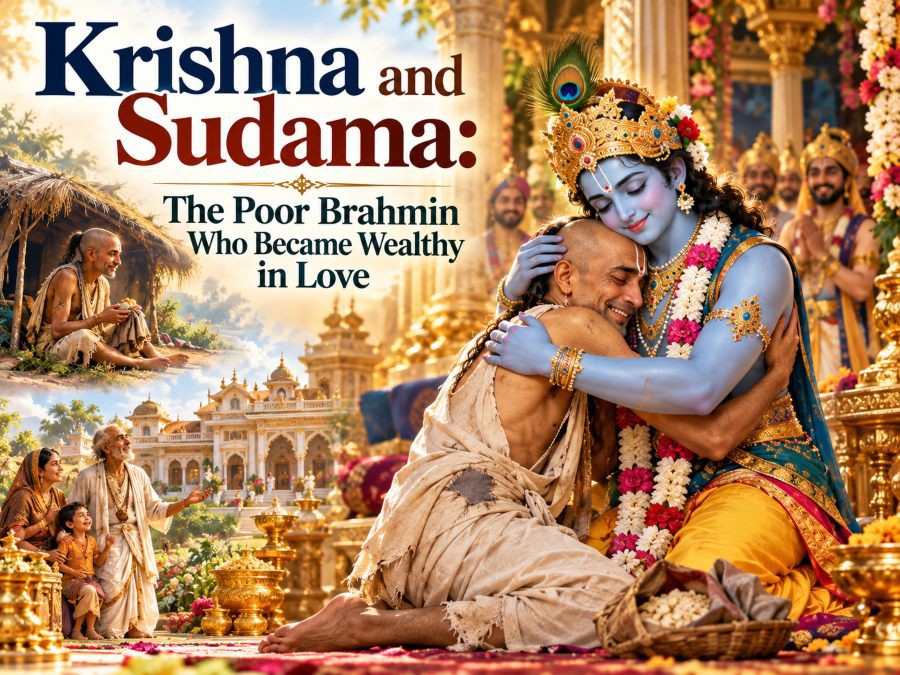 Krishna and Sudama: The Poor Brahmin Who Became Wealthy in LoveRead more
 -
 Vamana Avatar: How Three Steps Humbled Bali MaharajaRead more
Why did a powerful king give away three worlds to a boy asking for three steps? Learn the Vamana avatar story from...
-
 The Bhagavatam on Marriage: Duty, Love and Spiritual PartnershipRead more
What does the Bhagavatam say about marriage? Through the stories of Kardama and Devahuti, Rukmini's secret letter and...
-
 What Is Prema? The Bhagavatam's Highest Stage of Love for GodRead more
Prema is love for God with no "because" attached. Learn how the Bhagavatam describes it, the nine steps from faith to...
-
 Is Shiva Parvati Kalyana Mentioned in Srimad Bhagavatam? What the Scripture Really SaysRead more
Looking for Shiva and Parvati's wedding in the Srimad Bhagavatam? Find out what the scripture actually describes,...
-
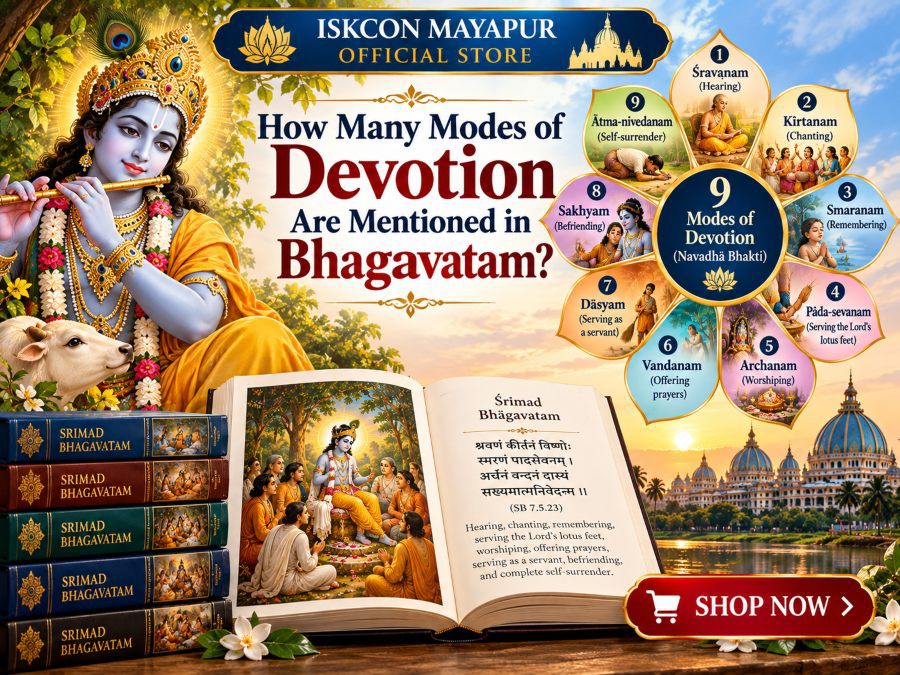 How Many Modes of Devotion Are Mentioned in Bhagavatam?Read more
A young boy named Prahlada listed nine ways to serve God, and the Bhagavatam keeps them as its answer. Learn what the...
-
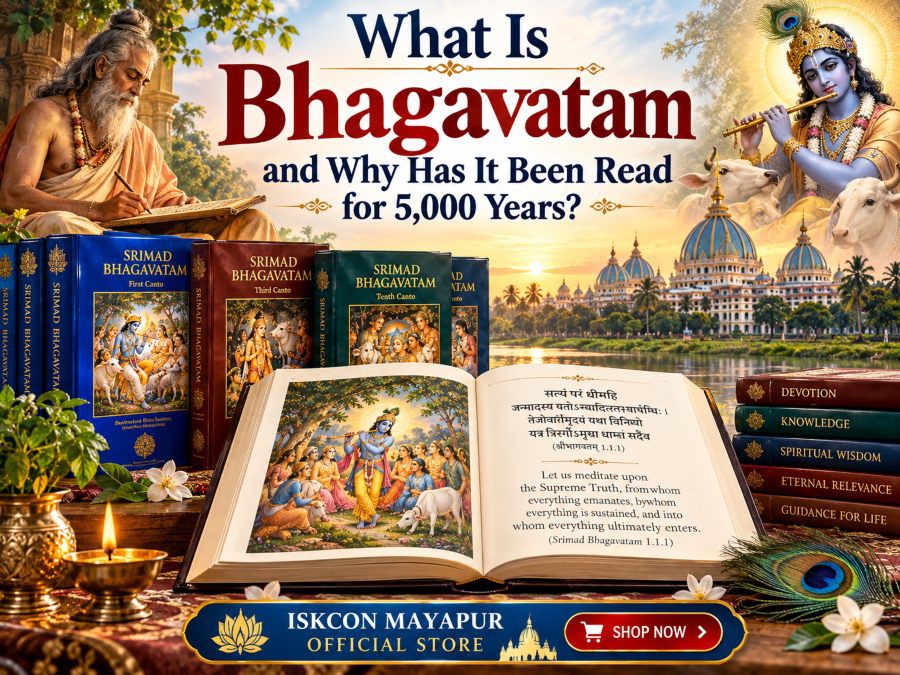 What Is Bhagavatam and Why Has It Been Read for 5,000 Years?Read more
A dying king asked one question, and the answer became the Bhagavatam. Learn what this Sanskrit scripture contains,...
-
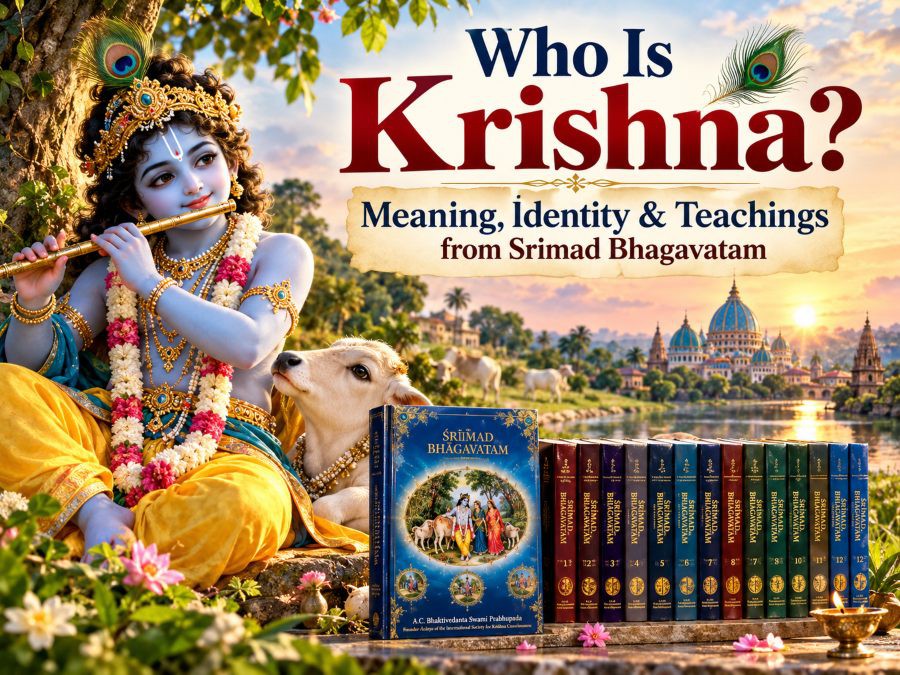 Who Is Lord Krishna? His Meaning, Teachings and Pastimes ExplainedRead more
Discover who Krishna is according to Srimad Bhagavatam, including His divine identity, childhood pastimes, teachings,...
-
 Incense in Islam: Bakhoor, Agarbatti and What Tradition SaysRead more
Is burning fragrance part of Muslim tradition? Explore incense in Islam, from the Prophetic practice of fumigating...
-
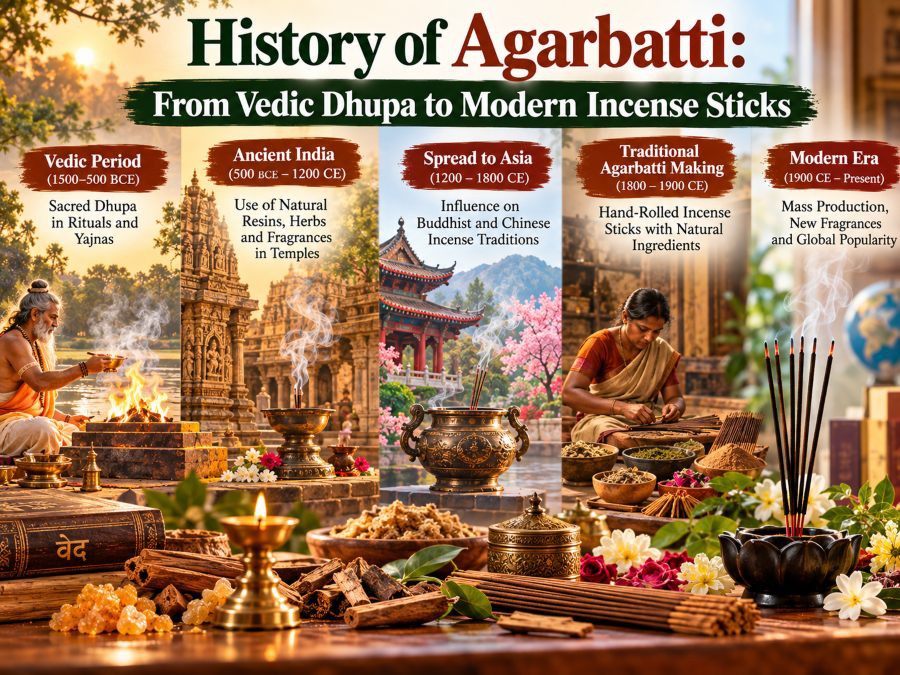 History of Agarbatti: From Vedic Dhupa to Modern Incense SticksRead more
Where did agarbatti really come from? Follow the history of agarbatti from Vedic fire rituals and temple dhupa to...
Blog categories
- Default category (0)
- MUSICAL INSTRUMENT (1)
- BOOK (5)
- DEVOTIONAL GIFT (0)
- Blog (30) click
- CHANDAN (12)
- Bhagavatam Wisdom Series (68)
- Krishna Consciousness (14)
- Mridangam Musical Instrument (6)
- Bhagavad Gita for Beginners (13)
- Bhagavad Gita As It Is (37) click
- Bhagavad Gita As It Is Telugu (0)
- Bhagavad Gita As It Is Marathi (0)
- Bhagavad Gita As It Is In Hindi (0)
- Bhagavad Gita As It Is In English (0)
- Bhagavad Gita As It Is In Bengali (8)
- Bhagavad Gita As It Is In Kannada (0)
- Bhagavad Gita As It Is In Gujarati (0)
- Bhagavad Gita As It Is In Panjabi (0)
- Bhagavad Gita As It Is In Tamil (0)
- Bhagavad Gita As It Is Odia (0)
- BHAGAVAD GITA As It Is GERMAN (0)
- Bhagavad Gita As It Is In French (0)
- Bhagavad Gita As It Is In Nepali (0)
- Bhagavad Gita As It Is In Assamese (0)
- Incense or Agarbatti (38)
- Lord Chaitanya Mahaprabhu (3)
- Vedic Temple Mayapur (14)
- kalki (15)
- Mahabharata – Dharma & Destiny (27)
- Vaishnava Scriptures (4)
- healthy product (4)
- chaitanya mahaprabhu (5)
- Tulsi Mala Guide (17)
Search in blog
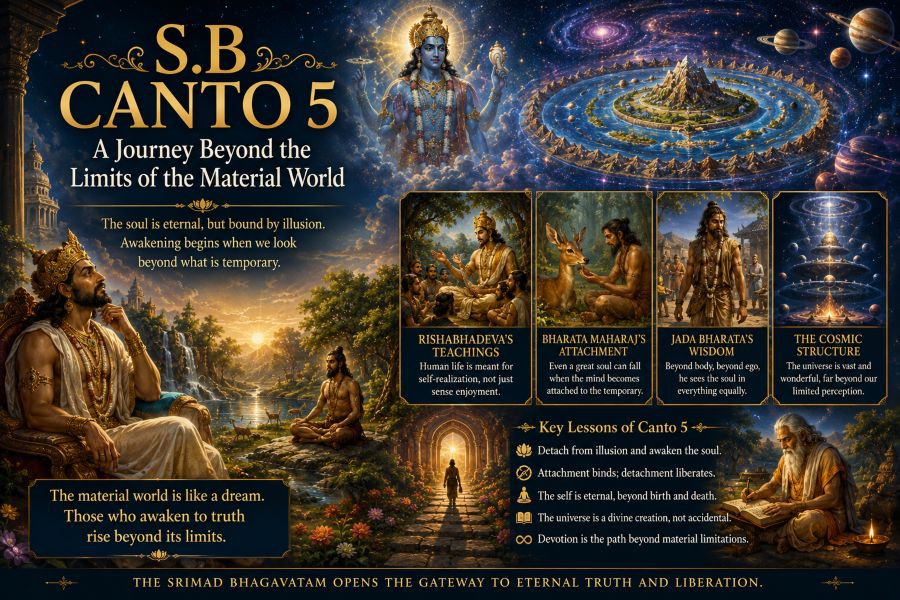
Srimad Bhagavatam Canto 5: A Journey Beyond the Limits of the Material World
S.B Canto 5 — A Journey Beyond the Limits of the Material World
Imagine standing beneath a sky filled with billions of stars and suddenly realizing something unsettling:
Human beings know how to measure distant galaxies, yet many still do not understand their own consciousness.
That contradiction sits at the heart of modern existence.
People can map planets, decode genetics, build artificial intelligence, and explore space — but internally remain confused, anxious, restless, and spiritually disconnected. The fifth canto of the Srimad Bhagavatam enters directly into that tension between material exploration and spiritual blindness.
Readers discovering authentic editions through the Mayapur Store often find Canto 5 unlike anything they expected. It is cosmic, philosophical, symbolic, psychological, and deeply spiritual all at once. This canto speaks about kings, renunciation, consciousness, the structure of the universe, hellish conditions, illusion, attachment, and the soul’s desperate need to rise beyond material limitations.
But beneath all the cosmic descriptions lies one essential message:
Human life was never meant to remain trapped in material consciousness alone.
And that realization changes how existence itself feels.
.jpg)
Why Human Beings Keep Searching Beyond the Visible World
There is something fascinating about humanity.
Even after satisfying basic survival needs, people continue searching for something larger:
- meaning
- transcendence
- truth
- permanence
- connection with the infinite
Why?
The Srimad Bhagavatam answers boldly:
because the soul itself is not material.
Canto 5 repeatedly reminds readers that human dissatisfaction cannot be fully solved through external accumulation alone. The soul instinctively seeks something beyond temporary experience.
That longing explains:
- spiritual curiosity
- fascination with the cosmos
- existential questioning
- the hunger for purpose
People are not merely trying to survive. They are trying to understand existence itself.
King Rishabhadeva and the Rejection of Empty Materialism
One of the most powerful figures in Canto 5 is Lord Rishabhadeva.
His teachings strike with unusual force because they expose a painful truth:
human life becomes wasted when consciousness remains absorbed only in animalistic pursuits.
This is a shocking statement initially, but the Bhagavatam explains it carefully.
Animals also:
- eat
- sleep
- mate
- defend
If human civilization becomes entirely centered around these same activities — only with more sophistication and technology — then spiritual potential remains unused.
Rishabhadeva challenges humanity to rise higher.
Not through artificial superiority.
Through awakened consciousness.
He explains that human life is meant for:
- self-realization
- purification
- spiritual inquiry
- devotion
- liberation from ignorance
That message feels incredibly relevant today because modern culture often mistakes stimulation for fulfillment.
Why Comfort Alone Cannot Create Meaning
Canto 5 repeatedly exposes one modern illusion:
“If life becomes comfortable enough, happiness will naturally follow.”
Yet many materially comfortable societies still experience:
- depression
- addiction
- loneliness
- anxiety
- emotional emptiness
Why?
The Srimad Bhagavatam explains that comfort can reduce certain forms of suffering, but it cannot automatically satisfy the soul’s deeper spiritual hunger.
This distinction matters enormously.
The soul seeks:
- transcendence
- eternal connection
- spiritual truth
- divine remembrance
Without these deeper dimensions, material life often begins feeling repetitive and emotionally hollow no matter how advanced civilization becomes.
Bharata Maharaj and the Danger of Misplaced Attachment
Few stories in the Bhagavatam are as psychologically sophisticated as Bharata Maharaj’s journey.
Bharata renounces enormous worldly power for spiritual realization. Yet later, he develops deep attachment to a deer.
At first glance, this story surprises many readers.
How can a spiritually advanced person become distracted so unexpectedly?
That question is exactly why the story matters.
The Bhagavatam understands something deeply human:
attachment can redirect consciousness gradually and subtly.
Not always through dramatic sin.
Sometimes through emotional absorption itself.
Bharata’s story becomes emotionally powerful because it reveals how even sincere spiritual seekers must remain careful about where consciousness becomes anchored.
Why the Mind Easily Forgets Spiritual Purpose
Canto 5 repeatedly shows how fragile human focus can become.
The mind constantly moves outward toward:
- distraction
- emotional attachment
- fear
- pleasure
- identity obsession
- temporary concerns
Modern life intensifies this dramatically.
Attention is constantly under attack:
- endless scrolling
- notifications
- advertising
- comparison culture
- digital stimulation
The Bhagavatam recognized long ago that uncontrolled consciousness naturally drifts toward material absorption unless intentionally guided toward higher awareness.
This is why spiritual discipline appears repeatedly throughout the canto.
Not as punishment.
As protection.
Jada Bharata and the Wisdom Hidden Behind Silence
After Bharata’s rebirth, he appears as Jada Bharata — externally strange, silent, detached, and misunderstood by society.
This part of Canto 5 feels incredibly profound psychologically.
Modern society often judges intelligence through:
- social performance
- charisma
- status
- external behavior
But Jada Bharata possesses deep spiritual realization beneath his unusual appearance.
The Bhagavatam quietly asks readers:
How often do humans completely misunderstand genuine wisdom because they are obsessed with surfaces?
That question feels uncomfortable because it remains true.
People often worship appearance while ignoring consciousness itself.
King Rahugana Learns the Hard Truth About Ego
One of the greatest conversations in Canto 5 occurs between Jada Bharata and King Rahugana.
Initially, Rahugana sees himself as powerful and superior. But Jada Bharata dismantles that illusion completely through spiritual wisdom.
This interaction reveals one of the canto’s deepest teachings:
Material identity is temporary performance.
The king believes:
“I am ruler.”
But the Bhagavatam asks:
Who is the “I” beneath the role itself?
This question becomes spiritually explosive.
Without deeper self-understanding, humans become trapped inside temporary labels:
- profession
- wealth
- social identity
- appearance
- political status
Canto 5 repeatedly pulls consciousness beyond these external definitions.
The Universe in Canto 5 Is More Than Astronomy
One reason Canto 5 fascinates readers endlessly is its detailed description of cosmic structure.
Planets.
Mountains.
Oceans.
Universal systems.
Celestial realms.
Some approach these descriptions symbolically. Others approach them cosmologically. But emotionally and spiritually, the deeper purpose becomes clear:
the Bhagavatam is expanding human vision beyond ordinary material thinking.
Most people live psychologically trapped within tiny personal concerns:
- reputation
- money
- social comparison
- daily stress
- temporary ambition
Canto 5 breaks that narrowness completely.
It forces readers to confront immensity.
And once consciousness encounters cosmic perspective, ordinary ego obsession begins looking smaller.
Why Humanity Feels Spiritually Trapped
A recurring emotional theme in Canto 5 is bondage.
Not physical chains.
Mental and spiritual bondage.
The Bhagavatam describes how people become trapped by:
- uncontrolled desire
- false identity
- attachment
- greed
- sensory obsession
- ignorance
And the frightening part?
Most people normalize these conditions completely.
Modern culture often treats endless consumption and distraction as ordinary life rather than spiritual imprisonment.
Canto 5 challenges that assumption aggressively.
Hellish Conditions Are Described Psychologically Too
Toward later sections, Canto 5 describes hellish planetary conditions in vivid detail.
Some readers interpret these literally. Others see symbolic dimensions within them. But regardless of interpretation, one message becomes impossible to miss:
actions shape consciousness and suffering follows ignorance naturally.
Even psychologically, humans create hellish conditions through:
- hatred
- addiction
- greed
- violence
- cruelty
- ego-driven behavior
The Bhagavatam repeatedly warns that consciousness cannot violate spiritual law endlessly without consequence.
This gives human choices enormous seriousness.
Why Material Achievement Feels So Temporary
Canto 5 continuously reminds readers how quickly worldly achievement disappears.
Kings rise and vanish.
Empires collapse.
Bodies age.
Desires change.
Pleasures fade.
This is not pessimism.
It is clarity.
The Bhagavatam repeatedly pushes consciousness toward eternal perspective because attachment to temporary identity creates inevitable anxiety.
Modern culture constantly encourages deeper material identification:
- build image
- protect status
- maximize consumption
- chase validation
Yet beneath all of it remains fear because temporary things cannot provide permanent security.
Canto 5 exposes this directly.
The Soul’s Real Journey Begins Beyond Material Identity
One of the most beautiful truths in Canto 5 is that spiritual life truly begins when humans stop reducing themselves to bodily identity alone.
This realization changes everything:
- suffering
- success
- relationships
- mortality
- purpose
- identity itself
The Bhagavatam explains that consciousness becomes liberated gradually through spiritual remembrance and devotion.
This is not abstract philosophy disconnected from life. It changes emotional experience directly.
A spiritually awakened person begins seeing:
- temporary events differently
- material success differently
- fear differently
- death differently
Perspective transforms consciousness itself.
Why Modern Civilization Still Feels Restless
Despite extraordinary advancement, modern humanity often appears emotionally exhausted.
People consume more yet feel less satisfied.
Communication increases while loneliness spreads.
Entertainment expands while attention weakens.
Canto 5 explains why material progress alone cannot fully nourish spiritual consciousness.
The soul seeks:
- eternal meaning
- transcendental connection
- spiritual truth
- divine remembrance
Without these dimensions, external advancement eventually feels emotionally incomplete.
The Bhagavatam recognized this long before modern civilization emerged.
The Forest Represents Freedom From Illusion
Throughout Canto 5, forests and renunciation appear repeatedly.
This symbolism matters psychologically.
Forests represent stepping away from:
- noise
- social performance
- distraction
- ego competition
- endless material stimulation
Modern humans rarely experience mental stillness anymore. Attention remains constantly fragmented.
The Bhagavatam repeatedly guides characters into solitude because spiritual clarity often becomes visible only when distraction weakens.
Not everyone must abandon society physically. But spiritually, some separation from endless material absorption becomes necessary.
Why Canto 5 Feels So Vast
The fifth canto of the Srimad Bhagavatam feels enormous because it stretches consciousness itself.
It moves from:
- kingship to renunciation
- attachment to liberation
- earthly concerns to cosmic structure
- bodily identity to eternal truth
This vastness is intentional.
The Bhagavatam wants readers to realize that ordinary material perception captures only a tiny fragment of reality.
Human beings are not merely biological organisms trapped inside temporary existence. They are eternal souls journeying through material experience while searching — consciously or unconsciously — for transcendence.
That realization transforms the emotional meaning of life completely.
Beyond the Limits of the Material World
By the end of Canto 5, one truth becomes increasingly clear:
material existence alone cannot fully explain human longing.
People seek more because consciousness itself belongs to something greater than temporary matter.
The Srimad Bhagavatam does not ask readers to hate the world. It asks them to see beyond its limitations.
That distinction changes everything.
The stars become reminders of divine intelligence.
The universe becomes spiritually alive.
Human life gains sacred purpose.
Consciousness becomes eternal rather than accidental.
And suddenly, existence itself begins feeling larger, deeper, and infinitely more meaningful.
That is the extraordinary power of Srimad Bhagavatam Canto 5.
It takes readers beyond the limits of the material world — and quietly reminds the soul that it was never meant to remain imprisoned there forever.
Posted in: Bhagavatam Wisdom Series
Related posts
-
 Why to read srimad bhagavatamReading the Srimad Bhagavatam fosters deep spiritual growth by narrating the life and teachings of Lord Krishna,...Read more
 -
 When was srimad bhagavatam written?The Srimad Bhagavatam is believed to have been written around 9th-10th century CE, though its oral traditions date...Read more
 -
 How many chapters are there in srimad bhagavatam?The Srimad Bhagavatam consists of 12 cantos (books) containing 335 chapters in total. Each canto covers various...Read more
 -
 How many skandhas are there in srimad bhagavatamThe Srimad Bhagavatam is divided into 12 skandhas (cantos or books). Each skandha explores different themes,...Read more
 -
 How many slokas in srimad bhagavatamThe Srimad Bhagavatam contains approximately 18,000 shlokas (verses). These verses are spread across its 12 skandhas...Read more
Leave a comment