
Why did Krishna run to embrace a poor brahmin in rags? Read the Sudama story from the Bhagavatam and learn how a...
Latest posts
-
 Krishna and Sudama: The Poor Brahmin Who Became Wealthy in LoveRead more
 -
 Vamana Avatar: How Three Steps Humbled Bali MaharajaRead more
Why did a powerful king give away three worlds to a boy asking for three steps? Learn the Vamana avatar story from...
-
 The Bhagavatam on Marriage: Duty, Love and Spiritual PartnershipRead more
What does the Bhagavatam say about marriage? Through the stories of Kardama and Devahuti, Rukmini's secret letter and...
-
 What Is Prema? The Bhagavatam's Highest Stage of Love for GodRead more
Prema is love for God with no "because" attached. Learn how the Bhagavatam describes it, the nine steps from faith to...
-
 Is Shiva Parvati Kalyana Mentioned in Srimad Bhagavatam? What the Scripture Really SaysRead more
Looking for Shiva and Parvati's wedding in the Srimad Bhagavatam? Find out what the scripture actually describes,...
-
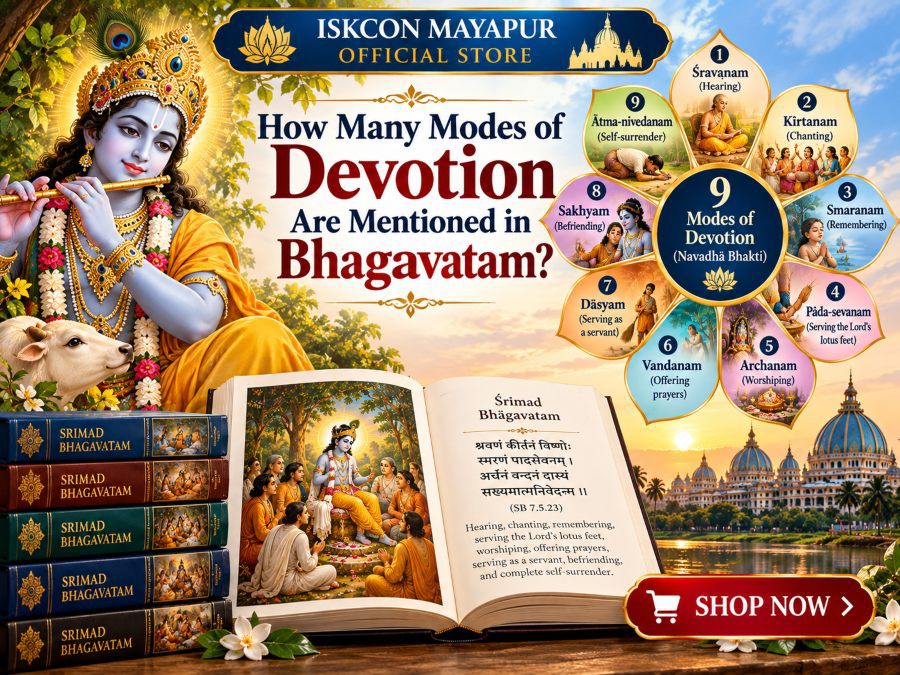 How Many Modes of Devotion Are Mentioned in Bhagavatam?Read more
A young boy named Prahlada listed nine ways to serve God, and the Bhagavatam keeps them as its answer. Learn what the...
-
 What Is Bhagavatam and Why Has It Been Read for 5,000 Years?Read more
A dying king asked one question, and the answer became the Bhagavatam. Learn what this Sanskrit scripture contains,...
-
 Who Is Lord Krishna? His Meaning, Teachings and Pastimes ExplainedRead more
Discover who Krishna is according to Srimad Bhagavatam, including His divine identity, childhood pastimes, teachings,...
-
 Incense in Islam: Bakhoor, Agarbatti and What Tradition SaysRead more
Is burning fragrance part of Muslim tradition? Explore incense in Islam, from the Prophetic practice of fumigating...
-
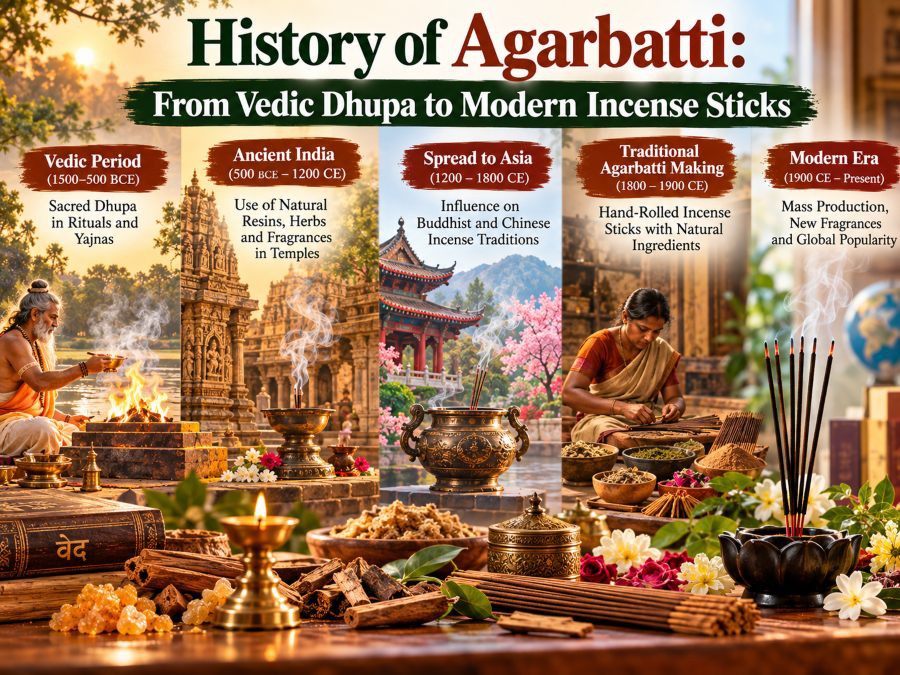 History of Agarbatti: From Vedic Dhupa to Modern Incense SticksRead more
Where did agarbatti really come from? Follow the history of agarbatti from Vedic fire rituals and temple dhupa to...
Blog categories
- Default category (0)
- MUSICAL INSTRUMENT (1)
- BOOK (5)
- DEVOTIONAL GIFT (0)
- Blog (30) click
- CHANDAN (12)
- Bhagavatam Wisdom Series (68)
- Krishna Consciousness (14)
- Mridangam Musical Instrument (6)
- Bhagavad Gita for Beginners (13)
- Bhagavad Gita As It Is (37) click
- Bhagavad Gita As It Is Telugu (0)
- Bhagavad Gita As It Is Marathi (0)
- Bhagavad Gita As It Is In Hindi (0)
- Bhagavad Gita As It Is In English (0)
- Bhagavad Gita As It Is In Bengali (8)
- Bhagavad Gita As It Is In Kannada (0)
- Bhagavad Gita As It Is In Gujarati (0)
- Bhagavad Gita As It Is In Panjabi (0)
- Bhagavad Gita As It Is In Tamil (0)
- Bhagavad Gita As It Is Odia (0)
- BHAGAVAD GITA As It Is GERMAN (0)
- Bhagavad Gita As It Is In French (0)
- Bhagavad Gita As It Is In Nepali (0)
- Bhagavad Gita As It Is In Assamese (0)
- Incense or Agarbatti (38)
- Lord Chaitanya Mahaprabhu (3)
- Vedic Temple Mayapur (14)
- kalki (15)
- Mahabharata – Dharma & Destiny (27)
- Vaishnava Scriptures (4)
- healthy product (4)
- chaitanya mahaprabhu (5)
- Tulsi Mala Guide (17)
Search in blog
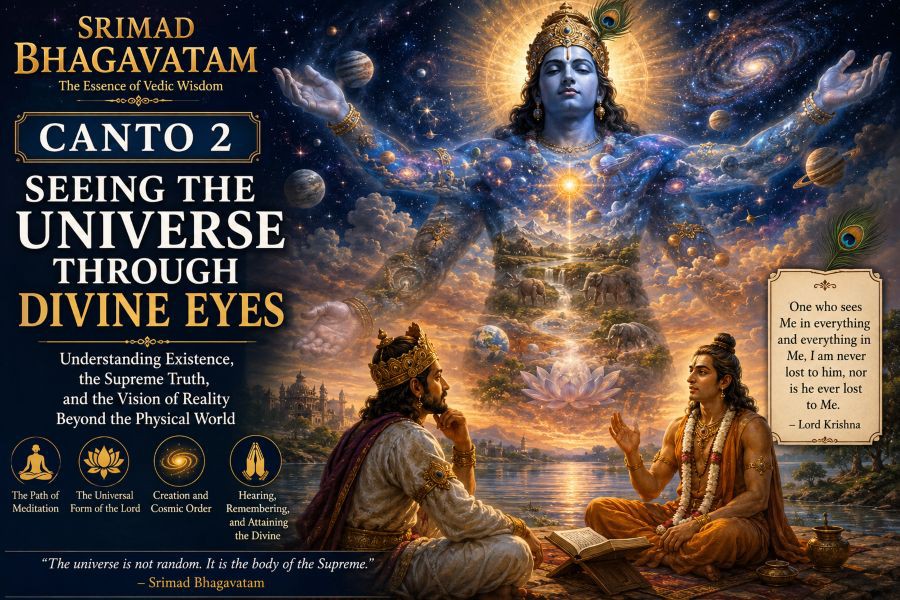
Srimad Bhagavatam Canto 2: Seeing the Universe Through Divine Eyes
S.B Canto 2 — Seeing the Universe Through Divine Eyes
A king is about to die.
Seven days remain before everything he owns, controls, remembers, and identifies with disappears forever. No palace can stop it. No army can fight it. No wealth can negotiate with it.
At that moment, King Parikshit asks the most intelligent question a human being can ask:
“What should a person hear, remember, worship, and meditate upon at the time of death?”
That question becomes the doorway into the second canto of the Srimad Bhagavatam.
Readers discovering authentic editions through the ISKCON Mayapur Store often notice something immediately about Canto 2: it does not waste time with superficial comfort. It speaks directly to consciousness itself. This canto expands the spiritual vision introduced in Canto 1 and begins teaching readers how to see existence from a divine perspective rather than a purely material one.
The title “Seeing the Universe Through Divine Eyes” captures the heart of this canto beautifully because the Srimad Bhagavatam is not merely describing the universe physically. It is teaching humanity how to perceive reality spiritually.
And those are not the same thing.
.jpg)
Most People See the World Without Truly Seeing It
Human beings spend entire lives surrounded by mystery while barely noticing it.
The sky changes color every evening.
Consciousness exists inside matter.
Life emerges from invisible intelligence.
The universe operates with astonishing precision.
Yet people often become so absorbed in survival, ambition, distraction, and emotional noise that existence itself stops feeling miraculous.
Canto 2 of the Srimad Bhagavatam interrupts this mechanical way of living.
It asks readers to pause and reconsider:
- What is this universe?
- Where did it come from?
- What sustains it?
- Is existence accidental?
- What lies beyond temporary physical experience?
These are not childish questions. They are the beginning of deeper intelligence.
Sukadeva Goswami Speaks With Extraordinary Urgency
One reason Canto 2 feels emotionally powerful is because time matters intensely.
Parikshit has only seven days left.
No philosophical entertainment remains possible. Every word spoken now carries existential weight. Sukadeva Goswami responds accordingly. He does not offer shallow positivity or emotional distraction. He speaks directly about consciousness, meditation, creation, God, and liberation.
This atmosphere gives the canto unusual intensity.
The Srimad Bhagavatam repeatedly reminds readers that human life is temporary, not to create fear, but clarity.
Most people live as though death belongs only to others. Parikshit’s situation destroys that illusion completely.
And strangely, that honesty becomes spiritually liberating.
The Universal Form: Learning to See God Everywhere
One of the most fascinating teachings in Canto 2 is the description of the universal form of the Lord, often called the Virat Purusha.
At first, this idea may sound symbolic or poetic. But its psychological purpose is profound.
The Bhagavatam understands that many people struggle perceiving spiritual reality directly. So it begins by teaching meditation through the visible universe itself.
The mountains become His bones.
The oceans become His abdomen.
The sun and moon become His eyes.
The planetary systems become parts of His cosmic body.
Why present the universe this way?
Because the Bhagavatam wants readers to stop seeing existence as disconnected fragments. It trains consciousness to perceive divine intelligence woven throughout creation.
This changes how reality itself feels.
Suddenly:
- nature becomes sacred
- existence gains meaning
- life feels interconnected
- consciousness expands beyond selfish absorption
The universe stops appearing random.
Why Modern Society Lost the Sense of Wonder
Canto 2 quietly exposes a major modern problem:
people became informed but spiritually numb.
Technology explains mechanisms beautifully, but explanation alone does not create awe. A person can scientifically describe a sunset and still fail to experience its deeper beauty.
The Srimad Bhagavatam restores sacred vision.
Not blind superstition.
Sacred perception.
This canto teaches that existence points toward consciousness and divine intelligence rather than meaningless accident.
That perspective changes emotional experience profoundly.
A spiritually blind world often feels emotionally empty because people unconsciously crave meaning larger than temporary material survival.
Meditation in the Bhagavatam Is Deeply Practical
Many modern readers imagine meditation as vague relaxation techniques or stress reduction exercises. Canto 2 presents meditation differently.
Meditation means directing consciousness intentionally toward transcendence.
This canto explains:
- how the mind wanders
- why concentration weakens
- how attachment distracts consciousness
- why spiritual focus matters
The Srimad Bhagavatam recognizes something modern psychology increasingly confirms:
Attention shapes experience.
A mind constantly absorbed in fear, lust, comparison, greed, and distraction gradually becomes emotionally restless.
A mind trained toward higher contemplation gradually becomes peaceful.
This is why Sukadeva Goswami instructs Parikshit to hear and remember Krishna continuously.
The goal is not escapism. The goal is purification of consciousness.
The Bhagavatam Does Not Treat Humans as Accidents
Canto 2 repeatedly emphasizes intentional creation.
This matters because modern culture often struggles with existential emptiness partly due to accidental-worldview thinking. If existence is ultimately meaningless, then human longing for purpose becomes difficult to explain fully.
The Srimad Bhagavatam offers another perspective:
consciousness has divine origin and existence carries spiritual purpose.
This idea changes emotional psychology significantly.
A purposeless universe easily produces:
- nihilism
- emptiness
- emotional detachment
- moral confusion
But a meaningful universe changes how suffering, morality, and identity are understood.
Canto 2 continually moves readers toward this higher vision.
Why Hearing About Krishna Is Repeated So Often
One phrase appears again and again throughout the Srimad Bhagavatam:
hearing about Krishna.
At first, repetitive hearing may seem simple. But psychologically, it makes complete sense.
Human identity gradually forms around repeated absorption.
Think carefully:
- repeated thoughts shape personality
- repeated media shapes emotion
- repeated conversations shape worldview
- repeated habits shape destiny
The Bhagavatam applies this principle spiritually.
Hearing transcendental topics purifies consciousness because the mind slowly becomes aligned with higher reality rather than temporary illusion.
That is why Parikshit spends his final days hearing the Bhagavatam instead of pursuing temporary distractions.
He understands something modern culture often forgets:
What enters consciousness matters enormously.
The Fear of Death Changes Everything
Canto 2 never ignores mortality.
In fact, mortality becomes one of its greatest spiritual teachers.
Most people avoid thinking about death because it threatens ego identity and material attachment. Yet the Bhagavatam presents awareness of death as spiritually awakening rather than psychologically destructive.
Why?
Because death exposes illusion.
Suddenly:
- status feels temporary
- possessions feel fragile
- pride loses importance
- shallow conflict appears meaningless
Parikshit’s approaching death sharpens spiritual intelligence instead of destroying it.
That may be one of the canto’s most important lessons.
Brahma’s Search Mirrors Humanity’s Search
Another profound section in Canto 2 involves Lord Brahma attempting to understand creation itself.
Imagine the symbolism here.
Even the cosmic engineer begins searching for truth.
Brahma meditates deeply before receiving divine realization. The message becomes clear:
higher understanding requires humility and spiritual openness.
This matters because modern arrogance often assumes human intellect alone can solve every existential question. The Bhagavatam respects intelligence but warns against intellectual pride disconnected from spiritual realization.
Knowledge without transcendence easily becomes emotionally dry.
The Universe Is Presented as Conscious, Not Dead
Modern material thinking often views the universe as fundamentally mechanical. Canto 2 offers another vision entirely.
Existence is alive with divine presence.
This does not mean every object is literally God. Rather, the universe exists within divine intelligence and reflects higher consciousness continuously.
This perspective changes how people relate to reality itself.
Nature stops feeling empty.
Life stops feeling accidental.
Consciousness stops feeling isolated.
The Srimad Bhagavatam teaches readers to perceive sacred meaning hidden beneath ordinary experience.
That is what “seeing through divine eyes” truly means.
Why Material Obsession Shrinks Human Vision
One of the strongest themes in Canto 2 is limitation caused by excessive material attachment.
When consciousness becomes absorbed only in:
- consumption
- competition
- ego
- pleasure
- social identity
- external success
spiritual perception weakens.
The Bhagavatam repeatedly compares materialistic life to sleeping consciousness. Not because physical life is evil, but because people forget their deeper identity.
This is psychologically powerful.
Many people today feel emotionally restless despite external comfort because material satisfaction alone cannot fully nourish spiritual consciousness.
Canto 2 explains why.
The Process of Remembering Krishna at Death
One of the canto’s most emotionally intense teachings involves remembering Krishna at the moment of death.
This idea may initially sound distant or intimidating. But the Bhagavatam approaches it logically.
Whatever the mind repeatedly practices during life naturally arises during death.
That principle applies psychologically even outside spirituality.
People develop mental patterns through repetition.
The Bhagavatam simply extends this truth spiritually:
a life centered around divine remembrance prepares consciousness for transcendence naturally.
This transforms spiritual practice from ritual obligation into preparation for ultimate reality.
Why Simplicity Feels Spiritually Powerful
Canto 2 contains surprising simplicity beneath its philosophical depth.
Hear about Krishna.
Remember Krishna.
Meditate on Krishna.
Develop devotion.
That simplicity matters because truth often becomes obscured through excessive complication.
Modern people frequently overload themselves with:
- endless information
- intellectual noise
- emotional distraction
- digital overstimulation
The Bhagavatam brings consciousness back toward spiritual essence.
Not artificial complexity.
Essence.
That emotional clarity gives the canto enduring power.
The Bhagavatam Expands Human Vision Beyond Earthly Thinking
Most human concerns remain painfully small:
- personal success
- temporary conflict
- social comparison
- fear of opinion
- material accumulation
Canto 2 repeatedly expands perspective outward toward cosmic reality and eternal existence.
This shift changes emotional priorities dramatically.
A person who deeply understands spiritual eternity becomes less psychologically enslaved by temporary disturbances.
That does not create emotional coldness. It creates perspective.
The Bhagavatam teaches readers to live in the world without becoming completely trapped by it.
Why Canto 2 Still Feels Relevant Today
The second canto of the Srimad Bhagavatam continues speaking powerfully to modern readers because humanity still struggles with the same existential problems:
- fear
- attachment
- confusion
- identity crisis
- mortality
- spiritual emptiness
Technology evolved.
Human longing did not.
People still search desperately for meaning large enough to hold life together emotionally.
Canto 2 responds by offering divine vision instead of temporary distraction.
It teaches readers to:
- see sacredness in existence
- understand consciousness spiritually
- prepare intelligently for mortality
- hear transcendental wisdom
- reconnect with divine reality
That message remains deeply relevant because the human soul still hungers for transcendence, even when modern culture pretends otherwise.
Seeing the Universe Differently Changes Everything
By the end of Canto 2, something subtle begins happening inside attentive readers.
The universe no longer appears merely physical.
Existence begins feeling intentional, sacred, interconnected, and spiritually alive. The Bhagavatam gradually trains consciousness to see beyond surfaces.
And once that vision begins awakening, ordinary life itself changes.
The sky feels different.
Silence feels different.
Time feels different.
Even mortality feels different.
That is the real miracle of the Srimad Bhagavatam.
It does not merely describe divine truth.
It teaches human beings how to see reality through divine eyes.
Posted in: Bhagavatam Wisdom Series
Related posts
-
 Why to read srimad bhagavatamReading the Srimad Bhagavatam fosters deep spiritual growth by narrating the life and teachings of Lord Krishna,...Read more
 -
 When was srimad bhagavatam written?The Srimad Bhagavatam is believed to have been written around 9th-10th century CE, though its oral traditions date...Read more
 -
 How many chapters are there in srimad bhagavatam?The Srimad Bhagavatam consists of 12 cantos (books) containing 335 chapters in total. Each canto covers various...Read more
 -
 How many skandhas are there in srimad bhagavatamThe Srimad Bhagavatam is divided into 12 skandhas (cantos or books). Each skandha explores different themes,...Read more
 -
 How many slokas in srimad bhagavatamThe Srimad Bhagavatam contains approximately 18,000 shlokas (verses). These verses are spread across its 12 skandhas...Read more
Leave a comment