
Why did Krishna run to embrace a poor brahmin in rags? Read the Sudama story from the Bhagavatam and learn how a...
Latest posts
-
 Krishna and Sudama: The Poor Brahmin Who Became Wealthy in LoveRead more
 -
 Vamana Avatar: How Three Steps Humbled Bali MaharajaRead more
Why did a powerful king give away three worlds to a boy asking for three steps? Learn the Vamana avatar story from...
-
 The Bhagavatam on Marriage: Duty, Love and Spiritual PartnershipRead more
What does the Bhagavatam say about marriage? Through the stories of Kardama and Devahuti, Rukmini's secret letter and...
-
 What Is Prema? The Bhagavatam's Highest Stage of Love for GodRead more
Prema is love for God with no "because" attached. Learn how the Bhagavatam describes it, the nine steps from faith to...
-
 Is Shiva Parvati Kalyana Mentioned in Srimad Bhagavatam? What the Scripture Really SaysRead more
Looking for Shiva and Parvati's wedding in the Srimad Bhagavatam? Find out what the scripture actually describes,...
-
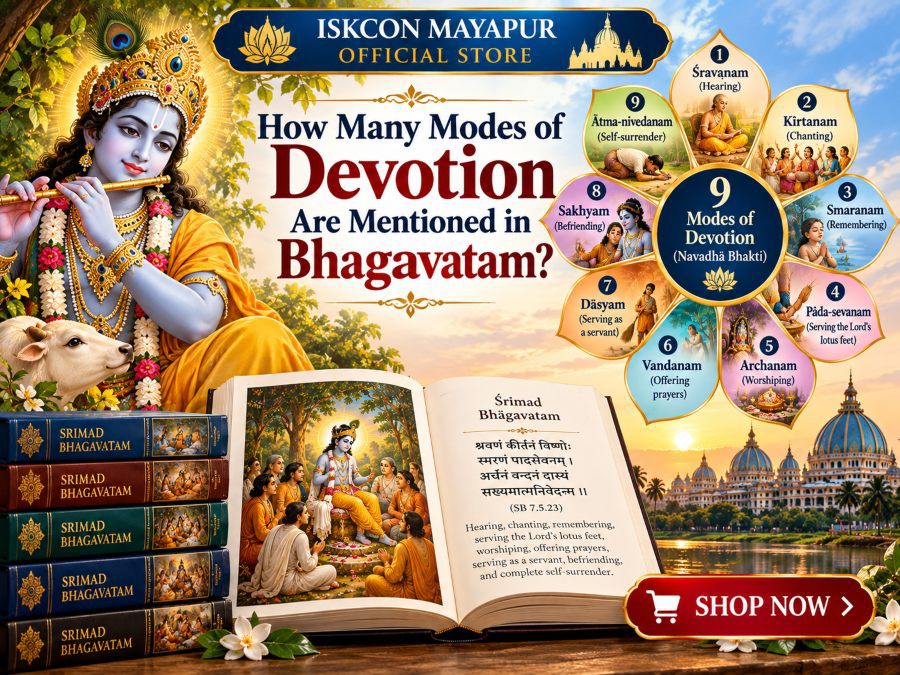 How Many Modes of Devotion Are Mentioned in Bhagavatam?Read more
A young boy named Prahlada listed nine ways to serve God, and the Bhagavatam keeps them as its answer. Learn what the...
-
 What Is Bhagavatam and Why Has It Been Read for 5,000 Years?Read more
A dying king asked one question, and the answer became the Bhagavatam. Learn what this Sanskrit scripture contains,...
-
 Who Is Lord Krishna? His Meaning, Teachings and Pastimes ExplainedRead more
Discover who Krishna is according to Srimad Bhagavatam, including His divine identity, childhood pastimes, teachings,...
-
 Incense in Islam: Bakhoor, Agarbatti and What Tradition SaysRead more
Is burning fragrance part of Muslim tradition? Explore incense in Islam, from the Prophetic practice of fumigating...
-
 History of Agarbatti: From Vedic Dhupa to Modern Incense SticksRead more
Where did agarbatti really come from? Follow the history of agarbatti from Vedic fire rituals and temple dhupa to...
Blog categories
- Default category (0)
- MUSICAL INSTRUMENT (1)
- BOOK (5)
- DEVOTIONAL GIFT (0)
- Blog (30) click
- CHANDAN (12)
- Bhagavatam Wisdom Series (68)
- Krishna Consciousness (14)
- Mridangam Musical Instrument (6)
- Bhagavad Gita for Beginners (13)
- Bhagavad Gita As It Is (37) click
- Bhagavad Gita As It Is Telugu (0)
- Bhagavad Gita As It Is Marathi (0)
- Bhagavad Gita As It Is In Hindi (0)
- Bhagavad Gita As It Is In English (0)
- Bhagavad Gita As It Is In Bengali (8)
- Bhagavad Gita As It Is In Kannada (0)
- Bhagavad Gita As It Is In Gujarati (0)
- Bhagavad Gita As It Is In Panjabi (0)
- Bhagavad Gita As It Is In Tamil (0)
- Bhagavad Gita As It Is Odia (0)
- BHAGAVAD GITA As It Is GERMAN (0)
- Bhagavad Gita As It Is In French (0)
- Bhagavad Gita As It Is In Nepali (0)
- Bhagavad Gita As It Is In Assamese (0)
- Incense or Agarbatti (38)
- Lord Chaitanya Mahaprabhu (3)
- Vedic Temple Mayapur (14)
- kalki (15)
- Mahabharata – Dharma & Destiny (27)
- Vaishnava Scriptures (4)
- healthy product (4)
- chaitanya mahaprabhu (5)
- Tulsi Mala Guide (17)
Search in blog

The Srimad Bhagavatam Explains the Human Mind Better Than Most Modern Books
The Srimad Bhagavatam Explains the Human Mind Better Than Most Modern Books
A person can read hundreds of psychology books, listen to endless podcasts about mental health, study productivity systems for years, and still remain deeply confused about one thing:
Why does the mind keep creating suffering even when life appears externally stable?
That question sits at the center of human existence.
And strangely enough, one of the most profound answers came thousands of years ago through the srimad bhagavatam mahapuran.
At first glance, the Srimad Bhagavatam may look like an ancient spiritual text focused mainly on devotion, philosophy, and divine stories. Yet beneath its narratives lies an extraordinarily sharp understanding of human psychology. The scripture examines fear, attachment, ego, anxiety, desire, emotional conditioning, loneliness, anger, greed, obsession, and mental illusion with a level of depth that still feels startlingly relevant today.
The Bhagavatam does not use modern psychological vocabulary.
It does something more powerful.
It explains why the human mind behaves the way it does.
And even more importantly, it explains how consciousness can become free from unnecessary suffering.
.jpg)
Why Modern Minds Feel So Exhausted
People today have more information than any generation in history.
Still, anxiety continues rising.
Attention spans shrink.
Loneliness deepens.
Emotional stability weakens.
That contradiction matters.
If information alone solved mental suffering, modern society should feel emotionally healthier than ever.
Clearly, something deeper is happening.
The Srimad Bhagavatam identifies the root issue very directly:
the mind becomes disturbed when consciousness loses connection with spiritual reality and becomes trapped in endless material absorption.
That idea may sound philosophical initially.
Then life experience starts proving it repeatedly.
The Bhagavatam Understands That the Mind Never Stays Neutral
This is one of its most psychologically accurate insights.
The mind always moves toward something:
- Desire
- Fear
- Memory
- Attachment
- Ambition
- Anxiety
- Pleasure
- Identity
It never simply remains empty.
The Bhagavatam repeatedly explains that uncontrolled mental absorption creates bondage. Whatever consciousness repeatedly contemplates begins shaping emotional experience and behavior.
Modern neuroscience discusses conditioning and neural pathways.
The Bhagavatam discussed mental conditioning centuries earlier through spiritual language.
Desire: The Endless Engine Inside the Mind
One of the scripture’s clearest observations is brutally simple:
Desire does not naturally end.
A person thinks:
“If I achieve this one thing, then I will finally feel satisfied.”
Then the mind creates another craving immediately.
The Bhagavatam examines this cycle repeatedly through kings, rulers, wealthy personalities, celestial beings, and ordinary people.
Some possess:
- Power
- Beauty
- Wealth
- Influence
- Pleasure
- Intelligence
Yet they remain internally restless.
Why?
Because the mind constantly expands material desire once temporary satisfaction fades.
Why Temporary Pleasure Cannot Fully Satisfy Consciousness
The Bhagavatam makes a distinction modern culture often ignores:
There is a difference between stimulation and fulfillment.
The mind may temporarily enjoy:
- Entertainment
- Luxury
- Recognition
- Sensory pleasure
- Social validation
But temporary stimulation cannot create permanent peace.
That mismatch produces ongoing dissatisfaction.
Modern society often treats endless craving as normal ambition. The Bhagavatam treats uncontrolled craving as psychological instability.
The Bhagavatam Understands Ego Better Than Most Self-Help Systems
Many modern systems try improving the ego.
The Bhagavatam tries exposing it.
That difference changes everything.
The text repeatedly shows how ego:
- Distorts perception
- Creates false superiority
- Generates attachment
- Fuels conflict
- Blocks wisdom
- Produces insecurity
And the most dangerous part?
Ego rarely recognizes itself.
Hiranyakashipu: A Psychological Study of Power Addiction
The story of Hiranyakashipu is far deeper than many people realize.
On the surface, he appears as a powerful tyrant opposing devotion.
Psychologically, he represents something terrifyingly human:
the ego’s obsession with control.
He wants:
- Absolute authority
- Immortality
- Recognition
- Domination
- Worship
Yet despite immense power, he remains emotionally unstable and constantly angry.
The Bhagavatam reveals something modern psychology also recognizes:
external control cannot eliminate internal fear.
Why the Bhagavatam Says the Mind Creates Illusion
The scripture repeatedly uses the concept of maya — illusion.
This does not merely mean hallucination or fantasy.
It refers to distorted perception caused by material attachment and ego-centered consciousness.
The mind begins believing:
- Temporary things are permanent
- The body is the true self
- Material success equals happiness
- Sensory pleasure equals fulfillment
- Control creates security
The Bhagavatam argues these assumptions create suffering because they conflict with reality itself.
The Mind Becomes Attached to Temporary Identity
Modern identity often revolves around:
- Career
- Appearance
- Social status
- Achievement
- Public image
- Possessions
The Bhagavatam challenges this directly.
It teaches that the self is eternal consciousness temporarily occupying the material body.
That insight changes how people understand:
- Aging
- Failure
- Success
- Fear
- Death
And suddenly many mental anxieties begin looking different.
Anxiety Exists Because the Mind Clings to Unstable Things
This observation feels painfully accurate.
People experience fear because they attach emotionally to things guaranteed to change eventually:
- Bodies age
- Relationships shift
- Wealth disappears
- Reputation changes
- Circumstances collapse
The Bhagavatam does not say attachment itself is evil.
It says misplaced attachment creates inevitable mental disturbance.
Why Fear Never Fully Leaves Material Consciousness
Even successful people remain anxious because material existence itself is unstable.
The Bhagavatam explains:
when consciousness depends entirely on temporary conditions for happiness, fear becomes unavoidable.
That explains why:
- Wealthy people still feel insecure
- Famous people still feel empty
- Powerful people still fear loss
The mind cannot feel permanently safe while depending entirely on impermanent things.
The Bhagavatam’s Understanding of Anger Feels Strikingly Modern
The text repeatedly links anger to frustrated desire.
This psychological sequence appears constantly:
1. The mind becomes attached
2. Desire intensifies
3. Expectation develops
4. Frustration occurs
5. Anger emerges
Modern psychology describes similar emotional patterns using different terminology.
The Bhagavatam simply traces the chain deeper toward attachment itself.
Why the Mind Keeps Repeating Harmful Patterns
Another major insight involves conditioning.
The Bhagavatam recognizes that repeated thought patterns strengthen mental habits over time.
Whatever the mind repeatedly contemplates becomes easier to revisit again and again.
This applies to:
- Fear
- Lust
- Greed
- Anger
- Devotion
- Compassion
- Gratitude
The mind slowly becomes shaped by its dominant absorption.
That principle explains both spiritual growth and psychological decline.
King Parikshit and the Psychology of Mortality
The Bhagavatam begins with one of the most psychologically powerful situations imaginable.
King Parikshit learns he has seven days left to live.
Everything changes instantly.
Status becomes meaningless.
Politics lose urgency.
Material distractions collapse.
He asks:
“What should a person hear, remember, and do before death?”
This question exposes something important:
awareness of mortality reorganizes consciousness rapidly.
Why Modern Society Avoids Thinking About Death
Most people distract themselves constantly because silence eventually forces existential questions to appear.
The Bhagavatam approaches death differently.
It argues that remembering mortality:
- Sharpens priorities
- Reduces illusion
- Weakens ego
- Creates urgency for spiritual realization
Strangely, awareness of death becomes psychologically clarifying rather than depressing.
The Bhagavatam Understands Loneliness Deeply
Modern life creates unusual emotional isolation.
People remain digitally connected constantly while feeling internally disconnected.
The Bhagavatam explains loneliness spiritually:
the soul naturally longs for loving connection with Krishna, and material substitutes cannot fully satisfy that deeper longing.
This idea becomes emotionally powerful for readers experiencing:
- Emptiness
- Restlessness
- Existential confusion
- Emotional dissatisfaction
Why Material Success Often Feels Emotionally Hollow
The Bhagavatam repeatedly shows powerful individuals remaining internally disturbed despite enormous achievement.
This happens because external accomplishment cannot automatically resolve:
- Fear
- Attachment
- Identity confusion
- Spiritual emptiness
The mind continues searching because the soul seeks something beyond temporary stimulation.
Prahlada Maharaja: Emotional Stability Under Pressure
Prahlada’s story offers one of the Bhagavatam’s greatest psychological lessons.
A child remains spiritually peaceful despite:
- Threats
- Violence
- Isolation
- Fear
- Emotional pressure
How?
Because his consciousness remains anchored beyond temporary circumstances.
This does not mean he becomes emotionally numb.
It means his identity no longer depends entirely on external conditions.
That distinction matters enormously.
The Bhagavatam Separates Consciousness From Circumstances
Modern thinking often assumes happiness depends mainly on external improvement.
The Bhagavatam agrees external conditions matter, but it argues consciousness matters even more.
Two people may experience identical circumstances while responding completely differently internally.
Why?
Because perception shapes emotional experience.
Why the Bhagavatam Treats the Mind Like a Force That Requires Training
The scripture never assumes the mind automatically behaves wisely.
It describes the uncontrolled mind as:
- Restless
- Impulsive
- Easily distracted
- Desire-driven
- Emotionally unstable
Sound familiar?
The Bhagavatam emphasizes spiritual discipline because untrained consciousness naturally drifts toward lower absorption repeatedly.
Attention Determines Inner Life
This may be one of the text’s most practical insights.
Whatever repeatedly captures attention slowly shapes consciousness.
If the mind constantly absorbs:
- Fear
- Lust
- Anger
- Envy
- Material obsession
then emotional life gradually reflects those influences.
The Bhagavatam therefore emphasizes hearing spiritual wisdom regularly because consciousness becomes shaped by repeated exposure.
Why Devotion Heals the Mind Differently Than Motivation
Modern motivation often tries making people feel temporarily stronger.
The Bhagavatam aims much deeper.
Bhakti — loving devotion toward Krishna — gradually purifies:
- Desire
- Attachment
- Ego
- Fear
- Emotional instability
Devotion changes the direction of consciousness itself.
Krishna Is Presented as the Mind’s Ultimate Shelter
The Bhagavatam portrays Krishna not merely as:
- Cosmic authority
- Distant creator
- Philosophical abstraction
But as:
- Friend
- Protector
- Beloved
- Companion
This emotional relationship matters psychologically because the mind naturally seeks loving attachment.
The Bhagavatam redirects attachment toward something eternal rather than temporary.
Why Readers Feel the Bhagavatam “Understands” Them
Because the scripture speaks honestly about inner conflict.
Its characters experience:
- Doubt
- Pride
- Grief
- Fear
- Emotional weakness
- Spiritual struggle
The text never pretends human psychology is simple.
That realism creates trust.
Readers recognize themselves inside the narratives repeatedly.
The Bhagavatam Does Not Shame Mental Struggle
This matters deeply.
The text acknowledges that conditioned consciousness naturally experiences confusion and emotional turbulence.
Transformation happens gradually through:
- Hearing sacred wisdom
- Reflection
- Devotional practice
- Spiritual association
- Purification of consciousness
Not through instant perfection.
Why the Bhagavatam Feels More Insightful Than Many Modern Books
Because it studies the root causes of suffering rather than only surface symptoms.
Modern systems often focus on:
- Performance optimization
- Emotional management
- Productivity
- Confidence-building
The Bhagavatam asks more foundational questions:
- Who are you really?
- Why does the mind remain restless?
- What creates lasting peace?
- Why does desire never stop naturally?
- What survives death?
These questions reach deeper than temporary self-improvement strategies.
More Than Ancient Wisdom
Calling the Srimad Bhagavatam merely an old spiritual text misses its psychological brilliance entirely.
It functions simultaneously as:
- Spiritual philosophy
- Emotional guidance
- Consciousness analysis
- Existential reflection
- Devotional literature
- Deep psychological observation
The scripture understands something modern culture often forgets:
The human mind cannot experience lasting peace while disconnected from spiritual truth.
People may temporarily distract themselves.
Temporarily stimulate themselves.
Temporarily entertain themselves.
But eventually the deeper questions return.
And when they do, the Srimad Bhagavatam still speaks with astonishing clarity even after thousands of years.
Posted in: Bhagavatam Wisdom Series
Related posts
-
 Why to read srimad bhagavatamReading the Srimad Bhagavatam fosters deep spiritual growth by narrating the life and teachings of Lord Krishna,...Read more
 -
 When was srimad bhagavatam written?The Srimad Bhagavatam is believed to have been written around 9th-10th century CE, though its oral traditions date...Read more
 -
 How many chapters are there in srimad bhagavatam?The Srimad Bhagavatam consists of 12 cantos (books) containing 335 chapters in total. Each canto covers various...Read more
 -
 How many skandhas are there in srimad bhagavatamThe Srimad Bhagavatam is divided into 12 skandhas (cantos or books). Each skandha explores different themes,...Read more
 -
 How many slokas in srimad bhagavatamThe Srimad Bhagavatam contains approximately 18,000 shlokas (verses). These verses are spread across its 12 skandhas...Read more
Leave a comment