
Why did Krishna run to embrace a poor brahmin in rags? Read the Sudama story from the Bhagavatam and learn how a...
Latest posts
-
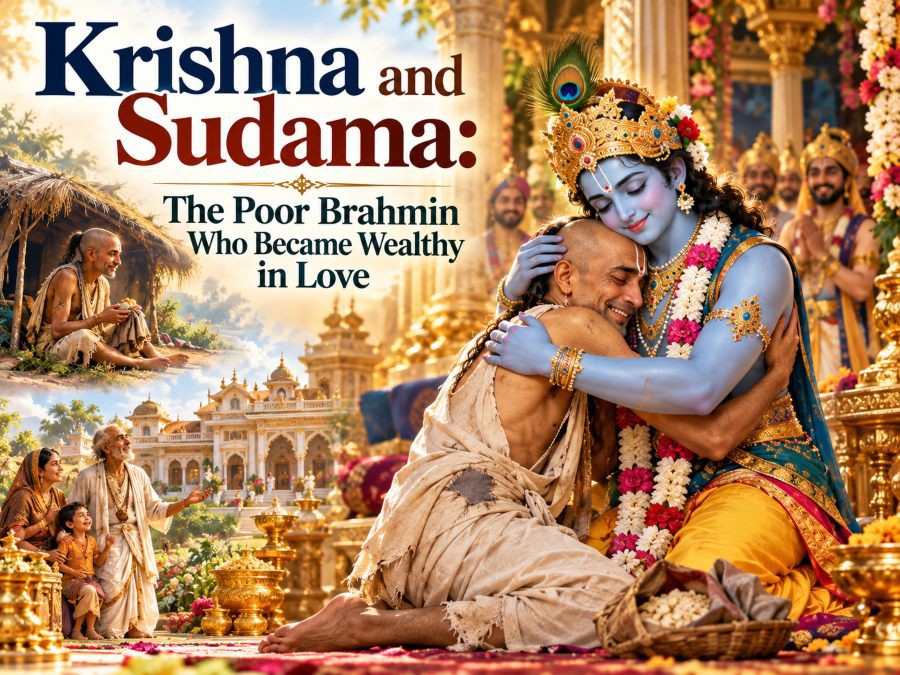 Krishna and Sudama: The Poor Brahmin Who Became Wealthy in LoveRead more
 -
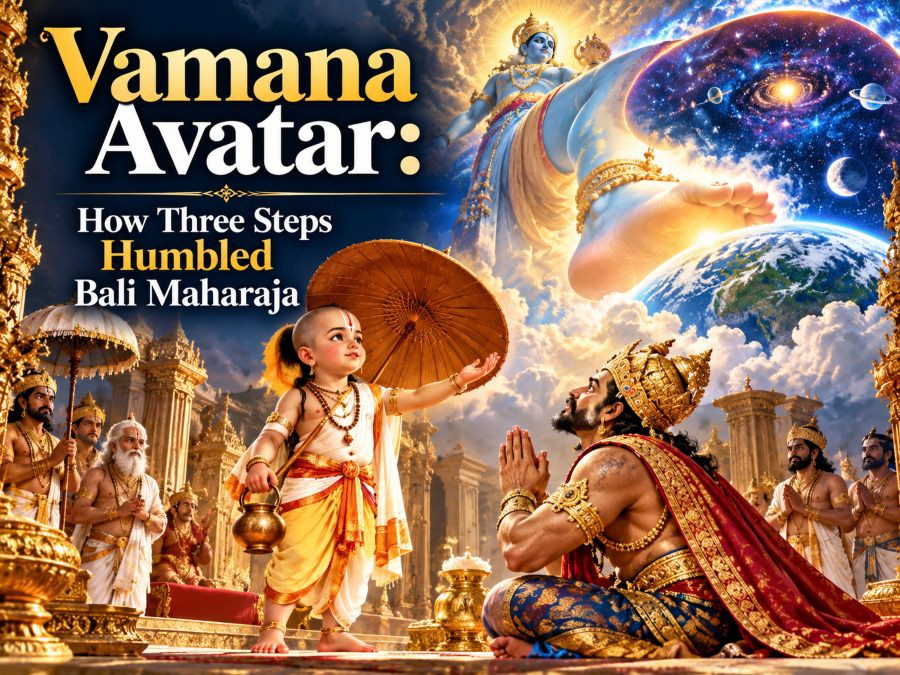 Vamana Avatar: How Three Steps Humbled Bali MaharajaRead more
Why did a powerful king give away three worlds to a boy asking for three steps? Learn the Vamana avatar story from...
-
 The Bhagavatam on Marriage: Duty, Love and Spiritual PartnershipRead more
What does the Bhagavatam say about marriage? Through the stories of Kardama and Devahuti, Rukmini's secret letter and...
-
 What Is Prema? The Bhagavatam's Highest Stage of Love for GodRead more
Prema is love for God with no "because" attached. Learn how the Bhagavatam describes it, the nine steps from faith to...
-
 Is Shiva Parvati Kalyana Mentioned in Srimad Bhagavatam? What the Scripture Really SaysRead more
Looking for Shiva and Parvati's wedding in the Srimad Bhagavatam? Find out what the scripture actually describes,...
-
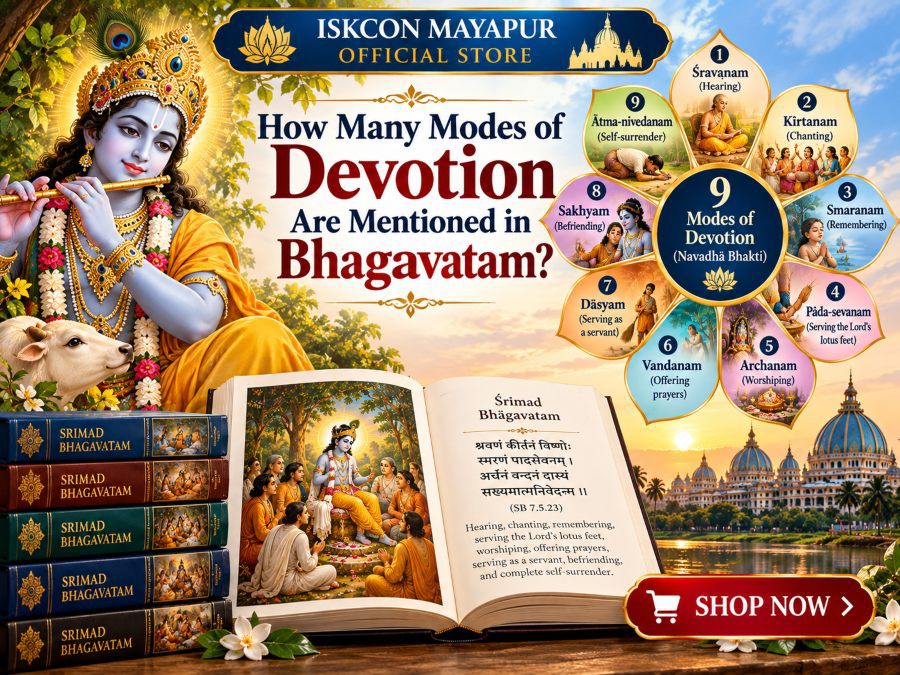 How Many Modes of Devotion Are Mentioned in Bhagavatam?Read more
A young boy named Prahlada listed nine ways to serve God, and the Bhagavatam keeps them as its answer. Learn what the...
-
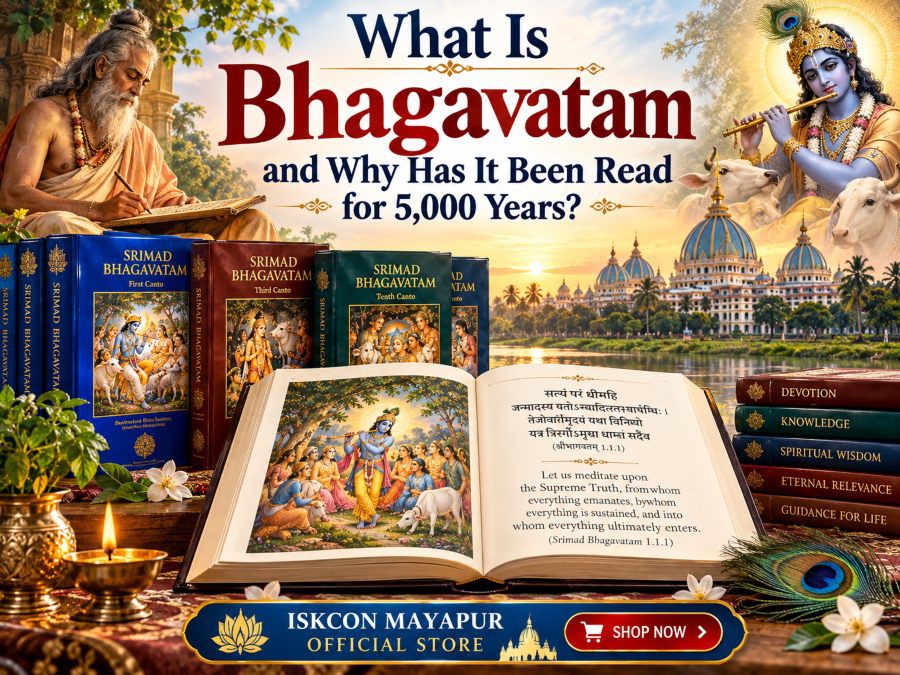 What Is Bhagavatam and Why Has It Been Read for 5,000 Years?Read more
A dying king asked one question, and the answer became the Bhagavatam. Learn what this Sanskrit scripture contains,...
-
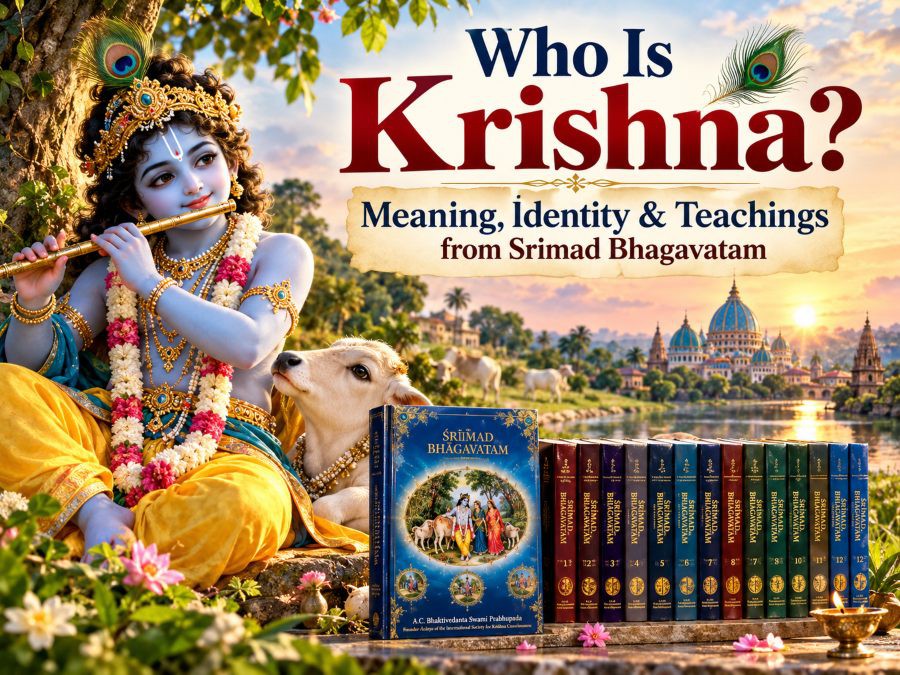 Who Is Lord Krishna? His Meaning, Teachings and Pastimes ExplainedRead more
Discover who Krishna is according to Srimad Bhagavatam, including His divine identity, childhood pastimes, teachings,...
-
 Incense in Islam: Bakhoor, Agarbatti and What Tradition SaysRead more
Is burning fragrance part of Muslim tradition? Explore incense in Islam, from the Prophetic practice of fumigating...
-
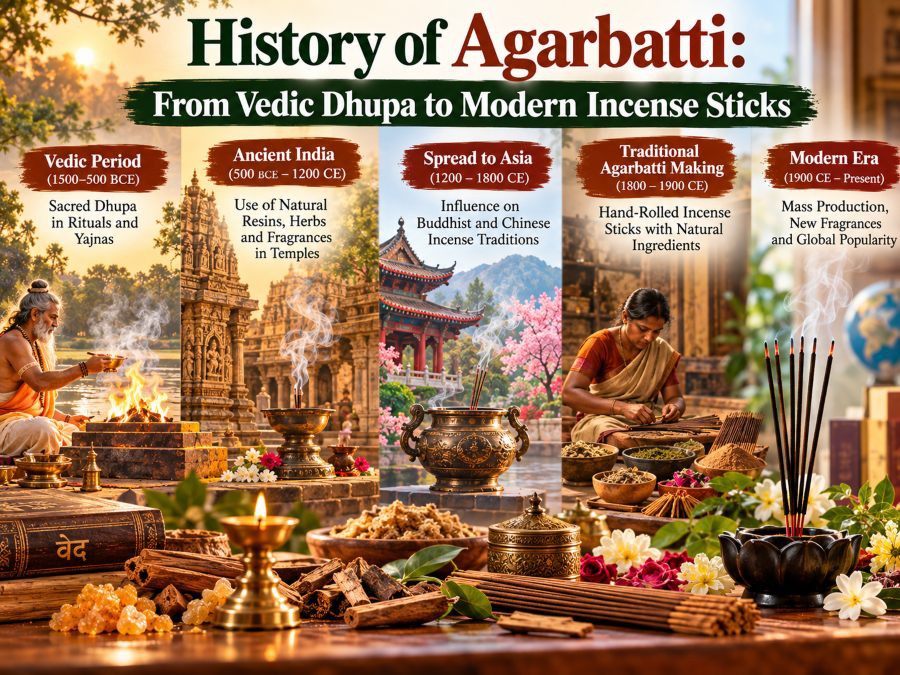 History of Agarbatti: From Vedic Dhupa to Modern Incense SticksRead more
Where did agarbatti really come from? Follow the history of agarbatti from Vedic fire rituals and temple dhupa to...
Blog categories
- Default category (0)
- MUSICAL INSTRUMENT (1)
- BOOK (5)
- DEVOTIONAL GIFT (0)
- Blog (30) click
- CHANDAN (12)
- Bhagavatam Wisdom Series (68)
- Krishna Consciousness (14)
- Mridangam Musical Instrument (6)
- Bhagavad Gita for Beginners (13)
- Bhagavad Gita As It Is (37) click
- Bhagavad Gita As It Is Telugu (0)
- Bhagavad Gita As It Is Marathi (0)
- Bhagavad Gita As It Is In Hindi (0)
- Bhagavad Gita As It Is In English (0)
- Bhagavad Gita As It Is In Bengali (8)
- Bhagavad Gita As It Is In Kannada (0)
- Bhagavad Gita As It Is In Gujarati (0)
- Bhagavad Gita As It Is In Panjabi (0)
- Bhagavad Gita As It Is In Tamil (0)
- Bhagavad Gita As It Is Odia (0)
- BHAGAVAD GITA As It Is GERMAN (0)
- Bhagavad Gita As It Is In French (0)
- Bhagavad Gita As It Is In Nepali (0)
- Bhagavad Gita As It Is In Assamese (0)
- Incense or Agarbatti (38)
- Lord Chaitanya Mahaprabhu (3)
- Vedic Temple Mayapur (14)
- kalki (15)
- Mahabharata – Dharma & Destiny (27)
- Vaishnava Scriptures (4)
- healthy product (4)
- chaitanya mahaprabhu (5)
- Tulsi Mala Guide (17)
Search in blog
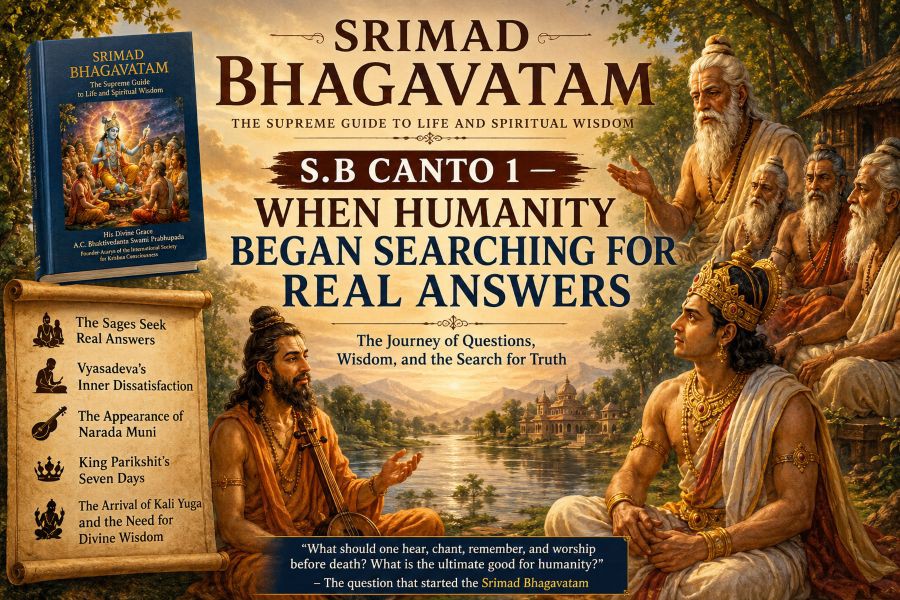
S.B Canto 1 — When Humanity Began Searching for Real Answers
A dying king sits beside the Ganges River with only seven days left to live. Around him stand sages, saints, scholars, and seekers. No one discusses politics, money, military strength, or social prestige. One question rises above everything else:
“What should a human being hear, remember, and do before death?”
.jpg)
That moment becomes the heartbeat of the Srimad Bhagavatam.
Inside authentic editions of the srimad bhagavatam mahapuran, Canto 1 opens not with fantasy or blind mythology, but with a civilization confronting life’s deepest questions honestly. That is why this canto still feels powerful thousands of years later. It speaks directly to human confusion, fear, longing, and the search for something real beneath temporary existence.
The first canto of the Srimad Bhagavatam is not merely an introduction. It is the beginning of humanity’s serious spiritual inquiry. Every major theme of the Bhagavatam starts here:
- the purpose of life
- the nature of suffering
- the problem of ego
- the illusion of material security
- the importance of divine hearing
- the search for truth
- the appearance of Krishna
- the decline of morality in Kali Yuga
And perhaps most importantly, Canto 1 asks a question modern civilization still struggles to answer:
What actually satisfies the human soul?
Why Canto 1 Feels Surprisingly Modern
At first glance, many people assume ancient scriptures belong to another era entirely. Yet the opening canto of the Srimad Bhagavatam feels strangely current because human anxiety has not changed as much as technology has.
People still fear:
- death
- loneliness
- failure
- insignificance
- uncertainty
- emotional emptiness
Modern society became skilled at distraction, but distraction is not the same as peace.
Canto 1 begins after the devastating Kurukshetra war. Externally, victory has already happened. The great conflict is over. Yet emotionally and spiritually, the atmosphere feels heavy.
This detail matters.
The Bhagavatam immediately establishes an important truth:
External success does not automatically heal internal suffering.
That insight alone explains why so many modern readers connect deeply with the text.
The Sages Ask the Most Intelligent Question Possible
One of the most fascinating moments in Canto 1 occurs in the forest of Naimisharanya, where sages gather to discuss the future of humanity.
Notice what they are concerned about.
Not economic growth.
Not entertainment.
Not political expansion.
They ask:
- How can people find peace in the age of chaos?
- What is the essence of all spiritual wisdom?
- What should humans focus on when life becomes spiritually degraded?
These questions feel incredibly relevant now.
The sages recognize that Kali Yuga — the age of confusion and decline — will weaken:
- memory
- morality
- attention span
- compassion
- discipline
- truthfulness
Look honestly at modern society and the parallels become difficult to ignore.
People are overloaded with information yet starving for wisdom.
That is why the Srimad Bhagavatam begins with inquiry. Not blind acceptance. Inquiry.
Why Honest Questions Matter More Than Pretending
Canto 1 repeatedly shows spiritually intelligent people asking difficult questions openly.
This is important because genuine spiritual growth rarely begins with arrogance. It begins with humility and curiosity.
Modern culture often pressures people to appear certain about everything. The Bhagavatam moves in another direction.
The sages ask questions because they understand something profound:
Human life becomes meaningful when people seriously seek truth instead of endlessly distracting themselves.
That idea changes how spirituality is approached.
The Bhagavatam does not glorify ignorance disguised as confidence. It glorifies sincere inquiry.
This makes the text intellectually refreshing.
Suta Goswami and the Power of Hearing Wisdom
The sages approach Suta Goswami because they recognize him as spiritually realized and deeply learned.
But something fascinating happens here.
Canto 1 repeatedly emphasizes hearing.
Not merely reading.
Not merely arguing.
Hearing.
The Bhagavatam teaches that consciousness becomes shaped by what repeatedly enters the mind. Modern neuroscience would actually agree with this principle.
If the mind constantly absorbs:
- outrage
- fear
- gossip
- lust
- comparison
- distraction
then emotional instability naturally grows.
The Bhagavatam offers another process entirely:
hearing transcendental wisdom capable of purifying consciousness gradually.
This is why the text places enormous importance on listening to spiritual discussions attentively.
Not as ritual.
As psychological transformation.
Vyasadeva’s Unexpected Emptiness
One of the most emotionally striking moments in Canto 1 involves Vyasadeva himself — the legendary compiler of Vedic literature.
Think about his achievements:
- immense knowledge
- spiritual authority
- literary mastery
- philosophical brilliance
Yet despite accomplishing extraordinary work, he feels dissatisfied internally.
That detail is deeply human.
The Srimad Bhagavatam immediately destroys the illusion that achievement alone creates fulfillment.
Many people today quietly experience the same confusion:
“I achieved what I wanted. Why do I still feel incomplete?”
Vyasadeva’s dissatisfaction becomes one of the most psychologically important moments in the entire Bhagavatam.
Narada Exposes the Missing Piece
Narada Muni visits Vyasadeva and explains the source of his emptiness.
This conversation changes everything.
Narada tells Vyasadeva that despite composing vast spiritual literature, he did not fully glorify the Supreme Personality of Godhead and pure devotional service in a direct, emotionally complete way.
This insight becomes the birth of the Srimad Bhagavatam itself.
The implication is profound:
Knowledge alone is insufficient without connection to the Divine center of existence.
The Bhagavatam suggests that the soul naturally longs for loving spiritual connection, and when that connection remains absent, subtle dissatisfaction persists no matter how successful life appears externally.
That idea explains enormous amounts of modern emotional unrest.
Why Material Progress Alone Cannot Satisfy the Soul
Canto 1 repeatedly challenges one of humanity’s oldest assumptions:
“If I acquire enough externally, I will become fulfilled internally.”
Modern systems still operate heavily on this belief.
More money.
More recognition.
More comfort.
More stimulation.
Yet emotional emptiness continues spreading across societies with unprecedented material abundance.
The Srimad Bhagavatam does not condemn material existence itself. It simply explains its limitations.
Temporary things cannot permanently satisfy eternal consciousness.
This is why the Bhagavatam places spiritual realization at the center of human life rather than treating it as optional decoration.
King Parikshit and the Urgency of Mortality
Few openings in world literature feel as psychologically intense as King Parikshit learning he has seven days left before death.
No escape exists.
No denial remains possible.
Suddenly, all temporary distractions lose importance.
This scenario forces a question most people avoid:
What actually matters when life becomes undeniably temporary?
Parikshit’s greatness appears not because he avoids fear completely, but because he responds intelligently.
Instead of collapsing into panic, he seeks transcendental truth.
That reaction reveals the spiritual maturity Canto 1 admires deeply.
Kali Yuga Enters the Scene
Canto 1 introduces Kali — the symbolic representation of quarrel, hypocrisy, and spiritual decline.
The description feels disturbingly recognizable today.
Kali thrives where:
- greed dominates
- truth weakens
- addiction spreads
- morality collapses
- exploitation increases
- spirituality becomes superficial
The Bhagavatam does not describe Kali Yuga merely as historical prophecy. It describes psychological conditions emerging within society and individual consciousness.
This makes the canto feel startlingly relevant.
People today often sense something is emotionally wrong with modern culture but struggle explaining it clearly.
The Bhagavatam provides language for that discomfort.
Why Krishna’s Departure Changes Everything
One of the saddest emotional undercurrents in Canto 1 is Krishna preparing to leave the world.
The atmosphere becomes spiritually heavy because Krishna’s physical presence brought protection, clarity, and divine guidance.
His departure symbolizes something larger:
humanity entering deeper spiritual confusion.
This theme becomes deeply meaningful when viewed psychologically.
When divine consciousness weakens within society, confusion naturally increases.
People lose:
- spiritual direction
- inner restraint
- higher purpose
- emotional clarity
Canto 1 quietly warns that civilization without spiritual grounding eventually becomes unstable regardless of technological advancement.
That observation feels increasingly difficult to dismiss.
The Bhagavatam Is Not Escapism
Some people mistakenly assume spiritual literature exists to help people avoid reality. Canto 1 proves the opposite.
The Bhagavatam directly addresses:
- suffering
- death
- moral collapse
- fear
- political instability
- emotional pain
- existential anxiety
It does not hide from human difficulty.
Instead, it asks:
How should consciousness respond intelligently to unavoidable suffering?
That is a psychologically mature question.
The text does not encourage emotional numbness. It encourages spiritual clarity.
Why Devotional Hearing Is Treated as Medicine
Canto 1 repeatedly compares hearing spiritual wisdom to purification.
This may sound poetic initially, but the psychological logic is powerful.
Human consciousness is constantly influenced by repeated exposure.
Modern people understand this already:
- media shapes perception
- environments shape behavior
- conversations shape mentality
- habits shape emotional patterns
The Bhagavatam simply extends this principle spiritually.
Hearing about Krishna gradually transforms consciousness because the mind absorbs what it repeatedly contemplates.
That is why the sages become eager to hear the Bhagavatam continuously.
Not out of blind ritualism.
Because they recognize its transformative effect.
Why Canto 1 Begins With Humility
Something beautiful runs through the entire first canto:
humility.
The sages ask sincerely.
Suta speaks respectfully.
Parikshit listens attentively.
Narada instructs compassionately.
This atmosphere matters because the Bhagavatam repeatedly suggests that spiritual truth becomes accessible through humility rather than ego-driven intellectual pride.
Modern culture often rewards performance, self-promotion, and constant opinion expression. Canto 1 offers another model entirely:
thoughtful listening and sincere inquiry.
That emotional tone gives the text unusual depth.
The Real Beginning of Human Intelligence
According to Canto 1, real intelligence begins when humans stop living mechanically and start questioning existence seriously.
Questions like:
- Who am I beyond the body?
- Why does suffering exist?
- What survives death?
- Why does temporary pleasure fail to satisfy permanently?
- What is the highest purpose of life?
The Bhagavatam treats these questions as signs of awakening rather than pessimism.
That perspective changes how spiritual inquiry itself is understood.
Why Readers Still Feel Drawn to Canto 1
The first canto of the Srimad Bhagavatam continues attracting readers because it feels emotionally honest.
It does not flatter the ego.
It does not promise superficial happiness.
It does not reduce life into material success formulas.
Instead, it respectfully confronts reality.
Human life is temporary.
Material satisfaction has limits.
The mind remains restless without spiritual grounding.
The soul longs for something eternal.
These truths remain uncomfortable, but they also feel strangely liberating.
Because once people stop pretending temporary things will fully satisfy them, they become ready for deeper spiritual understanding.
The Beginning of a Greater Journey
Canto 1 is not merely an introduction to a scripture.
It is the beginning of a transformation.
The sages gather because humanity needs answers. Vyasadeva composes the Bhagavatam because knowledge without devotion feels incomplete. King Parikshit listens because death removes illusion and exposes what truly matters.
Every thread points toward one realization:
Human beings are searching for something beyond temporary existence.
And the Srimad Bhagavatam begins responding to that search with extraordinary depth, compassion, and spiritual intelligence.
That is why Canto 1 still matters today.
Because even after thousands of years, humanity is still asking the same essential question:
What is the real purpose of life — and where can lasting peace actually be found?
Posted in: Bhagavatam Wisdom Series
Related posts
-
 Why to read srimad bhagavatamReading the Srimad Bhagavatam fosters deep spiritual growth by narrating the life and teachings of Lord Krishna,...Read more
 -
 When was srimad bhagavatam written?The Srimad Bhagavatam is believed to have been written around 9th-10th century CE, though its oral traditions date...Read more
 -
 How many chapters are there in srimad bhagavatam?The Srimad Bhagavatam consists of 12 cantos (books) containing 335 chapters in total. Each canto covers various...Read more
 -
 How many skandhas are there in srimad bhagavatamThe Srimad Bhagavatam is divided into 12 skandhas (cantos or books). Each skandha explores different themes,...Read more
 -
 How many slokas in srimad bhagavatamThe Srimad Bhagavatam contains approximately 18,000 shlokas (verses). These verses are spread across its 12 skandhas...Read more
Leave a comment