
Why did Krishna run to embrace a poor brahmin in rags? Read the Sudama story from the Bhagavatam and learn how a...
Latest posts
-
 Krishna and Sudama: The Poor Brahmin Who Became Wealthy in LoveRead more
 -
 Vamana Avatar: How Three Steps Humbled Bali MaharajaRead more
Why did a powerful king give away three worlds to a boy asking for three steps? Learn the Vamana avatar story from...
-
 The Bhagavatam on Marriage: Duty, Love and Spiritual PartnershipRead more
What does the Bhagavatam say about marriage? Through the stories of Kardama and Devahuti, Rukmini's secret letter and...
-
 What Is Prema? The Bhagavatam's Highest Stage of Love for GodRead more
Prema is love for God with no "because" attached. Learn how the Bhagavatam describes it, the nine steps from faith to...
-
 Is Shiva Parvati Kalyana Mentioned in Srimad Bhagavatam? What the Scripture Really SaysRead more
Looking for Shiva and Parvati's wedding in the Srimad Bhagavatam? Find out what the scripture actually describes,...
-
 How Many Modes of Devotion Are Mentioned in Bhagavatam?Read more
A young boy named Prahlada listed nine ways to serve God, and the Bhagavatam keeps them as its answer. Learn what the...
-
 What Is Bhagavatam and Why Has It Been Read for 5,000 Years?Read more
A dying king asked one question, and the answer became the Bhagavatam. Learn what this Sanskrit scripture contains,...
-
 Who Is Lord Krishna? His Meaning, Teachings and Pastimes ExplainedRead more
Discover who Krishna is according to Srimad Bhagavatam, including His divine identity, childhood pastimes, teachings,...
-
 Incense in Islam: Bakhoor, Agarbatti and What Tradition SaysRead more
Is burning fragrance part of Muslim tradition? Explore incense in Islam, from the Prophetic practice of fumigating...
-
 History of Agarbatti: From Vedic Dhupa to Modern Incense SticksRead more
Where did agarbatti really come from? Follow the history of agarbatti from Vedic fire rituals and temple dhupa to...
Blog categories
- Default category (0)
- MUSICAL INSTRUMENT (1)
- BOOK (5)
- DEVOTIONAL GIFT (0)
- Blog (30) click
- CHANDAN (12)
- Bhagavatam Wisdom Series (68)
- Krishna Consciousness (14)
- Mridangam Musical Instrument (6)
- Bhagavad Gita for Beginners (13)
- Bhagavad Gita As It Is (37) click
- Bhagavad Gita As It Is Telugu (0)
- Bhagavad Gita As It Is Marathi (0)
- Bhagavad Gita As It Is In Hindi (0)
- Bhagavad Gita As It Is In English (0)
- Bhagavad Gita As It Is In Bengali (8)
- Bhagavad Gita As It Is In Kannada (0)
- Bhagavad Gita As It Is In Gujarati (0)
- Bhagavad Gita As It Is In Panjabi (0)
- Bhagavad Gita As It Is In Tamil (0)
- Bhagavad Gita As It Is Odia (0)
- BHAGAVAD GITA As It Is GERMAN (0)
- Bhagavad Gita As It Is In French (0)
- Bhagavad Gita As It Is In Nepali (0)
- Bhagavad Gita As It Is In Assamese (0)
- Incense or Agarbatti (38)
- Lord Chaitanya Mahaprabhu (3)
- Vedic Temple Mayapur (14)
- kalki (15)
- Mahabharata – Dharma & Destiny (27)
- Vaishnava Scriptures (4)
- healthy product (4)
- chaitanya mahaprabhu (5)
- Tulsi Mala Guide (17)
Search in blog
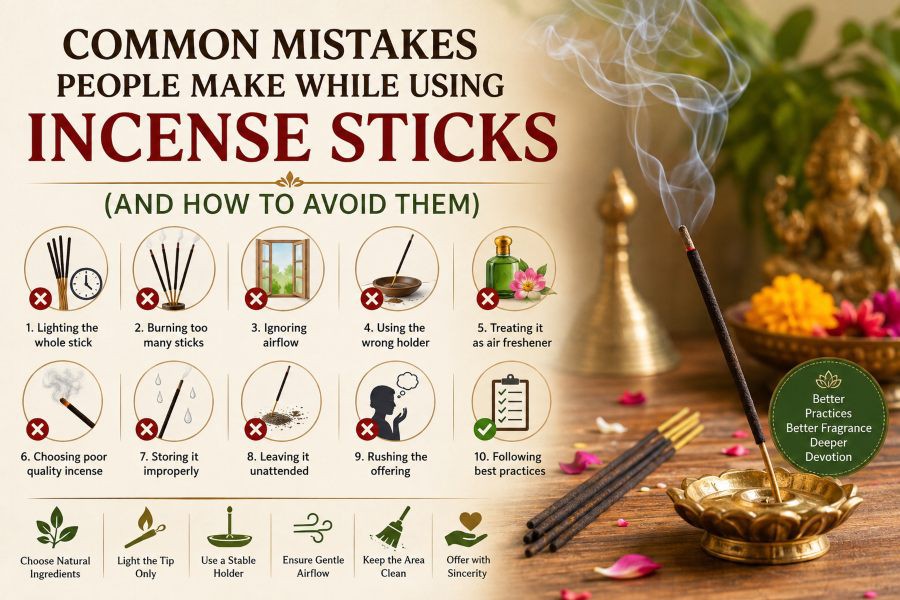
Are You Using Incense Sticks the Right Way? Common Mistakes Explained
Common Mistakes People Make While Using Incense Sticks (And How to Avoid Them)
Have you ever walked into a prayer room expecting a peaceful atmosphere, only to find the fragrance overwhelming, the smoke irritating, or the incense burning out too quickly? Many people assume that lighting Incense Sticks is as simple as striking a match and placing them in a holder. In reality, a few small mistakes can change the entire experience. Choosing authentic products from the ISKCON Mayapur Store is a good first step, but understanding how to use incense correctly is just as important. Whether you perform daily puja, meditate each morning, or simply enjoy a calming aroma at home, the way you handle incense has a direct impact on its fragrance, safety, and spiritual significance.
For centuries, incense has played a meaningful role in devotional worship across many cultures. The gentle fragrance symbolizes offering one's heart and mind to the Divine while creating an atmosphere that encourages prayer, concentration, and inner peace. Yet even experienced devotees sometimes develop habits that reduce the beauty of this sacred practice without realizing it.
This guide explores the most common mistakes people make while using Incense Sticks and explains practical ways to avoid them. Rather than relying on myths or shortcuts, you'll learn simple habits that help every stick burn cleanly, safely, and beautifully.
Why Using Incense Properly Matters More Than Most People Realize
Many people think the fragrance alone makes incense valuable. While aroma is certainly part of the experience, traditional incense has always represented something deeper.
When incense is offered during worship, it reflects respect, purity, and devotion. The rising smoke reminds many devotees of prayers ascending toward the Supreme Lord. A properly burning incense stick creates a calm environment that naturally supports chanting, meditation, scripture reading, and quiet reflection.
Improper use often leads to problems such as:
- Excessive smoke
- Weak fragrance
- Uneven burning
- Ash falling everywhere
- Fire hazards
- Headaches caused by poor-quality products
- Wasted incense
Fortunately, these problems are usually easy to prevent.
Mistake #1: Buying Incense Only Because It Smells Strong
One of the biggest misconceptions is that stronger fragrance always means better quality.
Many inexpensive incense sticks rely heavily on artificial fragrance oils. They may smell pleasant for a few minutes, but the aroma often becomes harsh, overly sweet, or synthetic as they continue burning.
High-quality incense behaves differently.
Instead of overwhelming the room immediately, it releases fragrance gradually and naturally. The scent feels balanced rather than aggressive.
When selecting incense, look for products made with natural ingredients such as:
- Sandalwood
- Herbs
- Natural resins
- Flowers
- Essential oils
- Plant powders
- Traditional wood bases
Natural ingredients usually create a smoother fragrance that feels comfortable during longer periods of worship.
Signs of Better Quality Incense
- Even coating along the stick
- Consistent thickness
- Pleasant fragrance before lighting
- Slow, steady burn
- Fine, light-colored ash
- No chemical smell
Remember, quality matters much more than intensity.
Mistake #2: Lighting the Entire Stick Like a Candle
Many beginners accidentally treat incense the same way they would light a candle.
The correct method is surprisingly simple.
1. Light only the tip.
2. Allow a small flame to burn for several seconds.
3. Gently blow out the flame.
4. Let the glowing ember continue producing fragrant smoke.
If the flame continues burning, the incense burns far too quickly.
If you extinguish it immediately before an ember forms, the stick may go out within minutes.
Taking an extra few seconds during lighting creates a much more consistent burn.
Why This Matters
A properly glowing ember:
- Produces cleaner fragrance
- Reduces unnecessary smoke
- Extends burning time
- Prevents waste
Mistake #3: Burning Too Many Incense Sticks at Once
Some people believe that more incense automatically creates a more spiritual atmosphere.
The opposite is often true.
Lighting five or six sticks inside a small room can quickly overwhelm the senses.
Instead of feeling peaceful, the room becomes smoky and uncomfortable.
Your nose gradually becomes saturated, making it difficult to appreciate the fragrance.
For daily worship, one or two high-quality Incense Sticks are usually enough.
Larger temple halls naturally require more because of the increased space and airflow, but most home prayer rooms do not.
Less Can Create More
Using fewer incense sticks allows:
- Better fragrance distribution
- Cleaner air
- Longer enjoyment
- Easier breathing
- Greater appreciation of subtle aromas
The goal is creating serenity—not filling every corner with smoke.
Mistake #4: Ignoring Airflow Completely
Many people make one of two opposite mistakes.
Some close every window.
Others place incense directly under a fan.
Neither approach works well.
A completely sealed room traps smoke.
Too much airflow causes incense to burn unevenly while carrying away the fragrance almost instantly.
The ideal environment has gentle ventilation.
Fresh air helps the fragrance circulate naturally without allowing strong drafts to interfere with the burn.
Finding the Right Balance
Good airflow should:
- Keep the room comfortable
- Prevent smoke buildup
- Allow fragrance to spread evenly
- Maintain a steady ember
Small adjustments often make a noticeable difference.
Mistake #5: Using the Wrong Holder
An unstable holder may seem like a minor issue until ash begins falling across furniture or the incense stick tips over.
The holder should keep the incense at a slight angle while catching nearly all falling ash.
Avoid holders that:
- Wiggle
- Lean excessively
- Allow the stick to move freely
- Are made from flammable materials
Stone, ceramic, brass, and heavy wooden holders generally provide better stability.
A quality holder protects both your home and your devotional space.
Never Leave Burning Incense on Makeshift Supports
People occasionally insert incense into flowerpots, cardboard, folded paper, or loose soil.
These temporary solutions often create unnecessary fire risks.
Always use a dedicated incense holder designed for safe burning.
Mistake #6: Treating Incense as an Air Freshener Instead of a Sacred Offering
Incense certainly makes a room smell pleasant, but reducing it to nothing more than an air freshener misses its traditional purpose.
In devotional practice, fragrance is an offering.
Lighting incense mindfully changes the entire experience.
Instead of rushing through the process:
- Clean the altar first.
- Arrange offerings respectfully.
- Light the incense calmly.
- Offer prayers with attention.
- Allow the fragrance to become part of your meditation.
This simple shift transforms a daily routine into a meaningful act of devotion.
Quality Always Outlasts Quantity
One premium incense stick often provides a richer experience than several low-quality sticks burning together.
Natural ingredients, careful craftsmanship, proper lighting, and thoughtful placement all work together to produce a clean, peaceful atmosphere.
Many problems people blame on incense are actually caused by incorrect usage rather than the incense itself.
Understanding these basics creates a noticeably better devotional experience every single day.
Mistake #7: Choosing the Wrong Incense for the Occasion
Not every fragrance creates the same atmosphere. Yet many people buy a single scent and use it for every purpose, whether they are performing morning worship, meditating, welcoming guests, or celebrating a festival.
Traditional devotional practices often associate different natural aromas with different moods. While there is no rigid rule that says one fragrance must always be used for a particular ceremony, selecting a suitable scent can enhance the overall experience.
For example:
- Sandalwood creates a calm and meditative environment.
- Rose adds warmth and devotion to daily worship.
- Jasmine brings a gentle, uplifting fragrance.
- Frankincense is often appreciated during extended meditation.
- Natural herbal blends create a fresh and balanced atmosphere.
Instead of choosing incense solely because it smells pleasant in the package, think about the environment you wish to create.
Ask yourself:
- Is this for personal meditation?
- Is this part of a daily puja?
- Will several people be present?
- Does anyone nearby have fragrance sensitivity?
Matching the incense to the purpose often produces a far more satisfying experience.
Mistake #8: Ignoring the Ingredients List
Many buyers pay attention only to the packaging.
That can be an expensive mistake.
Beautiful boxes do not always contain quality incense.
Some inexpensive products contain excessive synthetic fragrance oils, artificial colors, or fillers that burn unevenly and create unnecessary smoke.
Reading the ingredient information may take only a minute, yet it tells you a great deal about what you are bringing into your home.
Whenever possible, choose incense made from naturally derived ingredients such as:
- Wood powders
- Herbs
- Flowers
- Plant resins
- Essential oils
- Traditional binding materials
Natural incense generally provides a softer, more authentic aroma that develops gradually as it burns.
Quality ingredients also tend to leave finer ash and produce a cleaner burn.
Mistake #9: Forgetting That Cleanliness Is Part of Worship
Many people carefully light incense but overlook the space around it.
Imagine placing beautiful flowers in a dusty vase. The flowers remain attractive, but the overall presentation loses its beauty.
The same principle applies during worship.
Before lighting Incense Sticks, take a few moments to tidy the prayer area.
Simple habits make a noticeable difference:
- Dust the altar regularly.
- Remove old flowers.
- Empty accumulated ash.
- Wipe incense holders.
- Replace damaged holders.
- Keep nearby surfaces clean.
A clean devotional space allows the fragrance to complement the environment rather than compete with clutter.
Mistake #10: Leaving Burning Incense Unattended
People often underestimate how long incense continues burning.
A typical stick may remain lit for 30 to 60 minutes depending on its size and composition.
During that time, accidents can happen if the incense is placed near curtains, papers, decorative fabrics, or wooden shelves.
Even falling ash can become a problem if the holder is unstable.
For safety:
- Always place incense on a heat-resistant surface.
- Keep it away from children and pets.
- Avoid burning incense near open windows where strong wind may knock it over.
- Extinguish it if you must leave the room for an extended period.
Devotion should always be accompanied by responsibility.
Mistake #11: Storing Incense Improperly
Many people unknowingly shorten the life of their incense before ever lighting it.
Incense naturally absorbs moisture from the surrounding air.
If stored carelessly, it may:
- Lose fragrance.
- Burn unevenly.
- Become difficult to light.
- Break easily.
The best storage conditions are surprisingly simple.
Store incense:
- In a cool location.
- Away from direct sunlight.
- Inside its original box or a sealed container.
- Away from excessive humidity.
- Away from strong household odors.
Strong-smelling products such as cleaning chemicals or perfumes may gradually affect delicate natural fragrances.
Proper storage helps preserve the original aroma for many months.
Mistake #12: Expecting Instant Relaxation
Some people light incense expecting immediate peace of mind.
When that doesn't happen, they assume the incense isn't effective.
The fragrance itself is only one part of the experience.
Your surroundings, breathing, thoughts, and level of attention all influence how you feel.
Think of incense as creating the right atmosphere—not as performing the meditation for you.
Pair incense with simple practices such as:
- Slow breathing
- Quiet chanting
- Reading sacred scriptures
- Silent prayer
- Gentle reflection
These habits allow the fragrance to support your spiritual practice instead of becoming background decoration.
Why Cheap Incense Often Costs More in the Long Run
At first glance, inexpensive incense appears to save money.
But poor-quality products often:
- Burn faster.
- Produce inconsistent fragrance.
- Leave excessive ash.
- Break during handling.
- Require several sticks to scent one room.
A well-made incense stick generally burns evenly from beginning to end, providing a richer experience with fewer sticks.
Quality is often more economical than quantity.
Creating a Peaceful Daily Ritual
One of the greatest benefits of incense is consistency.
A familiar fragrance gradually becomes associated with prayer and inner stillness.
Over time, simply lighting the incense can gently signal your mind that it is time to slow down and focus.
A simple daily routine might look like this:
1. Clean the altar.
2. Arrange flowers or offerings.
3. Light one incense stick correctly.
4. Offer prayers with attention.
5. Sit quietly for a few minutes.
6. Allow the fragrance to fill the room naturally.
This takes only a short time but can become one of the most meaningful moments of the day.
Small Changes Make a Big Difference
Most incense-related problems are not caused by the incense itself.
They usually come from small habits that people never question.
Choosing better-quality products, storing them correctly, maintaining a clean worship area, and using incense thoughtfully can completely transform the experience.
The beauty of devotional practices often lies in these small details. When each step is performed with care and attention, even the simple act of lighting an incense stick becomes a meaningful expression of devotion rather than just another daily routine.
Mistake #13: Believing More Smoke Means Better Quality
A thick cloud of smoke may look impressive, but it is not a reliable sign of high-quality Incense Sticks. Many people assume that the more smoke an incense stick produces, the richer the fragrance will be. In reality, excessive smoke often comes from low-grade ingredients or an improper burning process.
Well-crafted incense burns steadily and releases its aroma in a balanced way. The fragrance should gradually fill the room rather than overwhelm it within a few minutes.
If you notice that a stick creates heavy smoke with very little pleasant aroma, it may be worth trying a product made with more natural ingredients.
What to Look For Instead
A quality incense stick should:
- Burn evenly from top to bottom.
- Produce a consistent fragrance.
- Leave light, fine ash.
- Stay lit without constant relighting.
- Create a pleasant atmosphere instead of making the room feel smoky.
Remember, your goal is not to produce smoke—it is to create an environment that supports prayer, meditation, and peace.
Mistake #14: Relighting the Same Incense Stick Repeatedly
Some people light an incense stick for a few minutes, extinguish it, and then relight it several times throughout the day.
Although this may seem economical, it often changes the fragrance and burning quality.
Each time the ember is extinguished, residue forms around the burning tip. When relit, the incense may burn unevenly or produce a slightly different aroma.
If you only need incense for a short prayer session, consider using:
- Shorter incense sticks.
- Half-length sticks.
- Naturally smaller handcrafted varieties.
This approach preserves the fragrance while reducing waste.
Mistake #15: Holding the Burning Stick Incorrectly
After lighting incense, some people carry it around while it is still producing ash.
Although this may appear harmless, ash can fall unexpectedly onto clothing, carpets, or furniture.
A safer approach is to:
- Hold the stick near the unlit end.
- Move carefully.
- Place it in the holder immediately after offering it during worship.
Simple habits like these help keep both the altar and surrounding space clean.
Mistake #16: Forgetting That Every Room Is Different
An incense stick that performs beautifully in one room may behave differently in another.
Several factors influence how fragrance spreads:
- Room size.
- Ceiling height.
- Ventilation.
- Humidity.
- Air conditioning.
- Open windows.
For example, a small meditation room usually requires only one incense stick.
A large prayer hall may need several, spaced thoughtfully throughout the area.
Instead of following a fixed rule, adjust the number of sticks according to the space.
Mistake #17: Choosing Fragrance Over Craftsmanship
Beautiful packaging and attractive scent descriptions can easily influence buying decisions.
However, experienced devotees often evaluate incense differently.
They pay attention to craftsmanship.
Signs of careful manufacturing include:
- Straight bamboo core.
- Even coating from top to bottom.
- Consistent thickness.
- Smooth finish without cracks.
- Minimal powder falling off before lighting.
These details indicate attention during production and usually result in a better burning experience.
Mistake #18: Rushing Through the Offering
Many people light incense while thinking about work, household responsibilities, or their next appointment.
The offering becomes automatic.
Traditional worship encourages something very different.
Even a single minute of focused attention can transform the experience.
Before lighting incense:
Take one slow breath.
Pause.
Offer your prayer sincerely.
Allow your attention to settle before moving on.
These few seconds often make the devotional experience far more meaningful than simply completing another task on a checklist.
Common Myths About Incense Sticks
Many ideas about incense have been repeated for years without much evidence. Let's separate myth from reality.
Myth 1: Expensive Always Means Better
Price alone doesn't determine quality.
Some premium products genuinely use excellent natural ingredients, while others rely mainly on attractive branding.
Judge incense by its ingredients, craftsmanship, fragrance, and performance—not only by its price tag.
Myth 2: Every Natural Incense Smells the Same
Natural incense comes from a wide variety of flowers, woods, herbs, spices, and resins.
Each ingredient contributes its own character.
For example:
- Sandalwood is warm and calming.
- Rose feels soft and devotional.
- Jasmine is light and floral.
- Herbal blends often feel earthy and refreshing.
Exploring different fragrances help
Posted in: Incense or Agarbatti
Related posts
-
 How to Light Incense SticksDiscover the right way to light incense sticks (agarbatti) for worship, meditation, and peace. Learn step-by-step...Read more
 -
 Where to Buy Incense SticksDiscover where to buy the best natural incense sticks for your daily puja, meditation, and relaxation. Explore pure,...Read more
 -
 Is Incense Sticks Bad for Pregnancy? Wondering if incense sticks are safe during pregnancy? Discover the truth about incense smoke, its effects on...Read more
 -
 Do Incense Sticks Trigger Fire Alarms? Wondering if incense sticks can trigger fire alarms? Learn how smoke affects detectors, safe burning tips, and...Read more
 -
 How Many Incense Sticks to Burn for Good LuckDiscover how many incense sticks to burn for good luck and prosperity. Learn the ideal numbers, rituals, and natural...Read more
Leave a comment