
Why did Krishna run to embrace a poor brahmin in rags? Read the Sudama story from the Bhagavatam and learn how a...
Latest posts
-
 Krishna and Sudama: The Poor Brahmin Who Became Wealthy in LoveRead more
 -
 Vamana Avatar: How Three Steps Humbled Bali MaharajaRead more
Why did a powerful king give away three worlds to a boy asking for three steps? Learn the Vamana avatar story from...
-
 The Bhagavatam on Marriage: Duty, Love and Spiritual PartnershipRead more
What does the Bhagavatam say about marriage? Through the stories of Kardama and Devahuti, Rukmini's secret letter and...
-
 What Is Prema? The Bhagavatam's Highest Stage of Love for GodRead more
Prema is love for God with no "because" attached. Learn how the Bhagavatam describes it, the nine steps from faith to...
-
 Is Shiva Parvati Kalyana Mentioned in Srimad Bhagavatam? What the Scripture Really SaysRead more
Looking for Shiva and Parvati's wedding in the Srimad Bhagavatam? Find out what the scripture actually describes,...
-
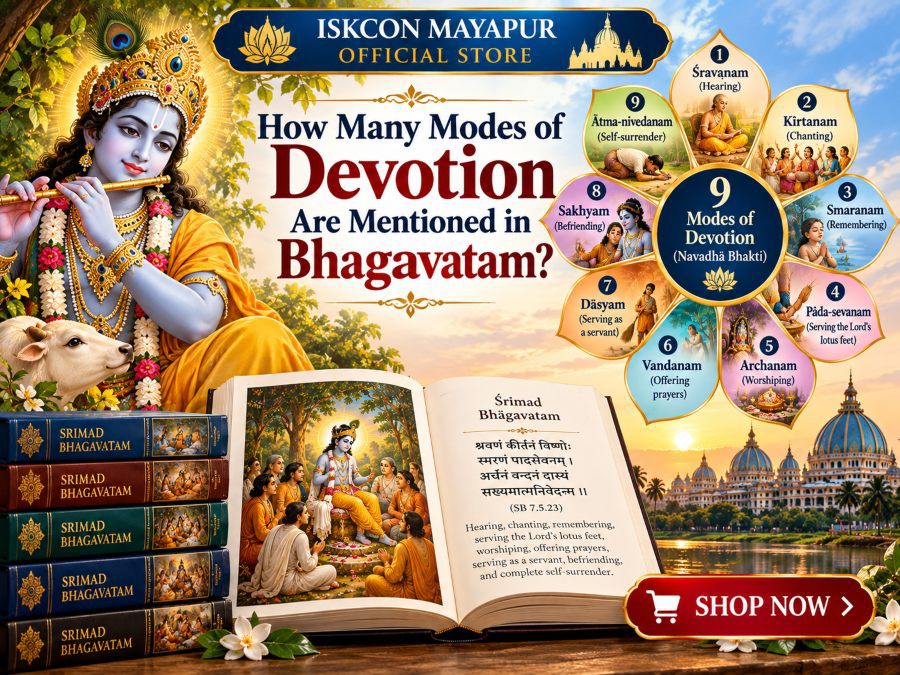 How Many Modes of Devotion Are Mentioned in Bhagavatam?Read more
A young boy named Prahlada listed nine ways to serve God, and the Bhagavatam keeps them as its answer. Learn what the...
-
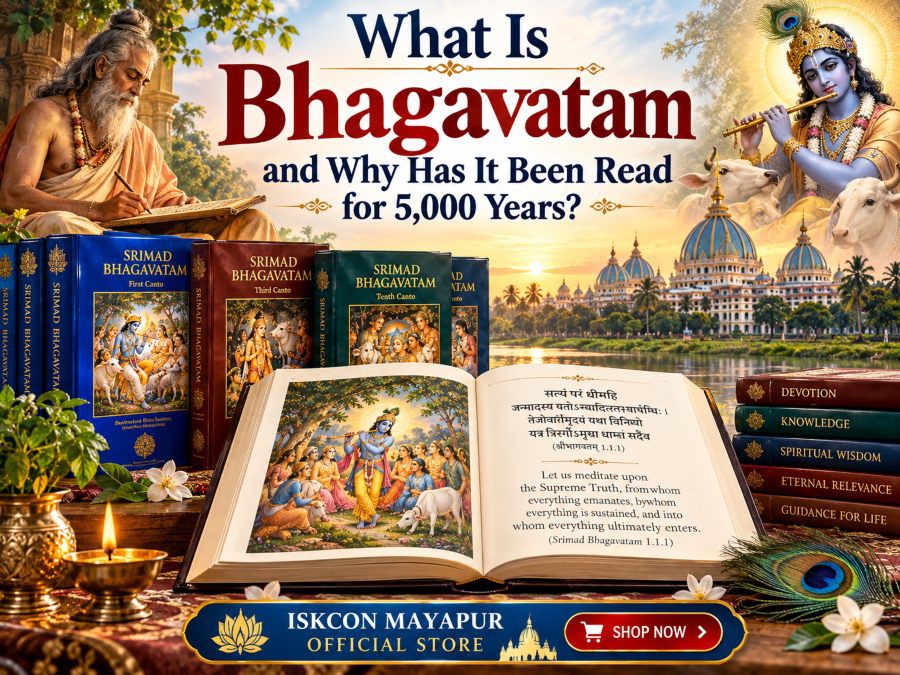 What Is Bhagavatam and Why Has It Been Read for 5,000 Years?Read more
A dying king asked one question, and the answer became the Bhagavatam. Learn what this Sanskrit scripture contains,...
-
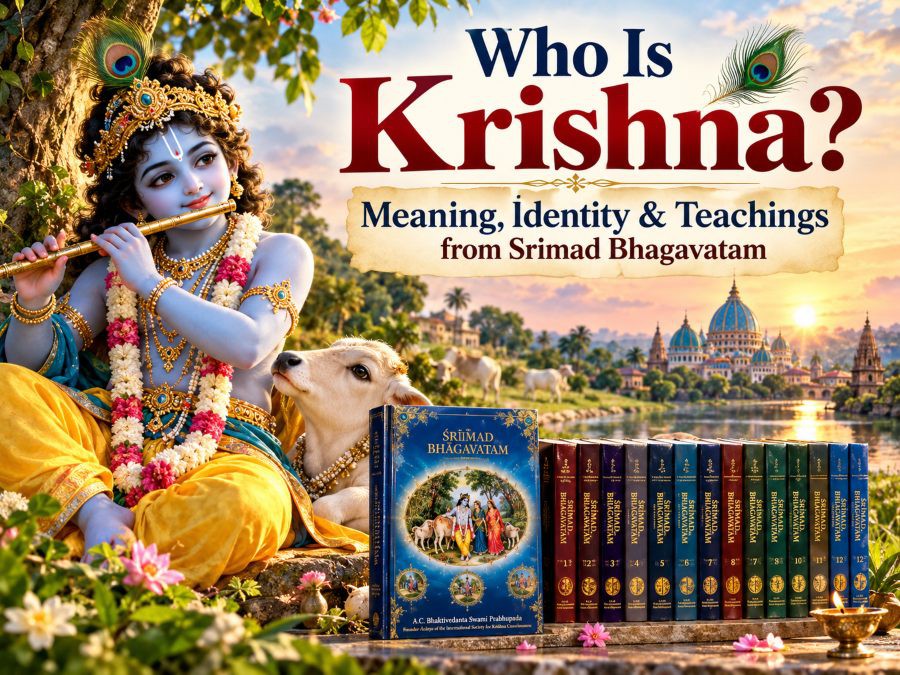 Who Is Lord Krishna? His Meaning, Teachings and Pastimes ExplainedRead more
Discover who Krishna is according to Srimad Bhagavatam, including His divine identity, childhood pastimes, teachings,...
-
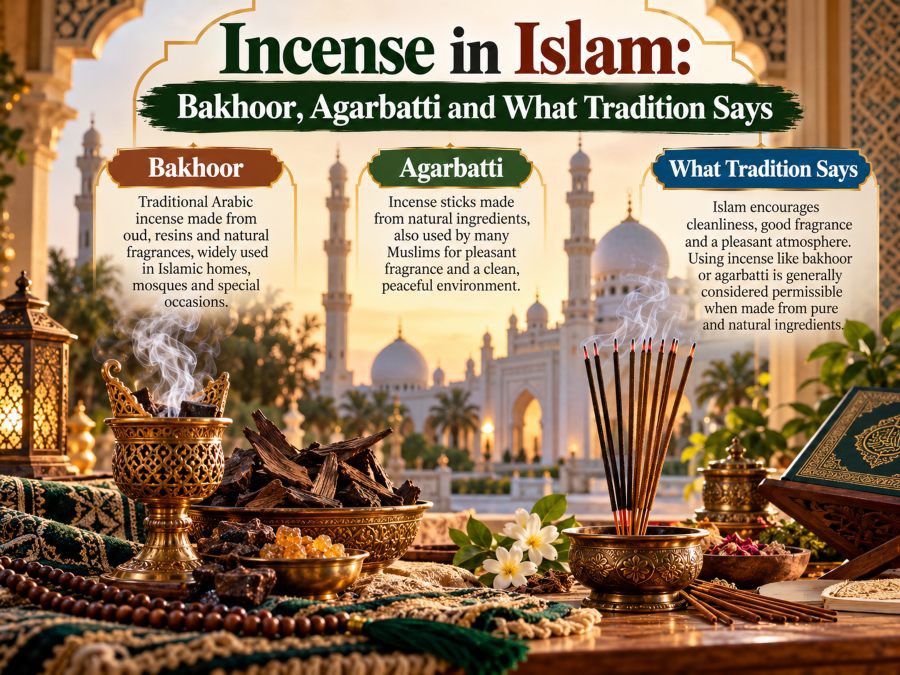 Incense in Islam: Bakhoor, Agarbatti and What Tradition SaysRead more
Is burning fragrance part of Muslim tradition? Explore incense in Islam, from the Prophetic practice of fumigating...
-
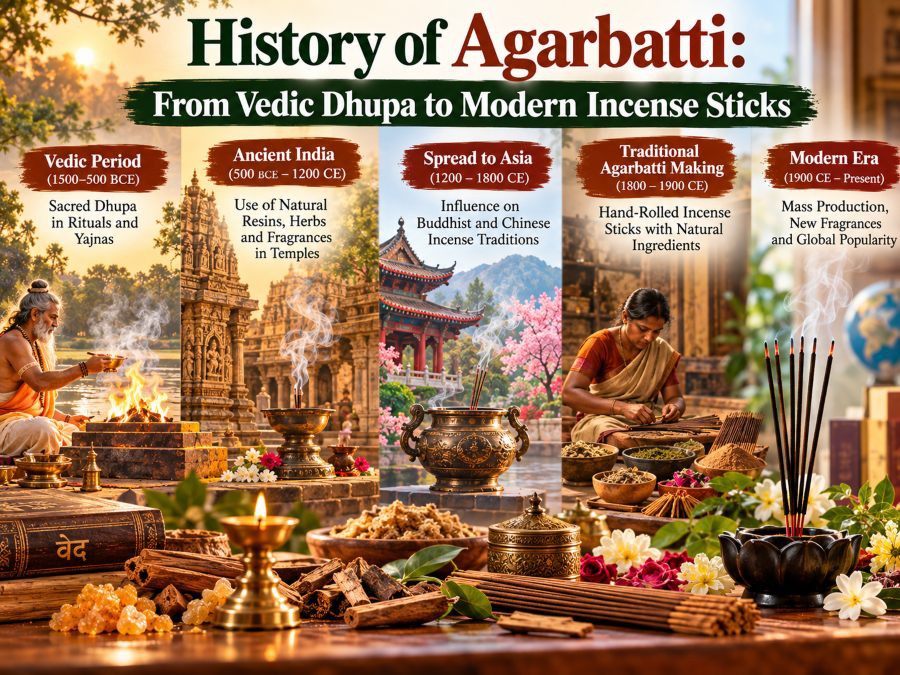 History of Agarbatti: From Vedic Dhupa to Modern Incense SticksRead more
Where did agarbatti really come from? Follow the history of agarbatti from Vedic fire rituals and temple dhupa to...
Blog categories
- Default category (0)
- MUSICAL INSTRUMENT (1)
- BOOK (5)
- DEVOTIONAL GIFT (0)
- Blog (30) click
- CHANDAN (12)
- Bhagavatam Wisdom Series (68)
- Krishna Consciousness (14)
- Mridangam Musical Instrument (6)
- Bhagavad Gita for Beginners (13)
- Bhagavad Gita As It Is (37) click
- Bhagavad Gita As It Is Telugu (0)
- Bhagavad Gita As It Is Marathi (0)
- Bhagavad Gita As It Is In Hindi (0)
- Bhagavad Gita As It Is In English (0)
- Bhagavad Gita As It Is In Bengali (8)
- Bhagavad Gita As It Is In Kannada (0)
- Bhagavad Gita As It Is In Gujarati (0)
- Bhagavad Gita As It Is In Panjabi (0)
- Bhagavad Gita As It Is In Tamil (0)
- Bhagavad Gita As It Is Odia (0)
- BHAGAVAD GITA As It Is GERMAN (0)
- Bhagavad Gita As It Is In French (0)
- Bhagavad Gita As It Is In Nepali (0)
- Bhagavad Gita As It Is In Assamese (0)
- Incense or Agarbatti (38)
- Lord Chaitanya Mahaprabhu (3)
- Vedic Temple Mayapur (14)
- kalki (15)
- Mahabharata – Dharma & Destiny (27)
- Vaishnava Scriptures (4)
- healthy product (4)
- chaitanya mahaprabhu (5)
- Tulsi Mala Guide (17)
Search in blog
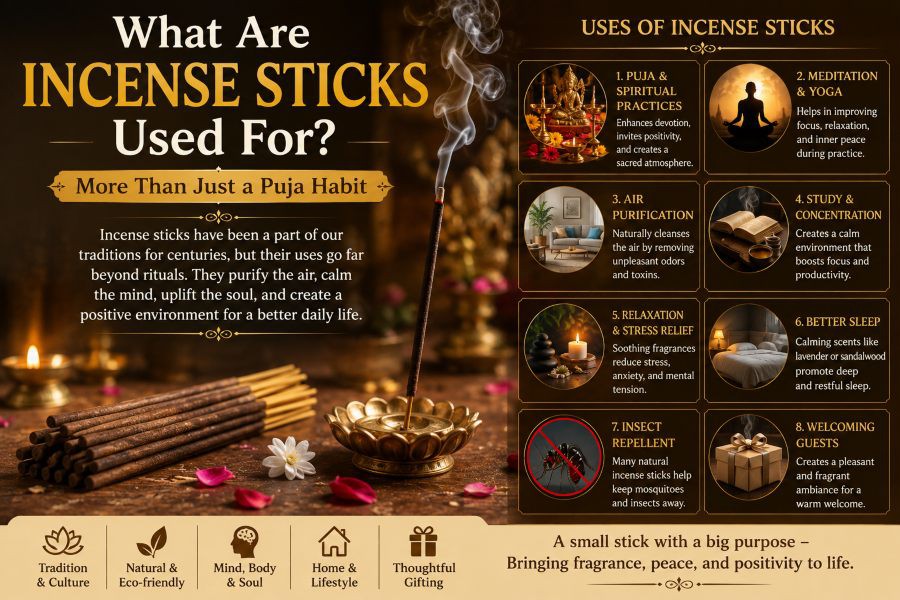
What Are Incense Sticks Used For?
What Are Incense Sticks Used For? More Than Just a Puja Habit
Light one, and within seconds a room transforms. That's the strange power of a single thin stick of smoke — something so small doing so much work at once. Incense sticks are burned for reasons far wider than most people assume: worship, meditation, cleansing a space, masking odors, marking time during rituals, even therapeutic use in traditional medicine systems. If you've only ever associated them with the morning aarti at home or picked up a pack from ISKCON Mayapur Store Incense Stick for temple offerings, you're only seeing one slice of what these sticks actually do.
Once you understand the full range of uses, the humble incense stick stops looking like a small ritual accessory and starts looking like one of the most versatile objects sitting quietly on your shelf.
The Obvious One First: Worship and Puja
Let's start where most people already know incense belongs — religious ritual. Across nearly every major devotional tradition in India, incense forms part of the panchopachara or shodashopachara — the five or sixteen traditional offerings made to a deity during worship. Fragrance sits right alongside light, water, flowers, and food as something offered with reverence, not just lit as background atmosphere.
In ISKCON temples specifically, incense is offered during aarti as one of the five elements presented to the deities — representing the element of air, moving in circular motions before the altar. It's not decorative. It's structural to the ritual itself.
But even within "worship," the specific uses branch out:
- Daily home puja — a quick stick lit each morning or evening as part of a regular routine
- Temple aarti — larger dhoop or incense burned collectively during group worship
- Special occasions — festivals, ekadashi observances, and birthdays of deities often call for specific, more elaborate incense blends
- Homa and yajna rituals — where incense-grade resins are sometimes added directly to the sacred fire, distinct from stick-form incense but part of the same fragrance-offering tradition
Marking Sacred Time — The Incense Clock
Here's a use for incense sticks that most people have never even heard of: telling time. Long before mechanical clocks existed, monasteries and temples across Asia used calibrated incense sticks, sometimes with knotted threads or embedded metal balls, to measure fixed intervals during meditation or ritual sessions.
A stick burning at a known, consistent rate becomes a surprisingly reliable timer. Some traditional meditation practices still use this method today — lighting a stick and sitting until it burns out, rather than glancing at a phone screen every few minutes. There's something quietly disciplined about that approach. You're not checking progress. You're just present until the smoke says you're done.
Meditation and Mental Focus
Speaking of meditation — this might be the single fastest-growing non-religious use of incense sticks today, especially among younger practitioners who aren't necessarily approaching it from a devotional angle at all.
Here's the logic behind why it works so well:
Smell creates an anchor. The brain associates repeated sensory cues with specific mental states. Light the same incense every time you sit down to meditate, and over weeks, your brain starts linking that scent directly with focus and stillness. Eventually, just the smell alone begins nudging your mind toward calm, almost like a trigger.
It gives restless minds something to notice. Beginners often struggle with meditation because their attention has nothing anchored to hold onto besides breath, which can feel abstract. A slow curl of smoke rising in front of you gives the eyes and mind a gentle, non-distracting point of focus.
It marks a clear beginning and end. Just like the ancient incense clocks, a burning stick signals "this is meditation time" the moment it's lit, and "we're done" when it burns out — no timer app required.
Aromatherapy and Emotional Regulation
Move outside spiritual contexts entirely, and incense sticks show up constantly in aromatherapy — a field built on the idea that specific scents can influence mood, stress levels, and even sleep quality.
- Lavender and sandalwood blends are commonly used to reduce anxiety and promote calm before sleep
- Citrus and floral blends are used for uplifting, energizing effects during daytime work
- Musk and woody notes are often chosen for grounding, especially during stressful periods
This isn't purely folk wisdom either — the olfactory system's direct line into the brain's limbic region (the part handling emotion) is well documented, which is exactly why scent-based mood regulation has legitimate physiological backing rather than being purely psychological placebo.
Masking Odors and Creating Ambience
Sometimes the reason is refreshingly simple: a room smells like last night's cooking, or a guest is arriving in twenty minutes, and incense is the fastest fix available. This everyday, practical use doesn't get talked about much because it feels less profound than spiritual or therapeutic uses, but it's genuinely one of the most common reasons people reach for a stick.
Restaurants, boutique stores, and even office receptions use incense or similar fragrance diffusion for exactly this reason — creating a specific sensory first impression the moment someone walks in. A well-chosen fragrance does more atmospheric work in ten seconds than any amount of interior decorating.
Air Purification — Myth, Partial Truth, and What's Actually Happening
There's a popular belief that incense "purifies" the air, and this claim deserves an honest look rather than blanket acceptance or dismissal.
What's true: Certain natural resins burned as incense — particularly frankincense and guggul — release compounds that have measurable antimicrobial properties in enclosed spaces. Traditional Ayurvedic practice has used dhoop specifically for this reason during illness recovery periods, and some modern research has explored antibacterial effects of burning specific resins.
What's overstated: Burning any incense doesn't magically "cleanse" a room of all pollutants. In fact, poor-quality synthetic incense actually adds particulate matter and volatile compounds to indoor air, which can work against air quality rather than for it.
The distinction matters: natural resin-based dhoop, burned occasionally in a ventilated space, likely does carry some antimicrobial benefit rooted in genuine chemistry. Synthetic, chemically-dipped sticks burned constantly in a sealed room are a different story altogether, and treating both as equivalent "air purifiers" isn't accurate.
Gifting and Cultural Exchange
Incense sticks have quietly become one of the more popular gifting items during festivals, especially as people move away from sweets and toward more personal, longer-lasting gifts. A beautifully packaged box of handmade sandalwood or rose incense signals thoughtfulness in a way that's harder to achieve with generic gift items.
This use has expanded internationally too. Devotees and travelers regularly carry temple incense back home after visiting places like Mayapur, both for personal use and to share with fellow practitioners abroad who don't have easy access to authentic, temple-grade blends. In this sense, incense sticks function almost like edible souvenirs of a spiritual journey — compact, meaningful, and genuinely usable rather than decorative clutter.
Insect Deterrence — The Practical Cousin of Ritual Use
Certain traditional incense blends, particularly those containing neem, citronella-adjacent botanicals, or specific resins, double as natural insect deterrents. This isn't a modern discovery — rural households across India have burned specific herbal blends at dusk for generations, partly for ritual reasons and partly because it kept mosquitoes at bay during evening hours.
This dual-purpose nature is worth remembering: many "purely spiritual" traditions actually carried practical wisdom baked in, whether or not that was the stated intention at the time.
Yoga and Bodywork Studios
Walk into most yoga studios, and incense is almost guaranteed to be part of the sensory setup — usually a lighter, floral, or woody blend burned before or during a session. The reasoning mirrors the meditation use case: scent as an anchor, a signal that transitions the mind from regular activity into practice mode.
Some instructors specifically avoid heavier, smoke-dense incense during active practice, given that deep breathing during yoga makes the body more sensitive to particulate irritation — a good reminder that context matters when choosing which type of incense fits which activity.
Grief, Remembrance, and Quiet Moments
One of the more understated uses of incense sticks is during moments of remembrance — lighting one near a photograph of someone who has passed, or during specific memorial rituals. The slow burn and gradual fading fragrance mirror something about grief itself: present, then softening, then gone, but leaving a trace behind.
This use rarely makes it into commercial descriptions of incense, but anyone who has done it understands why it carries weight. It's a small, physical act that gives an abstract emotion — grief, longing, remembrance — something concrete to do.
Choosing the Right Incense for the Right Use
Since incense sticks serve so many different purposes, using the same blend for everything is a bit like wearing the same outfit to a wedding and a workout. A few practical pairings worth knowing:
- For daily puja: Sandalwood, rose, or classic temple blends work best for consistency and emotional anchoring
- For meditation: Lighter, single-note fragrances like pure sandalwood avoid overstimulating the senses
- For sleep and relaxation: Lavender-adjacent or musk-based blends support winding down
- For guest-ready ambience: Floral or citrus blends create a fresh, welcoming impression quickly
- For insect deterrence: Neem or citronella-infused traditional blends handle both function and fragrance
Incense in Study Spaces and Focused Work
There's a smaller but growing use case worth mentioning: students and remote workers burning incense while studying or working on demanding tasks. The logic borrows directly from the meditation anchor effect described earlier, just applied to concentration instead of stillness.
A consistent, non-distracting scent — usually something mild like sandalwood or a light woody blend — can help signal "focus mode" to the brain the same way certain playlists or specific lighting does. It's not a magic productivity hack, but for people who already respond well to sensory cues, it's a low-effort addition to a study or work routine. The key word here is mild. Heavy, smoke-dense incense in a small room during hours of concentrated work tends to backfire, causing drowsiness or headaches rather than helping focus.
Marking Transitions in the Home
Beyond formal ritual, many households use incense to mark smaller, everyday transitions — lighting a stick after cleaning the house, before guests arrive, or at the start of a new week. This isn't tied to any specific scripture or rule; it's more of an inherited household instinct, passed down without anyone necessarily articulating why.
Psychologically, this fits a well-documented pattern: humans use small sensory rituals to signal a shift from one state to another — messy to clean, ordinary to prepared, one week to the next. Incense, with its clear beginning and gradual end, happens to be perfectly suited for this kind of quiet transition marking, even outside any religious framework.
The Bigger Picture
What starts as a simple stick of fragrant smoke turns out to be doing an enormous amount of quiet work — anchoring rituals, marking time, shifting moods, easing grief, deterring insects, and occasionally even supporting genuine air quality benefits when the ingredients are right. Few household objects carry that much range without anyone really noticing.
The next time you light one, it's worth pausing for a second longer than usual. That thin curl of smoke rising in front of you isn't just tradition running on autopilot — it's centuries of accumulated practical and spiritual wisdom, distilled into something you can hold between two fingers.
Frequently Asked Questions
Can incense sticks be used every day without harm? Yes, provided the blend is natural and the room has some ventilation. Daily use of synthetic, chemically-dipped sticks in a closed space is where problems tend to arise, not the practice of daily burning itself.
Is there a difference between incense used for meditation and incense used for puja? Not structurally, but practically yes — meditation generally calls for lighter, single-note fragrances that don't overwhelm focus, while puja incense often carries richer, more layered traditional blends suited to ritual offering.
Do incense sticks actually repel mosquitoes? Certain traditional blends containing neem or similar botanicals do have a mild deterrent effect, though they shouldn't be relied on as a sole mosquito control method in high-risk areas.
Why do different regions use different incense fragrances for the same rituals? Regional plant availability, climate, and localized temple traditions have shaped distinct fragrance preferences over centuries, which is why sandalwood-forward blends dominate in some areas while resin-heavy dhoop is more common in others.
Posted in: Incense or Agarbatti
Related posts
-
 How to Light Incense SticksDiscover the right way to light incense sticks (agarbatti) for worship, meditation, and peace. Learn step-by-step...Read more
 -
 Where to Buy Incense SticksDiscover where to buy the best natural incense sticks for your daily puja, meditation, and relaxation. Explore pure,...Read more
 -
 Is Incense Sticks Bad for Pregnancy? Wondering if incense sticks are safe during pregnancy? Discover the truth about incense smoke, its effects on...Read more
 -
 Do Incense Sticks Trigger Fire Alarms? Wondering if incense sticks can trigger fire alarms? Learn how smoke affects detectors, safe burning tips, and...Read more
 -
 How Many Incense Sticks to Burn for Good LuckDiscover how many incense sticks to burn for good luck and prosperity. Learn the ideal numbers, rituals, and natural...Read more
Leave a comment