
Why did Krishna run to embrace a poor brahmin in rags? Read the Sudama story from the Bhagavatam and learn how a...
Latest posts
-
 Krishna and Sudama: The Poor Brahmin Who Became Wealthy in LoveRead more
 -
 Vamana Avatar: How Three Steps Humbled Bali MaharajaRead more
Why did a powerful king give away three worlds to a boy asking for three steps? Learn the Vamana avatar story from...
-
 The Bhagavatam on Marriage: Duty, Love and Spiritual PartnershipRead more
What does the Bhagavatam say about marriage? Through the stories of Kardama and Devahuti, Rukmini's secret letter and...
-
 What Is Prema? The Bhagavatam's Highest Stage of Love for GodRead more
Prema is love for God with no "because" attached. Learn how the Bhagavatam describes it, the nine steps from faith to...
-
 Is Shiva Parvati Kalyana Mentioned in Srimad Bhagavatam? What the Scripture Really SaysRead more
Looking for Shiva and Parvati's wedding in the Srimad Bhagavatam? Find out what the scripture actually describes,...
-
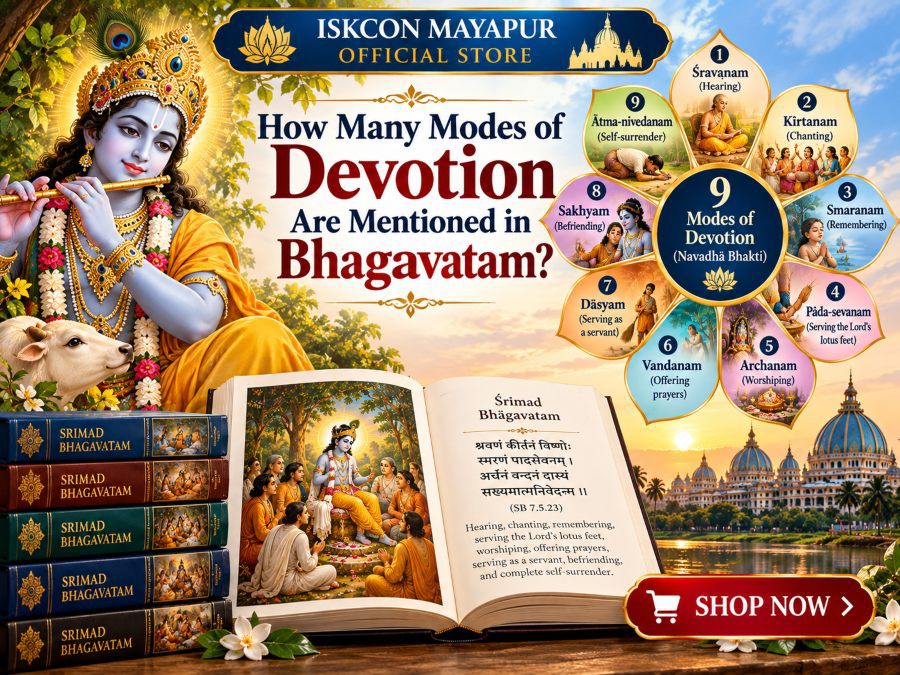 How Many Modes of Devotion Are Mentioned in Bhagavatam?Read more
A young boy named Prahlada listed nine ways to serve God, and the Bhagavatam keeps them as its answer. Learn what the...
-
 What Is Bhagavatam and Why Has It Been Read for 5,000 Years?Read more
A dying king asked one question, and the answer became the Bhagavatam. Learn what this Sanskrit scripture contains,...
-
 Who Is Lord Krishna? His Meaning, Teachings and Pastimes ExplainedRead more
Discover who Krishna is according to Srimad Bhagavatam, including His divine identity, childhood pastimes, teachings,...
-
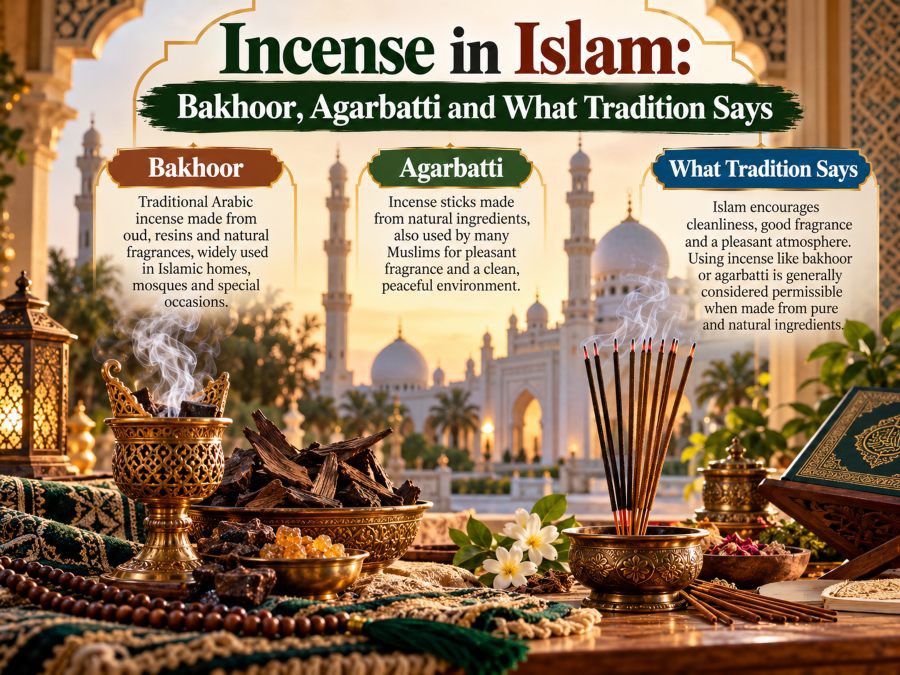 Incense in Islam: Bakhoor, Agarbatti and What Tradition SaysRead more
Is burning fragrance part of Muslim tradition? Explore incense in Islam, from the Prophetic practice of fumigating...
-
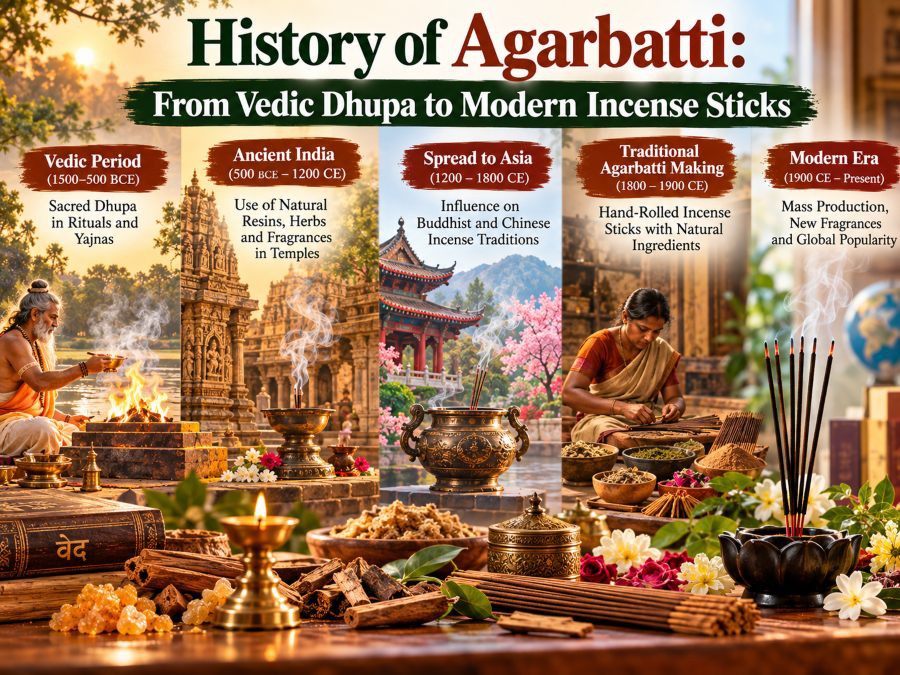 History of Agarbatti: From Vedic Dhupa to Modern Incense SticksRead more
Where did agarbatti really come from? Follow the history of agarbatti from Vedic fire rituals and temple dhupa to...
Blog categories
- Default category (0)
- MUSICAL INSTRUMENT (1)
- BOOK (5)
- DEVOTIONAL GIFT (0)
- Blog (30) click
- CHANDAN (12)
- Bhagavatam Wisdom Series (68)
- Krishna Consciousness (14)
- Mridangam Musical Instrument (6)
- Bhagavad Gita for Beginners (13)
- Bhagavad Gita As It Is (37) click
- Bhagavad Gita As It Is Telugu (0)
- Bhagavad Gita As It Is Marathi (0)
- Bhagavad Gita As It Is In Hindi (0)
- Bhagavad Gita As It Is In English (0)
- Bhagavad Gita As It Is In Bengali (8)
- Bhagavad Gita As It Is In Kannada (0)
- Bhagavad Gita As It Is In Gujarati (0)
- Bhagavad Gita As It Is In Panjabi (0)
- Bhagavad Gita As It Is In Tamil (0)
- Bhagavad Gita As It Is Odia (0)
- BHAGAVAD GITA As It Is GERMAN (0)
- Bhagavad Gita As It Is In French (0)
- Bhagavad Gita As It Is In Nepali (0)
- Bhagavad Gita As It Is In Assamese (0)
- Incense or Agarbatti (38)
- Lord Chaitanya Mahaprabhu (3)
- Vedic Temple Mayapur (14)
- kalki (15)
- Mahabharata – Dharma & Destiny (27)
- Vaishnava Scriptures (4)
- healthy product (4)
- chaitanya mahaprabhu (5)
- Tulsi Mala Guide (17)
Search in blog
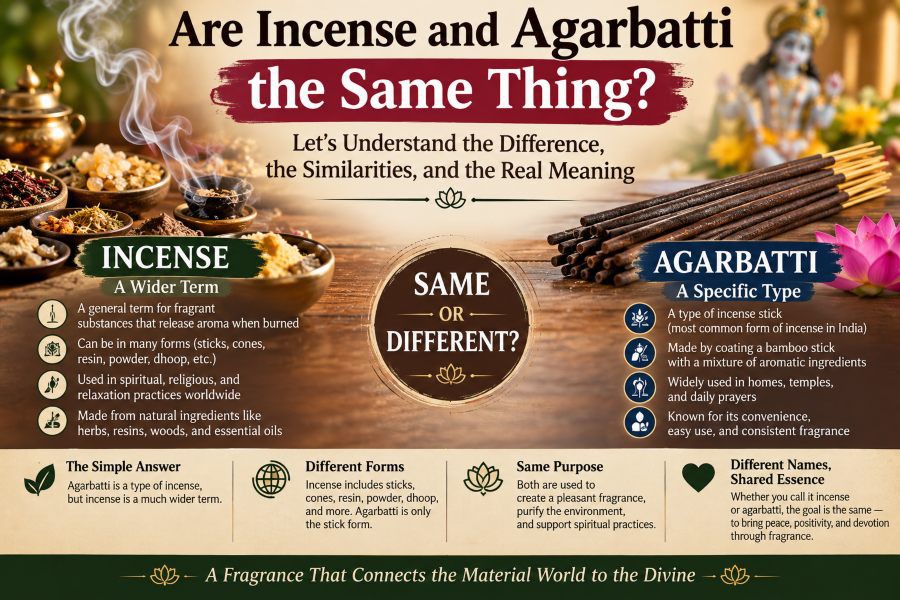
Are Incense and Agarbatti the Same Thing?
Are Incense and Agarbatti the Same Thing? The Confusion Explained
Ask ten people in a puja shop whether "incense" and "agarbatti" mean the same thing, and you'll probably get ten confident, contradictory answers. Some will say they're identical. Others will insist agarbatti is just the Hindi word for incense sticks. A few will shrug and say it doesn't matter anyway. Here's the honest answer: incense sticks and agarbatti aren't quite the same thing, though the confusion is completely understandable once you see how the language actually evolved. If you've been buying products from a trusted source like ISKCON Mayapur Store Incense Sticks/Agarbatti without ever questioning the terminology, you're not alone — most devotees never stop to untangle these words either.
This isn't just a pedantic language exercise. Understanding the actual difference changes how you shop, how you choose the right product for a specific ritual, and honestly, it makes you sound like you know what you're talking about the next time someone brings up the topic at a puja gathering.
The Short Answer, Before We Get Into the Long One
Incense is the umbrella category — any substance burned to produce fragrant smoke, regardless of shape, form, or method.
Agarbatti is one specific type of incense — the stick form, built around a bamboo core, coated in an aromatic paste.
So every agarbatti is incense. But not every incense is agarbatti. That's the entire relationship in one sentence. The rest of this article is really just unpacking why that distinction matters more than it seems.
Where the Word "Agarbatti" Actually Comes From
Language tells you more than dictionaries ever admit. The word agarbatti splits into two parts: agar (referring to fragrant resin, historically tied to agarwood, though the word broadened over time to mean "fragrant substance" generally) and batti, meaning "stick" or "wick" — the same root you'll hear in phrases describing a lamp's wick.
Put together, agarbatti literally means "fragrant stick." It's not a vague poetic name — it's a precise, functional description of the object itself: a stick, coated in fragrance, meant to burn.
This is actually a good example of how practical Indian naming conventions tend to be. Compare it to English, where "incense" comes from the Latin incendere — "to set on fire" — a word about the action, not the shape. Agarbatti describes the object. Incense describes the process. That single difference in linguistic origin explains almost the entire confusion that follows.
Why Everyone Uses These Words Interchangeably Anyway
If agarbatti and incense mean genuinely different things, why does nearly every shopkeeper, packaging label, and even devotee use them as synonyms without a second thought?
Because agarbatti has become so dominant, it swallowed the entire category in everyday speech.
Here's the pattern, and it's not unique to incense — it happens with brand names and product categories constantly. Think about how people say "Xerox" for any photocopy, or "Colgate" for any toothpaste, regardless of the actual brand on the tube. Agarbatti sticks became so overwhelmingly common as the form of incense used in Indian households that the specific term quietly absorbed the general one.
Walk through any market and count how many incense products are actually stick-form versus cone, coil, or loose resin. Sticks dominate by a wide margin, largely because they're:
- Easy to store — no special container needed
- Simple to light and place — just stick them in a holder or sand-filled stand
- Predictable in burn time — usually 30 to 45 minutes, giving a reliable ritual duration
- Cheap to mass produce — the bamboo core keeps material costs low
Given how thoroughly agarbatti dominates the category, it's no surprise the word became shorthand for "incense" itself, even though technically it's describing just one form among several.
Meet the Rest of the Incense Family Agarbatti Overshadowed
This is where things get genuinely interesting, because most people have used several of these without knowing they belong to a completely different classification than agarbatti.
Dhoop — The Coreless Cousin
Dhoop is incense without the bamboo stick. It's usually shaped into a cone, a thick roll, or sometimes loose granules, and burns without any internal support structure. Because there's no bamboo core absorbing part of the burn, dhoop tends to release a denser, more immediate cloud of fragrance — which is exactly why it's favored during larger temple aartis where a stronger sensory presence is wanted.
Some devotees specifically prefer dhoop for ritual offerings because, without the bamboo core, the entire burning substance is aromatic material — nothing extraneous mixed in. That purity matters to certain traditions where offerings are expected to be composed entirely of the intended substance.
Dhoop Cones — Small, Concentrated, Direct
A subcategory worth separating out on its own: dhoop cones. These are compact, pyramid-shaped pieces designed to burn in a single sitting, usually five to fifteen minutes, releasing a concentrated burst of fragrance. They're popular for quick rituals or smaller spaces where a full-length stick would be excessive.
Loose or Resin Incense — The Oldest Form of All
Before anyone shaped incense into sticks or cones, it existed simply as loose resin or powder, burned directly on hot charcoal. Frankincense, myrrh, guggul — these classical resins are still used this way today, particularly in more traditional or elaborate ritual settings.
This form requires more effort. You need a heat-resistant burner, actual charcoal, and some patience to manage the burn. But many practitioners argue it produces the purest, most authentic fragrance experience, since there's no binder, no bamboo, and no shaping process altering the material.
Incense Coils — Built for Duration
Coiled incense, often shaped into a spiral, is designed for extended burning — sometimes six to twelve hours. You'll see these more commonly in larger temple spaces or during extended ceremonies where continuous fragrance is needed without someone having to relight a stick every 40 minutes.
Bakhoor and Sambrani — Regional and Cultural Cousins
Step outside the Hindu devotional context, and you'll find parallel incense traditions with their own specific names. Bakhoor, common in Middle Eastern and some South Asian Muslim households, refers to wood chips soaked in fragrant oils and resins, burned on charcoal — a completely different physical form from agarbatti, but functionally serving a similar purpose. Sambrani, used widely in South Indian households, refers to benzoin resin, often burned in a specific perforated container called a sambrani dani, filling a room with thick, distinctive smoke during evening prayers.
None of these are agarbatti. All of them are incense.
So Why Does This Distinction Actually Matter?
Fair question — if everyone understands what you mean anyway, why bother separating the terms?
Because ritual specificity is often genuinely important, and vague language leads to buying the wrong product.
Here's a real scenario: someone wants dense, extended fragrance for a large group aarti and walks into a shop asking for "agarbatti." They'll be handed sticks — because that's what the word technically requests — when what they actually needed was dhoop or coiled incense for a longer, stronger burn. The mismatch isn't the shopkeeper's fault. It's the linguistic collapse causing a functional problem.
Understanding the distinction also helps when reading ingredient labels or sourcing quality products. A dhoop cone and an agarbatti stick, even from the same brand using similar aromatic ingredients, will behave completely differently once lit — burn time, smoke density, and fragrance intensity all shift based on form, not just ingredients. If you only ever ask for "incense" in a general sense without specifying form, you might end up disappointed by a product that's technically excellent but wrong for your specific use case.
A Quick Comparison, Side by Side
Feature | Agarbatti (Stick) | Dhoop (Coreless) |
Core structure | Bamboo stick | None |
Burn time | 30–45 minutes | 15–40 minutes, varies by form |
Smoke density | Lighter, steadier | Thicker, more immediate |
Best suited for | Daily home puja, meditation | Group aarti, larger spaces |
Storage | Easy, upright in holder | Needs flat, heat-safe surface |
Purity perception | Contains bamboo material | Considered "purer" by some traditions |
This table alone probably clarifies more than a dozen paragraphs of explanation, because once you see the practical differences laid out, the terminology stops feeling abstract and starts feeling useful.
The Deeper Cultural Layer Nobody Mentions
Here's something worth sitting with for a moment: the fact that agarbatti became the default word for all incense in everyday Indian speech says something about how deeply embedded stick-form incense became in domestic ritual life specifically, as opposed to temple or ceremonial life.
Think about it this way. Temples, with larger spaces and communal worship, historically leaned more on dhoop, resin, and coiled incense — forms built for volume and duration. Households, working with smaller rooms and daily, individual practice, gravitated toward the convenience and predictability of the stick. Over generations, as household puja became the dominant daily religious experience for most people — more frequent, more personal, more universally practiced than temple attendance — the household's preferred form, agarbatti, became linguistically dominant too.
In other words, the language shift mirrors an actual shift in where and how most people practice their faith day to day. That's a more interesting explanation than simple laziness or confusion, though a bit of both is probably at play as well.
How to Choose the Right Form for Your Specific Need
Given everything above, here's a practical way to think about it rather than defaulting to whatever's on the shelf:
Choose agarbatti (sticks) when:
- You're doing individual, daily puja at home
- You want predictable, moderate burn time
- You're using it during meditation and want a steady, non-overwhelming presence
- Storage simplicity matters to you
Choose dhoop when:
- You're preparing for a larger group ritual or aarti
- You want a stronger, more immediate fragrance presence
- Your tradition specifically calls for coreless offerings
- You have a heat-safe surface or holder available
Choose loose resin when:
- You want the most traditional, unaltered form of fragrance offering
- You're comfortable managing charcoal and a proper burner
- You're doing an elaborate or special-occasion ritual
Choose coiled incense when:
- You need continuous fragrance for many hours without relighting
- You're managing a larger temple or community space
- Duration matters more than intensity
Common Myths Worth Correcting
Myth: Dhoop is always more "authentic" than agarbatti. Not necessarily true. Both forms have centuries of documented use. Dhoop's coreless composition gives it a purity argument in some traditions, but agarbatti's convenience made it the backbone of daily household worship for generations — that's its own kind of authenticity, just a different flavor of it.
Myth: All agarbatti is low quality because it's mass-produced. This conflates form with production method. Plenty of handmade, high-quality agarbatti exists, using the same natural resins and oils found in premium dhoop — the stick shape itself has nothing to do with quality.
Myth: The words are regional dialects of the same thing. Not quite. It's not a regional variation like "capsicum" versus "bell pepper" — it's a category word (incense) being used interchangeably with a subcategory word (agarbatti), which is a different kind of linguistic collapse entirely.
Myth: Buying "premium" always means buying agarbatti with fancy packaging. Premium quality has nothing to do with which form of incense you're buying. A beautifully boxed agarbatti set can still use synthetic fragrance oils, while a plain, unbranded dhoop cone might be made entirely from real sandalwood and resin. Packaging tells you about marketing spend, not ingredient quality. The only reliable way to judge is by smell before burning, the color and texture of the material, and, frankly, trusting a seller with a track record of sourcing honestly rather than a seller with the prettiest box.
Frequently Asked Questions
Is agarbatti a type of incense or a separate product? Agarbatti is a specific type of incense — the stick form built around a bamboo core. Incense is the broader category that also includes dhoop cones, coils, and loose resin.
Which burns longer, agarbatti or dhoop? It depends on the specific product, but agarbatti sticks generally burn for 30 to 45 minutes, while dhoop varies more widely — cones burn faster, while coiled incense can last several hours.
Can agarbatti and dhoop be used together during the same ritual? Yes, many households and temples use both — agarbatti for steady, individual worship moments and dhoop for the stronger presence needed during collective aarti.
Why do some people insist dhoop is more traditional than agarbatti? The reasoning usually centers on dhoop's coreless composition, seen by some traditions as a purer offering since nothing but the aromatic material itself is burned. Both forms, however, have long, well-documented histories in Indian ritual practice.
Posted in: Incense or Agarbatti
Related posts
-
 How to Light Incense SticksDiscover the right way to light incense sticks (agarbatti) for worship, meditation, and peace. Learn step-by-step...Read more
 -
 Where to Buy Incense SticksDiscover where to buy the best natural incense sticks for your daily puja, meditation, and relaxation. Explore pure,...Read more
 -
 Is Incense Sticks Bad for Pregnancy? Wondering if incense sticks are safe during pregnancy? Discover the truth about incense smoke, its effects on...Read more
 -
 Do Incense Sticks Trigger Fire Alarms? Wondering if incense sticks can trigger fire alarms? Learn how smoke affects detectors, safe burning tips, and...Read more
 -
 How Many Incense Sticks to Burn for Good LuckDiscover how many incense sticks to burn for good luck and prosperity. Learn the ideal numbers, rituals, and natural...Read more
Leave a comment