
Why did Krishna run to embrace a poor brahmin in rags? Read the Sudama story from the Bhagavatam and learn how a...
Latest posts
-
 Krishna and Sudama: The Poor Brahmin Who Became Wealthy in LoveRead more
 -
 Vamana Avatar: How Three Steps Humbled Bali MaharajaRead more
Why did a powerful king give away three worlds to a boy asking for three steps? Learn the Vamana avatar story from...
-
 The Bhagavatam on Marriage: Duty, Love and Spiritual PartnershipRead more
What does the Bhagavatam say about marriage? Through the stories of Kardama and Devahuti, Rukmini's secret letter and...
-
 What Is Prema? The Bhagavatam's Highest Stage of Love for GodRead more
Prema is love for God with no "because" attached. Learn how the Bhagavatam describes it, the nine steps from faith to...
-
 Is Shiva Parvati Kalyana Mentioned in Srimad Bhagavatam? What the Scripture Really SaysRead more
Looking for Shiva and Parvati's wedding in the Srimad Bhagavatam? Find out what the scripture actually describes,...
-
 How Many Modes of Devotion Are Mentioned in Bhagavatam?Read more
A young boy named Prahlada listed nine ways to serve God, and the Bhagavatam keeps them as its answer. Learn what the...
-
 What Is Bhagavatam and Why Has It Been Read for 5,000 Years?Read more
A dying king asked one question, and the answer became the Bhagavatam. Learn what this Sanskrit scripture contains,...
-
 Who Is Lord Krishna? His Meaning, Teachings and Pastimes ExplainedRead more
Discover who Krishna is according to Srimad Bhagavatam, including His divine identity, childhood pastimes, teachings,...
-
 Incense in Islam: Bakhoor, Agarbatti and What Tradition SaysRead more
Is burning fragrance part of Muslim tradition? Explore incense in Islam, from the Prophetic practice of fumigating...
-
 History of Agarbatti: From Vedic Dhupa to Modern Incense SticksRead more
Where did agarbatti really come from? Follow the history of agarbatti from Vedic fire rituals and temple dhupa to...
Blog categories
- Default category (0)
- MUSICAL INSTRUMENT (1)
- BOOK (5)
- DEVOTIONAL GIFT (0)
- Blog (30) click
- CHANDAN (12)
- Bhagavatam Wisdom Series (68)
- Krishna Consciousness (14)
- Mridangam Musical Instrument (6)
- Bhagavad Gita for Beginners (13)
- Bhagavad Gita As It Is (37) click
- Bhagavad Gita As It Is Telugu (0)
- Bhagavad Gita As It Is Marathi (0)
- Bhagavad Gita As It Is In Hindi (0)
- Bhagavad Gita As It Is In English (0)
- Bhagavad Gita As It Is In Bengali (8)
- Bhagavad Gita As It Is In Kannada (0)
- Bhagavad Gita As It Is In Gujarati (0)
- Bhagavad Gita As It Is In Panjabi (0)
- Bhagavad Gita As It Is In Tamil (0)
- Bhagavad Gita As It Is Odia (0)
- BHAGAVAD GITA As It Is GERMAN (0)
- Bhagavad Gita As It Is In French (0)
- Bhagavad Gita As It Is In Nepali (0)
- Bhagavad Gita As It Is In Assamese (0)
- Incense or Agarbatti (38)
- Lord Chaitanya Mahaprabhu (3)
- Vedic Temple Mayapur (14)
- kalki (15)
- Mahabharata – Dharma & Destiny (27)
- Vaishnava Scriptures (4)
- healthy product (4)
- chaitanya mahaprabhu (5)
- Tulsi Mala Guide (17)
Search in blog
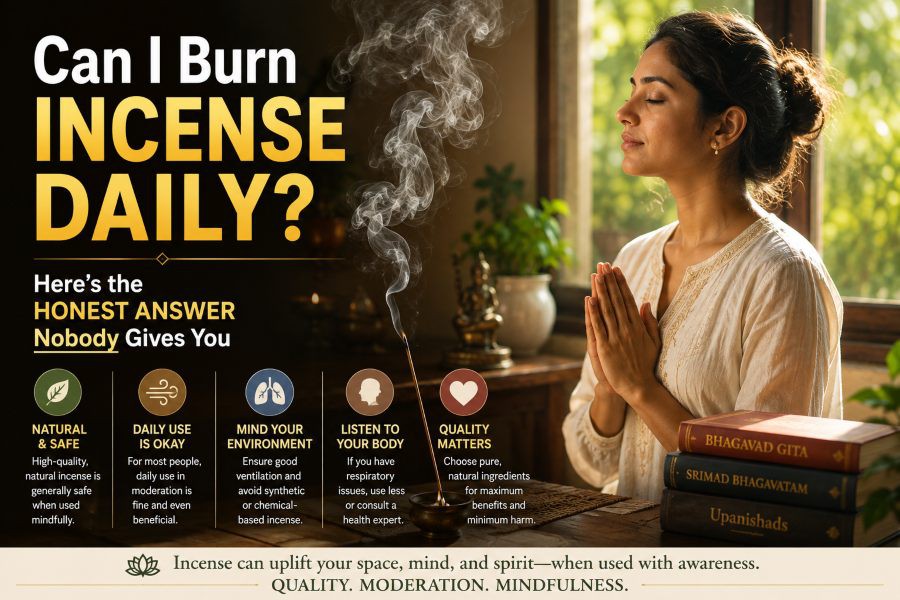
Can I Burn Incense Daily? The Honest Answer Nobody Gives You
Can I Burn Incense Daily? Here's the Honest Answer Nobody Gives You
Picture this: it's early morning, the house is still quiet, and you light a stick of incense before you sit down to pray or just gather your thoughts for the day. You've done this every single morning for years. Then one day you read an article online with a scary headline about smoke and lungs, and suddenly you're standing there holding a lit stick, wondering if the one ritual that grounds your entire day is secretly working against you.
That hesitation is completely reasonable, and it deserves a real answer instead of a scare headline or a blind reassurance. So let's actually answer it properly: can you burn incense sticks every day without worry? The short version is yes, for the overwhelming majority of people, daily incense use is a low-risk habit — but the full answer depends on a handful of factors that almost nobody explains clearly. Many households that rely on Mayapur Store Incense Sticks for their morning and evening puja want exactly this kind of grounded, practical explanation rather than vague internet anxiety.
Let's break down what actually determines whether daily burning is fine for you, and what changes the equation.
Why This Question Even Comes Up
Nobody worried about this fifty years ago. Incense has been part of daily worship, meditation, and home life across cultures for thousands of years — Vedic temples, Buddhist monasteries, churches, and homes throughout Asia and beyond have burned it as a daily act without a second thought. So why does the question suddenly feel urgent now?
Partly it's a symptom of the times. We're more aware of indoor air quality than any previous generation, and that awareness is generally a good thing. Wildfire smoke, urban pollution, and a growing understanding of what particulate matter does to the body have made people more careful about everything they breathe, including things that were once taken for granted.
But awareness without context turns into anxiety fast. Somewhere between "we should think about air quality" and "one incense stick a day might be secretly poisoning me," a lot of nuance gets lost. That's the gap this article is here to close.
What "Daily" Actually Means — Because It's Not One Thing
Here's the first mistake almost every anxious article makes: it treats "daily incense burning" as a single, fixed activity. It isn't. Daily use covers an enormous range of actual behavior, and the range matters more than the label.
Consider the difference between these two people:
Person A lights one stick each morning during a ten-minute prayer, in a room with a window cracked open, then lets the stick burn out and leaves the room.
Person B keeps three or four sticks burning continuously throughout the day in a small, sealed room with no airflow, using cheap synthetic incense, for eight or more hours at a stretch.
Both of these fall under "burns incense daily." But they are not remotely the same exposure. Person A's daily total exposure to smoke particulates over an entire week might be lower than Person B's exposure in a single afternoon. Lumping these together and asking "is daily incense safe" as if there's one universal answer is like asking "is daily driving safe" without asking how far, how fast, or in what kind of car.
So before answering the question for yourself, get specific about your own actual pattern. How many sticks? How long do they burn? What's the room size? Is there airflow? These four questions matter more than the single word "daily."
The Science, Explained Without the Drama
Combustion — burning anything, incense included — releases fine particulate matter and a mix of volatile organic compounds into the air. This is basic chemistry, not a controversial claim, and it applies to candles, cooking, fireplaces, and incense alike.
Some studies looking at incense smoke, particularly ones conducted in enclosed temple spaces with heavy, near-constant burning over many hours, have found elevated particulate levels and some associated respiratory findings in populations with very high, prolonged exposure. These studies get cited constantly in online health content, often stripped of their actual context.
Here's the detail that keeps getting left out: the studies showing concerning results are almost always measuring extreme, high-volume, poorly ventilated exposure — think small enclosed shrine rooms with multiple large coils burning non-stop for years, not a single stick during a ten-minute morning ritual with a window open.
Dose determines risk far more than mere presence. Your body handles small, intermittent exposure to combustion particles reasonably well — it's the same reason a backyard barbecue once in a while doesn't functionally compare to working in a smoke-filled kitchen eight hours a day for twenty years. Scale is everything.
This doesn't mean incense smoke is harmless in any amount, and pretending otherwise would be dishonest. It means the relevant question isn't "does incense smoke contain particulates" — the answer to that is always yes — but rather "how much, how often, and in what kind of space."
The Four Variables That Actually Decide Your Answer
If you want a genuinely useful, personalized answer to "can I burn incense daily," walk through these four factors honestly.
1. Room Size and Airflow
A large room with a window or door open clears particulate matter far faster than a small, sealed space. If your daily incense habit happens in a room with some ventilation, your actual exposure drops significantly compared to a tightly closed one. This single factor probably matters more than any other on this list.
2. Number of Sticks and Duration
One stick burning for ten to fifteen minutes is a completely different exposure profile than multiple sticks burning continuously for hours. If your ritual involves a quick, focused burn rather than all-day smoldering, you're already in a much lower-risk category.
3. Ingredient Quality
This is the variable most people never think about, and it deserves more attention than it usually gets. Incense made from natural ingredients — sandalwood, herbal resins, natural gums, and plant-based oils — tends to burn cleaner than mass-produced sticks built around synthetic fragrance compounds and charcoal cores soaked in artificial scent. Cheap, heavily synthetic incense often produces a harsher, denser smoke profile than a well-made traditional stick. If you're burning daily, this is the one place where paying attention to quality actually changes the chemistry of what you're inhaling.
4. Your Own Respiratory Health
Someone with asthma, chronic bronchitis, or another existing respiratory condition has a lower margin for smoke exposure of any kind, incense included. This doesn't mean giving up the ritual entirely — it usually means shorter sessions, better ventilation, and paying closer attention to how your body responds.
Run your own daily habit through these four filters, and you'll have a far more accurate personal answer than any generic headline could give you.
What Centuries of Daily Ritual Actually Tell Us
Here's an angle that almost never comes up in the health-anxiety articles: incense has been burned daily, in enclosed rooms, for thousands of years, across an enormous range of cultures — and it never disappeared.
If daily incense use in the way it's traditionally practiced were genuinely as hazardous as some headlines imply, you'd expect that pattern to show up clearly across the long history of temples, monasteries, and home shrines that have used it as a daily practice for generations. Instead, what actually happened is that the practice adapted naturally around moderate, mindful use — a stick or two, briefly, with reasonable airflow, rather than industrial-scale, sealed-room burning.
This isn't proof of zero risk. It's context. Traditions built around daily ritual tend to self-correct toward sustainable patterns over long stretches of time, because anything genuinely harmful at the scale people actually practiced it would have produced visible consequences that the tradition would have moved away from. The version of incense burning that raises real concern in research — extreme volume, sealed rooms, years of nonstop exposure — was never the traditional daily pattern to begin with.
How Many Sticks a Day Is Actually Reasonable?
People want a number, so here's a sensible range based on the variables above rather than a made-up rule.
- One to three sticks a day, burned individually rather than simultaneously, in a room with some airflow, is a pattern that fits comfortably within low-risk daily use for most people.
- Four or more sticks burning at once, especially in a small or sealed room, starts to shift you toward the higher end of exposure, and it's worth cutting back or improving ventilation.
- Continuous, all-day burning in any room, regardless of size, is the pattern most associated with the higher-exposure findings in research, and it's worth rethinking regardless of how much you love the scent.
Think of it less like a strict medical limit and more like a common-sense range — the kind of guidance you'd give a friend rather than a rule enforced by a lab coat.
Signs Worth Paying Attention To
Your body is usually a better guide than any article, including this one. A few signs suggest it might be time to adjust your habit rather than eliminate it entirely:
- Noticeable throat irritation or a dry cough that shows up specifically during or right after burning
- Headaches that consistently follow a long burning session, especially in a small room
- A stuffy or heavy feeling in the chest that improves once you leave the room or open a window
- Watery or irritated eyes during extended sessions
None of these are emergencies, and none of them mean incense is dangerous in general. They're simply feedback that your specific setup — room size, stick quality, or duration — needs adjusting. Try more ventilation first, then consider switching to a more naturally made incense before assuming you need to give up the ritual altogether.
Who Should Be Extra Thoughtful About Daily Use
Most people can burn incense daily without a second thought, but a few groups benefit from being a bit more deliberate:
- People with asthma or COPD, who should favor shorter sessions, better airflow, and naturally made sticks over synthetic ones
- Infants and very young children, whose lungs are still developing and who benefit from rooms with better airflow during any kind of burning
- Pregnant women, out of general caution around any smoke exposure, even at low daily levels
- Households with birds, since birds have extremely sensitive respiratory systems and are affected by airborne particles far more easily than humans or other pets
None of this means these groups need to abandon incense entirely — many families simply shift the ritual to a well-ventilated space, keep sessions shorter, and choose higher-quality sticks.
Simple Habits That Make Daily Burning Genuinely Safer
You don't have to overhaul your entire ritual. A few small, consistent habits make a real difference without changing the spirit of the practice at all.
- Crack a window or door during and shortly after burning, even in cooler months. A few minutes of airflow clears far more particulate matter than people expect.
- Burn one stick at a time rather than multiple sticks simultaneously, unless the occasion specifically calls for more.
- Let the room air out between sessions instead of relighting back-to-back throughout the day.
- Choose incense made with natural ingredients — sandalwood, herbal blends, and resin-based sticks — over heavily synthetic, artificially scented varieties.
- Keep the burning stick away from your direct breathing zone, rather than sitting with your face close to the smoke for extended periods.
- Rotate rooms if you burn incense in multiple parts of the house, so no single space accumulates smoke residue over time.
None of these require giving anything up. They just make an already low-risk habit even lower-risk.
Common Myths Worth Clearing Up
Myth: "Any smoke exposure at all causes cancer." This dramatically oversimplifies a genuinely complex area of research. Risk is about cumulative dose over time, not the mere presence of smoke in a room once a day for a few minutes. Treating every trace of combustion byproduct as equivalent to heavy, prolonged industrial exposure isn't how toxicology actually works.
Myth: "Natural incense is always completely smoke-free." Even the cleanest, most naturally made incense produces some smoke, because burning organic material always does. "Natural" changes the composition and harshness of that smoke — it doesn't eliminate it.
Myth: "If it smells nice, it's automatically safe." Fragrance and safety aren't connected. Some of the most heavily synthetic, artificially scented sticks smell the strongest precisely because of the chemical fragrance load, which isn't a mark of quality.
Myth: "You should stop your daily ritual entirely to be safe." For the vast majority of people burning a stick or two a day in a reasonably ventilated space, this reaction is disproportionate to the actual risk. The smarter move is refinement, not elimination.
Building a Sustainable Daily Ritual
The goal isn't to turn a peaceful, grounding daily habit into a source of anxiety. It's to practice it with a bit of awareness, the same way you'd cook with a bit of awareness about ventilation, or drive with a bit of awareness about weather conditions — not out of fear, just out of basic care.
A sustainable daily incense practice usually looks like this: one or two well-made sticks, burned during a focused window of time, in a space that gets some fresh air, using ingredients you actually trust. That's it. It's not complicated, and it doesn't require constant monitoring or worry.
Quick Answers to What People Actually Ask
Is it bad to burn incense every single day? For most people, burning one or two sticks daily in a ventilated space is a low-risk habit, comparable to many other everyday activities involving mild combustion exposure.
How long should I let incense burn each day? A single stick typically burns for twenty to forty-five minutes depending on length and type. There's no need to relight repeatedly throughout the day unless the occasion specifically calls for it.
Does burning incense in a small room make a big difference? Yes, meaningfully. Smaller rooms accumulate particulate matter faster than larger or better-ventilated spaces, so airflow matters more in a small room than almost anywhere else.
Is agarbatti safer than dhoop for daily use? Both are forms of incense and follow the same basic principles — quality of ingredients, ventilation, and quantity matter more than the specific format. Neither is automatically safer than the other on its own.
The Real Takeaway
Burning incense daily isn't the hidden hazard some headlines make it out to be, and it isn't something to burn without any thought either. The honest, unglamorous truth sits in the middle: moderate daily use, in a ventilated space, with well-made ingredients, is a low-risk habit that has sustained itself across centuries of daily practice for good reason.
If your current routine already looks something like that, there's no need to second-guess a ritual that grounds your day. If it doesn't — if you're burning multiple sticks nonstop in a sealed room — a few small adjustments will bring your daily habit comfortably into a range you don't need to worry about.
The stick itself was never really the question. How you burn it always was.
Visit Our Official Store Collection: https://mayapur.store/37-incense-sticks
Posted in: Incense or Agarbatti
Related posts
-
 How to Light Incense SticksDiscover the right way to light incense sticks (agarbatti) for worship, meditation, and peace. Learn step-by-step...Read more
 -
 Where to Buy Incense SticksDiscover where to buy the best natural incense sticks for your daily puja, meditation, and relaxation. Explore pure,...Read more
 -
 Is Incense Sticks Bad for Pregnancy? Wondering if incense sticks are safe during pregnancy? Discover the truth about incense smoke, its effects on...Read more
 -
 Do Incense Sticks Trigger Fire Alarms? Wondering if incense sticks can trigger fire alarms? Learn how smoke affects detectors, safe burning tips, and...Read more
 -
 How Many Incense Sticks to Burn for Good LuckDiscover how many incense sticks to burn for good luck and prosperity. Learn the ideal numbers, rituals, and natural...Read more
Leave a comment