
Why did Krishna run to embrace a poor brahmin in rags? Read the Sudama story from the Bhagavatam and learn how a...
Latest posts
-
 Krishna and Sudama: The Poor Brahmin Who Became Wealthy in LoveRead more
 -
 Vamana Avatar: How Three Steps Humbled Bali MaharajaRead more
Why did a powerful king give away three worlds to a boy asking for three steps? Learn the Vamana avatar story from...
-
 The Bhagavatam on Marriage: Duty, Love and Spiritual PartnershipRead more
What does the Bhagavatam say about marriage? Through the stories of Kardama and Devahuti, Rukmini's secret letter and...
-
 What Is Prema? The Bhagavatam's Highest Stage of Love for GodRead more
Prema is love for God with no "because" attached. Learn how the Bhagavatam describes it, the nine steps from faith to...
-
 Is Shiva Parvati Kalyana Mentioned in Srimad Bhagavatam? What the Scripture Really SaysRead more
Looking for Shiva and Parvati's wedding in the Srimad Bhagavatam? Find out what the scripture actually describes,...
-
 How Many Modes of Devotion Are Mentioned in Bhagavatam?Read more
A young boy named Prahlada listed nine ways to serve God, and the Bhagavatam keeps them as its answer. Learn what the...
-
 What Is Bhagavatam and Why Has It Been Read for 5,000 Years?Read more
A dying king asked one question, and the answer became the Bhagavatam. Learn what this Sanskrit scripture contains,...
-
 Who Is Lord Krishna? His Meaning, Teachings and Pastimes ExplainedRead more
Discover who Krishna is according to Srimad Bhagavatam, including His divine identity, childhood pastimes, teachings,...
-
 Incense in Islam: Bakhoor, Agarbatti and What Tradition SaysRead more
Is burning fragrance part of Muslim tradition? Explore incense in Islam, from the Prophetic practice of fumigating...
-
 History of Agarbatti: From Vedic Dhupa to Modern Incense SticksRead more
Where did agarbatti really come from? Follow the history of agarbatti from Vedic fire rituals and temple dhupa to...
Blog categories
- Default category (0)
- MUSICAL INSTRUMENT (1)
- BOOK (5)
- DEVOTIONAL GIFT (0)
- Blog (30) click
- CHANDAN (12)
- Bhagavatam Wisdom Series (68)
- Krishna Consciousness (14)
- Mridangam Musical Instrument (6)
- Bhagavad Gita for Beginners (13)
- Bhagavad Gita As It Is (37) click
- Bhagavad Gita As It Is Telugu (0)
- Bhagavad Gita As It Is Marathi (0)
- Bhagavad Gita As It Is In Hindi (0)
- Bhagavad Gita As It Is In English (0)
- Bhagavad Gita As It Is In Bengali (8)
- Bhagavad Gita As It Is In Kannada (0)
- Bhagavad Gita As It Is In Gujarati (0)
- Bhagavad Gita As It Is In Panjabi (0)
- Bhagavad Gita As It Is In Tamil (0)
- Bhagavad Gita As It Is Odia (0)
- BHAGAVAD GITA As It Is GERMAN (0)
- Bhagavad Gita As It Is In French (0)
- Bhagavad Gita As It Is In Nepali (0)
- Bhagavad Gita As It Is In Assamese (0)
- Incense or Agarbatti (38)
- Lord Chaitanya Mahaprabhu (3)
- Vedic Temple Mayapur (14)
- kalki (15)
- Mahabharata – Dharma & Destiny (27)
- Vaishnava Scriptures (4)
- healthy product (4)
- chaitanya mahaprabhu (5)
- Tulsi Mala Guide (17)
Search in blog
Where Not to Burn Incense: Safety Guide
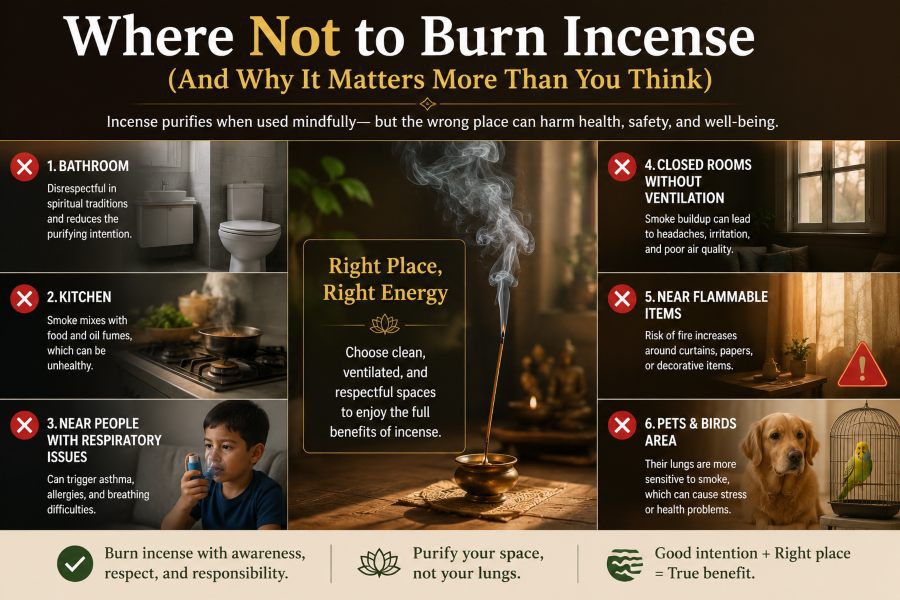
Where Not to Burn Incense (And Why It Matters More Than You Think)
A woman in Texas once fell asleep with incense burning on a shelf lined with tissue paper decorations. She woke up to a fire alarm and a scorched shelf, inches away from becoming a genuine house fire. Nothing about her ritual was wrong — the incense itself, the intention behind it, the practice of lighting it before rest. What went wrong was where she placed it.
That's the part almost nobody talks about when they discuss incense sticks. Most guidance online focuses on how to burn incense, what scent to pick, or whether the smoke is safe to breathe. Almost nothing tells you where you genuinely shouldn't be burning it at all — and that gap in advice causes far more real damage than any question about lung health ever will. Before we get into the specifics, it's worth knowing that if you're going to Buy Premium Incense Sticks/Agarbatti, pairing quality sticks with smart placement is what actually keeps the ritual safe, not just the product itself.
Let's walk through the places where lighting incense turns from a peaceful habit into a genuine hazard.
Near Anything That Catches Fire Easily
This sounds obvious until you actually look around most homes and realize how many flammable materials sit within arm's reach of where people typically place a burning stick.
Common danger zones people overlook:
- Curtains or drapes hanging near the incense holder
- Paper decorations, prayer cards, or loose stacks of paper nearby
- Wooden shelving with dry, aged wood
- Bedding, especially if the incense sits on a nightstand close to a pillow or blanket
- Dry flower arrangements or decorative dried grass
A lit incense stick isn't a dramatic flame, so people underestimate it. But the ember at the tip stays hot enough to ignite paper or thin fabric on contact, and a stray gust from an open window or a fan can send ash further than you'd expect. The safest rule is simple: give a clear radius of at least a foot or two around any burning stick, with nothing flammable in that space.
Small, Sealed Rooms With Zero Airflow
This one is about health rather than fire risk, but it's just as important. A tightly closed room with no ventilation — no window cracked, no door open, no airflow of any kind — turns even a single stick into a smoke-heavy environment fairly quickly.
Bathrooms without windows, small closets converted into meditation nooks, or tiny prayer rooms with the door shut are the worst offenders. Smoke has nowhere to go, so particulate matter builds up in the air you're directly breathing. This doesn't mean the ritual has to move outdoors — it just means that specific sealed space isn't the right spot, even if it feels private and quiet.
If your prayer room happens to be small, the fix isn't abandoning the space. It's cracking the door or window for the duration of the burn and for a few minutes after.
Around Infants, Pets, and Anyone With Breathing Difficulties
You wouldn't smoke a cigarette while holding a newborn, and the same logic applies here, even though incense feels entirely different in spirit and intention.
Specific groups that need distance from burning incense:
- Infants and very young children, whose lungs are still developing and are more sensitive to any airborne particles
- Birds, which have an extraordinarily sensitive respiratory system and can be seriously harmed by smoke that wouldn't bother a human or even a dog or cat
- Anyone with asthma, COPD, or another active respiratory condition, especially during a flare-up
This doesn't mean incense and babies, or incense and birds, can never exist under the same roof. It means the burning itself should happen in a separate, well-ventilated room, away from their direct breathing zone, rather than in the same enclosed space they're sitting in.
Directly Under Smoke Detectors
This is the most avoidable mistake on this entire list, and yet it happens constantly. Placing incense directly beneath or extremely close to a smoke detector will, more often than not, set the alarm off — not because there's an actual fire, but because the detector can't distinguish between dangerous smoke and a deliberate, controlled one.
Beyond the annoyance of a blaring alarm at six in the morning, this habit teaches a bad long-term pattern: people start disabling or removing batteries from smoke detectors to stop the false alarms, and then forget to put them back. That's how a minor daily irritation turns into a genuinely dangerous gap in home safety. Burn incense in a spot at least several feet away from any detector, and never directly beneath one.
Inside a Car
It might seem convenient — a small car-mounted incense holder, a quick ritual before a long drive. But a car is one of the smallest, most sealed environments most people regularly sit inside, and it lacks any real airflow unless a window is down.
Add the fact that you're often driving while it burns, meaning your attention is split and you can't monitor an open flame or hot ember the way you would at home. A car is one of the least suitable environments for burning anything, regardless of how compact the incense holder claims to be. If you want a similar calming scent while driving, a sealed diffuser or scented sachet is a far safer substitute.
On Unstable or Cluttered Surfaces
This one is about basic physics, not chemistry. Incense holders tip over. It happens more often than people expect — a pet brushes past, a draft blows through, someone bumps a table while walking by.
Surfaces to avoid:
- Wobbly side tables or uneven shelving
- Cluttered altars or prayer spaces where the holder has no dedicated stable spot
- Surfaces near the edge of a table where a light touch could send it toppling
- Directly on top of cloth runners or altar cloths that could catch a falling ember
A heavy, stable holder on a flat, clear surface solves nearly all of this. It's a small detail, but it's the difference between a fallen stick that goes out harmlessly on a tile floor and one that lands on a stack of paper or fabric.
Around Oxygen Equipment or Medical Devices
This is a serious one and worth stating plainly: never burn incense, candles, or any open flame near supplemental oxygen equipment. Oxygen dramatically accelerates combustion, and even a small ember near an oxygen line or concentrator creates a real fire risk that escalates far faster than people expect. If anyone in the household uses medical oxygen, incense burning should happen in a completely separate room, with the door closed, and ideally with the oxygen equipment turned off or the person moved elsewhere during the ritual.
Unattended, Ever
This deserves its own section because it's the single most common cause of incense-related accidents, more than any specific location on this list. Walking away from a burning stick — even for a few minutes — is where most real damage happens. People step out to answer the door, take a phone call, or start cooking, and forget the stick is still glowing.
A few habits prevent this almost entirely:
- Only light incense when you're staying in the room for its full burn time
- Use a proper heat-resistant holder that catches falling ash
- Extinguish it fully if you need to leave the room, rather than assuming it'll be fine
- Keep it away from pets who might knock it over while you're not watching
None of this requires giving up the ritual. It just means treating a burning stick with the same basic respect you'd give any small open flame.
Rented Spaces With Sensitive Smoke Policies
This is a more modern, practical concern. Many rental apartments and hotel rooms have highly sensitive smoke detection systems tied directly to building-wide fire alarms, and burning incense — even briefly — can trigger evacuations or result in cleaning fees for lingering odor. If you're staying somewhere temporary, it's worth checking the property's policy before assuming your usual habit will translate smoothly. A quick email or a glance at the lease terms saves a genuinely awkward situation later.
The Pattern Behind All of This
Look at every single item on this list, and a clear pattern emerges: the danger was never the incense itself. It was always about placement, attention, and airflow. A well-made stick, burned in an open, stable, ventilated space, with someone present the whole time, is about as low-risk a ritual as exists in most homes.
The mistakes that actually cause harm are almost always about where the stick was set down, not what was inside it. Move it away from flammable material, give the room some air, keep it upright and stable, keep it away from detectors and oxygen equipment, and never leave it burning while you step away.
Get those basics right, and the ritual stays exactly what it was always meant to be — a small, steady point of calm in your day, without the worry.
Mayapur Store Incense Stick Collection: https://mayapur.store/37-incense-sticks
Posted in: Incense or Agarbatti
Related posts
-
 How to Light Incense SticksDiscover the right way to light incense sticks (agarbatti) for worship, meditation, and peace. Learn step-by-step...Read more
 -
 Where to Buy Incense SticksDiscover where to buy the best natural incense sticks for your daily puja, meditation, and relaxation. Explore pure,...Read more
 -
 Is Incense Sticks Bad for Pregnancy? Wondering if incense sticks are safe during pregnancy? Discover the truth about incense smoke, its effects on...Read more
 -
 Do Incense Sticks Trigger Fire Alarms? Wondering if incense sticks can trigger fire alarms? Learn how smoke affects detectors, safe burning tips, and...Read more
 -
 How Many Incense Sticks to Burn for Good LuckDiscover how many incense sticks to burn for good luck and prosperity. Learn the ideal numbers, rituals, and natural...Read more
Leave a comment