
Why did Krishna run to embrace a poor brahmin in rags? Read the Sudama story from the Bhagavatam and learn how a...
Latest posts
-
 Krishna and Sudama: The Poor Brahmin Who Became Wealthy in LoveRead more
 -
 Vamana Avatar: How Three Steps Humbled Bali MaharajaRead more
Why did a powerful king give away three worlds to a boy asking for three steps? Learn the Vamana avatar story from...
-
 The Bhagavatam on Marriage: Duty, Love and Spiritual PartnershipRead more
What does the Bhagavatam say about marriage? Through the stories of Kardama and Devahuti, Rukmini's secret letter and...
-
 What Is Prema? The Bhagavatam's Highest Stage of Love for GodRead more
Prema is love for God with no "because" attached. Learn how the Bhagavatam describes it, the nine steps from faith to...
-
 Is Shiva Parvati Kalyana Mentioned in Srimad Bhagavatam? What the Scripture Really SaysRead more
Looking for Shiva and Parvati's wedding in the Srimad Bhagavatam? Find out what the scripture actually describes,...
-
 How Many Modes of Devotion Are Mentioned in Bhagavatam?Read more
A young boy named Prahlada listed nine ways to serve God, and the Bhagavatam keeps them as its answer. Learn what the...
-
 What Is Bhagavatam and Why Has It Been Read for 5,000 Years?Read more
A dying king asked one question, and the answer became the Bhagavatam. Learn what this Sanskrit scripture contains,...
-
 Who Is Lord Krishna? His Meaning, Teachings and Pastimes ExplainedRead more
Discover who Krishna is according to Srimad Bhagavatam, including His divine identity, childhood pastimes, teachings,...
-
 Incense in Islam: Bakhoor, Agarbatti and What Tradition SaysRead more
Is burning fragrance part of Muslim tradition? Explore incense in Islam, from the Prophetic practice of fumigating...
-
 History of Agarbatti: From Vedic Dhupa to Modern Incense SticksRead more
Where did agarbatti really come from? Follow the history of agarbatti from Vedic fire rituals and temple dhupa to...
Blog categories
- Default category (0)
- MUSICAL INSTRUMENT (1)
- BOOK (5)
- DEVOTIONAL GIFT (0)
- Blog (30) click
- CHANDAN (12)
- Bhagavatam Wisdom Series (68)
- Krishna Consciousness (14)
- Mridangam Musical Instrument (6)
- Bhagavad Gita for Beginners (13)
- Bhagavad Gita As It Is (37) click
- Bhagavad Gita As It Is Telugu (0)
- Bhagavad Gita As It Is Marathi (0)
- Bhagavad Gita As It Is In Hindi (0)
- Bhagavad Gita As It Is In English (0)
- Bhagavad Gita As It Is In Bengali (8)
- Bhagavad Gita As It Is In Kannada (0)
- Bhagavad Gita As It Is In Gujarati (0)
- Bhagavad Gita As It Is In Panjabi (0)
- Bhagavad Gita As It Is In Tamil (0)
- Bhagavad Gita As It Is Odia (0)
- BHAGAVAD GITA As It Is GERMAN (0)
- Bhagavad Gita As It Is In French (0)
- Bhagavad Gita As It Is In Nepali (0)
- Bhagavad Gita As It Is In Assamese (0)
- Incense or Agarbatti (38)
- Lord Chaitanya Mahaprabhu (3)
- Vedic Temple Mayapur (14)
- kalki (15)
- Mahabharata – Dharma & Destiny (27)
- Vaishnava Scriptures (4)
- healthy product (4)
- chaitanya mahaprabhu (5)
- Tulsi Mala Guide (17)
Search in blog
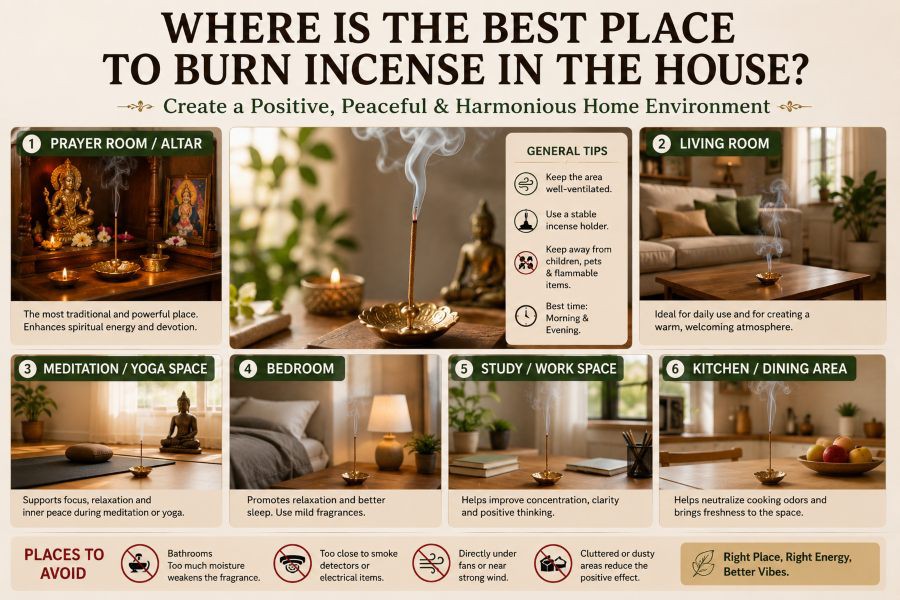
Where Is the Best Place to Burn Incense in the House?
Where Is the Best Place to Burn Incense in the House?
You Lit It Right, So Why Doesn't It Smell Right?
Ever lit a stick of incense, walked away excited for that warm, fragrant cloud to fill your room, and come back twenty minutes later to... nothing? No lingering scent, no calm atmosphere, just an empty stick and a faint smoky smell that dissolves the second you open a window. If this has happened to you, the problem probably wasn't the incense. It was where you burned it.
Most people assume incense sticks work the same no matter where you place them. Light it, stick it in a holder, done. But placement changes everything — how the scent spreads, how long it lasts, whether it actually reaches your nose in a meaningful way, and even how safe the whole experience is. If you're using genuinely well-made sticks, like the ones in the Mayapur Store Agarbatti collection, the difference between a good spot and a bad spot becomes even more obvious, because you can actually smell the quality getting wasted in the wrong location.
So let's actually figure this out properly — room by room, condition by condition — instead of just guessing.
Why Location Matters More Than You Think
Here's the thing nobody explains when you buy your first pack of incense sticks: fragrance travels through air currents, not through magic. Smoke particles carrying scent compounds move exactly the way any smoke would — following drafts, rising with heat, settling in still corners, or getting sucked straight out of an open window before they even get a chance to spread.
This means the "best" spot isn't universal. It depends on:
- Airflow in the room (windows, fans, AC vents, doors)
- Room size and ceiling height
- What you're trying to achieve (meditation, masking odors, ambiance, ritual purposes)
- Who else is in the house (pets, allergies, small children, elderly family members)
Get these four factors wrong, and even the finest sandalwood stick in the world will feel underwhelming.
The Golden Rule: Still Air, Not Stagnant Air
This confuses a lot of beginners, so let's be precise about it. You don't want a windy spot — a fan or open window right next to your incense holder will scatter the smoke before it develops any real presence in the room. But you also don't want a completely sealed, airless box of a room, because then the smoke just builds up in one dense pocket instead of spreading evenly.
The sweet spot is gentle, natural air movement — the kind you get from a room with one window cracked slightly, or a door left ajar to a hallway. That mild circulation lets the fragrance drift outward gradually instead of vanishing or pooling.
Room-by-Room Breakdown: Where It Actually Works Best
The Puja Room or Meditation Corner
This is the most traditional placement, and for good reason. A dedicated puja space is usually smaller, calmer, and less trafficked by daily household chaos, which means the fragrance has room to settle and build a consistent atmosphere over time.
What makes this spot ideal:
- Minimal foot traffic means less disturbance to the smoke pattern
- Often has a fixed altar or shelf, giving you a stable, elevated surface for the holder
- The psychological association between this space and calmness gets reinforced every time the scent triggers memory
Place the holder slightly away from any cloth offerings, curtains, or dried flower arrangements — a stray ember or falling ash is a genuine fire risk that people underestimate constantly.
The Living Room (But Not Where You Think)
Most people place incense right in the center of the living room, usually on a coffee table. That's actually one of the least effective spots, because center-of-room placement means the scent disperses in every direction equally and gets diluted fast in a large open space.
A better move: place it near a corner shelf or console table along a wall, ideally at a slightly elevated height. Smoke naturally rises and then spreads outward as it cools, so an elevated placement near a wall lets the fragrance drift across the room in a wider arc instead of dissipating straight up toward a nine-foot ceiling.
The Bedroom — Handle With Care
Bedrooms are tempting spots for evening incense, especially calming scents like lavender before sleep. But this is also the room where mistakes get made most often.
Do:
- Burn it 20–30 minutes before bedtime, not while you're actually sleeping
- Keep it on a stable, non-flammable surface away from bedding and curtains
- Choose lighter, less smoke-heavy varieties for smaller bedrooms
Don't:
- Leave it burning unattended while you doze off
- Place it near an air purifier or humidifier, since the two can interact oddly with airflow and moisture
The Bathroom — Surprisingly Effective, Rarely Used
This one gets overlooked constantly, and it shouldn't be. Bathrooms deal with odor issues that living rooms simply don't, and incense handles this far more elegantly than a chemical spray.
The catch is humidity. Burning incense in a very steamy, just-showered bathroom can actually dampen the stick and cause uneven burning. Light it either before a shower or a good ten minutes after the steam has cleared, and you'll get a much cleaner burn with a scent that lingers pleasantly instead of mixing awkwardly with soap fragrance.
The Entryway or Hallway
If your goal is creating a first impression — the moment guests walk in and immediately notice something feels warm and welcoming — the entryway is genuinely underrated. It's usually a transitional space with natural airflow from the front door, which helps carry a gentle waft of fragrance further into the house without overwhelming any single room.
Spots You Should Actually Avoid
Not every corner of your house is a good idea, no matter how convenient it seems.
- Directly under a ceiling fan or AC vent — the airflow is too aggressive and scatters smoke before it builds any presence
- Near bookshelves or paper-heavy areas — prolonged smoke exposure can yellow paper and fabric over years of regular use
- Inside closets or small enclosed cabinets — poor ventilation causes smoke buildup that can leave a stale, almost burnt smell instead of a fragrant one
- Kitchen countertops near cooking areas — competing smells from food prep clash badly with incense fragrance, and open flames nearby increase fire risk
- On top of electronics or near cables — ash and heat near sensitive equipment is simply not worth the risk
The Height Factor Nobody Talks About
Here's an insight most guides skip entirely: the height at which you burn incense changes how the scent reaches you. Smoke rises, cools, then spreads horizontally as it loses heat — this is basic physics, not incense mythology.
- Low placement (floor level) works well in larger rooms since the scent has more vertical distance to travel and spread before reaching nose-level in a seated position
- Mid-height placement (shelf, table) is the most balanced option for most rooms and most people
- High placement (tall shelf, mounted holder) works better in smaller rooms where you want the scent to settle downward gradually rather than concentrate near the burning point
If you're constantly feeling like your incense "isn't strong enough," the fix might not be a stronger fragrance — it might just be adjusting the height by a foot or two.
Ventilation: The Difference Between Ambiance and Overwhelm
A lot of people either over-ventilate (open windows, fans running, and the scent disappears entirely) or under-ventilate (sealed room, and the smoke becomes thick and almost bitter instead of pleasant).
The real trick is partial, indirect ventilation. A window cracked in an adjoining room, a door left slightly open to a hallway, or a small gap under a door works far better than a fully open window or a fully sealed space. You want the air to move slowly enough that the fragrance has time to actually settle into fabric, walls, and the general atmosphere of the room — not disappear before it's had the chance.
If you're experimenting with different fragrances across different rooms, it genuinely helps to explore the range here and match specific scent intensities to specific spaces — a heavier resin-based fragrance for a larger living room versus a lighter floral note for a compact bedroom.
Safety Placement Rules You Shouldn't Skip
This deserves its own section because too many house fires and burn scars trace back to careless incense placement, not defective sticks.
1. Always use a proper holder with a catch tray for falling ash
2. Keep it at least 12 inches away from curtains, bedding, or paper
3. Never place it on a wobbly or uneven surface — vibrations from footsteps or doors closing can tip it over
4. Keep pets and small children away from the burning area — curious hands and paws cause more incidents than people expect
5. Never leave a room with incense still burning, even for "just a minute"
Matching Placement to Purpose
Different reasons for burning incense actually call for different placements, and this is where most beginners never think strategically.
For daily prayer or meditation → puja room or a quiet, dedicated corner with minimal foot traffic
For general home ambiance → living room, elevated on a side console, away from direct airflow
For odor control → bathroom or kitchen entryway (not the kitchen counter itself)
For sleep and relaxation → bedroom, burned well before bedtime and extinguished before sleeping
For guest impressions → entryway or hallway, timed about 15–20 minutes before guests arrive
Does the Season Change Where You Should Burn It?
This is something almost nobody considers, but it genuinely matters. Weather conditions change how a room holds air, humidity, and heat — all of which directly affect how incense smoke behaves.
During summer: Rooms with AC running tend to have drier, faster-circulating air, which can carry fragrance away quicker than usual. In this case, placing incense slightly closer to where you sit — rather than across the room — helps you actually catch the scent before the AC pulls it elsewhere.
During monsoon: Humidity is the real challenge here. Damp air makes incense sticks burn slower and can even cause a slightly muted fragrance. Choose drier, well-ventilated rooms during this season, and avoid bathrooms or kitchens where ambient moisture is already high.
During winter: Closed windows and heaters mean less air exchange, so a little goes a long way. You'll often need shorter burn times in winter to avoid the room feeling overly smoky, since natural ventilation is minimal.
Common Questions Beginners Ask About Placement
Can I burn incense in a small studio apartment? Yes, but be more deliberate about it. Smaller spaces build up scent faster, so you'll want shorter burn sessions — around 15 minutes instead of the usual 30 — and slightly more airflow than you'd use in a larger home.
Is it okay to burn incense near a work desk? It depends on the fragrance and your sensitivity to smoke while concentrating. Lighter, less resinous scents tend to work better near workspaces since heavier ones can become distracting or even mildly headache-inducing during long sitting sessions.
Should incense be placed at eye level or below? Below eye level is generally safer and more effective. Eye-level placement puts the burning ember closer to your face, which isn't ideal for either safety or comfort, especially in smaller rooms.
Does the type of flooring or surface matter? Absolutely. Wooden furniture and fabric-covered surfaces are more vulnerable to ash damage and heat marks than tile, stone, or metal surfaces. Always use a proper heat-resistant holder regardless of what surface you're placing it on.
Can incense placement affect how strong the fragrance smells? Yes, significantly. The same stick placed near an open window versus a sheltered corner can smell noticeably different in intensity, simply because of how quickly the smoke disperses in each location.
The Bigger Picture: It's Not Just About Smell
Placement isn't only a fragrance decision — it's a mood decision. A stick burning quietly in a puja corner does something psychologically different than one placed in a busy living room, even if it's the exact same fragrance. The location shapes the ritual, and the ritual shapes how your brain associates that scent with a feeling — calm, focus, warmth, or celebration.
Once you start thinking about incense placement this way, you stop treating it as background decoration and start treating it as something closer to a deliberate, sensory design choice. And honestly, once you notice the difference a well-chosen spot makes, you won't want to go back to just sticking it wherever's convenient.
Posted in: Incense or Agarbatti
Related posts
-
 How to Light Incense SticksDiscover the right way to light incense sticks (agarbatti) for worship, meditation, and peace. Learn step-by-step...Read more
 -
 Where to Buy Incense SticksDiscover where to buy the best natural incense sticks for your daily puja, meditation, and relaxation. Explore pure,...Read more
 -
 Is Incense Sticks Bad for Pregnancy? Wondering if incense sticks are safe during pregnancy? Discover the truth about incense smoke, its effects on...Read more
 -
 Do Incense Sticks Trigger Fire Alarms? Wondering if incense sticks can trigger fire alarms? Learn how smoke affects detectors, safe burning tips, and...Read more
 -
 How Many Incense Sticks to Burn for Good LuckDiscover how many incense sticks to burn for good luck and prosperity. Learn the ideal numbers, rituals, and natural...Read more
Leave a comment