
Why did Krishna run to embrace a poor brahmin in rags? Read the Sudama story from the Bhagavatam and learn how a...
Latest posts
-
 Krishna and Sudama: The Poor Brahmin Who Became Wealthy in LoveRead more
 -
 Vamana Avatar: How Three Steps Humbled Bali MaharajaRead more
Why did a powerful king give away three worlds to a boy asking for three steps? Learn the Vamana avatar story from...
-
 The Bhagavatam on Marriage: Duty, Love and Spiritual PartnershipRead more
What does the Bhagavatam say about marriage? Through the stories of Kardama and Devahuti, Rukmini's secret letter and...
-
 What Is Prema? The Bhagavatam's Highest Stage of Love for GodRead more
Prema is love for God with no "because" attached. Learn how the Bhagavatam describes it, the nine steps from faith to...
-
 Is Shiva Parvati Kalyana Mentioned in Srimad Bhagavatam? What the Scripture Really SaysRead more
Looking for Shiva and Parvati's wedding in the Srimad Bhagavatam? Find out what the scripture actually describes,...
-
 How Many Modes of Devotion Are Mentioned in Bhagavatam?Read more
A young boy named Prahlada listed nine ways to serve God, and the Bhagavatam keeps them as its answer. Learn what the...
-
 What Is Bhagavatam and Why Has It Been Read for 5,000 Years?Read more
A dying king asked one question, and the answer became the Bhagavatam. Learn what this Sanskrit scripture contains,...
-
 Who Is Lord Krishna? His Meaning, Teachings and Pastimes ExplainedRead more
Discover who Krishna is according to Srimad Bhagavatam, including His divine identity, childhood pastimes, teachings,...
-
 Incense in Islam: Bakhoor, Agarbatti and What Tradition SaysRead more
Is burning fragrance part of Muslim tradition? Explore incense in Islam, from the Prophetic practice of fumigating...
-
 History of Agarbatti: From Vedic Dhupa to Modern Incense SticksRead more
Where did agarbatti really come from? Follow the history of agarbatti from Vedic fire rituals and temple dhupa to...
Blog categories
- Default category (0)
- MUSICAL INSTRUMENT (1)
- BOOK (5)
- DEVOTIONAL GIFT (0)
- Blog (30) click
- CHANDAN (12)
- Bhagavatam Wisdom Series (68)
- Krishna Consciousness (14)
- Mridangam Musical Instrument (6)
- Bhagavad Gita for Beginners (13)
- Bhagavad Gita As It Is (37) click
- Bhagavad Gita As It Is Telugu (0)
- Bhagavad Gita As It Is Marathi (0)
- Bhagavad Gita As It Is In Hindi (0)
- Bhagavad Gita As It Is In English (0)
- Bhagavad Gita As It Is In Bengali (8)
- Bhagavad Gita As It Is In Kannada (0)
- Bhagavad Gita As It Is In Gujarati (0)
- Bhagavad Gita As It Is In Panjabi (0)
- Bhagavad Gita As It Is In Tamil (0)
- Bhagavad Gita As It Is Odia (0)
- BHAGAVAD GITA As It Is GERMAN (0)
- Bhagavad Gita As It Is In French (0)
- Bhagavad Gita As It Is In Nepali (0)
- Bhagavad Gita As It Is In Assamese (0)
- Incense or Agarbatti (38)
- Lord Chaitanya Mahaprabhu (3)
- Vedic Temple Mayapur (14)
- kalki (15)
- Mahabharata – Dharma & Destiny (27)
- Vaishnava Scriptures (4)
- healthy product (4)
- chaitanya mahaprabhu (5)
- Tulsi Mala Guide (17)
Search in blog
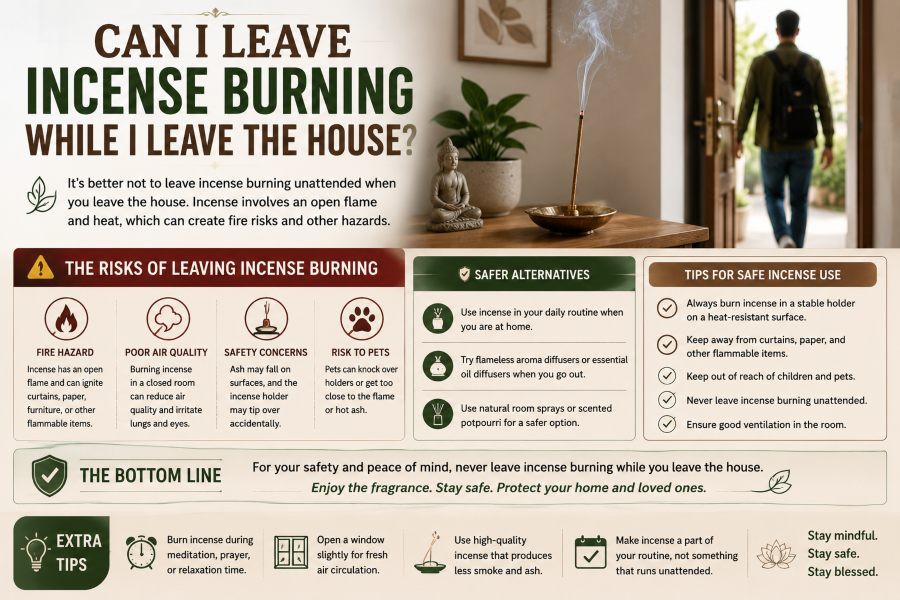
Can I Leave Incense Burning While I Leave the House?
The Question You Ask Right Before You Grab Your Keys
You've lit your incense stick, the room finally smells the way you wanted, and then your phone buzzes — you're already running late. Do you blow it out, or just... leave? Millions of people face this exact split-second decision every single day, and most of them make the wrong call without even realizing it.
Let's settle this properly, because the honest answer isn't a simple yes or no — it depends on a few things most people never stop to think about. If you're someone who burns incense sticks daily as part of your routine, understanding the real risk versus the real convenience matters a lot more than just following a gut feeling. And if you're looking for pure incense sticks online that burn cleanly and predictably, that choice alone already reduces a chunk of the risk we're about to talk about.
So here's the direct answer first, and then we'll unpack why: No, you should not leave incense burning unattended while you leave the house. Not even for five minutes. Not even if you've done it a hundred times before without incident. Here's exactly why that "it's always been fine" logic is more dangerous than it sounds.
Why This Question Even Needs an Answer
Incense feels harmless. It's small, it's slow-burning, and it doesn't look anything like an open flame once it's lit and glowing rather than actively burning. That perception is exactly what makes it risky — people mentally categorize it closer to "a candle that's basically out" rather than "an active ember that can ignite things."
But physically, an incense stick is doing the same basic thing a cigarette does: it maintains a slow, steady combustion point that can reach several hundred degrees at the tip. That's more than enough to ignite paper, dry fabric, or certain synthetic materials if it falls or if ash builds up and drops onto something flammable.
What Actually Happens When You "Just Leave It For a Bit"
Let's walk through the realistic sequence of events, because this is where most people underestimate what can go wrong.
Airflow changes. A door left ajar, a window with a breeze, even the AC kicking on — any of these can shift how the stick burns, sometimes causing it to burn faster or unevenly on one side.
Ash accumulates. As the stick burns down, ash builds up along its length. In a well-designed holder, this ash falls into a tray. But if the holder is tilted even slightly, or if a gust of air disturbs it, that ash — still hot — can drop onto a nearby surface.
The ember doesn't self-extinguish reliably. Unlike a candle flame that can be blown out by a strong draft, an incense ember tends to keep smoldering even in moving air, sometimes for much longer than people expect, especially with denser, resin-heavy sticks.
Pets and curious hands. If you have a cat that likes knocking things off shelves, or a toddler who's just learned to reach higher surfaces, an unattended incense stick becomes an entirely different risk category.
None of these scenarios require anything unusual to happen. They're just normal household conditions that occasionally line up badly.
"But I've Left It Burning Before and Nothing Happened"
This is the most common argument, and it's actually a logical trap worth understanding. Just because something didn't go wrong the first ten times doesn't mean the risk wasn't there — it means the specific combination of conditions needed for an incident didn't occur yet.
Think of it like driving without a seatbelt. Most short trips end without incident. That doesn't mean skipping the seatbelt was ever actually safe; it means you got lucky repeatedly. Fire safety works the same way. The absence of an accident isn't proof of safety — it's just proof that this particular time, the odds worked in your favor.
When People Are Most Likely to Take the Risk
Understanding when this bad habit tends to happen actually helps prevent it. It's rarely a conscious decision — it's almost always circumstantial.
- During daily puja routines, when someone lights incense as part of morning prayers and then rushes off to work
- While multitasking, lighting a stick before stepping out "just for two minutes" to check the mailbox or move the car
- In shared households, where someone assumes another family member is home and keeping an eye on things
- During long burn sessions, where a stick is lit for ambiance and the person simply forgets it's still going
If you regularly burn devotional agarbatti for daily puja, this is worth paying extra attention to, because ritual burning often happens during busy morning routines — exactly the time people are most likely to rush out the door distracted.
The Real Risk Isn't Just Fire — It's Also Air Quality
Here's an angle most people don't consider: even if nothing catches fire, leaving incense burning in a closed house for an extended period changes the indoor air composition significantly. Smoke particles accumulate in an unventilated space, and by the time you return, you're walking into air with a much higher particulate concentration than what you'd get from a properly monitored, shorter burn session.
This matters more for:
- People with asthma or respiratory sensitivities
- Homes with pets, whose lungs are smaller and more sensitive to particulate buildup
- Smaller apartments or rooms where smoke has less space to disperse
A stick burning for the 20–30 minutes you're actively present is a completely different air quality situation than one burning for two unattended hours while you're out running errands.
What About Timed or "Safer" Incense Products?
You might be wondering if there's a workaround — some kind of incense specifically designed to be safer for unattended burning. The honest answer is: not really, not in any meaningful sense.
Some products marketed as "safer" simply burn slower or produce less smoke, but the fundamental physics doesn't change. There's still an active ember. There's still ash. There's still a combustion point capable of igniting nearby materials under the wrong conditions. Marketing language shouldn't override basic fire safety logic here.
Electric or flameless incense diffusers, on the other hand, are a genuinely different category. These use heat elements or ultrasonic diffusion to release fragrance without an open ember, and many are designed with auto-shutoff timers. If your goal is fragrance while you're away from a room — or away from the house entirely — this is the safer alternative, not a "safer" stick.
A Realistic Routine That Actually Works
Instead of treating this as an all-or-nothing choice between "never burn incense" and "burn it whenever, wherever," here's a routine that actually respects both the ritual and the safety concern.
1. Light your incense with enough time to enjoy it while you're still home — don't light it as you're walking out the door
2. Set a mental or phone timer if you tend to lose track of time during prayer or relaxation
3. Extinguish it fully before leaving, even if it's not completely burned down — you can always relight the remainder later
4. Use a stable, tip-resistant holder with a proper ash catcher, especially if pets or kids are in the house
5. If ritual timing matters, light it earlier in your routine rather than rushing the last stick before departure
This isn't about cutting your ritual short. It's about restructuring the timing slightly so the practice and the safety don't conflict.
What to Do If You Need Fragrance Lingering After You Leave
Sometimes the actual goal isn't "keep it burning" — it's "I want the house to smell nice when I get back." If that's the real intention, there are better ways to achieve it without an unattended ember.
- Burn incense fully before leaving, then close doors to trap the fragrance in that room longer
- Use natural fragrance sachets or potpourri in key rooms for longer-lasting scent without combustion
- Switch to a flameless diffuser with a built-in timer for the hours you're away
- Light incense right when you get home instead, so the fragrance builds during the time you're actually there to enjoy and monitor it
Common Myths That Keep This Habit Alive
Myth: "Incense burns too slowly to be a real fire risk." Slow burning doesn't mean low risk — it means the risk window is simply longer. A stick that takes 40 minutes to burn down gives ash and airflow far more time to interact unpredictably than a 5-minute burn would.
Myth: "It's in a metal holder, so it's completely contained." A holder reduces risk, but it doesn't eliminate it. Ash can still fall outside the tray if the holder is bumped, tilted, or placed on an uneven surface. Containment helps, but it isn't a guarantee.
Myth: "My grandparents did this for decades and it was fine." Older homes often had different building materials, less synthetic fabric and furniture, and sometimes more open ventilation — all of which changed the actual fire dynamics. What was survivable in one household context isn't automatically safe to replicate in a modern apartment with synthetic carpets and tighter insulation.
Myth: "A small stick can't cause a big fire." Fires don't need a big ignition source — they need the right combination of heat, fuel, and time. A small ember resting against dry fabric for even a few unattended minutes has historically been enough to start house fires. Size of the flame isn't what determines outcome; contact time with flammable material is.
Frequently Asked Questions
Is it safe to leave incense burning in a separate room while I'm home in another part of the house? It's safer than leaving the house entirely, but still not ideal. You want to be able to notice a problem quickly — a closed door or a room far from where you're spending time reduces how fast you'd catch an issue.
What should I do if incense falls over while burning? Extinguish it immediately by dousing it in water or placing it in a fire-safe container. Check the surrounding area for scorch marks or lingering heat, even if it looks like it went out on its own.
Can incense ash cause a fire even after the stick has finished burning? Yes, in rare cases. Ash can retain heat for longer than expected, especially in larger accumulated piles. Always let ash cool completely in its tray before disposing of it, and never dump it directly into a bin lined with paper or plastic.
Is burning incense near an altar with cloth offerings more risky? Yes, significantly. Cloth, dried flowers, and paper offerings common in puja setups are highly flammable. Keep at least a foot of clearance between the burning stick and any offering materials, and never leave this specific setup unattended even briefly.
Are incense cones or dhoop safer than sticks for unattended burning? No — the same fire safety logic applies to all forms of incense combustion, whether it's a stick, cone, or coil. The shape changes burn time and smoke density, not the fundamental need for supervision.
So, Can You Leave It Burning? Here's the Honest Bottom Line
No — not because incense sticks are inherently dangerous when used properly, but because "unattended" and "properly used" don't belong in the same sentence. The risk isn't dramatic or immediate in most cases, which is exactly what makes it easy to dismiss. But fire safety has never been about drama. It's about consistently removing small risks before they compound into real incidents.
The good news is that avoiding this risk doesn't require giving up your incense routine at all. It just means adjusting timing slightly — lighting earlier, staying present, and extinguishing fully before you walk out the door. That small shift costs you nothing in ritual value and removes a risk that, frankly, isn't worth taking for the sake of five extra minutes of fragrance.
Posted in: Incense or Agarbatti
Related posts
-
 How to Light Incense SticksDiscover the right way to light incense sticks (agarbatti) for worship, meditation, and peace. Learn step-by-step...Read more
 -
 Where to Buy Incense SticksDiscover where to buy the best natural incense sticks for your daily puja, meditation, and relaxation. Explore pure,...Read more
 -
 Is Incense Sticks Bad for Pregnancy? Wondering if incense sticks are safe during pregnancy? Discover the truth about incense smoke, its effects on...Read more
 -
 Do Incense Sticks Trigger Fire Alarms? Wondering if incense sticks can trigger fire alarms? Learn how smoke affects detectors, safe burning tips, and...Read more
 -
 How Many Incense Sticks to Burn for Good LuckDiscover how many incense sticks to burn for good luck and prosperity. Learn the ideal numbers, rituals, and natural...Read more
Leave a comment