
Why did Krishna run to embrace a poor brahmin in rags? Read the Sudama story from the Bhagavatam and learn how a...
Latest posts
-
 Krishna and Sudama: The Poor Brahmin Who Became Wealthy in LoveRead more
 -
 Vamana Avatar: How Three Steps Humbled Bali MaharajaRead more
Why did a powerful king give away three worlds to a boy asking for three steps? Learn the Vamana avatar story from...
-
 The Bhagavatam on Marriage: Duty, Love and Spiritual PartnershipRead more
What does the Bhagavatam say about marriage? Through the stories of Kardama and Devahuti, Rukmini's secret letter and...
-
 What Is Prema? The Bhagavatam's Highest Stage of Love for GodRead more
Prema is love for God with no "because" attached. Learn how the Bhagavatam describes it, the nine steps from faith to...
-
 Is Shiva Parvati Kalyana Mentioned in Srimad Bhagavatam? What the Scripture Really SaysRead more
Looking for Shiva and Parvati's wedding in the Srimad Bhagavatam? Find out what the scripture actually describes,...
-
 How Many Modes of Devotion Are Mentioned in Bhagavatam?Read more
A young boy named Prahlada listed nine ways to serve God, and the Bhagavatam keeps them as its answer. Learn what the...
-
 What Is Bhagavatam and Why Has It Been Read for 5,000 Years?Read more
A dying king asked one question, and the answer became the Bhagavatam. Learn what this Sanskrit scripture contains,...
-
 Who Is Lord Krishna? His Meaning, Teachings and Pastimes ExplainedRead more
Discover who Krishna is according to Srimad Bhagavatam, including His divine identity, childhood pastimes, teachings,...
-
 Incense in Islam: Bakhoor, Agarbatti and What Tradition SaysRead more
Is burning fragrance part of Muslim tradition? Explore incense in Islam, from the Prophetic practice of fumigating...
-
 History of Agarbatti: From Vedic Dhupa to Modern Incense SticksRead more
Where did agarbatti really come from? Follow the history of agarbatti from Vedic fire rituals and temple dhupa to...
Blog categories
- Default category (0)
- MUSICAL INSTRUMENT (1)
- BOOK (5)
- DEVOTIONAL GIFT (0)
- Blog (30) click
- CHANDAN (12)
- Bhagavatam Wisdom Series (68)
- Krishna Consciousness (14)
- Mridangam Musical Instrument (6)
- Bhagavad Gita for Beginners (13)
- Bhagavad Gita As It Is (37) click
- Bhagavad Gita As It Is Telugu (0)
- Bhagavad Gita As It Is Marathi (0)
- Bhagavad Gita As It Is In Hindi (0)
- Bhagavad Gita As It Is In English (0)
- Bhagavad Gita As It Is In Bengali (8)
- Bhagavad Gita As It Is In Kannada (0)
- Bhagavad Gita As It Is In Gujarati (0)
- Bhagavad Gita As It Is In Panjabi (0)
- Bhagavad Gita As It Is In Tamil (0)
- Bhagavad Gita As It Is Odia (0)
- BHAGAVAD GITA As It Is GERMAN (0)
- Bhagavad Gita As It Is In French (0)
- Bhagavad Gita As It Is In Nepali (0)
- Bhagavad Gita As It Is In Assamese (0)
- Incense or Agarbatti (38)
- Lord Chaitanya Mahaprabhu (3)
- Vedic Temple Mayapur (14)
- kalki (15)
- Mahabharata – Dharma & Destiny (27)
- Vaishnava Scriptures (4)
- healthy product (4)
- chaitanya mahaprabhu (5)
- Tulsi Mala Guide (17)
Search in blog
What Is the Best Time to Burn Incense?
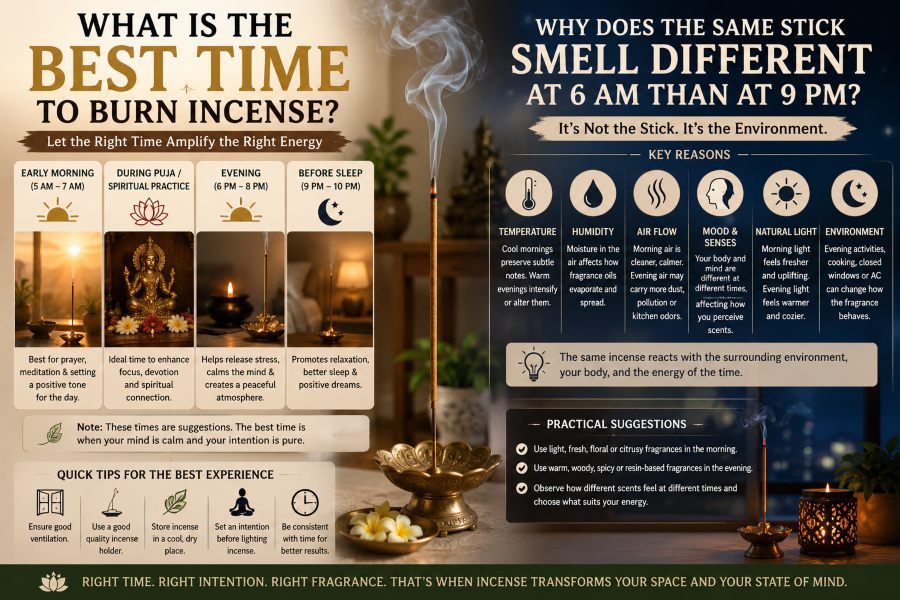
Why Does the Same Stick Smell Different at 6 AM Than at 9 PM?
Light an incense stick first thing in the morning, and it feels crisp, almost sharp, cutting through the stillness of a quiet house. Light the exact same stick at night, and suddenly it feels warmer, heavier, more enveloping. Same fragrance. Same brand. Completely different experience. If you've ever noticed this and wondered whether it's just your imagination, it isn't — timing genuinely changes how incense behaves and how you perceive it.
Most beginners never think about timing at all. They light incense whenever the mood strikes, which is fine if you're just after casual ambiance. But if you're trying to build a real practice — spiritual, meditative, or simply for a consistently pleasant home — understanding when to burn incense sticks matters just as much as understanding which fragrance to pick. If you're working with a genuinely well-crafted handmade agarbatti collection, timing becomes even more noticeable, because the subtler layers in a naturally made stick actually respond to the conditions around them.
So let's break this down properly — not just "morning or evening," but the actual reasoning behind each window, so you can make an informed choice instead of guessing.
The Two Traditional Windows: Morning and Evening
In most Vedic and devotional traditions, incense burning has historically clustered around two specific times of day: early morning and dusk. This isn't arbitrary. These windows correspond to what's traditionally called Brahma Muhurta (the pre-dawn hours) and Sandhya (twilight) — both considered transitional periods between states, whether that's night to day or day to night.
There's a practical logic buried in this tradition too, beyond the spiritual symbolism. These are naturally quieter times in most households. Less foot traffic, less noise, calmer air currents indoors. All of which happen to be exactly the conditions incense smoke needs to spread evenly and linger meaningfully, as we covered when talking about airflow and placement.
Morning: The Reset Button
There's something almost universal about morning incense — it doesn't just scent a room, it seems to reset the entire tone of the day. Ask anyone who's grown up around daily puja rituals, and they'll tell you the smell of morning agarbatti is practically inseparable from memories of waking up in their childhood home.
Why mornings work particularly well:
- Air is naturally still. Before the day's activity kicks in — doors opening and closing, fans running, people moving around — morning air tends to be calmer, letting the fragrance settle rather than scatter immediately.
- The mind is less cluttered. Whether or not you're spiritually inclined, there's a real psychological benefit to associating a distinct sensory cue with the start of your day. It works similarly to how a specific alarm tone or a cup of coffee smell can anchor your brain into "okay, day has begun" mode.
- It pairs naturally with morning prayer or meditation routines, especially in households where puja happens before breakfast rather than after.
If your goal leans toward focus, clarity, or spiritual grounding, morning is genuinely the stronger choice. Something about starting the day with a scent connected to calm and intention tends to carry that tone forward, even subtly, through the hours that follow.
Evening: The Wind-Down Signal
Evening incense serves a completely different psychological function. Where morning incense signals "begin," evening incense signals "settle."
This is the time most people associate with Sandhya Aarti in temple and home worship, and it's not hard to understand why once you think about the sensory logic. As daylight fades, the body's natural rhythm starts shifting toward rest. Burning incense at this time — especially warmer, heavier fragrances like sandalwood or resin-based blends — reinforces that natural wind-down instead of fighting against it.
What makes evenings distinct:
- Household activity is winding down, similar to morning's stillness but from the opposite direction — people are returning home, settling in, rather than rushing out
- Warmer fragrances feel more appropriate psychologically at this hour; heavier, muskier notes that might feel overwhelming at 7 AM often feel comforting at 7 PM
- It creates a clear boundary between "day mode" and "evening mode", which matters more than people realize in an era where work and home life constantly blur together
If you're using incense specifically to unwind, transition out of work mode, or prepare for a calmer night, evening is the more effective window — not because mornings don't work, but because the psychological association is different.
Midday: The Overlooked Option
Almost nobody talks about midday incense, and there's a reason for that — it doesn't carry the same traditional or ritual weight as dawn or dusk. But that doesn't mean it's useless. It just serves a different, more practical purpose.
Midday burning works well for:
- Odor control after cooking, especially in kitchens or open-plan living spaces
- A quick mood reset during a stressful afternoon, particularly if you work from home
- Guests arriving, since a fresh midday burn creates immediate ambiance without needing hours of advance planning
The tradeoff is that midday air currents tend to be more active — doors opening, people moving, sometimes fans or AC running — so the fragrance disperses faster and doesn't linger as effectively as a still morning or evening burn would.
What About Burning Incense at Night, Right Before Bed?
This is where people genuinely disagree, so let's address it honestly instead of pretending there's one universal answer.
The case for it: Calming fragrances like lavender or mild sandalwood blends can genuinely support a wind-down routine before sleep, similar to how some people use aromatherapy diffusers at night.
The case against it: Burning anything — including incense — directly before falling asleep raises legitimate safety concerns, since you're transitioning into a state where you're not actively monitoring a burning ember.
The practical middle ground: burn it 30 minutes before you intend to sleep, not while you're already lying down drowsy. Let the fragrance settle into the room, extinguish it fully, then go to bed once it's already done its job. This gets you the psychological benefit without the safety tradeoff.
Timing for Spiritual and Meditative Practice
If your incense use is tied specifically to meditation or devotional practice rather than general ambiance, timing becomes even more deliberate. Many practitioners specifically seek out temple-grade incense for meditation because the burn consistency and purity of ingredients matter more when the practice itself demands sustained focus over 20–30 minutes or longer.
A few timing principles worth following:
- Consistency matters more than the specific hour. Whether you meditate at 5:30 AM or 7:00 PM, burning incense at the same time relative to your practice — always right before you begin — builds a reliable sensory trigger over weeks and months.
- Avoid burning incense during active practice if you're doing breathwork-heavy meditation. Some pranayama techniques involve deep, extended breathing, and heavy smoke exposure during that specific practice can be counterproductive rather than calming.
- Light it a few minutes before you sit down, not the exact moment you begin. This gives the fragrance time to establish itself in the room rather than hitting you at full intensity right as you're trying to settle your mind.
Does the Day of the Week or Lunar Calendar Matter?
In many devotional households, certain days carry specific ritual significance — Ekadashi, for instance, or particular tithis tied to specific deities. On these days, incense timing often shifts to align with specific puja hours rather than a generic morning-evening pattern.
This isn't something a general guide can prescribe universally, since it varies significantly across regional and sampradaya-specific practices. But if you follow a structured devotional calendar, it's worth aligning your incense timing with those specific hours rather than defaulting to habit alone — the intentionality itself is part of what gives the practice its meaning.
How Long Should You Actually Let It Burn?
Timing isn't just about when you start — it's also about how long you let it run, which people rarely think through carefully.
- Short sessions (10–15 minutes): ideal for quick odor control, small rooms, or brief midday resets
- Medium sessions (20–30 minutes): the standard for most daily rituals, meditation practice, or general ambiance
- Full-stick sessions (35–45 minutes): best reserved for larger rooms, gatherings, or occasions where sustained fragrance matters, like festival days or guest visits
Letting incense burn far longer than necessary doesn't make the room smell better past a certain point — it just increases smoke density without adding proportional benefit, which circles back to the air quality concerns worth keeping in mind regardless of what time of day you're burning.
Common Questions About Incense Timing
Is it bad to burn incense at random times without a set routine? Not bad, just less effective if your goal is building a psychological or ritual association. Random timing works fine for casual ambiance but won't build the same conditioned calming response that consistent timing creates over weeks.
Can I burn incense both morning and evening? Yes, and many devotional households do exactly this — a lighter fragrance in the morning for clarity, and a warmer, heavier one in the evening for settling down. There's no rule against burning it twice daily as long as ventilation is adequate between sessions.
Does burning incense too early in the morning disturb sleeping family members? It can, particularly with denser, smoke-heavy sticks in smaller homes. If household members are still sleeping, opt for a lighter fragrance and ensure the room has some ventilation so smoke doesn't build up near sleeping areas.
Is there a specific time considered inauspicious for burning incense? Practices vary by regional and family tradition, but generally there's less emphasis on strictly "bad" times and more emphasis on aligning with specific ritual hours like Brahma Muhurta or Sandhya for devotional purposes. Outside of ritual contexts, there's no universal inauspicious window for casual incense use.
Should timing change based on the fragrance I'm using? Somewhat, yes. Lighter, citrus, or floral notes tend to suit morning hours better, while heavier, resinous, or musky fragrances feel more natural in the evening. This isn't a strict rule, just a pattern most people find intuitively fits better once they experiment with both.
How do I know if I'm burning incense at the wrong time for my needs? If you're lighting it for focus but feel drowsy afterward, or lighting it for calm but feeling unexpectedly alert, the fragrance-timing combination might be mismatched. Pay attention to how specific scents affect you at specific hours, and adjust accordingly rather than following a rigid template.
Building a Timing Routine That Actually Sticks
Here's the honest truth: the "best" time isn't a fixed universal answer. It's the time that aligns with what you're actually trying to achieve and what fits naturally into your existing routine. A rigid rule that doesn't match your lifestyle won't survive past the first busy week.
A simple framework to figure out your own best time:
1. Identify your primary reason for burning incense — spiritual practice, ambiance, odor control, or relaxation
2. Match that reason to its natural window — morning for grounding and focus, evening for winding down, midday for practical freshness
3. Anchor it to an existing habit — right after waking up, right before dinner, right before meditation — so it becomes automatic rather than something you have to remember separately
4. Stay consistent for a few weeks and notice how the scent starts triggering the associated mood on its own, almost like a conditioned response
Once that association builds, incense stops being just a fragrance choice. It becomes a genuine anchor point in your day — a small, reliable signal that shifts your state of mind exactly when you need it to, whether that's the calm clarity of early morning or the settled stillness of evening.
Posted in: Incense or Agarbatti
Related posts
-
 How to Light Incense SticksDiscover the right way to light incense sticks (agarbatti) for worship, meditation, and peace. Learn step-by-step...Read more
 -
 Where to Buy Incense SticksDiscover where to buy the best natural incense sticks for your daily puja, meditation, and relaxation. Explore pure,...Read more
 -
 Is Incense Sticks Bad for Pregnancy? Wondering if incense sticks are safe during pregnancy? Discover the truth about incense smoke, its effects on...Read more
 -
 Do Incense Sticks Trigger Fire Alarms? Wondering if incense sticks can trigger fire alarms? Learn how smoke affects detectors, safe burning tips, and...Read more
 -
 How Many Incense Sticks to Burn for Good LuckDiscover how many incense sticks to burn for good luck and prosperity. Learn the ideal numbers, rituals, and natural...Read more
Leave a comment