
Why did Krishna run to embrace a poor brahmin in rags? Read the Sudama story from the Bhagavatam and learn how a...
Latest posts
-
 Krishna and Sudama: The Poor Brahmin Who Became Wealthy in LoveRead more
 -
 Vamana Avatar: How Three Steps Humbled Bali MaharajaRead more
Why did a powerful king give away three worlds to a boy asking for three steps? Learn the Vamana avatar story from...
-
 The Bhagavatam on Marriage: Duty, Love and Spiritual PartnershipRead more
What does the Bhagavatam say about marriage? Through the stories of Kardama and Devahuti, Rukmini's secret letter and...
-
 What Is Prema? The Bhagavatam's Highest Stage of Love for GodRead more
Prema is love for God with no "because" attached. Learn how the Bhagavatam describes it, the nine steps from faith to...
-
 Is Shiva Parvati Kalyana Mentioned in Srimad Bhagavatam? What the Scripture Really SaysRead more
Looking for Shiva and Parvati's wedding in the Srimad Bhagavatam? Find out what the scripture actually describes,...
-
 How Many Modes of Devotion Are Mentioned in Bhagavatam?Read more
A young boy named Prahlada listed nine ways to serve God, and the Bhagavatam keeps them as its answer. Learn what the...
-
 What Is Bhagavatam and Why Has It Been Read for 5,000 Years?Read more
A dying king asked one question, and the answer became the Bhagavatam. Learn what this Sanskrit scripture contains,...
-
 Who Is Lord Krishna? His Meaning, Teachings and Pastimes ExplainedRead more
Discover who Krishna is according to Srimad Bhagavatam, including His divine identity, childhood pastimes, teachings,...
-
 Incense in Islam: Bakhoor, Agarbatti and What Tradition SaysRead more
Is burning fragrance part of Muslim tradition? Explore incense in Islam, from the Prophetic practice of fumigating...
-
 History of Agarbatti: From Vedic Dhupa to Modern Incense SticksRead more
Where did agarbatti really come from? Follow the history of agarbatti from Vedic fire rituals and temple dhupa to...
Blog categories
- Default category (0)
- MUSICAL INSTRUMENT (1)
- BOOK (5)
- DEVOTIONAL GIFT (0)
- Blog (30) click
- CHANDAN (12)
- Bhagavatam Wisdom Series (68)
- Krishna Consciousness (14)
- Mridangam Musical Instrument (6)
- Bhagavad Gita for Beginners (13)
- Bhagavad Gita As It Is (37) click
- Bhagavad Gita As It Is Telugu (0)
- Bhagavad Gita As It Is Marathi (0)
- Bhagavad Gita As It Is In Hindi (0)
- Bhagavad Gita As It Is In English (0)
- Bhagavad Gita As It Is In Bengali (8)
- Bhagavad Gita As It Is In Kannada (0)
- Bhagavad Gita As It Is In Gujarati (0)
- Bhagavad Gita As It Is In Panjabi (0)
- Bhagavad Gita As It Is In Tamil (0)
- Bhagavad Gita As It Is Odia (0)
- BHAGAVAD GITA As It Is GERMAN (0)
- Bhagavad Gita As It Is In French (0)
- Bhagavad Gita As It Is In Nepali (0)
- Bhagavad Gita As It Is In Assamese (0)
- Incense or Agarbatti (38)
- Lord Chaitanya Mahaprabhu (3)
- Vedic Temple Mayapur (14)
- kalki (15)
- Mahabharata – Dharma & Destiny (27)
- Vaishnava Scriptures (4)
- healthy product (4)
- chaitanya mahaprabhu (5)
- Tulsi Mala Guide (17)
Search in blog
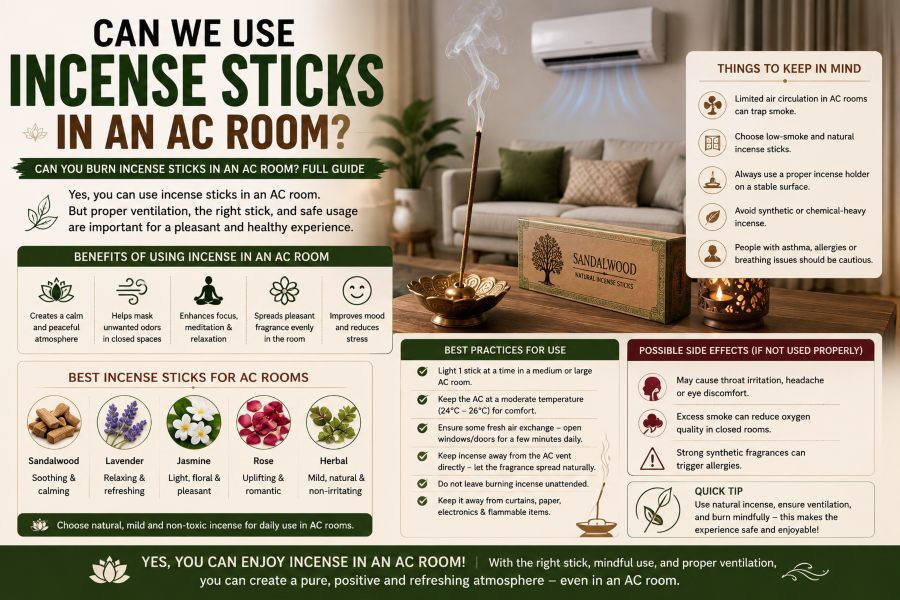
Can We Use Incense Sticks in an AC Room?
The Puja Dilemma Nobody Warns You About
You've just moved into a new apartment, or maybe you finally installed that AC unit you'd been saving up for. Your puja corner is set, your daily routine is intact, and then it hits you — can you actually light incense in a room that's sealed shut with the AC running? Will the smoke damage the unit? Will the smell just sit there and get worse instead of dissipating? Will your landlord or roommate complain about lingering smoke in a room that barely gets fresh air?
This is one of those questions that sounds simple but genuinely trips people up, especially in modern apartments where AC rooms are often smaller, more sealed, and less naturally ventilated than the open-air homes many of us grew up in. If your practice depends on natural incense sticks for puja, figuring this out isn't optional — it's something you'll deal with almost daily if you live somewhere with AC-dependent rooms.
So let's answer this properly: yes, you can burn incense in an AC room, but it requires a few adjustments that most people never think about until something goes wrong — a hazy room, a lingering burnt smell, or in worse cases, actual buildup inside the AC unit itself.
Why This Question Even Matters
Traditional puja and incense burning practices developed in homes with far more natural airflow — open windows, courtyards, doors that stayed open through the day. Modern AC rooms flip that entirely. They're designed to be sealed, insulated, and airtight specifically so the cooling doesn't escape. That fundamental design conflict is exactly why incense behaves so differently in these spaces.
Smoke needs somewhere to go. In an open room, it disperses gradually through natural air exchange. In a sealed AC room, it has nowhere to go except to circulate, settle, and potentially get pulled into the AC's own airflow system.
What Actually Happens When You Burn Incense With the AC On
Let's walk through the real mechanics here, because understanding this changes how you approach the whole situation.
The AC recirculates air, it doesn't ventilate it. This is the single most misunderstood point. Most split ACs and window units don't pull in fresh outdoor air — they just cool and recirculate the air already in the room. That means smoke particles don't get filtered out or removed; they just keep circulating through the same enclosed space, getting cooled and pushed back at you repeatedly.
Particulate buildup happens faster in sealed rooms. Without natural ventilation, smoke density increases much quicker than it would in an open room. What feels like a light, pleasant amount of incense smoke in a naturally ventilated space can feel noticeably heavier and more concentrated in a sealed AC room within the same burn time.
Some smoke particles can settle on internal AC components. Over months and years of regular exposure, fine particulate matter — the same particles responsible for that "smoky" smell — can build up on the AC's internal coils and filters, particularly if the unit's air intake happens to be close to where the incense is burning.
None of this means incense is incompatible with AC rooms. It just means the room needs to be managed a little differently than a naturally ventilated one.
The Real Fix: Timing Your Ventilation Right
Here's the practical approach that actually works, used by plenty of people who maintain daily puja routines in fully AC-dependent apartments.
Step 1: Turn Off the AC Before Lighting Incense
This sounds counterintuitive if you're used to keeping the AC running constantly, but it matters. An active AC creates directional airflow that pushes smoke unpredictably around the room — sometimes concentrating it in one corner, sometimes pulling it directly toward the unit's intake vent.
Step 2: Crack a Window or Door During the Burn
Even a small gap — a few inches — creates enough passive airflow to let smoke gradually exit rather than just circulating in place. If the room genuinely has no window, propping the door open to an adjoining space with better ventilation works nearly as well.
Step 3: Let the Room Air Out for 10–15 Minutes After the Stick Finishes
Don't switch the AC back on the second the incense burns out. Give the room a short window to clear naturally. This single step prevents most of the long-term particulate buildup people worry about.
Step 4: Resume AC Use Once the Air Feels Clear
Once the smoke has visibly settled and the room doesn't smell heavy anymore, it's safe to close everything back up and switch the AC on as usual.
This entire routine takes maybe 20–25 extra minutes total, and it completely changes the outcome compared to just lighting incense with the AC running and doors sealed the whole time.
Does the Type of Incense Matter More in AC Rooms?
Yes, actually — more than people expect. Not all incense produces the same smoke density, and in a sealed, air-conditioned space, that difference becomes far more noticeable than it would in an open room.
Lighter, cleaner-burning sticks work significantly better in AC rooms, particularly ones made with natural ingredients rather than heavy synthetic fillers. Naturally made sticks tend to produce thinner, less acrid smoke, which matters a lot when that smoke doesn't have anywhere to disperse quickly.
Heavier, resin-dense sticks — while beautiful in open, well-ventilated spaces — can feel overwhelming in a sealed AC room, building up a thick haze faster than lighter varieties would.
If you're setting up your regular Vaishnava puja essentials for an AC-dependent home, it's worth specifically choosing incense known for clean, moderate smoke output rather than the heaviest, most intense options available.
What About AC Damage — Is That Actually a Real Concern?
This gets exaggerated online sometimes, so let's be realistic about it. Occasional, well-ventilated incense burning is not going to meaningfully damage a modern AC unit. The concern becomes legitimate only under specific conditions:
- Daily heavy incense burning directly beneath or near the AC's air intake, with no ventilation gap at all
- Years of consistent exposure without ever airing out the room between sessions
- Using very smoke-heavy, low-quality incense that produces excessive particulate matter compared to naturally made sticks
For most households doing a standard daily or twice-daily puja routine with reasonable ventilation practices, this isn't something to lose sleep over. It's a long-term maintenance consideration, not an immediate danger.
Positioning Incense Away From the AC Unit
Beyond ventilation timing, physical placement inside the room matters just as much.
- Never place incense directly beneath or in front of the AC's air intake vent — this is the fastest way to pull smoke particles straight into the unit
- Position the incense holder on the opposite side of the room from the AC, ideally near a window or door you'll be cracking open during the burn
- Keep it away from the direct airflow path even when the AC is switched off, since residual air currents can still exist in a room right after the unit stops running
A little distance between your incense setup and your AC unit does more to prevent buildup over time than almost any other single adjustment.
Small Rooms vs. Larger AC Rooms
Room size changes this equation quite a bit, and it's worth being specific about it rather than treating every AC room the same way.
In smaller AC rooms (bedrooms, small puja corners), smoke density builds up noticeably faster. Shorter burn times — closer to 10–15 minutes instead of a full stick — combined with the ventilation routine above works best here.
In larger AC rooms (open living spaces with central or split AC), the same smoke has more physical space to spread before becoming concentrated, so slightly longer burns are more manageable, though the same basic ventilation principle still applies.
A Realistic Daily Routine for AC-Dependent Homes
If your puja space genuinely depends on AC for most of the day — common in many urban apartments — here's a routine that respects both the ritual and the practical reality of your living space:
1. Switch off the AC 5 minutes before your puja time
2. Open a window or door slightly to establish passive airflow
3. Light your incense and complete your ritual as normal
4. Leave the window or door cracked for 10–15 minutes after the stick finishes
5. Switch the AC back on once the air feels clear, not immediately after extinguishing
This doesn't disrupt your spiritual routine in any meaningful way — it just adds a short buffer window before and after, which quickly becomes second nature once you've done it a handful of times.
Common Myths About Incense and AC Rooms
Myth: "Incense smoke will immediately break your AC." Not true for occasional, well-ventilated use. Damage concerns apply mainly to heavy, unventilated daily exposure over years, not casual or moderate puja routines.
Myth: "Air purifiers make ventilation unnecessary." An air purifier helps reduce particulate density after the fact, but it doesn't replace actual air exchange. It cleans the air that's already there — it doesn't bring in fresh air the way an open window does.
Myth: "Scented AC fresheners can replace incense smell management." These just mask odor with another fragrance layered on top of the smoke smell, which often creates a stronger, more artificial-smelling combination rather than actually clearing the air.
Myth: "Bigger rooms don't need any ventilation adjustment." Larger rooms buy you more time before smoke feels concentrated, but they still need the same eventual air exchange — they just have a longer buffer before it becomes noticeable.
Frequently Asked Questions
Will incense smoke trigger my AC's smoke or air quality sensor, if it has one? Some newer smart ACs with built-in air quality sensors can register increased particulate levels from incense smoke, sometimes triggering a purifier mode or fan speed change. This isn't harmful, but it's worth knowing if your unit behaves differently right after you light incense.
Is it better to burn incense before or after running the AC for a while? Generally, it's better to burn it in a room that hasn't been sealed and cooling for hours already, since freshly circulated cool air combined with new smoke can create a heavier, more noticeable haze. A brief ventilation break beforehand helps regardless of AC history.
Can I use an exhaust fan instead of opening a window? Yes, if your AC room has a bathroom-style exhaust fan or a kitchen extractor nearby, running it during and briefly after the incense burn works as an effective substitute for a window, particularly in rooms without direct outdoor access.
Does incense affect indoor air quality readings on smart home devices? Yes, temporarily. Most air quality monitors will show a spike in particulate matter (PM2.5) readings during and shortly after burning incense, which is normal and typically settles back to baseline within 20–30 minutes with adequate ventilation.
Is it safer to use incense cones or dhoop instead of sticks in AC rooms? Not particularly — the ventilation principles apply the same way regardless of the incense format. What matters more is the smoke density of the specific product, not whether it's a stick, cone, or coil.
The Bigger Takeaway
Incense and AC rooms aren't actually incompatible — they just require a little more intention than burning incense in a naturally ventilated space would. The mistake most people make isn't burning incense in an AC room at all; it's doing so without ever creating a ventilation window, day after day, for months or years, without giving the smoke anywhere to actually go.
Once you build that small pause into your routine — AC off, brief airflow, incense burn, air out, AC back on — you get the full sensory and spiritual value of your daily practice without worrying about smoke buildup, lingering odors, or long-term wear on your cooling system. It's a small adjustment that lets tradition and modern apartment living coexist without either one having to compromise.
Posted in: Incense or Agarbatti
Related posts
-
 How to Light Incense SticksDiscover the right way to light incense sticks (agarbatti) for worship, meditation, and peace. Learn step-by-step...Read more
 -
 Where to Buy Incense SticksDiscover where to buy the best natural incense sticks for your daily puja, meditation, and relaxation. Explore pure,...Read more
 -
 Is Incense Sticks Bad for Pregnancy? Wondering if incense sticks are safe during pregnancy? Discover the truth about incense smoke, its effects on...Read more
 -
 Do Incense Sticks Trigger Fire Alarms? Wondering if incense sticks can trigger fire alarms? Learn how smoke affects detectors, safe burning tips, and...Read more
 -
 How Many Incense Sticks to Burn for Good LuckDiscover how many incense sticks to burn for good luck and prosperity. Learn the ideal numbers, rituals, and natural...Read more
Leave a comment