
Why did Krishna run to embrace a poor brahmin in rags? Read the Sudama story from the Bhagavatam and learn how a...
Latest posts
-
 Krishna and Sudama: The Poor Brahmin Who Became Wealthy in LoveRead more
 -
 Vamana Avatar: How Three Steps Humbled Bali MaharajaRead more
Why did a powerful king give away three worlds to a boy asking for three steps? Learn the Vamana avatar story from...
-
 The Bhagavatam on Marriage: Duty, Love and Spiritual PartnershipRead more
What does the Bhagavatam say about marriage? Through the stories of Kardama and Devahuti, Rukmini's secret letter and...
-
 What Is Prema? The Bhagavatam's Highest Stage of Love for GodRead more
Prema is love for God with no "because" attached. Learn how the Bhagavatam describes it, the nine steps from faith to...
-
 Is Shiva Parvati Kalyana Mentioned in Srimad Bhagavatam? What the Scripture Really SaysRead more
Looking for Shiva and Parvati's wedding in the Srimad Bhagavatam? Find out what the scripture actually describes,...
-
 How Many Modes of Devotion Are Mentioned in Bhagavatam?Read more
A young boy named Prahlada listed nine ways to serve God, and the Bhagavatam keeps them as its answer. Learn what the...
-
 What Is Bhagavatam and Why Has It Been Read for 5,000 Years?Read more
A dying king asked one question, and the answer became the Bhagavatam. Learn what this Sanskrit scripture contains,...
-
 Who Is Lord Krishna? His Meaning, Teachings and Pastimes ExplainedRead more
Discover who Krishna is according to Srimad Bhagavatam, including His divine identity, childhood pastimes, teachings,...
-
 Incense in Islam: Bakhoor, Agarbatti and What Tradition SaysRead more
Is burning fragrance part of Muslim tradition? Explore incense in Islam, from the Prophetic practice of fumigating...
-
 History of Agarbatti: From Vedic Dhupa to Modern Incense SticksRead more
Where did agarbatti really come from? Follow the history of agarbatti from Vedic fire rituals and temple dhupa to...
Blog categories
- Default category (0)
- MUSICAL INSTRUMENT (1)
- BOOK (5)
- DEVOTIONAL GIFT (0)
- Blog (30) click
- CHANDAN (12)
- Bhagavatam Wisdom Series (68)
- Krishna Consciousness (14)
- Mridangam Musical Instrument (6)
- Bhagavad Gita for Beginners (13)
- Bhagavad Gita As It Is (37) click
- Bhagavad Gita As It Is Telugu (0)
- Bhagavad Gita As It Is Marathi (0)
- Bhagavad Gita As It Is In Hindi (0)
- Bhagavad Gita As It Is In English (0)
- Bhagavad Gita As It Is In Bengali (8)
- Bhagavad Gita As It Is In Kannada (0)
- Bhagavad Gita As It Is In Gujarati (0)
- Bhagavad Gita As It Is In Panjabi (0)
- Bhagavad Gita As It Is In Tamil (0)
- Bhagavad Gita As It Is Odia (0)
- BHAGAVAD GITA As It Is GERMAN (0)
- Bhagavad Gita As It Is In French (0)
- Bhagavad Gita As It Is In Nepali (0)
- Bhagavad Gita As It Is In Assamese (0)
- Incense or Agarbatti (38)
- Lord Chaitanya Mahaprabhu (3)
- Vedic Temple Mayapur (14)
- kalki (15)
- Mahabharata – Dharma & Destiny (27)
- Vaishnava Scriptures (4)
- healthy product (4)
- chaitanya mahaprabhu (5)
- Tulsi Mala Guide (17)
Search in blog
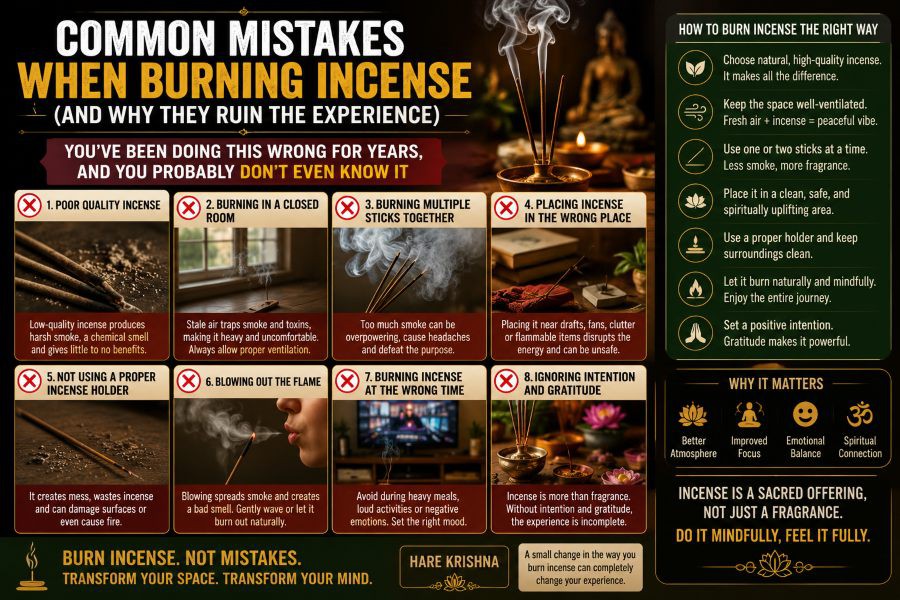
Common Mistakes When Burning Incense
You've Been Doing This Wrong for Years, and You Probably Don't Even Know It
Here's an uncomfortable thought: that stick of incense you've been lighting the same way for years might be burning unevenly, filling your room with more smoke than necessary, or losing half its fragrance before it even gets going — all because of small, avoidable mistakes nobody ever bothered explaining. Lighting incense looks simple enough that almost nobody stops to question whether they're doing it right. Strike a match, touch the tip, blow out the flame, done. Except that simplicity is exactly why so many people quietly get it wrong for years without realizing it.
This is a rundown of the mistakes that actually matter — not obscure trivia, but the practical errors that genuinely affect how your incense smells, how safely it burns, and how much you actually enjoy the experience. Whether you're new to this or you've been lighting sticks from the Official Mayapur Store Aagarbatti collection for years, there's a good chance at least one of these applies to you.
Mistake #1: Lighting the Whole Tip Instead of the Very End
This sounds too basic to matter, but it genuinely changes the burn. A lot of people light incense the way they'd light a candle — holding the flame against the stick for several seconds, letting a larger section catch fire before blowing it out.
The problem is this creates an oversized initial ember, which burns hotter and faster than intended, front-loading the fragrance and shortening the overall burn time. You end up with a strong initial burst of scent that fades faster than it should, rather than the slow, even release you're actually paying for.
The better approach:
- Hold the flame against just the very tip for two to three seconds
- Once you see a small, steady ember forming, gently blow it out
- Let the ember glow rather than flame — that glow is what produces the actual smoke and fragrance
This distinction between an open flame and a glowing ember is worth understanding at a slightly deeper level, because it explains almost everything else about proper incense technique. An open flame burns hot and fast, consuming material aggressively and producing a sharper, less refined smoke. A glowing ember, by contrast, burns slowly and steadily, releasing fragrance gradually as the material smolders rather than combusts outright. Every subsequent mistake on this list — airflow problems, over-blowing, uneven burning — ultimately traces back to disrupting this delicate ember state one way or another.
Mistake #2: Blowing Too Hard (Or Not Waiting for a Proper Ember)
Once you've lit the tip, how you extinguish the flame matters more than people realize. Blow too hard, and you can snuff out the ember entirely along with the flame, leaving you relighting the stick repeatedly and wasting both matches and patience.
Blow too gently or too soon, and the flame keeps burning openly instead of settling into a smoldering ember, which produces a harsher, more acrid smoke rather than the smooth, fragrant kind you actually want.
What actually works:
- Give the tip a short, controlled puff — enough to extinguish the visible flame but not so forceful that it kills the ember underneath
- If the ember doesn't catch on the first attempt, relight briefly rather than blowing repeatedly at an already-struggling stick
- Watch for a small, steady orange glow at the tip — that's your confirmation the stick is burning correctly
Mistake #3: Ignoring Airflow in the Room
This is probably the single most underrated factor in the entire incense-burning process. Airflow determines almost everything about how the fragrance actually reaches you, how quickly the stick burns, and whether the smoke feels pleasant or overwhelming.
Common airflow mistakes include:
- Burning incense directly under a ceiling fan or air conditioning vent, which disperses smoke too quickly for the fragrance to build properly and often causes uneven, erratic burning
- Lighting incense in a completely sealed room with no ventilation at all, which lets smoke concentration build to uncomfortable, sometimes headache-inducing levels
- Placing the stick right next to an open window with strong wind, which can blow the ember out entirely or cause it to burn unevenly down one side
The sweet spot is gentle, indirect airflow — enough to let smoke circulate naturally through the room without either overwhelming concentration or instant dispersal. A slightly cracked window in a room without a fan running usually strikes this balance well.
There's a broader logic worth understanding here, beyond just avoiding fans and vents. Smoke needs a certain amount of still air to actually carry fragrance the way it's meant to — think of how a campfire's smell lingers pleasantly on a calm evening but disappears almost instantly in strong wind. Incense operates on the same basic physics, just at a much smaller scale. Too much airflow scatters the fragrant particles before your nose has a chance to register them properly. Too little airflow, on the other hand, lets smoke concentration build up in a small area faster than it disperses, which is part of why closed bathrooms or small closets tend to feel overwhelming rather than pleasant when incense is burned inside them.
Mistake #4: Using the Wrong Holder (Or No Holder At All)
It's tempting to treat the incense holder as an afterthought — any small dish or makeshift stand will do, right? Not quite.
Here's what actually goes wrong with poor holder choices:
- Holders that don't catch falling ash create genuine fire hazards, especially on carpets, wooden furniture, or fabric surfaces
- Metal holders positioned too close to flammable material can transfer heat enough to scorch or discolor surfaces underneath, even without direct contact
- Holders with the wrong angle cause the stick to burn unevenly, sometimes extinguishing prematurely on one side while the other keeps smoldering
- Using no holder at all, balancing a stick precariously on a shelf edge, is asking for trouble the moment anyone bumps the surface
A proper holder should hold the stick at a stable angle, sit on a heat-resistant, non-flammable surface, and have enough surface area or a catch tray to collect falling ash without mess or risk.
Material choice matters more than most people assume, too. Wooden holders, unless specifically treated or designed for incense use, can gradually scorch or char at the point of contact with repeated use, eventually becoming a fire risk themselves rather than a safe surface. Stone, ceramic, and metal holders generally handle sustained heat far better, though metal ones can get surprisingly hot to the touch after a long burn, which matters if you're planning to move the holder before the stick has fully cooled. A few extra rupees spent on a properly designed holder, rather than repurposing a random dish, genuinely pays for itself in both safety and burn consistency over time.
Mistake #5: Burning Too Many Sticks at Once
More incense doesn't mean more enjoyment — it usually means the opposite. Burning multiple sticks simultaneously in an average-sized room quickly oversaturates the air with smoke and fragrance, to the point where individual scent notes blur into an undifferentiated haze rather than the layered, pleasant aroma you'd get from a single well-burned stick.
Beyond the sensory overload, this habit also increases smoke density to levels that can genuinely irritate eyes, throats, and sinuses, particularly for anyone with respiratory sensitivity. It's a classic case of more not being better, driven mostly by impatience rather than any actual improvement in the experience.
A reasonable guideline:
- One stick per small to medium room is typically sufficient
- Larger or open-plan spaces might reasonably handle two, spaced apart rather than clustered
- If you want a stronger scent presence, choose a more concentrated or resin-heavy variety rather than simply lighting more sticks
Mistake #6: Not Accounting for the Type of Incense You're Using
Different incense styles burn differently, and treating them all identically is a common source of frustration. Bamboo-core sticks, coreless (Japanese-style) sticks, dhoop cones, and resin-based incense all behave differently once lit.
A few examples worth knowing:
- Bamboo-core sticks tend to burn longer and more predictably, but the bamboo itself contributes a faint woody smell to the smoke — noticeable if you're using a very light, delicate fragrance.
- Coreless sticks, common in higher-end natural incense, burn without that underlying bamboo scent, giving a purer read of the actual fragrance ingredients, but they're often more fragile and prone to breaking if handled roughly.
- Dhoop cones burn faster and hotter than sticks, releasing fragrance in a more concentrated burst rather than a slow, extended release.
- Resin incense, burned over charcoal rather than as a self-contained stick, requires an entirely different setup and more active attention throughout the burn.
If you've been applying the same lighting and placement habits across all these formats without adjustment, that's likely part of why some varieties have felt disappointing compared to others — the mismatch is often technique, not quality.
It's also worth understanding why these formats exist in the first place, rather than assuming one is simply an inferior version of another. Bamboo-core sticks became popular historically partly because the core provides structural support that makes hand-rolling faster and more consistent at scale, which mattered considerably before modern manufacturing existed. Coreless sticks developed largely in Japanese incense traditions, where the emphasis on subtle, refined fragrance made even a faint bamboo undertone undesirable enough to justify the extra fragility and production complexity of a coreless format. Dhoop cones, meanwhile, evolved partly for practical reasons too — their concentrated, faster burn suits shorter ritual windows better than a twenty-minute stick would.
Mistake #7: Choosing Cheap, Heavily Synthetic Sticks and Blaming the Category
This one's less about technique and more about product choice, but it deserves mention because it colors people's entire perception of incense as a category. Heavily synthetic, poorly bound incense often produces a harsh, chemical-tinged smoke that bears little resemblance to the smooth, layered fragrance genuine natural ingredients produce.
If your only experience has been with cheap, mass-market sticks loaded with synthetic fragrance oils and low-quality binders, it's genuinely reasonable to walk away thinking incense generally smells harsh or gives you headaches. Switching to something like natural sandalwood dhoop sticks, made with genuine wood and resin content rather than synthetic shortcuts, often changes that impression entirely — the smoke burns cleaner, the fragrance feels rounder, and headaches or irritation from heavy synthetic loading become far less common.
Signs you might be dealing with low-quality synthetic incense:
- A sharp, almost chemical smell in the first few seconds of burning
- Fragrance that fades dramatically after the first minute or two
- Thick, visibly dense smoke compared to other sticks you've burned
- A lingering headache or throat irritation after moderate use
Mistake #8: Leaving Burning Incense Completely Unattended
This deserves its own section because it's genuinely the most important safety mistake on this list, and it's shockingly common. People light a stick, walk into another room, and forget about it entirely — sometimes for hours.
Why this matters more than it might seem:
- A burning ember, even a small one, represents an ongoing fire risk near flammable material, pets, curtains, or paper
- Falling ash from a poorly secured holder can ignite carpet or fabric surfaces without anyone noticing until it's already a problem
- In households with children or pets, an unattended burning stick within reach is a genuine hazard, not just a theoretical one
Reasonable precautions:
- Never leave incense burning in a room you're about to leave for an extended period
- Keep burning sticks well away from curtains, papers, and anything flammable
- Extinguish incense fully (not just letting it burn out naturally) if you need to leave the room unexpectedly
- Keep burning incense out of reach of small children and curious pets
It's worth putting this risk in perspective rather than treating it as alarmist. A single incense stick burning correctly, on a proper holder, in a room with reasonable clearance from flammable material, poses genuinely minimal risk over its typical twenty-to-thirty-minute burn time. The danger comes almost entirely from compounding smaller mistakes together — an unstable holder, positioned near curtains, in a room nobody's checking on for hours. Address any one of those individual factors and the overall risk drops considerably. It's the combination of neglect across several fronts simultaneously that turns a normally safe, centuries-old practice into an actual hazard.
Mistake #9: Storing Incense Poorly Between Uses
The mistakes don't stop once the stick is lit — how you store your incense between sessions affects quality considerably, and this is a step almost nobody thinks about.
Common storage errors:
- Leaving incense exposed to direct sunlight, which degrades natural oils and resins over time, dulling the fragrance
- Storing incense in humid environments, like bathrooms, which can cause sticks to absorb moisture and burn unevenly or extinguish prematurely
- Mixing multiple fragrance types in the same open container, allowing scents to bleed into each other and muddy the individual character of each variety
- Leaving packages open long-term, exposing the incense to air and dust that gradually dulls its potency
Better storage habits:
- Keep incense in a cool, dry, dark place — a drawer or closed cabinet works well
- Store different fragrances separately, or at minimum in their own sealed packaging
- Avoid bathroom or kitchen storage, where humidity and temperature fluctuate the most
The underlying reason storage matters so much comes down to how fragile natural fragrance compounds actually are. Essential oils and resins are volatile by nature — that's literally what allows them to release scent into the air when burned. But that same volatility means they can evaporate or degrade slowly even while just sitting in storage, especially when exposed to heat, light, or air. A stick that's been left in a sunny windowsill for months might look identical to a properly stored one, but it can smell noticeably weaker once lit, simply because a portion of its fragrant compounds have already dissipated before you ever struck a match.
Mistake #10: Expecting Every Stick to Smell the Same From Batch to Batch
This one trips up people who've found a favorite fragrance and then feel confused or disappointed when a new batch smells slightly different. With genuinely natural incense, this is actually expected rather than a sign of poor quality.
Natural ingredients — sandalwood, resins, dried florals — vary somewhat from harvest to harvest, the same way wine or coffee does. A batch of natural sandalwood incense made from wood harvested one season might smell marginally different from one made a year later, simply because the raw material itself isn't perfectly uniform. Heavily synthetic incense, by contrast, tends to smell identical batch after batch, since it's manufactured from consistent lab-produced fragrance oils rather than variable natural materials.
Understanding this distinction helps set realistic expectations. Slight batch variation in natural products isn't a defect — it's actually one of the more reliable signs you're dealing with a genuinely natural product rather than a synthetic one.
Putting It All Together — A Quick Mental Checklist
Before your next incense session, run through this short mental list:
- Light just the tip, not a large section of the stick
- Blow gently until you see a steady ember, not an open flame
- Check your airflow — avoid direct fan or vent exposure, but don't seal the room completely either
- Use a proper holder on a heat-resistant surface, positioned away from flammable material
- Stick to one or two sticks per room rather than overloading the space
- Match your technique to the incense type — bamboo-core, coreless, cones, and resins all behave differently
- Choose quality ingredients over cheap synthetic options if harsh smoke or headaches have been a recurring issue
- Never leave burning incense unattended, especially around children, pets, or flammable materials
- Store incense properly between uses to preserve fragrance quality
- Expect natural variation between batches rather than assuming inconsistency means poor quality
Why Getting This Right Actually Matters
None of these mistakes are dramatic on their own. Nobody's house burns down because they lit the whole tip instead of just the end, and a slightly uneven burn isn't exactly a crisis. But collectively, these small habits determine whether incense becomes something you genuinely look forward to — a reliable, pleasant part of your daily or weekly routine — or something that occasionally disappoints you enough that you stop bothering with it altogether.
Getting the technique right costs nothing extra. It's simply a matter of paying slightly more attention to a process most people have been running on autopilot for years. Once you adjust even a few of these habits — lighting technique, airflow awareness, proper storage — the difference in fragrance quality and overall experience tends to be immediate and genuinely noticeable, the very next time you strike a match.
There's a satisfying irony in all of this too. Incense has been burned essentially the same way for thousands of years, across dozens of cultures, without instruction manuals or online guides. People figured it out through repetition, observation, and the occasional frustrating batch of harsh, wasted smoke. You're now in a position to skip most of that trial and error simply by paying attention to the details laid out here. The practice itself hasn't changed much in centuries — what's changed is how quickly you can get good at it.
Visit Store: https://mayapur.store/37-incense-sticks
Posted in: Incense or Agarbatti
Related posts
-
 How to Light Incense SticksDiscover the right way to light incense sticks (agarbatti) for worship, meditation, and peace. Learn step-by-step...Read more
 -
 Where to Buy Incense SticksDiscover where to buy the best natural incense sticks for your daily puja, meditation, and relaxation. Explore pure,...Read more
 -
 Is Incense Sticks Bad for Pregnancy? Wondering if incense sticks are safe during pregnancy? Discover the truth about incense smoke, its effects on...Read more
 -
 Do Incense Sticks Trigger Fire Alarms? Wondering if incense sticks can trigger fire alarms? Learn how smoke affects detectors, safe burning tips, and...Read more
 -
 How Many Incense Sticks to Burn for Good LuckDiscover how many incense sticks to burn for good luck and prosperity. Learn the ideal numbers, rituals, and natural...Read more
Leave a comment