
Why did Krishna run to embrace a poor brahmin in rags? Read the Sudama story from the Bhagavatam and learn how a...
Latest posts
-
 Krishna and Sudama: The Poor Brahmin Who Became Wealthy in LoveRead more
 -
 Vamana Avatar: How Three Steps Humbled Bali MaharajaRead more
Why did a powerful king give away three worlds to a boy asking for three steps? Learn the Vamana avatar story from...
-
 The Bhagavatam on Marriage: Duty, Love and Spiritual PartnershipRead more
What does the Bhagavatam say about marriage? Through the stories of Kardama and Devahuti, Rukmini's secret letter and...
-
 What Is Prema? The Bhagavatam's Highest Stage of Love for GodRead more
Prema is love for God with no "because" attached. Learn how the Bhagavatam describes it, the nine steps from faith to...
-
 Is Shiva Parvati Kalyana Mentioned in Srimad Bhagavatam? What the Scripture Really SaysRead more
Looking for Shiva and Parvati's wedding in the Srimad Bhagavatam? Find out what the scripture actually describes,...
-
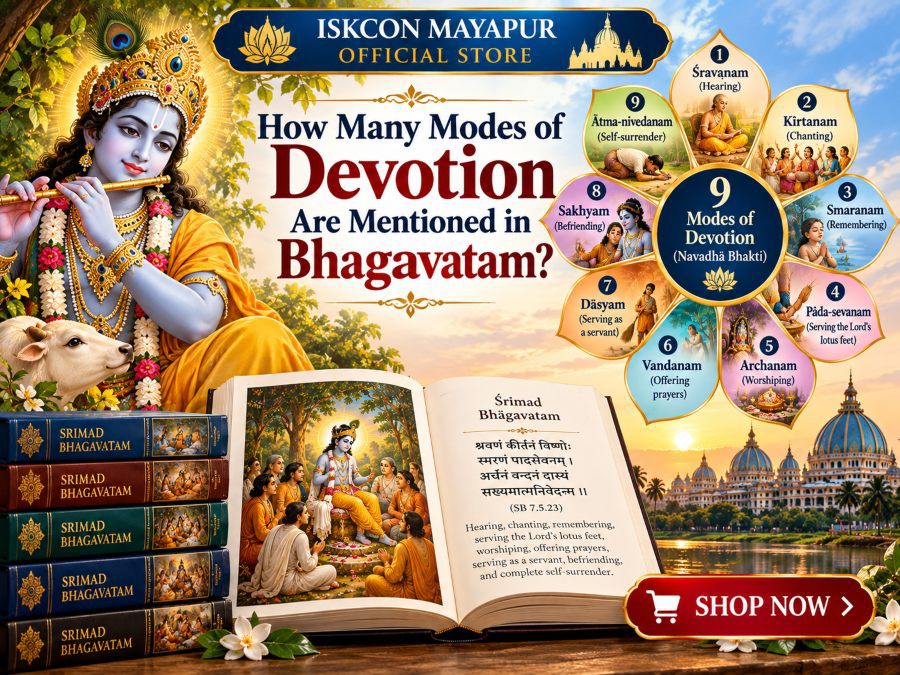 How Many Modes of Devotion Are Mentioned in Bhagavatam?Read more
A young boy named Prahlada listed nine ways to serve God, and the Bhagavatam keeps them as its answer. Learn what the...
-
 What Is Bhagavatam and Why Has It Been Read for 5,000 Years?Read more
A dying king asked one question, and the answer became the Bhagavatam. Learn what this Sanskrit scripture contains,...
-
 Who Is Lord Krishna? His Meaning, Teachings and Pastimes ExplainedRead more
Discover who Krishna is according to Srimad Bhagavatam, including His divine identity, childhood pastimes, teachings,...
-
 Incense in Islam: Bakhoor, Agarbatti and What Tradition SaysRead more
Is burning fragrance part of Muslim tradition? Explore incense in Islam, from the Prophetic practice of fumigating...
-
 History of Agarbatti: From Vedic Dhupa to Modern Incense SticksRead more
Where did agarbatti really come from? Follow the history of agarbatti from Vedic fire rituals and temple dhupa to...
Blog categories
- Default category (0)
- MUSICAL INSTRUMENT (1)
- BOOK (5)
- DEVOTIONAL GIFT (0)
- Blog (30) click
- CHANDAN (12)
- Bhagavatam Wisdom Series (68)
- Krishna Consciousness (14)
- Mridangam Musical Instrument (6)
- Bhagavad Gita for Beginners (13)
- Bhagavad Gita As It Is (37) click
- Bhagavad Gita As It Is Telugu (0)
- Bhagavad Gita As It Is Marathi (0)
- Bhagavad Gita As It Is In Hindi (0)
- Bhagavad Gita As It Is In English (0)
- Bhagavad Gita As It Is In Bengali (8)
- Bhagavad Gita As It Is In Kannada (0)
- Bhagavad Gita As It Is In Gujarati (0)
- Bhagavad Gita As It Is In Panjabi (0)
- Bhagavad Gita As It Is In Tamil (0)
- Bhagavad Gita As It Is Odia (0)
- BHAGAVAD GITA As It Is GERMAN (0)
- Bhagavad Gita As It Is In French (0)
- Bhagavad Gita As It Is In Nepali (0)
- Bhagavad Gita As It Is In Assamese (0)
- Incense or Agarbatti (38)
- Lord Chaitanya Mahaprabhu (3)
- Vedic Temple Mayapur (14)
- kalki (15)
- Mahabharata – Dharma & Destiny (27)
- Vaishnava Scriptures (4)
- healthy product (4)
- chaitanya mahaprabhu (5)
- Tulsi Mala Guide (17)
Search in blog
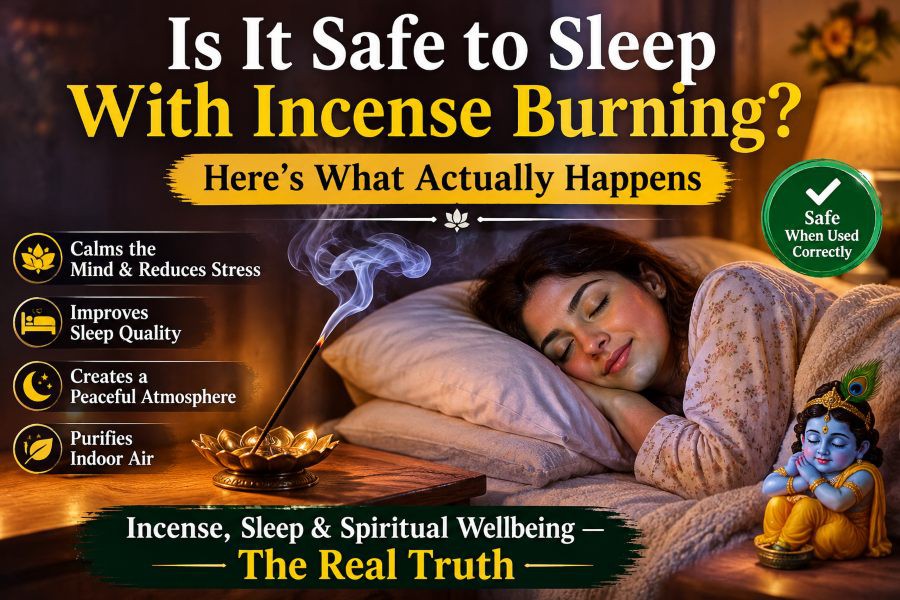
Is It Safe to Sleep With Incense Burning? Here's the Truth
Is It Safe to Sleep With Incense Burning? Here's What Actually Happens
Picture this: it's 11 PM, you've lit a stick of sandalwood incense to wind down, and your eyelids start getting heavy before the stick has even burned halfway. Do you blow it out and lose that lovely drifting curl of smoke, or just let it burn while you drift off too? Millions of people face this exact moment every night, and most of them guess rather than actually know the answer. If you've ever searched Buy Mayapur Store incense sticks while wondering whether it's fine to leave one smoldering next to your pillow, you're asking a smarter question than you might realize — because the answer isn't as simple as yes or no.
Let's settle this properly, with real reasoning instead of vague reassurance.
The Short, Honest Answer
No, it's not a good idea to sleep with incense burning unattended. Not because incense is dangerous by nature, but because fire plus an unconscious person plus several hours of no supervision is a combination that safety experts consistently advise against — for candles, for space heaters, and yes, for incense sticks too.
That doesn't mean incense is something to fear. It means the timing matters more than people assume.
Why This Question Even Needs Asking
Here's the thing about incense: it's genuinely relaxing. The scent, the small ritual of lighting it, the visual of smoke curling upward — all of it primes the nervous system to slow down. So it makes sense that people want to keep that ambiance going right through the moment they fall asleep. The instinct isn't wrong. The execution just needs a rethink.
Two separate issues are actually being combined into one question here, and untangling them makes everything clearer:
1. Fire risk — an open ember, unattended, for hours.
2. Air quality — what you're breathing in a closed room, all night, with no ventilation.
Let's take these one at a time, because they deserve separate answers.
The Fire Risk Nobody Likes Talking About
An incense stick is, structurally speaking, a slow-burning ember on a stick. It's not an open flame the way a candle is, but it's still combustion, and combustion needs respect.
Here's what can go wrong:
- The holder tips over. A pet brushes past, a gust from an open window, or simply an unstable holder — and now there's a lit ember on a bedsheet, carpet, or curtain.
- The stick burns down completely and the ash falls. Most holders catch this fine, but not all of them, and a stray ember landing on fabric doesn't need much time to smolder before catching properly.
- You're not awake to notice the first ten seconds when it would've been easy to stop. This is the actual core of the danger. A fire caught early is a non-event. A fire that's had three hours of unsupervised head start is a different story entirely.
Fire safety organizations worldwide list unattended open flames and embers — including incense — as a leading cause of preventable house fires. That's not scaremongering. It's just what the incident data shows, year after year.
What About the Smoke Itself?
This is the part people think about far less, and honestly, it might matter more over the long run than the fire risk.
Incense smoke contains fine particulate matter — the same category of pollutant (PM2.5) that makes wildfire smoke and vehicle exhaust a health concern. Burning one stick in a well-ventilated room for twenty minutes while you're awake and moving around is a completely different exposure than burning one in a closed bedroom for six to eight hours while you're lying still, breathing slowly, right next to the source.
Some research on prolonged indoor incense exposure has pointed toward:
- Respiratory irritation — a scratchy throat or mild cough on waking, especially in rooms with poor airflow.
- Aggravation of asthma or allergies — closed bedrooms concentrate particulates far more than open living spaces.
- A subtle, cumulative effect — one night won't do much, but a nightly habit over months is a different equation.
None of this means incense is secretly toxic or that people who enjoy it are making a mistake. It means the dose and duration matter, the same way they do with anything you inhale repeatedly.
So What's the Smarter Way to Use It?
This is where most articles either overcorrect into "never burn incense" fear-mongering, or swing the other way and pretend there's zero downside. Neither is honest. The better approach is simply to shift the timing.
Light it earlier, not right before sleep. Burn your incense while you're reading, journaling, or doing that last bit of tidying up — thirty to forty-five minutes before you actually plan to sleep. You still get the calming ritual and the lingering scent, but the stick is fully out and the room has aired out a bit by the time you're actually unconscious.
Keep it on a stable, heatproof holder, away from fabric. Not on the edge of a nightstand near curtains. Not on a pile of papers. A proper ceramic or brass holder, on a flat surface, away from anything flammable.
Crack a window if you can. Even a small gap in airflow dramatically reduces how concentrated the particulate matter gets in the room.
Choose quality over quantity. This is actually where the type of incense you buy starts to matter. Cheap, synthetic incense often uses heavier chemical binders and low-grade fragrance oils that burn dirtier and smell noticeably harsher. If you're going to burn incense regularly, sourcing pure Aagarbatti online made from natural ingredients — real sandalwood, genuine herbal resins, charcoal-free options — tends to burn cleaner and leave less residue in your lungs and your walls alike. It's a small switch that compounds over months of nightly use.
Never leave a room with incense still lit, even for "just a minute." Most fires that started this way had someone who thought it'd be fine for sixty seconds.
Alternatives If You Want the Scent All Night
If what you're really after is fragrance lasting through your sleep rather than the ritual of a burning stick, there are options that remove the fire risk entirely:
- Reed diffusers — no flame, no ember, continuous scent release.
- Wax melts with a flameless warmer — heated by a small bulb or electric plate rather than an open source.
- Essential oil diffusers with a shutoff timer — scent through the night with an automatic cutoff.
These aren't replacements for the specific experience of a lit incense stick — the smoke, the visual, the slow burn — but they solve the exact problem of wanting fragrance without a live ember while you're unconscious for eight hours.
The Real Takeaway
Incense isn't the villain here — unattended combustion is. The same stick that's perfectly pleasant and low-risk when you're awake and nearby becomes a genuine (if statistically small) hazard the moment nobody's watching it for hours on end. Light it earlier in your evening wind-down routine, let it finish burning while you're still up and about, and you get the calm without gambling on an ember you can't see.
And if you're going to make incense part of your nightly routine at all, the quality of what you're burning is worth as much attention as when you burn it. Clean, natural ingredients simply give you less to worry about, night after night.
Ready to upgrade your evening ritual? Explore natural, long-burning incense sticks crafted from authentic ingredients at Mayapur Store — because what you breathe before sleep deserves the same care as everything else in your routine.
Posted in: Incense or Agarbatti
Related posts
-
 How to Light Incense SticksDiscover the right way to light incense sticks (agarbatti) for worship, meditation, and peace. Learn step-by-step...Read more
 -
 Where to Buy Incense SticksDiscover where to buy the best natural incense sticks for your daily puja, meditation, and relaxation. Explore pure,...Read more
 -
 Is Incense Sticks Bad for Pregnancy? Wondering if incense sticks are safe during pregnancy? Discover the truth about incense smoke, its effects on...Read more
 -
 Do Incense Sticks Trigger Fire Alarms? Wondering if incense sticks can trigger fire alarms? Learn how smoke affects detectors, safe burning tips, and...Read more
 -
 How Many Incense Sticks to Burn for Good LuckDiscover how many incense sticks to burn for good luck and prosperity. Learn the ideal numbers, rituals, and natural...Read more
Leave a comment