
Why did Krishna run to embrace a poor brahmin in rags? Read the Sudama story from the Bhagavatam and learn how a...
Latest posts
-
 Krishna and Sudama: The Poor Brahmin Who Became Wealthy in LoveRead more
 -
 Vamana Avatar: How Three Steps Humbled Bali MaharajaRead more
Why did a powerful king give away three worlds to a boy asking for three steps? Learn the Vamana avatar story from...
-
 The Bhagavatam on Marriage: Duty, Love and Spiritual PartnershipRead more
What does the Bhagavatam say about marriage? Through the stories of Kardama and Devahuti, Rukmini's secret letter and...
-
 What Is Prema? The Bhagavatam's Highest Stage of Love for GodRead more
Prema is love for God with no "because" attached. Learn how the Bhagavatam describes it, the nine steps from faith to...
-
 Is Shiva Parvati Kalyana Mentioned in Srimad Bhagavatam? What the Scripture Really SaysRead more
Looking for Shiva and Parvati's wedding in the Srimad Bhagavatam? Find out what the scripture actually describes,...
-
 How Many Modes of Devotion Are Mentioned in Bhagavatam?Read more
A young boy named Prahlada listed nine ways to serve God, and the Bhagavatam keeps them as its answer. Learn what the...
-
 What Is Bhagavatam and Why Has It Been Read for 5,000 Years?Read more
A dying king asked one question, and the answer became the Bhagavatam. Learn what this Sanskrit scripture contains,...
-
 Who Is Lord Krishna? His Meaning, Teachings and Pastimes ExplainedRead more
Discover who Krishna is according to Srimad Bhagavatam, including His divine identity, childhood pastimes, teachings,...
-
 Incense in Islam: Bakhoor, Agarbatti and What Tradition SaysRead more
Is burning fragrance part of Muslim tradition? Explore incense in Islam, from the Prophetic practice of fumigating...
-
 History of Agarbatti: From Vedic Dhupa to Modern Incense SticksRead more
Where did agarbatti really come from? Follow the history of agarbatti from Vedic fire rituals and temple dhupa to...
Blog categories
- Default category (0)
- MUSICAL INSTRUMENT (1)
- BOOK (5)
- DEVOTIONAL GIFT (0)
- Blog (30) click
- CHANDAN (12)
- Bhagavatam Wisdom Series (68)
- Krishna Consciousness (14)
- Mridangam Musical Instrument (6)
- Bhagavad Gita for Beginners (13)
- Bhagavad Gita As It Is (37) click
- Bhagavad Gita As It Is Telugu (0)
- Bhagavad Gita As It Is Marathi (0)
- Bhagavad Gita As It Is In Hindi (0)
- Bhagavad Gita As It Is In English (0)
- Bhagavad Gita As It Is In Bengali (8)
- Bhagavad Gita As It Is In Kannada (0)
- Bhagavad Gita As It Is In Gujarati (0)
- Bhagavad Gita As It Is In Panjabi (0)
- Bhagavad Gita As It Is In Tamil (0)
- Bhagavad Gita As It Is Odia (0)
- BHAGAVAD GITA As It Is GERMAN (0)
- Bhagavad Gita As It Is In French (0)
- Bhagavad Gita As It Is In Nepali (0)
- Bhagavad Gita As It Is In Assamese (0)
- Incense or Agarbatti (38)
- Lord Chaitanya Mahaprabhu (3)
- Vedic Temple Mayapur (14)
- kalki (15)
- Mahabharata – Dharma & Destiny (27)
- Vaishnava Scriptures (4)
- healthy product (4)
- chaitanya mahaprabhu (5)
- Tulsi Mala Guide (17)
Search in blog
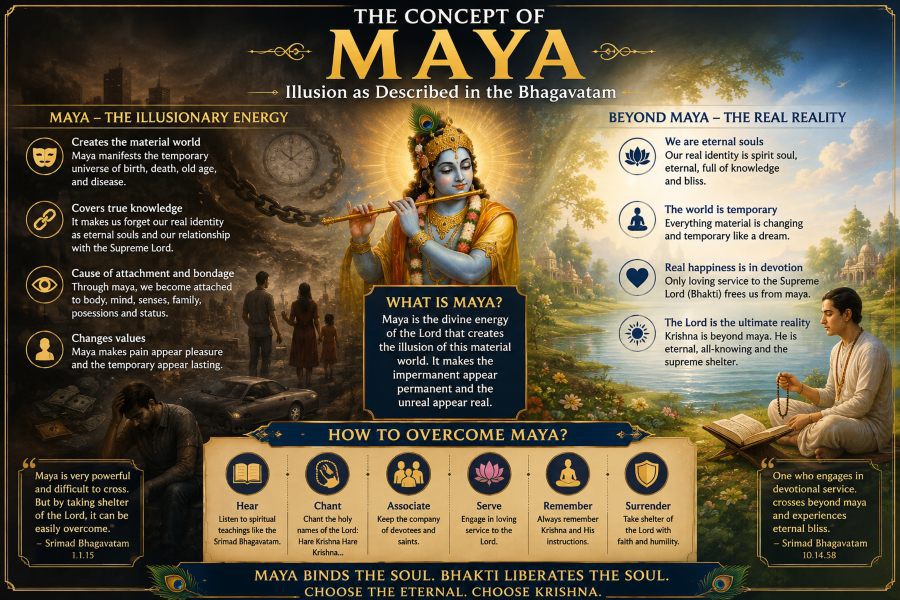
The Concept of Maya: Illusion as Described in the Bhagavatam
What If the Life You're So Sure About Isn't Quite What It Seems?
Picture this for a second. You're standing in a desert at dusk, and up ahead you see water — a shimmering, unmistakable pool of it, reflecting the orange sky. You walk toward it, thirsty and relieved, only to find sand. Just sand. Nothing changed about the desert. What changed was your perception of it. This is roughly the picture ancient Indian sages had in mind when they talked about maya, and nowhere is that idea explored with more nuance, more story, and more emotional weight than in the Srimad Bhagavatam, a scripture composed by the Author Bhagavatam, Sage Vyasa, specifically to help readers see past this kind of confusion.
Maya isn't some obscure footnote in Vedic philosophy. It's one of the central puzzles the entire Bhagavatam keeps circling back to, from the opening chapters all the way through to its final teachings. If you've ever wondered why the world feels so convincingly real while sages insist it's somehow a kind of dream, this is where that conversation actually starts, and it unfolds across cantos dedicated entirely to unpacking exactly what maya is, how it works, and why understanding it changes everything.
So What Actually Is Maya?
The word maya gets thrown around loosely in casual conversation — people use it to mean "illusion" and leave it there. But that translation, while not wrong, misses most of the texture.
In the Bhagavatam, maya isn't a lie exactly. It's closer to a magic trick performed so skillfully that even the performer's own audience forgets it's a trick at all. The root of the word in Sanskrit connects to measurement, to the act of "making" or "forming" — which is a clue in itself. Maya is the power that measures the immeasurable, that gives shape and form to something that, at its deepest level, has no shape or form.
It also helps to notice what maya is not. It isn't a punishment. It isn't a mistake in the design of the universe. And it isn't something imposed on the soul from the outside against its will. The Bhagavatam frames it as something closer to a natural consequence of the soul's own forgetfulness, a kind of cosmic sleep that everyone has to eventually wake up from at their own pace.
Here's a way to think about it that might land better than a dictionary definition:
- Maya is not the absence of reality. It's a distortion of how reality is perceived.
- Maya is not something separate from God. In the Bhagavatam's framework, it's actually God's own energy, just operating in a particular mode.
- Maya doesn't lie to you outright. It works more like a filter, letting you see the surface of things while hiding the depth underneath.
Think of a puppet show. The puppets move, talk, laugh, and cry, and if the show is good enough, you forget entirely that there are strings and a person behind the curtain pulling them. That forgetting — not the puppets themselves — is maya.
There's also a subtler point buried in the etymology that most casual explanations skip over entirely. The root "ma" doesn't just mean to measure — it also carries the sense of "to build" or "to fashion," the same root that eventually gives rise to words connected with architecture and construction in other Indo-European languages. So when the Bhagavatam calls the material world a product of maya, it's not saying the world was carelessly conjured out of nothing. It's describing something engineered, deliberate, and structurally sound within its own terms. The trick isn't sloppy. That's exactly what makes it so convincing.
This matters because it changes how you're supposed to relate to the whole idea. A shoddy illusion is easy to spot and easy to dismiss. A brilliantly constructed one requires real effort, real self-honesty, and usually some outside guidance to see through — which is precisely why the Bhagavatam spends so many chapters on this single theme instead of settling the matter in a single verse and moving on.
The Cosmic Magic Trick: How Maya Actually Operates
One of the more startling claims in the Bhagavatam is that maya isn't random or chaotic. It's structured, almost engineered, and it operates through three fundamental qualities known as gunas: sattva, rajas, and tamas.
Sattva brings clarity, goodness, and balance. Rajas brings passion, restlessness, and constant motion. Tamas brings inertia, confusion, and darkness. Every single thing in the material world — every object, every emotion, every personality trait — is some combination of these three qualities, blending and shifting constantly.
What makes this genuinely interesting is that the Bhagavatam doesn't present the gunas as good or evil in themselves. They're tools. A carpenter's hammer isn't good or bad; it depends entirely on what you build with it. Maya uses these three qualities to construct the entire experience of material existence — bodies, minds, relationships, ambitions, fears, all of it.
And here's the part that tends to catch people off guard: the Bhagavatam suggests that the soul, or atman, is never actually touched by any of this. The soul remains exactly what it always was, untouched and complete. What gets tangled up in maya is the mind's identification with the body and its endless string of desires. The confusion isn't in reality itself — it's in mistaking the costume for the actor wearing it.
Think about how strange this actually is when you sit with it for a moment. A person can go through decades of life — different bodies at different ages, different circumstances, different roles as child, spouse, parent, elder — and somehow feel like the "same person" throughout, even though almost nothing about the physical body has stayed constant. The Bhagavatam takes that continuity seriously as a clue. If the body keeps changing while something underneath still feels stable, maybe that underlying "something" was never really the body to begin with. Maya, in this reading, isn't just about grand cosmic illusion. It's operating in the smallest, most ordinary moments of daily self-recognition, and most people never think to question it because it's worked flawlessly their entire lives.
Kapila's Lecture to His Mother: Maya Gets Its First Real Explanation
If you're looking for where the Bhagavatam gets genuinely systematic about maya, Canto Three is where it happens. Lord Kapila, an incarnation of Vishnu according to the text, sits down with his mother Devahuti and gives what amounts to one of the most detailed philosophical breakdowns found anywhere in this scripture.
Kapila doesn't just say "the world is illusion" and move on. He builds an entire framework — describing how the unmanifest material nature, called prakriti, interacts with the individual soul, and how that interaction, driven by maya, produces the entire visible universe: the elements, the senses, the mind, the sense of ego. It's methodical, almost like watching someone assemble a machine piece by piece and naming each part as they go.
This is genuinely one of the more technical portions of the entire text, and readers working through the different skandhas in bhagavatam will notice this Canto reads almost like a philosophy lecture wrapped inside a mother-son conversation. Devahuti asks pointed questions. Kapila answers with precision. And by the end, what emerges is a picture of maya not as some vague spiritual buzzword, but as a describable, structured process — one that can, importantly, be understood and eventually seen through.
What's striking about this section is how personal it is. Kapila isn't lecturing a room full of scholars. He's talking to his own mother, trying to help her understand something that will genuinely change how she experiences the rest of her life. That intimacy gives the philosophy a warmth that pure academic writing usually lacks, and it's a reminder that this entire tradition of teaching maya was never meant to stay locked inside temples or monasteries — it was meant to be passed between people who loved each other, in ordinary conversation.
Krishna's Words to Uddhava: The Gunas Get Personal
Fast forward to Canto Eleven, and the conversation about maya returns, this time through Krishna himself, speaking directly to his close friend Uddhava. By this point in the narrative, Krishna is preparing to leave the earthly plane, and there's a kind of urgency to these teachings — the sense of someone passing on everything that actually matters before time runs out.
Krishna's explanation here is less like a systematic lecture and more like a series of pointed observations, almost koans, meant to shake loose old assumptions. He describes how the mind, under the influence of maya, mistakes the body for the self, mistakes possessions for security, and mistakes temporary pleasure for lasting happiness. None of these mistakes are presented as stupidity. They're presented as natural consequences of how maya operates — convincingly, persistently, and often invisibly.
One thing worth sitting with here: Krishna doesn't tell Uddhava to hate the material world or reject it outright. Instead, he talks about seeing it correctly — recognizing what it is and what it isn't, without needing to run from it in fear or cling to it in desperation. That distinction matters enormously, because a lot of surface-level readings of maya turn it into a reason for world-rejection, when the actual teaching is closer to clear-eyed recognition.
Markandeya's Vision: When the Curtain Actually Drops
Perhaps the single most vivid depiction of maya anywhere in the entire text shows up in the story of the sage Markandeya, found in the Twelfth Canto. Markandeya, after intense practice, is granted a direct vision of cosmic dissolution — he sees the universe collapse, sees himself as a lone infant floating on a vast ocean, and experiences what can only be described as a complete unraveling of everything he thought was solid and permanent.
It's an unsettling scene, deliberately so. The point isn't to frighten the reader for its own sake — it's to demonstrate, through direct experience rather than abstract argument, just how thoroughly maya can construct an entire convincing reality and then dissolve it completely. If a sage as advanced as Markandeya can be shaken by this vision, the text seems to be asking, what does that say about how tightly the rest of us hold onto our own sense of permanence?
This episode functions almost like a stress test for the philosophy laid out earlier in the text. It's one thing to hear Kapila describe maya in careful, structured language. It's another thing entirely to watch a realized sage confront it directly and feel the ground genuinely shift beneath him. Scholars who study the individual slokas in bhagavatam scholars often point to this particular episode when discussing how the text moves between philosophical instruction and visceral, almost cinematic storytelling — because this is a case where the story does more philosophical work than a direct explanation ever could.
Why Maya Isn't the Villain of This Story
Here's where a lot of casual readings of Indian philosophy go a little sideways. People sometimes hear "the world is maya" and assume this means the material world is bad, fake, or something to be resented. The Bhagavatam doesn't actually support that reading, and it's worth being precise about why.
Maya, within this framework, is described as Krishna's own energy — not something opposed to the divine, but something that belongs to it and operates under its direction. The problem was never the existence of the material world. The problem is forgetting the source, mistaking the display for the display's origin.
Consider a well-made film. The actors, sets, and story are all "illusion" in the sense that none of it is literally true — there's no actual murder in a murder mystery, no real kingdom in a fantasy epic. But nobody walks out of a good film angry that it wasn't real. The illusion, when understood as illusion, becomes a source of enjoyment and even insight. The problem only arises if you forget you're watching a film and start believing the events on screen are literally happening to you.
That's roughly the emotional register the Bhagavatam is working in when it discusses maya. It's not asking readers to reject the world. It's asking them to remember what they're actually looking at.
This distinction gets lost constantly in popular summaries of Indian philosophy, which tend to flatten "maya is illusion" into something closer to "nothing matters" or "nothing is real." That's a genuine misreading. The Bhagavatam's position is more precise than that, and arguably more demanding: things matter enormously, relationships matter, choices matter, but their meaning comes from something deeper than their permanence.
What This Actually Means for Someone Living an Ordinary Life
It's easy to treat all of this as abstract philosophy meant for renunciants and monks sitting in forest ashrams, disconnected from anyone with a job, a family, and bills to pay. But the Bhagavatam's teachings on maya were never meant to stay locked inside that context.
A few practical threads worth pulling on:
- Notice the gap between reaction and reality. A lot of daily suffering comes from treating temporary situations as permanent verdicts on your worth or your future. Recognizing maya's influence here means catching that gap before it spirals.
- Hold identity a little more loosely. Job titles, relationship status, physical appearance — all of these shift constantly. The Bhagavatam's point isn't that these things don't matter at all, but that building your entire sense of self around things this changeable is a setup for repeated disappointment.
- Enjoy things without needing them to be permanent. This is subtler than it sounds. You can genuinely love a sunset, a meal, a friendship, without insisting it last forever in order to have been meaningful.
- Watch for the stories your own mind tells you. Fear, jealousy, and resentment often run on assumptions the mind treats as certain facts. Maya's grip is strongest exactly where you're least willing to question your own narrative.
None of this requires abandoning ordinary responsibilities. If anything, the text repeatedly shows devotees — kings, warriors, mothers, sages — continuing their normal duties while gradually loosening maya's grip on their perception. The change happens on the inside first.
Readers exploring the different chapters of bhagavatam devotes to this theme will notice the same pattern repeating in different settings: a character is confronted with loss, confusion, or temptation, and the resolution almost always involves seeing the situation more clearly rather than escaping it physically. That pattern is deliberate. It's the text's way of insisting that maya is dealt with through perception, not geography.
The Story That Keeps Coming Back
One detail that's easy to miss on a first read: maya as a concept doesn't get explained once and then dropped. It resurfaces again and again, in different tones and contexts, almost like a musical theme that returns throughout a symphony. Kapila's philosophical version, Krishna's personal version to Uddhava, and Markandeya's terrifying direct-experience version are really the same idea approached from three completely different angles — intellectual, relational, and experiential.
That repetition isn't accidental or lazy writing. It reflects something the text seems to understand about how people actually learn difficult truths. Hearing an idea once, even a compelling one, rarely changes deeply held assumptions. Encountering the same truth through a lecture, then through a personal conversation, then through a direct, unsettling experience — that's a much more thorough education, and it's exactly the structure the Bhagavatam follows.
Maya, Modern Life, and Why This Isn't Just Ancient History
It's worth asking, honestly, whether any of this holds up outside a religious or philosophical framework — whether it's just poetic language dressed up as insight, or whether it describes something real about how minds actually work.
Modern psychology has its own version of this conversation, even if it doesn't use the word maya. Cognitive distortions, the gap between perception and reality, the way memory and expectation shape what a person "sees" in a given moment — these are all active areas of research, and the underlying observation isn't so different from what Kapila was describing to his mother thousands of years ago. People consistently mistake their interpretation of events for the events themselves. They react to the story they're telling about a situation rather than the situation as it actually is.
The Bhagavatam got there first, using different language and a different framework, but the core observation holds up remarkably well against modern scrutiny. That's not proof of anything supernatural. It's simply a sign that whoever composed these teachings was paying very close attention to how human minds actually behave, and wrote it down in a form durable enough to still be worth reading today.
A Concept Old Enough to Predate the Question of Its Own Age
There's an interesting irony worth sitting with here. Scholars still debate the exact age of the Bhagavatam itself, with traditional accounts placing its composition thousands of years ago and modern academic analysis generally pointing to a somewhat later window. But the concept of maya described within it addresses something that has nothing to do with historical dating at all — it's about how perception works, regardless of which century a person happens to be reading it in.
That's part of what makes this particular teaching hold up so well over time. Whether the age of Bhagavatam turns out to be five thousand years or twelve hundred, the basic observation at the heart of its teaching on maya doesn't really depend on the answer. People still mistake temporary things for permanent ones. People still build their sense of self around things that shift and fade. The desert still shimmers like water at dusk, no matter which century you're standing in it, and the sages who first wrote this down seem to have understood that this particular kind of confusion would outlast every empire, language, and technology that came after them.
Posted in: Bhagavatam Wisdom Series
Related posts
-
 Why to read srimad bhagavatamReading the Srimad Bhagavatam fosters deep spiritual growth by narrating the life and teachings of Lord Krishna,...Read more
 -
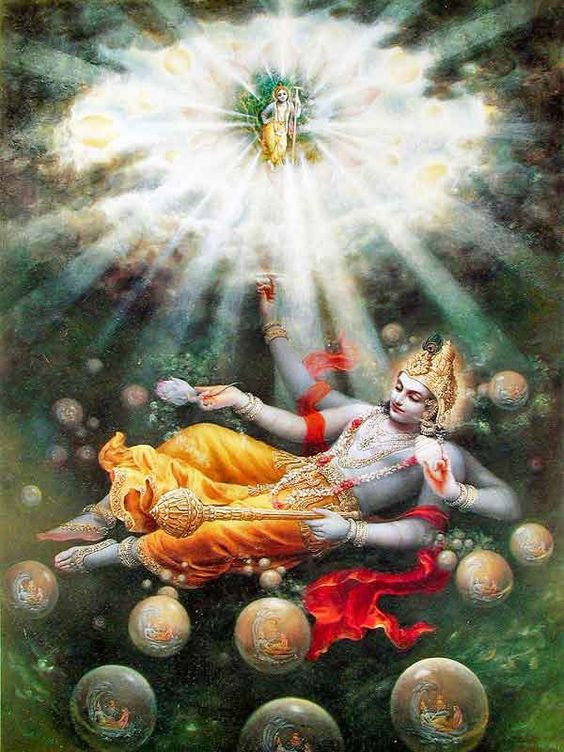 When was srimad bhagavatam written?The Srimad Bhagavatam is believed to have been written around 9th-10th century CE, though its oral traditions date...Read more
 -
 How many chapters are there in srimad bhagavatam?The Srimad Bhagavatam consists of 12 cantos (books) containing 335 chapters in total. Each canto covers various...Read more
 -
 How many skandhas are there in srimad bhagavatamThe Srimad Bhagavatam is divided into 12 skandhas (cantos or books). Each skandha explores different themes,...Read more
 -
 How many slokas in srimad bhagavatamThe Srimad Bhagavatam contains approximately 18,000 shlokas (verses). These verses are spread across its 12 skandhas...Read more
Leave a comment